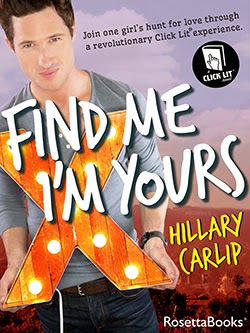
This E-book is a Game Changer for Storytelling

Here at TKZ we often discuss trends and changes in the publishing industry. Over the weekend I read a book that offers a glimpse of the future of e-publishing. It turns out that the future is multi-media, interactive, and fun!

FIND ME I’M YOURS, by Hillary Carlip, is the rom-com story of Mags Marclay, a love-challenged, artistic millennial who goes on a scavenger hunt to find true love. As the story unfolds, the reader encounters Mags’ original artwork, polls, graphics, videos, and embedded links. The links connect to custom websites having to do with various aspects of Mags’ universe.

I was blown away by the multi-media features of FIND ME I’M YOURS. It took my brain a few chapters to adapt to the story’s interactivity. For example, I initially assumed that all the websites contained within the story were fictional. Then I hit one site that talked about dog parks in LA. It described actual dog parks, including the one I frequent in my own neighborhood. I felt my brain go, “Wait. What?!” (It turns out that all the custom-designed websites in the book are fictional, but many contain “real” information.)

And that’s the thing about reading a story in multimedia format. It combines the brain-intensity of reading a story with the distinctly different experience of surfing the web and social media. Occasionally, I experienced a slight disconnect between the two flavors of the reading experience.  The longer I read the entertaining, fast-moving story, the more I found myself wanting to “stay” in the story. Once I fully engaged with the story, I spent less time navigating to the embedded websites. 

But that may be because I have an old brain that is slow to adapt to new technologies. I’m sure that people under 30 won’t be distracted at all by interactivity. In fact, I think they’ll eventually demand multi-media content in their stories. For example, imagine if HARRY POTTER included links to interactive websites exploring Harry’s universe? Or a cozy mystery with a cooking or crafts theme, with embedded links to websites containing recipes or patterns? The possibilities are limitless. This book offers a new storytelling paradigm that is truly exciting.

After reading FIND ME I’M YOURS, I had about a thousand questions I wanted to ask the author, Hillary Carlip, and the production team behind the book. They graciously answered a few questions via email.

(And after you read the Q and A, please share your thoughts about multimedia, interactive ebooks).

Q and A with Hillary Carlip and team

Q: Who did all the grunt work of coding and setting up links and websites? What software and tools were used? Did you pay professional actors and artists for the videos and graphics? They’re very high quality.


A: Thanks! Probably the only person in the world who would come up with the idea of integrating 33 websites into an eBook novel would be an artist and web designer. Hillary’s owned her own boutique agency, Fly HC Multimedia, for over a decade, and she’s got a small, talented, all-female core tech team of web developers and programmers who built out the Find Me I’m Yours “storyverse.” Most of the sites were programmed using Joomla, although a few of the sites are Tumblrs. Our lead developer is creating a totally innovative footer plug-in that ties all of the sites so that if someone stumbles upon one of them without knowing anything about Find Me I’m Yours, they can quickly tell that that site is tied into a compelling bigger-picture project. And of course Hillary was hands-on throughout the process, doing plenty of the grunt work, and also working closely with several of the component makers to get their help in making the whole experience as responsive and as user friendly as possible. Hillary also either designed the graphics or art directed other talented artists she found.

Q: The interactivity worked very well for this chick-lit style story involving a scavenger hunt. Do you see this type of interactivity applying to other literary genres, or even literary fiction? Can you describe an example of how the format might apply to other genres?

A: Yes, absolutely.  We’ve actually trademarked a term we think describes this experience – “CLICK LIT.”  CNN called Find Me I’m Yours “the BOOK of the FUTURE,” but we just see this as simply STORYTELLING of the future. And this format would work great for all types of literature – mysteries, science fiction, fantasy, literary fiction — you name it! People already turn to social media, wikis, etc. to dive deeper into stories they love. Why not give readers built-in, content- rich outlets and the ability to get personally involved and entertained by integrating pictures, videos, websites, social media channels, etc., right into the story itself?  You can imagine with a thriller the kind of clues you could work into websites, etc!


As for the videos, Maxine Lapiduss has written, produced, and directed some of television’s most popular sitcoms, so she was able to get high quality work done on a modest budget. We cast professional actors in key roles, such as the romantic lead, Mr. WTF, and the “hacktress” roomie and pin-up model, S.H.A.R.I.  Maxine is producing all of the series and ancillary content. We feature amazing new talent like Babbs and Maria Lopez starring in #whitepeopleweddings and established talent such as Susie Essman (Curb Your Enthusiasm) who stars in Dear Tabby, a photorealistic, disgruntled cat who gives advice to problem pet owners. Everything is being done at the highest quality of lighting, shooting, writing that we can afford. 
  

Q: Are you maintaining the websites in the book, or is someone else? Are these sites intended to take on a creative life of their own? (I’m thinking of the patriotic picture site and the ‘I F#cked Up’ sites, in particular).

A: Yes, we are maintaining and adding to the sites every day.  Of the 33 websites, more than half were conceived from the get-go to be ever-expanding, with new original content including blogs, vlogs, articles, web series, photos, and more being added all the time. We also have numerous options for readers to add their own content on sites like www.DIYintheUSA.com (which Mags, the main character, started featuring pics of “Questionable Patriotic Displays”), and www.IFkcedUp.com (a public apology site started by Mags’ cheating ex). Whether you are in the process of reading Find Me I’m Yours or have finished the book but want to stay involved in the story, there are loads of ways to interact, engage, share your own content, and get and stay personally involved with the story and characters.

FB and Twitter, she just can’t quit you

Eighteen months ago, I wrote a post in which I wondered whether social media were developing a personality disorder.  Now I’m wondering whether social media are causing people to develop personality disorders.

Over the years, the content of my Facebook feed has become progressively darker. It’s reliably clogged with distressing missives–political rants, plus tales of woe about suffering animals and the environment. (I suspect this content appears because Facebook’s algorithm, like Google’s, does an excellent job of micro tracking everything I “Like”, share, or search for.) Yes, I care about these issues, but I don’t want to be slapped in the face with how dreadful everything is, first thing in the morning when I turn on the computer. 

The more I read these distressing posts, the more upset I get about the state of the world. I do try to tune much of it out. For example, I skip over my friends’ political rants online–they’re tiresome, no matter what the point of view. (I don’t block these friends, because some of these people are dear to me in real life.)  But I worry about my friends who are struggling with depression or some other personal issue in real life, who do nothing but mutter darkly online about the nefarious activities of Evil Government, or Evil Corporations. Is it a sign that they’re slipping over the edge?

I tell you, it’s enough to make me long for the boring old days when people shared what they ate for breakfast.

And it’s not just Facebook. Whenever there’s a breaking news, I find that I stay ahead of the headlines on cable news by monitoring Twitter updates. Twitter has become our new wire service, and anyone can use it. I’ve developed an unhealthy fixation with the #Breaking hashtag. 

I know there’s a simple solution to my situation. “Turn it off! Unplug!” Easier said than done. I’ve been a news junkie all my life. Now apparently I’m a social media junkie, as well.

We’ve become a nation of social media junkies, it seems. I remember an incident from years ago. I was at a cocktail party, and feeling uncomfortable for some reason. I withdrew to a dark corner and began checking my cell phone. My husband came over to see what was wrong. Nowadays, I don’t think he’d bother. Everywhere  one goes, everyone is checking their devices. 

In the context of this discussion, I have to mention the Marysville shooting. I was stunned to see excerpts of the conversations that some of children involved had been posting online. I’m wondering why minors are even allowed to post profanity, plus violent and sexual content. Unfortunately, that kind of language seems to be the rule among adolescents in the Twitter-verse, rather than the exception. And that’s scary.

When one of my daughters was young, she was an early adopter of computer technology. She had taught herself to create a web site, and she posted a .gif of an animated dancing devil, complete with pitchfork. The image caused a big kerfuffle among the mothers of her friends, I recall, and I made her shut the site down. (I actually thought the dancing devil was kind of cute and creative, which tells you something about me. But I did want her to learn to respect “community standards”, such as they were back then).

Fast forward to current time. Where are the mothers and fathers who should be monitoring their kids’ online activities today? Perhaps we’ve all become  used to a level of discourse that’s unhealthy. Perhaps it’s unhealthy for us, as well as for our children. 

Here I was complaining about Facebook rants, but I seem to have written one of my own today. As writers, I know we all tend to be heavy users of social media. (For example, the #amwriting hashtag is a frequent trend on Twitter.) Do you think that social media is causing people to develop personality disorders, or does it merely reflect a pre-existing condition?

The TKZ Monthly Critique Group: The Shattered Kingdom

Note: Let’s approach today’s critique as a virtual critique group. We’ll go around our virtual “table” here at TKZ, giving constructive comments on today’s submission, THE SHATTERED KINGDOM. It’s described as “YA High Fantasy.” I’ll put comments at the end to get the ball rolling, and y’all take it from there! 

The Shattered Kingdom 
Lyria crouched in the deepest shadows, waiting for her target to make his move. The pommel of her knife stuck uncomfortably into her side through her jerkin; she shifted and impatiently hoped he would make it soon.
      Commotion at the front of the manor caught her eye and she shifted her fingers against the worn leather wrapped around the belly of her bow. The rattle of an opening portcullis broke the silence and a flash of light from a torch lit the side of a small cart emerging through the gatehouse.
      This was it, he was running. Lyria stood, grabbing her full quiver from the ground. She hooked the quiver to her belt and nocked an arrow to the bowstring. Shaking back a lock of loose hair, she waited for the small cart to roll into range.  The hilly terrain gave her an excellent vantage point and in the moon’s light she saw two men, one whipping the single horse into a swift trot and another hunkered inside the cart.  “Got you,” Lyria muttered, drawing the bowstring back.    
      The driver urged the horse to a canter, swiftly bringing the cart and its occupants into range. The driver was either well acquainted with every rut and turn of the road or an imbecile to drive in the dark at such speeds. Lyria suspected it was the second as the horse threw its head and the cart lurched and bounced.
     They hurtled closer, the cart’s wheels clattering in the silence. Lyria sighted along the arrow at the man hunched behind the driver, tensed to release and put an end to this man who thought he could cheat a demon.
     Something wasn’t right, instinct stayed her fingers. She eased her bow down and studied the man in the cart.       
      “Curse it,” she spun on the spot, silently dashing into the thick crop of trees where her horse waited. The horse spooked slightly as she jumped into the saddle.
     Clutching her bow, she grabbed the reins with one hand and turned the horse’s head, urging her to a fast trot through the trees.  They burst onto the road in front of the speeding cart. The driver shouted in terror at the black clad figure and yanked hard on the reins. His horse squealed and reared, its panicked eyes showing white. The cart skidded to a stop mere feet away from Lyria.
***
My thoughts: Even though YA and fantasy aren’t genres I typically read, I enjoyed this setup. The writer uses lots of “muscular” verbs, which are appropriate for an action scene (“hurtled,” “tensed,” “burst,”). That is good! My main suggestion to the writer would be to use shorter sentences. Action scenes are driven by short sentences and strong verbs. Using short sentences will add lots of punch to the verbs that are used here so well. For example: instead of
“Got you,” Lyria muttered, drawing the bowstring back.
Break it up as follows:
“Got you,” Lyria said. She drew the bowstring back.
Instead of:
Something wasn’t right, instinct stayed her fingers.
Break it up as follows:
Instinct stayed her fingers. Something wasn’t right. (I changed the order of the phrases because I think her thought should follow the physical instinct.)
Try to rewrite the scene so that there is no more than one action per sentence. When the sentences are broken up, I think this will be a strong opening scene. I did have a bit of confusion over the object of Lyria’s focus. At first, I assumed her “target” was an individual. I got confused when it shifted to “cart,” and then went back to “he.” That potential confusion could be avoided by including the moment when Lyria (and by extension, the reader) realizes that the hunkered down figure is, in fact, her target.
But these are all easy fixes! Overall, a promising start. Thank you for the submission!
Now I let’s go around our TKZ table. Please add a Comment with your notes for our brave writer.

Reader Friday: When Life Gives You Lemons…

Lately it feels as if the news has been all bad, all the time. (Isis! Ebola! Market roller coaster!)

Please answer the following question: 

When the 24-hour news cycle delivers nothing but lemons, how are you affected as a writer?

A. Full Stop. I make a stiff lemon-tini, and then I spend the rest of the day watching CNN Breaking News, and reading #ebola updates on Twitter.

B. I write faster! Like a depressed person who feels happier when it rains, I actually get energized by grim news. 

C. Meh, the daily headlines don’t affect my writing. I just tune it out. 

D. Other. (Explain.)

The Phenomenon of the Group Blog (And why we should consider returning to its power)

Note: It is my great pleasure today to welcome author J.T. Ellison as guest blogger at The Kill Zone. J.T. Ellison is the New York Times bestselling author of twelve critically acclaimed novels. Her topic today is one of my favorite subjects–the art (and future) of group blogging! ~ KL

Several years ago, the fiction world exploded with a number of group blogs. I was lucky to be a part of one of them – Murderati. Founded by Pari Taichert, the blog served as a one-stop shop for all things crime fiction. We made an early agreement to stay away from divisive issues like politics and religion, choosing to focus instead of the writing life. We started with 7 bloggers, and over the course of the blog’s life, had two dozen regular contributors. And that doesn’t include the countless guest blogs. There were births, and deaths. Triumphs and heartbreaks. Breakups and makeups. And books. So. Many. Books.

I was one of the first group of 7, and was the only one with the time (no book deal yet) and inclination to get involved in the backend of the site – the coding and hosting and all that technical stuff. And that, ultimately, was the reason I left the blog as well, but I get ahead of myself.

I grew up on Murderati. Late to writing (I started on Murderati when I was 34, published my first book when I was 37), not knowing much of what I was doing, knowing virtually nothing about the industry. The blog was both a learning experience, and a way to mark my own growth as a writer. It taught me the discipline of a deadline – for the first several years, I blogged every Friday – how important it was to think about writing, even if I wasn’t creating. In the beginning, I had to dedicate a full day to composing and editing and fretting about my blog. I ate up every ounce of advice and insight the other bloggers were sharing. I learned; we all did.

And it wasn’t just Murderati. The group blog phenomenon was everywhere. It crossed genres. There were mystery blogs and sci-fi blogs and romance blogs. There were male-centric and female-centric. We could gorge on the posts – I know the first thing I did every morning for years was get up and read everyone’s blog from all the sites. We all had communities of readers who chipped in daily with their own opinions. It was awesome.

And then we started repeating ourselves. After hundreds and thousands of entries, it was inevitable. The pressure to find a topic no one had discussed grew. People started dropping off to go work on their – you know – books. New people came in, and new life would be given. For a while.Then they too would run out of original topics, and peel away.

The decline of the group blog was gradual, but no less striking for its attrition. Facebook and Twitter gave quicker feedback, though its false intimacy at first didn’t seem to be enough to hook us all. But we began building ourselves as individuals, and boom. Talking to, instead of talking with. And like a lead singer who does a solo album, the next album had that shadow hanging over it. It was all over, though we didn’t want to admit it. We dragged on, desperately trying to keep things fresh and relevant, to work together, but all around us, the group blogs began dropping like flies, until Murderati too finally gave up the ghost.

We had a great run. Seven years of original work. Millions of words written. A built-in platform for book launches and celebrations. The respect of our peers. A community unlike any other.

Shutting down sucked.

Did the rise of “I” overcome the power of “Us”? Or did we all simply run out of things to say? I know for me, running the backend of the site was taking time away from my actual writing. I had so many deadlines that my head was spinning, and I had a massive set of personal losses that made me question the whole purpose behind the endeavor. Everything felt shallow to me – writing, blogging, reading, living – and I pulled out, knowing I wasn’t doing anyone any favors being involved anymore.

I know I missed the phenomenon that was us. But I kept telling myself it was for the best.

Oddly enough, several months later, we realized most of the Murderati folks still were blogging. Though we’d run out of things to say, and complained bitterly about the time it took away from our writing, we’d kept on blogging. We just didn’t do it on Murderati. We didn’t do it together. Together became too difficult. Too time consuming. Too much effort. But we still wanted to talk. So we did it on our own blogs. On Facebook. Alone. Built our own networks of people. Our own communities.

And damn if we didn’t miss being together.

Missed it enough to try an experiment.

With the help of Writerspace, we revamped Murderati.com. We built an archive site. Every blogger has their own pageof their old blogs. And everyone who was interested has their current blog feed automatically into the site. So we’re together, but not together. Blogging, but not on a set schedule.

I love seeing group blogs like The Kill Zone that are still going strong. I wish we could have found a way to make that happen for Murderati. Maybe someday in the future, we’ll all come together again, realizing that there is a reason animals run in packs – there’s safety and camaraderie in numbers.

What do you think? Can we ever get that heyday back again? Or have we become so divisive as a community – and we are, trust me. There’s a war going on out there –   that we are better off on our own?

Thanks so much for having me today. Y’all rock!

J.T. Ellison is the New York Times bestselling author of twelve critically acclaimed novels, including The Lost Keyand When Shadows Fall, and is the co-author of the Nicholas Drummond series with #1 New York Times bestselling author Catherine Coulter. Her work has been published in over twenty countries. Her novel The Cold Room won the ITW Thriller Award for Best Paperback Original and Where All The Dead Lie was a RITA® Nominee for Best Romantic Suspense. She lives in Nashville with her husband. Visit JTEllison.com for more insight into her wicked imagination, or follow her on Twitter @Thrillerchick or Facebook.com/JTEllison14. Or, if you’re so inclined, read her blog, The Tao of JT.

Manhunt Comes a Little Too Close for Comfort

It’s been an exciting week in my little  beachside burg.  A law enforcement manhunt transformed our sleepy, residential street into the eastern edge of a police perimeter lockdown.

A local police chase ended around noon, when a pair of auto thieves  rammed into another car at an intersection a few blocks away from my house.  Officers quickly apprehended one of the suspects, but the other one fled and began jumping fences. The police set up a perimeter, one leg of which ended at the foot of our driveway. When I poked my head out to see what was going on,  a boyish-looking officer ordered me to stay inside the house and lock all doors. Minutes later, a police chopper began buzzing our house.

Of course, I was thrilled by the ruckus. It offered me a rare opportunity to put our overpriced, high-tech security system to good use.  As my husband looked on with a bemused expression,  I ran around the house like a jumpy little chicken hawk,  arming doors while monitoring the progress of the police chase on an iPad pressed to my ear. Then I reviewed every angle of the house from the camera monitor, to make sure no one had snuck in when we weren’t looking. Leaving nothing to chance, I grabbed our Flat-coated retriever to do a perimeter check. (Our dog MacGregor is totally untrained and exuberantly friendly, but I figured he’d at  least throw me a warning bark if he sniffed out a car thief.) We watched from the third-floor balcony as police searched our neighbors’ yards. 


In the end, they caught the bad guy hiding inside a garage a couple of doors down from ours. 

The whole time the manhunt was going on, I was making notes and taking pictures, trying to preserve the finer details in my writer’s memory. 

Maybe my excitement over the manhunt episode had nothing to do with being a writer–maybe it was just a sign that I need to get out more.  I should take up some adrenaline-pumping sport, like sky-diving.

Or what if I tried, say, sky-diving from a police helicopter? That would be exciting.

Right. I definitely need to get out more.

What about you? Do you find yourself enjoying the random bits of excitement you encounter during your everyday life, just so you can “use” them as fodder for writing?

A page-turner? You decide.

Today, we have an untitled first page submission by another brave writer. I’ll get the ball rolling with a few comments after the page, but then I’d like you to put on your reader’s cap and give us your first gut reaction in the Comments. After reading this opening, would you turn to page two? Why, or why not? 

***

He lay still in a prone firing position looking through the scope of his rifle with his finger curled around the trigger. In the center of the crosshairs he watched the sinister eyes of his target. Even from a distance of eight hundred yards Max thought the man appeared to be smug. He was responsible for the planning of a terrorist attack in the United States that claimed the lives of thirteen innocent children. He was basking in the glory he was receiving from his fellow tribesmen. To them he was a king, a God among mortal men. He had attacked the great Satan in the name of Allah and they were all rejoicing.  The man looked around, smiling and waving to those around him. Without warning the man suddenly buckled at the knees and collapsed in a heap. There was no sound, other than him hitting the ground violently. Blood spewed three hundred and sixty degrees, splattering the crowd with blood and brain matter. Max couldn’t hear the screams of the crowd and didn’t take the time to see the fear on their faces. But he knew by the way they quickly scattered they were fearful and screaming. He wished the families of the thirteen victims could see what he was seeing. Perhaps it would bring some closure to some of them.

***

My comments: 

Perhaps because terrorism is dominating the news this week, I was grabbed by this premise of taking revenge on an evil-doer. The writer opens the story with a promising action scene.

Suggestions:

* I was distracted by the juxtaposition by the use of “sinister” and “smug” to describe the terrorist’s eyes, as seen by Max. I would suggest revising to convey “sinister” in a more specific way. Something like “flat, cold eyes,” perhaps?

* I was distracted in places by the point of view, by the middle of the paragraph in particular. The sentences beginning with “He was responsible…”; “He was basking in the glory…”; “To them he was a king…”; and “He had attacked…” seemed written in an omniscient point of view. Then we switch to the terrorist’s point of view, as he turns and waves. The next sentences, which begin with “Without warning…”; and “There was no sound…” seem to be from the crowd’s point of view. It would just take a little tweaking to show all of this action taking place from Max’s perspective. 

* Later in the page, there is a repetition of “screams and fear.” 

* There was a disconnect to me between “Max…didn’t take the time to see the fear on their faces,” and “He wished the families of the thirteen victims could see what he was seeing.” Again, a little tweaking could strengthen this section.

Overall:

I think this page simply needs a bit of tweaking to address the issues I’ve mentioned. I would definitely turn to page two to see what happens next in this story. Thank you, Writer, for your submission!

What about you? Would you turn the page? Why or why not?