About James Scott Bell

International Thriller Writers Award winner, #1 bestselling author of THRILLERS and BOOKS ON WRITING. Subscribe to JSB's NEWSLETTER.

When Your Brainstorming Hits a Drought

gobi-692640_1280A writing friend recently shared with a bunch of fellow scribes that she was seriously stuck on the brainstorming aspect of a new project. She gave me permission to blog about it. This author needs to solidify her idea and start writing because she has a thing called a deadline. But, she says, “the story and the characters are seriously playing hard to get.”

She asked, “Would love any brainstorming tips and tricks if you have them! How do you start building your story and characters? And how do you feel productive and intentional when brainstorming is such a creative (often stubborn…at least for me) process?”

It’s a great question. Here is what I wrote to her:

I wonder if part of the deal is what so many of us have expressed over the years with each new book, that it seems to get “harder.” And the reason for that, I believe, is that with each book you’re better and your standards go up. You know what goes into writing a whole book, all the constituent parts, and think, “Man, I’ve got to do all that again! And better!” So every idea in the brainstorming phase gets tested, when it should be a time for getting as many ideas as you can without judgment.

FWIW, I do the following at the beginning of any project.

– A free-form journal, interacting with myself, asking myself questions, going deeper into why I think I want to write this, and also putting down plot and character ideas as they come. I take several days (at least) for this, writing without stopping, but re-reading the journal each day, doing some editing on what I wrote the day before, highlighting the best ideas, and so on.

– At some point I take a stack of 3 x 5 cards to Starbucks and just write down scene ideas. Random. Whatever vivid scene comes to mind. I might prompt myself by playing the dictionary game (opening a dictionary to a random page, picking a noun, and riffing off that). When I have 30-40 scenes I shuffle the deck and pick two cards at random and see what the connection suggests.

– Finally, I want my concept in a three-sentence elevator pitch that I know is absolutely solid and marketable. Sentence 1 is character + vocation + current situation. Sentence 2 starts with “When” and is what I call the Doorway of No Return––the thing that pushes the Lead into the main plot. Sentence 3 begins with “Now” and the death (physical, professional, or psychological/spiritual) stakes. Here’s an example based on The Insider by Reece Hirsch:

Will Connelly is an associate at a prestigious San Francisco law firm, handling high level merger negotiations between computer companies. 

When Will celebrates by picking up a Russian woman at a club, he finds himself at the mercy of a ring of small-time Russian mobsters with designs on the top-secret NSA computer chip Will’s client is developing.  

Now, with the Russian mob, the SEC and the Department of Justice all after him, Will has to find a way to save his professional life and his own skin before the wrong people get the technology for mass destruction.  

Here’s another example:

Dorothy Gale is a farm girl who dreams of getting out of Kansas to a land far, far away, where she and her dog will be safe from the likes of town busybody Miss Gulch.

When a twister hits the farm, Dorothy is transported to a land of strange creatures and at least one wicked witch who wants to kill her.

Now, with the help of three unlikely friends, Dorothy must find a way to destroy the wicked witch so the great wizard will send her back home.

A good pitch guarantees a solid foundation. Now what?

Well, the next phase depends on how you like to approach things: plotter or pantser or something in between?

My own practice is to go immediately to the mirror moment, for it influences everything else. This is a concept I explain in detail in my book Write Your Novel From the Middle.

Now, I know there are some dedicated pantsers out there for whom any kind of pre-planning brings out a case of hives. They just want to start writing, and that’s okay … so long as you realize that you’re basically brainstorming the long way round. Some contend that this is the best way to find original story material. I would say it is only one way. There is still going to be a lot of editing and a ton of rewriting. The process I’ve described here is a faster and, to my mind, a more efficient way of getting to an original story line that you will be excited to write.

And so ended my advice, which I hope bursts the clouds for a fellow writer.

When things go dry in your writer’s mind, what are some of the things you do?


Creating Some Buzz For Your Book

bee-24638_1280If you go looking on Google for advice on creating “buzz,” you’ll find mountains of material to peruse (speaking of which, can we even say “mountains of material” anymore for digital content? It doesn’t pile up on your desk. It doesn’t overstuff your briefcase. What’s the alternative? A “bounty of bytes”? I digress).

Buzz, of course, is that low but continuous sound that a bunch of bees make. In business, that translates to excitement or anticipation for a product.

Buzz can happen spontaneously, or a company might do things to try to create it. In either case, the more people talk about something (assuming it’s not negative buzz), the better the sales forecast.

A recent example of buzz in the book world was the swirl of publicity surrounding the publication of Harper Lee’s novel Go Set A Watchman. There was a combination of buzz both positive (Harper Lee is finally releasing a new novel!) and negative (Harper Lee is being manipulated!). The whole mix inured to the benefit of HarperCollins, which sold over a million copies the first week.

For an author, then, it helps to be famous.

Absent that, what can a writer do before a launch to create some buzz? There are many options available, some of them for a price. I tend to avoid paying for PR, so today let me suggest a three-step plan that is simple to implement and costs nothing:

  1. Share content
  1. Invite email signups
  1. Use a light touch on social media

Share content

It’s one thing to say you’ve got a book coming. It’s another to give readers a taste of it. So make the first chapter of the book available for free. Amazon already does that for you with its “Look Inside” feature. If the book is not yet published, put the content on your website.

The best buzz is content related. That’s what a great movie trailer does (or book trailer, for that matter). So make sure your opening page is the best it can be, which you should be doing anyway, right?

Invite email signups

Associate that free content with an invitation for people to sign up for your email list. Tell them they will be the first to know when the book is available for purchase or pre-order. The proper care and feeding of an email list is a subject all its own. For buzz purposes, you want folks clamoring to find out what happens after your opening chapter.

Use a Light Touch on Social Media

Inform your social media platform of the free content, but don’t overstay your welcome. Keep to a 90/10 ratio of actual social interaction to marketing messages. Buzz is not created with a pounding hammer, but with drops of honey.

If you have a blog, create a buzz post.

As I am doing now.

Because I have a book coming out. The start of a new thriller series, in fact.

I have put first chapter on my website. (UPDATE: This page now has the sales copy. You can read the first chapter via the free LOOK INSIDE feature at Amazon.)

I invite you to read it and, if it intrigues you, sign up for my email list so you’ll be the first to know when it’s available.

I have not yet revealed the title, nor the cover.

Why not?

Because I’m trying to create some mystery, too, and thus more buzz! (I must be channeling my inner Flo Ziegfeld).

The first line of the book is: I was talking to a woman about flowers when John the Baptist blew up.

You can read the rest of the excerpt HERE (same link as above).

And now, having completed my post, I’m going to buzz off.

Please feel free to share any buzz ideas of your own.

Let Me Entertain You

wing-221526_1280Some time ago I was on a plane coming back from New York. Sitting in the window seat was a woman of about sixty. As soon as we were in the air she took a paperback out of her purse and started to read.

Since one out of every three paperbacks in the world is by James Patterson, it was no surprise when I saw his name on the cover.

I took out my Kindle and started reading the complete works of Charles Dickens.

After half an hour or so, I heard a ripping noise. I glanced over and saw the woman tearing off a good chunk of pages from Mr. Patterson’s book. She folded these and stuck them in the seat pocket.

And went back to reading.

I said nothing, returning to the travails of Little Dorrit.

Another half hour or so went by, and the woman did the same thing with the next section of the book. I held my Kindle in a protective position.

Time went on, and eventually what I guessed to be about half the book was torn asunder. At some point a flight attendant came down the aisle with a trash bag. The woman gestured to the attendant and placed the pages that had formerly been part of a bound paperback into the bag.

I couldn’t resist. “That must be a trashy novel,” I said.

She looked at me quizzically, which is a look I’m used to.

“I’ve never seen someone do that before,” I said.

“Oh,” she said, “before I go on a trip I pick up a few paperbacks at a garage sale. I don’t want to carry them around after I’m finished. And if I’m in the middle of a book I don’t want to carry the whole book. I read and tear off pages so I’m left with a smaller book to put in my purse.”

“Mr. Patterson might feel ripped off,” I said.

She stared.

“Are you enjoying the book?” I said.

“It keeps me occupied,” she said.

And isn’t that why most people read fiction? To be occupied, transported, distracted, entertained? To have a few hours when they’re not worried about jobs, relationships, politics, crime, money, Jennifer Aniston?

Thus the term escapist. And that is not a bad thing. In fact, it may be essential for survival. Unless we can shut down for awhile and let our brains be entertained we are doomed to walk through the dense fog of existence without so much as a candle.

Of course, there is room for what some call “difficult” fiction. Sometimes tagged “literary,” it’s the kind of fiction that tests readers, that requires a certain amount of aerobics of the brain. It’s also the kind of fiction that’s being squeezed out of the marketplace, for as one editor said to me at a conference, “The definition of literary fiction is fiction that doesn’t sell.”

Which is more about the business aspect of publishing than any inherent worth. Publishers and authors would love it if literary fiction was more marketable. But publishers need to make money. They do it primarily with A-list authors who entertain.

Again, not a bad thing. “In a world that encompasses so much pain and fear and cruelty, it is noble to provide a few hours of escape, moments of delight and forgetfulness.” – Dean Koontz, How to Write Best-Selling Fiction (Writer’s Digest Books, 1981)

So what are the elements of entertaining fiction? Here is what I look for—and try to write myself:

  • A Lead we absolutely bond with and root for
  • A touch of humor
  • Heart and heat
  • Death overhanging (physical, psychological, and/or professional)
  • Vindication of the moral order
  • Surprise, things we haven’t seen before
  • Twists and turns
  • A knockout ending
  • A style with a bit of unobtrusive poetry

A few questions for the TKZ community today:

  1. What makes for entertaining fiction in your eyes?
  1. When was the last time you threw a book across the room (literally or figuratively)? You don’t have to name names, but what prompted your reaction?
  1. What was a “difficult” book that tested your brain?


Advice to Traditionally Published Authors

alice-in-wonderland-29904_1280I have a number of writing friends who are in one phase or another of a traditional career––still in it, sometimes hanging by a thread, a few dropped by their publishers. These friends all started in the “old system.” You wrote a book, got an agent, signed with a publishing company. Getting invited inside the walls of the Forbidden City was the only game in town.

Of course, that’s all changed. The indie revolution that began in earnest in 2008 has grown from healthy baby to active toddler to good-looking adolescent. It’s driving the family car now. It has some acne, sure, but the teeth are good and the body sound.

From time to time I’ll hear from one of my friends, asking for advice about which way to go. They may be near the end of a contract, or in new talks offering them lower advances and tighter terms. Here is some of what I tell them.

  1. Traditional publishing is still a viable option 

To paraphrase Mark Twain, reports of the death of traditional publishing are greatly exaggerated. Yes, trad pub is in the throes of reinvention due to digital disruption. That process is slow, as it is for any large industry facing a shifting infrastructure. Rapid innovation has never been the strength of large industry. But they’re trying.

Traditional companies are also the only way to distribute print books widely into physical stores, including big boxes and airports. If that’s where you want your books to be then traditional publishing is your best shot.

Just understand that your shot is getting increasingly long. Because big bookstores are closing. There is tighter shelf space within those stores. Big boxes and airports are ordering fewer books, and therefore sticking with the big names like Lee Child and Janet Evanovich. While there has been a nice resurgence in independent bookstores, they can’t replace what’s being lost when a major chain store closes.

  1. I understand your anxiety

Being with a traditional house provides a level of security. When you’ve been working with the same people for a long time, there’s a comfort level. When you’re used to the system—editorial, design, distribution, marketing—the thought of switching to a place where you have ultimate responsibility for these things can be nervous time.

Many writers just “want to write,” and not worry about all that other jazz.

My advice is: don’t let anxiety be the tail that wags you. Think back to when you wanted to break in the first time. How nervous were you pitching to an agent? Getting rejected? Wondering if you had what it takes? Eventually, you broke through. You can do it if you go indie, too, because you have the added benefit of a track record. You know what you’re doing as a writer. You have readers who will follow you.

Writers always operate with a certain degree of fear. The trick is to translate anxiety into action, with a rational plan for where you truly want to be.

  1. Don’t think of traditional publishing as your nanny

Trad pub is about the bottom line, because it has to be. You can’t stay in business unless you make a profit. Publishers have to stay in business, and they will treat you with that in mind.

I tell my writing colleagues that a publishing company is not your nanny. If you don’t make them money they are not going to coddle you, make you breakfast, or tuck you in at night. There will continue to be very nice (albeit overworked) people within the company, who like you and want you to succeed. But it is the counter of beans who will determine your future at said company.

Now, if you’re making midlist money and your publisher continues to offer it, you may want to stay right where you are. One successful indie author misses several things about traditional publishing. Have a look here.

Fight for a fair non-compete clause.  Your business partner owes you that.

But you should also learn to sing “It’s a Hard-Knock Life” like the orphans in Annie. I have several writing friends who have been “orphaned” over the years when their editor-advocate within a company moved on or was let go.

  1. Traditional contracts are tight

Traditional publishers are taking fewer risks these days. This is reflected in contracts many writers and agents find particularly onerous. Which is why the Authors Guild is calling for fairer terms. It’s a lovely thought. But it is slamming up against harsh reality. Big publishing simply cannot afford to be overly generous or induced to easily revert assets (i.e., books) back to authors.

It’s business. I hold no animus for a corporation that is trying to stay in business.

But you are in business, too. So be educated about contracts. Work with your agent on the terms you can live with, and those you can’t.

In a lengthy piece on this topic, Kristine Kathryn Rusch wrote:

[W]riters need to know what they’re up against.

They’re not signing up for a partnership with a production and distribution company like they had in the past. Mostly, these days, writers are signing with an international entertainment conglomerate that wants to exploit its assets for as long as possible…

When writers do business with an international entertainment conglomerate, they should be prepared to walk away from what initially looks like a good deal. Because, in most cases, the writers will lose the right to exploit that property themselves for the life of the copyright.


  1. Know your risk tolerance

Thus, what you really need to assess, right now, is your own risk tolerance. Are you willing to walk away from a sure, albeit smaller and more restrictive contract? Can you do without an advance? Do you have the patience it will take to build up an indie publishing stream?

You are taking a risk either way. Traditional publishing is a wheel of fortune. When you pay to play, you’re hoping your book will be the one on the wheel that comes up the big winner. If it does, it could be worth millions. It could be the next Harry Potter or The Fault in Our Stars or Gone Girl.

That’s what you’re playing for—a #1 bestseller slot, the movie deal, the airport placement, the Today Show appearance.

Of course, this sort of fortune happens to very, very few. Books that deserve to be there don’t ring the bell. Yes, your book could be the one, which is what lottery players say to themselves every time they walk into a liquor store or gas station mini-mart.

If you play and your books don’t make it, the cost may be several years of your writing life and possibly no reversion of rights. So be rational about your gambling. If you are you willing to risk all that for a spin of the wheel, then get the best terms you can and good luck to you.

  1. Know your freedom and creativity valuation

But here’s another thing to consider: how much do you value the freedom to write what you want to write and to publish when you are ready to publish? To try a different genre and not worry about branding restrictions and non-compete clauses?

Do you want to be creative more than you want to be secure?

Another thing: if you decide to stay traditional, you at least need a footprint in the indie world. Work with your agent and publisher about non-competing, short-form work to grow your readership.

It all comes down to making the decision YOU want to make, without letting a thousand anxious thoughts hack away at your dreams. So listen to counsel and advice. Talk things over with your agent, your spouse, your talking cat. Pray, if you believe there is divine benevolence.

How Make Living Writer-online coverJust don’t wait for certainty, because the only constant is change.

Traditional publishing will stick around and try to find its way forward. Indie publishing will continue to grow and diversify, and new options for writers who own their rights will appear. This requires constant vigilance and business savvy, which some writers don’t like. Don’t be afraid. The principles of success are not difficult to understand and implement. I wrote a whole book about that.

Whatever you decide, keep writing. I love what one of my favorite Hollywood writer-directors, Preston Sturges, once said. He was riding high in the early 1940s with a string of hits that still shine today. But he knew Hollywood careers are transient. “When the last dime is gone,” he said, “I’ll sit on the curb with a pencil and a ten-cent notebook, and start the whole thing all over again.”

As long as you write, you’re never out of the game.

Avoiding Writing Paralysis Due To Over-Analysis


frustrated-writer300x199Got a lengthy email from a writer who has attended my workshops in the past. He gave me permission to paraphrase the gist of his lament.

This writer has worked on his craft for years and felt he was making progress. He produced three novels, and at a conference had good feedback from an editor with a big publishing house. This editor told him it was not a matter of if, but when, he would get a contract from them. He was invited to submit at any time.

That was in 2012. To date he has not submitted anything.

What happened? He describes it as “paralysis by over-analysis.”

I cannot seem to get past the prison of being perfect in the first draft. Like writer’s block, it’s a horrible place to reside. Sometimes its paralyzing to start. At other times its critical negative talk in my mind remembering those sessions I attended.

The sessions he mentions came from joining a local critique group. Unfortunately this was one of those groups that was run by a large ego. The group sessions seemed mostly to be about “building themselves up by tearing down others.” Though this writer had great feedback from beta readers, his confidence was completely shaken as his pages were systematically massacred in the meetings. He finally left the group, but…

… I’m left with a nagging residual feeling that whatever I am writing it not good enough. I continue to write and rewrite my first chapters, never satisfied they’re ‘good enough’ to move on. Even though I’ve not lost the love of the story and series, I have lost confidence in my writing.

Finally, he asks:

Are we wrestling ourselves to be so perfect in a first draft we do not allow for a full first draft to later tackle or add (or subtract) to or from in revision? And why are we so pressured to get it perfect in the first draft? What can we learn or do to get out of that futile mental process?

I wrote him back with some advice, and thought it would be good to expand upon it here. It is based on Robert A. Heinlein’s Two Rules for Writing and Bell’s Corollary.

Heinlein’s Two Rules for Writing:

  1. You must write
  2. You must finish what you write

Bell’s Corollary

  1. You must fix what you’ve written, then write some more

You must write

Like the old joke says, if you have insomnia, sleep it off. And if you suffer from writer’s block, write yourself out of it.

With the paralysis-by-over-analysis type of block, your head is tangling itself up in your fingers, like kelp on a boat propeller. The motor is chugging but you’re not moving. You’ve got to cut away all that crud.

How?

First, write to a quota. I know some writers don’t like quotas, but all the professional writers who made a living in the pulp era knew their value. Yes, it’s pressure, but that’s what you need to get you past this type of block.

Second, mentally give yourself permission to write dreck. Hemingway said that all first drafts where [dreck]. So tell yourself that before you start to write. “I can write dreck! Because I can fix it later!”

Third, do some morning writing practice. Write for 5 minutes without stopping, on any random thing. Open a dictionary at random and find a noun and write about that. Write memoir glimpses starting with “I remember…”

If you’re an extreme paralysis case, try a dose of Dr. Wicked’s Write or Die. This nifty little online app (you can also purchase an inexpensive desktop version) makes you write fast or begins spewing a terrible noise at you. Set your own goal (e.g., 250 words in 7 minutes) and then GO. This could be extremely nerve-racking for some that are trying very hard but not getting anywhere, some writers have tried to free their minds with CBD products like cbd gummy bears and other products.

You are teaching yourself to be free to write when you write.

You must finish what you write

I always counsel writers to write their first drafts as fast as they comfortably can. This means:

  • You step back at 20K words and make sure your fundamental structure is sound (are the stakes high enough? Are you through the first Doorway of No Return?) If you are worried about structure, just think of it as writing from signpost to signpost.
  • You only lightly edit your previous day’s work, then move on and write to your quota.
  • Then you push on and finish.

You must fix what you’ve written …

The time to dig into a manuscript is after it’s done. Put your first draft away for at least three weeks. Then sit down with a hard copy and read the thing as if you were a reader with a new book.

Take minimal notes. Read it through it with one question in mind: “At what point would a busy reader, agent, or editor be tempted to put this aside?”

Work on that big picture first.

Read it through again looking at each scene. Here is where craft study comes in. It’s like golf. When you play golf, just play. Don’t be thinking of the 22 Things To Remember At Point Of Impact on The Full Swing. After a round is when you look back and decide what to work on in practice. And when you have a good teacher to help, you learn the fundamentals and you get better.

Same with writing. There are good teachers who write good books and articles and blogs, and lead workshops. Learn from them. Use what you learn to fix your manuscript after the first draft is done. When you write your next book, those lessons will be in your “muscle memory.” You’ll be a better writer from the jump.

And here I should issue a general warning about critique groups. As with everything in life, there’s the good, the bad, and the ugly. If you find a good, supportive critique group, fantastic. But know there are toxic critique groups, too. Those are usually dominated by one strong voice, with iron-fisted rules about what can never be done, like: Never open with dialogue! No backstory in the first fifty pages! Don’t mention anything about the weather in the first two pages!

There can also be a tone of such ripping apart that soon enough, when you’re all alone, you’ll freeze up over every sentence you write. That’s what happened to the writer of the email.

For further advice on critique groups, see these posts by P. J. Parrish and Jordan Dane.

Paying for a good, experienced editor at some point is worth it. How do you find one? Research and referrals. There is now an abundance of editors out there who used to work for New York houses, until the staffing cutbacks of the last few years. The cost of this is high. Expect between one and two grand. If that’s beyond your budget, then hunt down and nurture a good, solid group of beta readers. See the advice of Joe Moore.

Then write some more

The name of this game is production. My correspondent mentioned a writer he knows who spent eight years workshopping and conferencing the same book, until realizing it would have been much better writing eight books instead.

Make a book a year your minimum. If you want to be a professional writer you have to be able to do at least that. Is it easy? No. If it was, your cat would be writing novels. But as Richard Rhodes put it once, “A page a day is a book a year.” One book page is 250 words.

Just. Do. It.

The good news is I got an email from this author after I answered him and he said

I spent the bulk of Tuesday at the keyboard and wrote/fixed about 4500 words in one of four sessions. I feel liberated and just wanted to thank you. So thank you. Your Rx for my dilemma has been like a reset button. One long overdue.

So, TKZers, have you ever suffered from paralysis by over-analysis? How did you free yourself up to write?

Three Tips For Writing Historical Fiction

by James Scott Bell
@jamesscottbell

One of the challenges of writing contemporary thrillers is that technology and forensics are always changing. Something you write about this year can be dated the next. I remember a thriller that came out some years ago, from a big name, utilizing the amazing technology of a cell phone that could take pictures!

How quaint. That book now reads like one of those 1940s movies where reporters rush to pay phones to get a scoop to the office.

With historical fiction, though, that’s not an issue. Everything is fixed. You can take your time with the research because you don’t have to beat the clock.

Which is why I enjoyed writing about a young female lawyer in old Los Angeles. Six books in the Kit Shannon series, originally for the leading publisher of Christian historical fiction, Bethany House.

When that series was almost done, Carol Johnson, who was in charge of fiction at Bethany House, asked me if I’d consider writing a long, historical stand-alone for them. I was up for it, for I had long wanted to try writing one of those John Jakes-type historical novels. I also wanted to cover an era I felt was under-represented, World War I and the early 1920s in Hollywood.

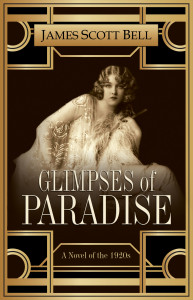
Which is how Glimpses of Paradise was born.

glimpses-front-1

The novel follows the fortunes of two high school kids from Nebraska. Doyle Lawrence is the scion of one of town’s wealthiest families. Zee Miller is a preacher’s kid from the poorer section. But she has a spirit and zest for living that draws Doyle to her, much to the consternation of his father.

From there the narrative tracks Doyle to the battlefields of World War I, and Zee to the glitter factory of Hollywood. And a stunning series of events that brings these two together again, both with innocence lost.

Glimpses of Paradise is the longest novel I’ve ever written, at 130,000 words. I absolutely lost myself in the research. Countless hours spent at L.A.’s central library, delving into first-hand accounts of World War I (a section of the book I’m particularly proud of, since my great uncle, a Marine, was killed at Belleau Wood in 1918) and soaking myself in the newspapers of the time. I have three big binders full of my research notes, copies of newspaper stories, maps, photos. (If you want to know what corned beef cost in 1921, I’m your man.)

The result was a novel that was a finalist for the Christy Award in Historical Fiction, and one of my personal favorites. There’s even a cameo appearance by Kit Shannon, still practicing law in Los Angeles. You can pick it up from these retailers:

AMAZON

AMAZON INTERNATIONAL STORES

If you would like a PRINT copy, I have a limited number of the original Bethany House edition. If you’d like one for $10 (free shipping in the U.S.), send an email to compendiumpress [at] yahoo [dot] com and we’ll tell you what to do.

So (doffing my cap to our resident historical fiction maven, Clare Langley-Hawthorne), I offer these three observations about writing historical fiction:

  1. It’s still about characters

The fundamentals of storytelling don’t change just because you write about a certain place and time. You still need to bond reader with characters, and put those characters into a life-altering struggle that requires strength of will to overcome.

  1. Make the setting itself a character

Don’t just render a historical setting accurately. Use that setting and the particulars of the time as a source of challenge and conflict for the characters. In Glimpses, for example, I try to capture what it was like for people struggling in the post-war depression in a city known for its glamour. I put the characters in challenging places to live, and in diners where they try to score some cheap food, etc.

  1. Weave research in seamlessly

Historical fiction writers love research. You can get lost in it. Every new discovery suggests a myriad of plot points. The great task is deciding what to leave out. And then taking what’s left and weaving it into the narrative so it doesn’t stick out like a neon sign announcing what a great researcher you are. The trick here is to start with a scene that has a clear POV character with a clear objective. Then brainstorm obstacles and helps to the character from the store of historical details. Use them in the conflict, don’t just list them for the reader.

Anything you historical fiction writers would like to add?

And if you’re a reader, what’s your take on historical fiction? There is always an ebb and flow in the market for historicals, but I contend that a well-written historical novel will always find readers to please.

First Page Critique: Attitude, Voice, Conflict

Our first page today comes from a novel called Things Unseen. My comments on the other side:

joshua-tree-national-park-74399_1280

At the southeastern edge of California, there’s a slice of land the color of desolation. The air is staler than a week-old bread crust and drier than a burnt piece of toast. It’s a place like a daydream, suspended between consciousness and slumber. Like dawn, or sunset—a place of transitions. For over fifty years, one man had called this place home. I was on my way to meet him.

“Oriana,” I addressed myself aloud, “you’ve run out of gas.” I sat back from the wheel of my dad’s ‘95 Toyota Camry and imagined my existence fading across the desert landscape. I could see the Camry’s sand-colored exterior melting into an unpaved expanse. “Twenty miles from her destination, young woman collapses in the heat of the Mojave summer.” That would make great fodder for one of my novels. I lifted my gallon water bottle from the passenger’s seat and took a long drink. You needed water in the desert, but extra gas would have been nice, too. I stepped outside and surveyed the low mountain range ahead. The last station was fifty miles back. I should have known to stock up on gasoline. My family used to come out here every summer, after all.

I jumped at the sound of my cell beeping from my pants pocket. Low battery, huh? Even if I could get service out here, who would I call? 911? That rundown gas station? The National Park Service? No one would ever pass by here, except for that man, maybe. No one would—

Something glinted ahead, like the flash of metal beneath the sun. A mirage? It was heading in my direction. It moved quickly across the flat land at the foot of the mountains, morphing from a distorted ripple to a human form—on a bicycle?

A boy, about eleven or twelve, pedaled up to the front of the car. A veil of t-shirts shaded his face and neck. He got down from his bike, walked over to the open window by the driver’s seat, reached in with his right hand, and switched on the ignition. I just stood there, watching. I’ve been saved. He turned off the ignition and towards me. “Out of gas?” he said, lifting his headgear.

***

  1. Opening with a description

There’s a meme going around that you shouldn’t open your novel with a physical description. I don’t see anything wrong with it, so long as you make it clear it’s coming from a character’s perspective and there is some sort of disturbance involved.

Here we have a woman who has run out of gas in the desert, only we don’t know that until the next paragraph. The first paragraph ends with For over fifty years, one man had called this place home. I was on my way to meet him. 

The problem I have with that is it isn’t disturbing. It doesn’t portend trouble or change or challenge. She could be going to see this man for tea.

If you were to keep the opening paragraph, and describe the desert and desolation, why not end the graph with: And I was out of gas.Then you’ve got an immediate sense of trouble.

But I would advise the author to reformulate the opening paragraph into action showing us the car running out of gas. Get that in early, give us the character, then bring in the setting.

  1. 1 + 1 = 1/2

This formula comes from Sol Stein, the noted writing teacher and editor. What it means is that two descriptions of the same thing don’t strengthen the effect, but dilute it.

In the first paragraph we have this: The air is staler than a week-old bread crust and drier than a burnt piece of toast. 

That’s two similar descriptions. But they make the reader hold both simultaneously, and that takes away from the power of either.

So a simple rule is: don’t describe the same thing in two different ways in the same sentence. Choose one, the best one. Personally, I’d go with burnt piece of toast because burning goes with the desert effect you’re trying to establish.

But the first paragraph also gives us other desert descriptions: color of desolation, daydream, dawn, sunset. This comes close to fiction writing blunder #21 (as explained in my book 27 Fiction Writing Blunders – And How Not To Make Them!)––being too in love with lyrical. Readers don’t often connect with a lyrical opening or passage, unless it is so dang good it cannot be resisted (like the opening of Ken Kesey’s saga, Sometimes a Great Notion).

So major in action and disturbance in the opening.

  1. Attitude adjustment

When using First Person POV, it’s crucial to establish a discernable attitude from the get-go. Readers love a character who has some ‘tude, who has blood coursing through her veins. They want to hear a distinct voice. Like Stephanie Plum’s in Janet Evanovich’s High Five:

When I was a little girl I used to dress Barbie up without underpants. On the outside, she’d look like the perfect lady. Tasteful plastic heels, tailored suit. But underneath, she was naked. I’m a bail enforcement agent now—also know as a fugitive apprehension agent, also knows as a bounty hunter. I bring ‘em back dead or alive. At least I try. And being a bail enforcement agent is a little like being bare-bottom Barbie. It’s about having a secret. And it’s about wearing a lot of bravado on the outside when you’re really operating without underpants.

My advice to the author would be to spend some time really getting to know your character’s voice. Delve deep into her background and wounds and strengths and fears and yearnings and drive. Give her a real attitude about running out of gas. Get her angry about it. Show us more emotion. Re-write this opening page until it is soaked with voice and attitude.

  1. White space

A purely practical matter: most readers these days don’t respond well to long blocks of text. Your first two paragraphs should be four or five. It’s not hard to do, and it makes things easier on the reader.

  1. The boy on the bike

Here is where you can inject more attitude. Why does Oriana just stand there while a boy walks over and reaches into her car? This is a perfect time for an argument.


“Get away from my car!”
“You wanna die, lady?”
“Now!”
“You gonna shoot me or something?”

 In other words, conflict. It’s basic, but so often writers leave it out in the opening pages. They set things up, describe landscapes and situations, and it’s only later that another character comes into the proceedings, and even then it might be a friend or ally and it’s Happy People in Happy Land (writing blunder #10).

I’m going to leave off here and let others weigh in, but I want to give this author a bit of good news. Your ability to write coherent sentences in a logical flow is sound. That’s not something easily developed or taught if it isn’t there in the first place.

So now it’s a matter of craft, which can be taught. I’ve given you my view of your first page, and now it’s time for others to do the same.

But I will say that a woman out of gas in the desert is a great opening disturbance. Work this page until is vibrates with attitude and emotion and conflict. Cut all flab. Do that, and I’ll want to go on to page 2.