About Joe Moore

#1 Amazon and international bestselling author. Co-president emeritus, International Thriller Writers.

Oh, The Glamour of it all

By Clare Langley-Hawthorne
www.clarelangleyhawthorne.com

How I wish that air travel was like it used to be – glamorous, exotic, even adventurous. Now it is a grueling ordeal which, after the recent long haul flights to and from Australia, makes me wonder why I even bother to fly at all (probably because I have no choice).

Our flight to Sydney was actually good – we had two rows of four seats for us all risking that no one would, in their right mind, want the middle two seats in the final two rows in economy if they knew there was a three and a half year old sitting on the aisle. Our plan paid off and the boys got to stretch out, so we actually got a fair amount of sleep on the 15 hour flight over. But landing in Sydney in the middle of a thunderstorm,with each twin threatening to throw up and crying the eternity it took for us to land amid the lightning and rain, soon brought home the realization that flying is no fun at all.

Once on the ground we also had to wait on the tarmac as lightning prevented any of the ground crews from operating the jetways with the result being that four jumbo jets (at the very least) all deplaned (a word which I never thought existed) at the same time once the storm passed. Two hours getting through customs and immigration – and we’re bloody Australian citizens – meant that we missed our connection to Melbourne and could not get on another flight for four hours. Great, four hours in Sydney airport with three and a half year old twin boys after a 15 hour flight. The thing that got to me the most was that no one seemed to give a shit. Not at the airlines, not at customs. That’s what flying is all about now – endurance.

Can you put up with the power play of the customs guy who refuses to let you go in the shorter line because (and I quote) “Just because I said no” (bastard!) despite two little boys in tow.

Can you put up with the Qantas staff who shrug and say ‘oh well’ when you are faced with a four hour wait after a long flight mainly due to the fact that Qantas had originally cancelled your international connecting flight (without telling you) forcing you on to a domestic flight which meant clearing customs etc. in Sydney – which meant you were screwed.

On the return flight, there were no spare seats so the boys got to sprawl over us instead (I was in a mini Yoga session trying to contort my body so I could sleep amongst the toddler heads, feet and arms). Qantas flight staff appeared maybe three times the whole flight and couldn’t even be bothered handing out a kids activity pack (good thing I always have about 100 hours worth of entertainment packed into a backpack and miracle of miracles our in flight entertainment did work – the family behind us had none that worked!) I guess at least the return flight was smooth but still the food was lousy, the service (if you can even call it that) was indifferent and this was on an Australian airline – which used to be a safe haven – an expensive but welcome change to the American flying experience.
No more.

So as I gear up for my first ever book tour which my publisher, Penguin, is actually paying for (!) for The Serpent and the Scorpion my excitement is tinged with trepidation. Because lets all face it – flying today is not what it used to be. Flying even in Australia is not what it used to be and that’s damn depressing.

So much for jet-setting to glamour and fame.

Lost in translation

By guest blogger, Alafair Burke

burke-alafair So I got an email today from an editor with my UK publisher, which will publish Angel’s Tip in November under the title City of Fear. All of my prior books were published in the UK in the identical form as the US editions. This time, however, the UK editor has ach-bunk suggested deleting cultural and  commercial references that might not be recognized on the other side of the pond: e.g., deleting an Archie Bunker reference and changing Tasti-delite, a ubiquitous NYC not-quite-ice-cream-like "food," to a Starbucks.

starbk I honestly don’t know whether UK versions of US-based books are typically changed to delete cultural references. Are they? Should they be? If I read a book based in the south and a character chows down on some ridiculous fried something or another at a food shack called Lucy’s, I don’t need to know about Lucy’s to get the general picture. On the other hand, if readers in the UK don’t want to feel left out of the story, I can certainly understand. What do you think?

Alafair Burke is the author of what the Sun-Sentinel has hailed as "two power house series" featuring NYPD Detective Ellie Hatcher and Portland Deputy District Attorney Samantha Kincaid. A former prosecutor, she now teaches criminal law at Hofstra Law School. She is a graduate of Stanford Law School and frequently serves as a legal and trial commentator for radio and television programs. She lives in New York City.

Note: Join us in the Sunday Kill Zone when our guest bloggers will be:
Allison Gaylin, September 14
Allison Brennan, September 28
Chris Roerden, October 26

Welcome to Bean-Counter Land

I still hear tales of authors in the old days whose work never sold impressively, but were published religiously because their words were deemed by the houses to be important to future readers and gave an author’s work deserved time and effort on their part to eventually build an audience. I don’t have to tell you that those days are, for the most part, long gone and any author’s importance to a publisher is measured strictly in units sold. The exception would be authors with exalted reputations whom a house wants to list as an author of theirs for reasons of status. Like movie studios, publishers seem only interested in books they believe will be blockbusters that will rapidly swell their quarterly numbers for stockholders. We can decry it as a shame, but we all need to understand that the world we write in is about numbers. The good old days, if they ever truly ever existed, are gone, baby gone.

By the way, it isn’t just numbers sold, but also the numbers of returns that publishers tend to go by. If you sell 50,000 copies of a first book, but they figured it would be a hunko seller so they printed 250,000 units because that was what “they” decided to print, you have failed them the worst way imaginable. And chances are that they will make you feel like a child who has disappointed his father––picture a New England Episcopal minister’s son who marries a snake-handling, poison-sipping toothless Holy roller from the mountains of West Tennessee.

Unless you are somehow able to sell a substantial number of books on your own, or if a book builds from word of mouth, the publishers won’t advertise, and if they do they will plant one ad in one spot and wonder why the advertising failed to move books. I was in advertising for many years and I can tell you that (according to some vague research we believed in) any ad has to be seen nine times to make an impression on an individual––and that’s a person who’s open to the product the ad is about. Print ads are a prohibitively expensive way to sell books, and unless you are a major best-selling author you will be lucky to get even one ad anywhere. Best-selling authors need ads only to hold their market share, so you can’t blame the publishers for putting their money where they are most likely to see results on their bottom lines. You can’t blame a business for wishing to make money because that is how everything is measured. It’s disheartening for an author to put a year of their life into a book, work to make sure it’s as good as they can make it and then watch the publisher ship it out to see what happens to it on the shelves. Even if a book wins a major prize, and gets great reviews, unless it hits their expectations, they watch it disappear after a few weeks and that’s it. It isn’t that they don’t care or believe in the book, it’s just a fact of business.

I have a great editor and a publisher I’ve been with since I started writing fiction and I know they care about me personally and want to see my career take off for all concerned. Okay, there’s some enlightened self-interest there, but such makes the world go around. I don’t mind. I am loyal to them, and they have been loyal to me. Each time I write a book I know they are watching and working hard and praying it will break out and I’ll sell enough books to make their sales team smile. I know when I fall below expectations, and I have, they are as disappointed as I am, but perhaps for a shorter time than I spend frustrated about it.

This business is hard, but I think no harder than most others. I see authors as cottage industry manufacturers working alone who make a product for a company that will refine and distribute it the best they know how. Some of us see the publishing company we’ve been with as our extended family, but unfortunately it’s not unconditional love, or life-long commitment. No matter how big your numbers are today, you are only as valuable to a publishing company as your sales sheets say you are. When you are selling big and making the lists, they dote on and pamper you, but when those sales slip, they will go to the next thing. This is true in most businesses. It’s as disheartening as discovering that the person you loved and thought you’d stay with forever has a change of heart, and falls for another, but it’s the reality.

The life of an author is hard. We work alone, are paid by the job, don’t receive insurance benefits from the company, work long hours, have no job security whatsoever, probably have little or no 401 Ks building up, and, if we are lucky manage to make a boom-to-bust living at it. But we do it for our own personal reasons, and if we complain, we know we’re wasting time we could be using to write, and that nobody outside our family really cares.

Recently a student asked me what advice I’d give an aspiring author. I said what I always say, “The writing life has its rewards for sure. Making a living doing what you love is as good as it gets. Despite highs and lows, creating stories from thin air and living with a book as you create and improve it is almost orgasmic. Seeing your books on bookstore shelves is a rush for sure, and hearing from truly appreciative readers is truly a great feeling. But… don’t become a writer if you think you will get rich from doing so. Don’t write for a living if you have a thin skin or can’t take rejection. Don’t become a writer, especially of commercial fiction, if you can’t take direction from editors and hack at your wonderful novel with a meat cleaver when it is necessary. And, if you are lucky enough to sell a book to a publisher, treat the first and each subsequent advance as though it is the last money you’ll ever see from your publisher …because it just might be.”

How Much Violence is Too Much?

By John Gilstrap

Language and violence are sensitive topics for fans and critics alike. My first book, Nathan’s Run, which I never considered to be a young adult book but nonetheless won the Alex Award from the American Library Association because of its relevance to teenage readers (the Nathan of the title is 12 years old), was banned by several school systems because of its language and violence. Apparently, there are 109 objectionable words in the book—an incensed mother actually counted. Maybe it was 409. Anyway, the book was banned from school libraries. (Memo to file: If you want to sell a lot of books, get it on a banned list somewhere.)

The whole book-banning thing is a soapbox of its own which likely will be the subject of a future rant, but for this blog entry, I want to focus on violence. As a society, we’re a little weird about it. There’s a whole subgenre of suspense fiction that celebrates vampires, the eroticization of oral exsanguinations, but if you kill a puppy or a kitty cat on the page, you’ll never sell a book in this town again. A few years ago, I was writing a very loose adaptation of Norman McLean’s Young Men and Fire for Warner Brothers, a never-produced flick about smoke jumpers—those wonderfully insane men and women who parachute into forest fires. The producers told me in no uncertain terms as I wrote the script that I should feel free to kill as many firefighters as I needed to serve the story, but that I could under no circumstances show a suffering, dying or dead animal. If I showed an animal in jeopardy, I had to later include a scene where we see that Yogi and Bambi made it out safely. Hey, the rules are the rules, and I signed the contract, so who am I to argue? But still.

In the world of the novels I create, no one tells me what I can and can’t do, and I have to say that the violence thing is something I struggle with. Not to keep flogging my fire service background, but I’ve seen violence up close. Torn, punctured flesh and broken bones are all ugly as hell. The screaming is unnerving, and injured people invariably smell awful. They make wee-wee and doo-doo on themselves, and if they’ve been dead for more than a couple of hours, they’re really unpleasant to be around.

As an author whose job it is to bring readers into the word of my characters, isn’t it my responsibility to make violence and its aftermath as squirmy as it is in real life? Shouldn’t violent actions have terrible consequences on the page as they do in the mean streets and combat zones? Clearly, I think the answer is yes, but truthfully, only to a point. A very fine line separates verisimilitude from a discomfiting violence-as-pornography. Like other forms of pornography, I suppose, it’s hard for me to define, but I know it when I see it.

A couple of weeks ago, John Ramsey Miller posted brilliantly on the importance of keeping scenes real in the reader’s mind. Along those lines, I become infuriated when I’m reading a story and a protagonist takes a bullet in the shoulder (or the thigh or the knee . . .) and keeps going. It’s not possible. The human body just doesn’t have a lot of free space in it. Every joint is a fragile structure. If you shatter a part of the scaffold that gives us structure, it doesn’t matter how tough you are; you’re going to fall down. You’re sure as hell not going to have one more fist fight with the bad guy just because you’re angry. Again, the anatomy and physiology of traumatic injury can be the subject of yet another future blog entry.

So here’s the tacit deal I make with my readers: Even when I take you to unpleasant places, trust me that I don’t do it for prurient reasons, and that I’ll never make you want to throw up because of what you’ve read.

Shake on it?

My Second Life

by Michelle Gagnon

So the last stop on my book tour for BONEYARD was a virtual one in Second Life. I was a little trepidatious. I’m not exactly a Luddite, but when forced to deal with computer tech support people I find myself saying “Which thingy was I supposed to click on again?” with alarming frequency. And they assume the tone one takes when explaining things to a very small, somewhat slow child. So the thought of navigating a virtual environment was nerve-wracking to say the least.

Apparently the good people at the writer’s enclave on Athena Isle have dealt with my kind before, since they sent multiple documents explaining the entire process step by step. I’m sure they thought the experience had therefore been idiot-proofed, but I was the idiot that proved them wrong.

I successfully downloaded the Second Life software, only to have it crash every time I tried to open it. By the tenth attempt I was ready to throw in the towel. One of my Second Life advisors suggested I try installing it on a different computer, since Vista was notoriously quirky. So I appropriated my husband’s Apple and presto: I was in.

Of course, figuring out where the heck I was, and how I was supposed to get to Athena Isle, was a different matter. I alit on some sort of “welcome” island, with lots of confusing signs everywhere. Remember that scene in the Matrix, where they pull Keanu Reeves out of the water and he can barely see? Kinda like that. I found a “sample” house, wandered inside and ended up chatting with another girl who was having the same issues that I was, in that a) she kept walking into walls, and b) she couldn’t figure out how to sit down. Or do anything else, really, aside from type.

I should back up a bit here to describe my avatar. Turns out that in Second Life it’s possible to buy yourself blue eyes, pink hair, and a complete outfit for the equivalent of two dollars This was extremely exciting, the only downside being that the only clothing retailers I could find apparently catered to streetwalkers. Seriously, the attire in Second Life is scanty at best. And even if you skew your avatar toward the “athletic” body type, she’s still going to be endowed with a Lara Croft-esque bust line. Not exactly my usual author look, but I decided to go with it.

After wandering around aimlessly for an embarrassing length of time, I discovered “teleporting.” Yes, teleporting, as in Star Trek. I’m one of those people who absolutely cannot wait for this technology to be available in my day to day life, along with that food machine that makes whatever you’re craving in a minute or less. I don’t care if teleporting means occasionally getting separated from a body part, as long as I no longer having to deal with the debacle that air travel has become. So far this was shaping up to be my kind of experience.

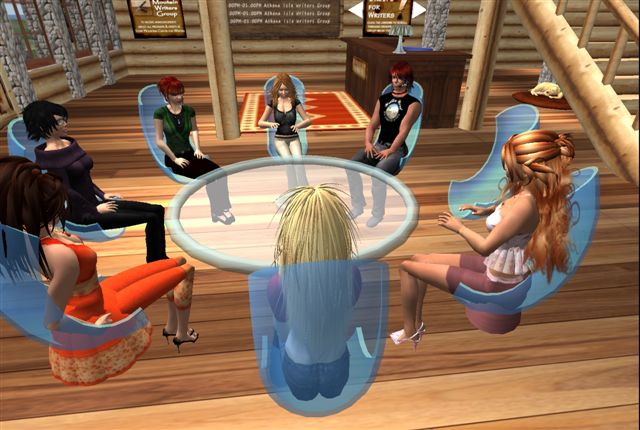
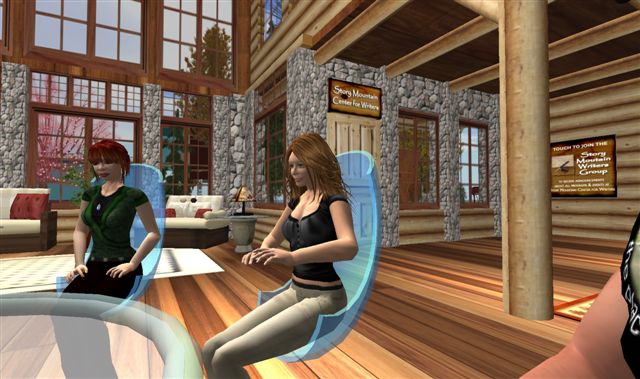
Unfortunately, regardless of which island I clicked on, every time I teleported I somehow ended up on the bottom of the ocean. Which forced me to circle the entire thing until I found a beach to climb on to. Seriously sad, I know. One of my gracious hosts finally sent me a link directly to the event location, and I ended up in what looked for all the world like a Tahoe cabin.

Another thing I want from Second Life is this magic table that my host, Alas, had. Every time a new person arrived, another chair appeared at the table (and a lot of the guests materialized in the air above the table, a very cool effect. Clearly they’d figured out how to avoid the whole deep-sea diving thing.)

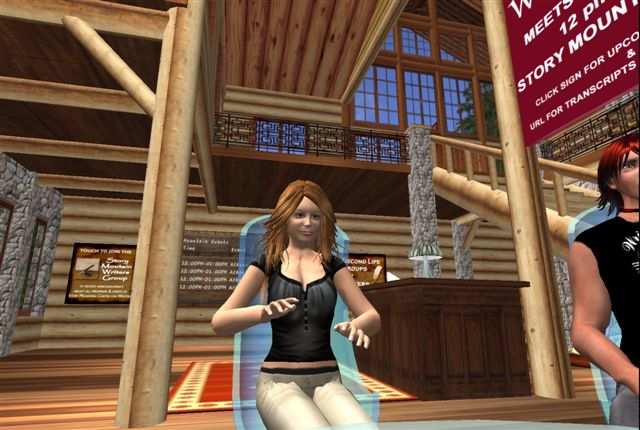
The event itself went well, as far as I could tell. I’ve done online chats before. For some reason, it was actually more distracting being able to see other figures there while chatting. I suspect part of the reason was that as someone was typing a question, their hands moved as though they were at an imaginary keyboard. And the time lag felt a little more unnatural when I could see everyone else sitting there awaiting my responses. Plus it was fairly silent, aside from some simulated ambient noise. I’d compare it to a Quaker meeting, with Friends dressed like they dropped by en route to a rave.

The questions were fairly standard, there’s a transcript posted online here

However it was the first time I’ve fielded questions about getting an agent from a Faerie (at least I think that’s what she was, but I could be wrong.) I wandered around on my own afterward, visiting a few more islands. People kept trying to bite me, which I found somewhat disturbing, and they got offended when I refused (I think I missed the biting protocol sheet). I also discovered that I’m just as inept at small talk there as I am in my first life. Plus, I tried to change into a new outfit and ended up wearing the bag it came in. I did finally master flying, however, and that was very cool.

When I looked up, five hours had passed. Ouch. I reluctantly signed off and decided to steer clear for a few weeks while I got my life back in order post-tour. Honestly, if I had more free time on my hands, I could see quickly becoming hooked. The various environments you can visit there are so amazing, it really is a virtual Shangri-La. But I barely have time to get through my email every day as it is, and I’m constantly missing deadlines. I’ve already sworn off Scrabulous (temporarily—I mean, let’s be reasonable) and have begrudgingly acknowledged that the last thing I need in my life is another time-suck. And even at $2 an outfit, I could still probably do some damage to my bank account once I figured out how to wear what I purchased. So Second Life, I’ll be back for more someday. Just promise not to bite me.

When good books go bad

By Joe Moore

How often have you heard a writer ask, "I don’t understand why my book is being rejected while so many bad books are published?" Or, "I keep reading books that are nowhere near as good as mine. Yet they wind up getting published while mine don’t. I don’t get it!"

Sound familiar?anger2 Here’s my spin on the answer to this never-ending source of frustration: there’s no such thing as a bad book. The reason I feel that way is I believe that all books are considered good or even great by someone.

No publisher will intentionally release a "bad" book. Doing so would be a doomed business plan, especially in today’s economy. Their goal is to find the best written manuscript, give it the most professional editing possible, promote it within budget limitations, and work closely with the author to raise the awareness of the book in the marketplace.

Here’s the problem: No publisher has a plan that is immune to failure. Not all books appeal to enough readers to make back the original investment. The dumpster is full of great books that did not make it into the hands of enough readers. And we have all come across books that we didn’t like or thought were "bad". (To be honest, I couldn’t make it through the first 50 pages of a huge best selling novel that won the 2007 Pulitzer Prize for fiction. Does that mean it was a "bad" book?)

Not liking a book is individual preference. Someone else may love it, which is usually the case. If a book is truly written poorly–spelling errors, typos, incorrect punctuation, etc.–that’s the failure of the line editor. And if it’s built on weak or sloppy writing (massive plot holes, 2-dimensional characters, stilted dialog, pacing issues, redundancy, cliche, etc.), that’s the fault of the acquisition editor. In both cases, the book should not have been published.

I have never met an author who said, "Today I’m going to write a mediocre book." I’ve never dealt with an agent who was seeking writers with minimal talent. There are no publishers out there willing to risk their money on a sure-fire loser. All books are considered great by someone. That’s why they were written, represented, and published. Did enough readers agree? Better yet, did enough readers even get the chance to agree. And if they didn’t, where does the fault lie? Marketing? Distribution? Promotion? Bad luck?

But even if we write a great book, there’s no guarantee that it will ever be published, much less sell enough copies to earn back the advance (many books fall short of that task). Don’t get me wrong, we all have to write the best book we can. But there are more great books that fail than succeed.

I think all books are great to someone. What do you think? Why does it seem that so many "bad" ones still get published while great books fail or never see the light of day?

Too close for comfort

So Clare regaled us with the best and worst of Australia yesterday.
My vacation tale is a bit more raw-edged. Over Labor Day, I nearly wound up as road kill at the hands of a schizo. Make that tram kill, since I was on a train in Portland at the time.

Here’s what happened: We were in Portland so that my daughter could attend an anime convention. Anime, as you know if you’re from any planet in the galaxy, is the world of animation. Basically, an anime convention is like a weekend-long Halloween party—everyone gets dressed up as their favorite characters.

So while she was romping around dressed as some kind of warrior princess, I spent the weekend taking in the sights of Portland. And for the most part, Portland is a lovely, charming city. But during my day-long walking tour, there seemed to be quite a number of homeless people around. And they were, how should I put it, extremely…loud. At one point I said to an acquaintance, “Maybe it’s because we never walk in LA, but don’t a lot of people seem to be shouting here?”
For example, one lady I called the “Sun Worshipper” because she threw her head and arms skyward every time she stepped into a patch of sunshine, and let loose with a holler. A hell of a holler.
Other shouters were the types you’d cross the street to avoid.

And finally, there was the guy I encountered on the train. I’d stepped onto the train—called the MAX—because I was too exhausted to keep walking. But then the train didn’t move for a while—God knows why.

While the train was stopped, a homeless-looking (and smelling) man grew increasingly agitated. He was pacing, shouting and air-boxing.

Now here’s something you should know about me. I attract crazies. I attract shizos on the street like people who don’t like cats attract every feline in the house. I’m like the Doctor Magneto of madmen. Why? I have no idea. My husband claims it’s because I’m too engaging, outgoing, and I never mind my own business. And he may have a point.


Take the guy on that tram in Portland. When I sat down, he was doing little circles around and around the middle of the tram. Each lap of his circle brought him closer to me. Sitting next to me were a couple of elderly ladies, and they were getting quietly nervous. Meanwhile, the guy kept trying to make eye contact with me. And his shouts were getting louder.
Finally I said to the ladies, “I think you’d better move to the front of the car.” Which they promptly did.
It was my next move that got me in trouble. On the next lap of this guy’s ranting orbit, I stood up, stepped toward him and said, “Now would be a good time for you to step off this train.”

For a second he stopped air-boxing and stood there, dumbfounded.

So I repeated, “Now’s a good time to leave the train.”

That’s when all his anger returned, only this time, it came back as a Category Four hurricane. And I was New Orleans.

There was a sheet of Plexiglass between us. He kung fu kicked it with tremendous force, right where my face would have been if it hadn’t been for the Plexiglass.

It’s amazing how alone you can feel when you’re in a crowd and someone is going after you. Everyone simply sits, silent and frozen, like spectators watching something on TV.

Even I felt like a spectator. I stood there, watching this guy pummel the Plexiglass, screaming at me. I wondered what it was going to feel like when his foot or his fist made contact with my flesh.

But then something miraculous happened.

He stepped off the train. And then the train began to move, and the door closed.
He continued to beat the window of the train. He pulled up his sleeve to show me some kind of tattoo. It looked like something religious, or maybe it said “Death from Above.” I couldn’t tell.

The fact that the train was leaving without my attacker put me in a decent mood, so I gave him a thumbs-up for his tattoo. Then I waved good-bye as we pulled away.

After the action was over, it was funny how convivial and chatty everyone got all of a sudden. One guy asked me why the man had taken out after me like that. I said, “I don’t know, I just have that effect on men.”

But one thought stayed with me during the entire episode (besides not giving instructions to crazies–that one I’ve totally learned). I decided it would be a good idea to carry some kind of weapon.

Not a gun—too lethal, and way too many sticky gun control laws. Not even a knife, I think. No, I’m looking for something disabling without being deadly. Anyone have any good ideas about that?

Anyway, next year for the anime convention, I’ll satisfy myself by donning an electric-blue wig and fake sword to play-act the warrior princess. Becoming one in real life is way too hazardous to one’s health.

TOTALLY ARBITRARY AUSTRALIANA

By Clare Langley-Hawthorne
www.clarelangleyhawthorne.com

As I was in Melbourne Australia last week and am now sunning myself in Queensland (well, given my complexion, hiding from the sun beneath a layer of sun cream and a wide brimmed hat) I’ve been thinking a lot about what I love (and hate) about Australia. Here’s my list – totally arbitrary mind you, so feel free to chime in and let me know what you love and hate about the place!

TOP 5 THINGS I LOVE ABOUT AUSTRALIA

1. The beaches

Of course my number one has to be the natural environment. Australia is a beautiful and terrifying country – amazing beaches, stunning scenery in both the outback and the bush, and of course awe-inspiring desert landscapes. However, if I was to narrow it down to just one thing it would have to be the beaches. I haven’t seen anywhere in the world that can compare.

2. Pavlova (the best dessert ever!)

Next on my list is pavlova – a meringue desert which is sublimely sweet, sticky and delicious! Whenever I come back to Australia I always put on at least five pounds reliving my childhood by eating my way through all the foods I love and miss. Pavlova tops the list but I haven’t even had a sniff of one as yet – and I’m getting desperate!

3. Cadbury Chocolate

Bugger the Swiss chocolate, I’m all for the good Australian Cadbury milk chocolate. Originally from England, the local version has some fabulous Australian favorites- Caramello Koalas and Freddo Frogs to name just two. I seriously haul pounds of this stuff back to America (aside from what’s already padding my derriere!)

4. Trams

Coming from Melbourne I have to include trams on my list – the ubiquitous mode of public transport in Melbourne. I rode a tram to school and the old green and yellow rattlers hold a special place in my heart. I think there’s one that trundles up and down the embarcadero in San Francisco but I love the old ones in Melbourne where kids used to hang out of doorways and which, in winter, would be freezing inside as the open doors let in the cold air.

5. The irreverent and colorful sense of humor (no-holds barred, no political correctness just ‘saying it like it is’)

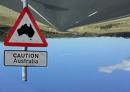
Finally, the most refreshing thing about being back in Australia is the totally irreverent sense of humor that is on display every where you go. This is the hardest to explain to non-Aussies but you just know you’re back in Australia when you see something like this.

WHAT I HATE ABOUT AUSTRALIA

This is where I will get into trouble…

1. The accent

Okay, I know I’m going to get comments on this but after 13 years living in the US the full frontal Aussie accent when I arrive can be truly horrific! There are degrees of ‘ockerism’ as we call it but still, when it’s bad…it’s bad.

2. Australian Rules Football (‘Footy’)

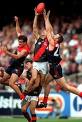
Melbournians obsessive love of Australian Rules Football is enough to make me get back on a plane and leave immediately. I grew up with all the ‘footy’ madness and now, even after just one week in Melbourne, is enough to make me scream!

3. Racial intolerance

Although Australia has come a long way I still sense an underlying intolerance particularly towards the aboriginal people that I still find disturbing. It is often veiled in humor but it is inescapable.

4. Chiko Rolls

I have only one food item on my list and it is peculiarly Australian – the chiko roll – it’s like a deep fried egg roll filled with some gross concoction of mutton, rice, cabbage and God only knows what else. Just describing it turns my stomach!

5. Being a 15 hour plane ride from bloody anywhere else!

My final ‘whinge’ about Australia is its location – I mean seriously it’s a bloody long way from anywhere else…so I’d better enjoy sunning myself on the beach at Palm Cove while it lasts!

Why I Hate Genres

By guest blogger, David Hewson

davidhewsonsmall Back when I was young, a time of plague and much wailing, I used to spend long and happy days in libraries. I’d like to say this was a literary leaning on my part, though the absence of girlfriends and money may also have made their contribution. In the late 1960s my local library in northern England was a wondrous place, full of books all neatly divided into two principal categories. There was non-fiction, broken down into the obvious sub-divisions, such as science and philosophy, nature and art. And there were novels which, as far as I recall, had just a single section to one side  – the yellow-jacketed science fiction titles bought in for the local weirdos.

The rest was just fiction. No labels for crime or thriller, noir or mysteries. Just books all jumbled up together. The way you picked one was to ask for recommendations among the people you knew or simply flick through the covers on the shelves to see what took your fancy. This, I guess, is why I read widely, from Robert Graves to Ray Bradbury, Jung to the weirder corners of magic. The grim god of genre had not yet reached my cold little corner of the north. As readers we were free to enjoy what we pleased without wondering whether we had crossed some invisible line into the land of the damned.

The writers of the time were, I guess, free to pen whatever took their fancy too. Don’t you envy them? A little while back I heard a couple of people saying about one well-known author who’d dared to do something unexpected, ‘He’s dissing the genre’. Apparently I’ve transcended the genre too on a couple of occasions, which is good I gather, not that I care much because a part of me wants to know this: What *$@*^& genre?

Now don’t get me wrong. If you write about werewolves and vampires, distant galaxies or detectives who happen to be the pet cat of Tutankhamen, you are in a fixed and discernible category of fiction to which people can and will attach a label. The same goes for an author who chooses to set a tale in 1940s Hollywood with a private detective as the protagonist. Or maybe anyone who uses a PI as a lead character. I’m a Brit. I have never in my entire life met a private detective. We scarcely have them over here. Yet still people turn out Brit-based private eye stories as if the back streets of Peckham are just duller, rainier versions of Chandler’s LA. Why? Beats me…

Most of us – and I include the luminous regulars around here – don’t fit any such bill. We write about a world that’s near as dammit real, and that – I hope – is what gives our work its power. There is no deus ex machina, no wizard with a wand, sometimes no super hero, with or without magical powers, to get our characters out of their fix. Nor are we alone.

200px-Charles_Dickens_3 Consider this for a story. A troubled young man discovers his father was murdered by the man who went on to marry his mother (who he, the son that is, happens to find rather hot). Crime? Noir? Thriller? Or just Hamlet?

How about this one? A starving student cooks up a plan to murder a greedy old woman he regards as a parasite. The crime goes wrong and he winds up killing her half sister too after she stumbles on him mid-blow. Haunted by his increasing guilt he’s driven to confess the crime first to a prostitute, with whom he has a strangely sexless relationship, and finally to the police. When he’s sent to jail in a distant prison the prostitute follows with some hope of redemption. Dexter with a twist? No, Dostoevsky’s Crime and Punishment.

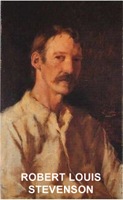
200px-Robert_louis_stevenson You see the point? Genre, for most of us, is an invention, a con, a tag to make us outcasts stuck in some well-labelled siding so that people – well, literary critics anyway – don’t make the mistake of taking us seriously.

The truth is that most of the folk around here are slap bang in the mainstream of popular story-telling, writing for the most part about ordinary people in extraordinary and threatening circumstances, which is 200px-Joseph_Conradwhat authors have been doing for centuries. Charles Dickens, Robert Louis Stevenson, Joseph Conrad and Émile Zola are just a few of the ‘literary’ writers who produced work which, if it were new today, would be classified as crime or thriller or noir or mystery. Does that lessen the power of books like Oliver Twist, Treasure Island, The Secret Agent or Thérèse Raquin? Of course not.

Genre is an irrelevance, at best a marketing tag, at worst a straitjacket that stops people writing what they should. It’s a control freak parent screaming at you to conform when you should be rebelling. It’s a comfort blanket slyly telling you to be lazy when really you ought to stretch and feel the pain.

200px-Emile_Zola_2 The longer I spend in this business, the more difficult I find it to categorize the work of the many talented and interesting authors I encounter along the way. This is as it should be. The little library back home that first fired me with the ambition to be an author derived its power from its refusal to classify the books it contained. If it had, I wouldn’t have read as widely as I did, and I wouldn’t be writing the books I do today.

Literature’s greatest strength is its rich breadth, the fact it doesn’t adopt the dumbed-down one-size-fits-all philosophy that has taken over so much of our culture. Does that embrace sub-categories? Yes, but only when we choose to place ourselves inside classifications – horror, history, or science fiction, say – that make sense to readers and writers alike.

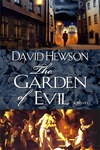
garden-evilFiling everyone else who writes popular fiction under the catch-all labels of crime, thriller and mystery serves no one any purpose. Next time you find yourself in a book store gravitating automatically to the shelves and names you know so well here’s a tip. Go try something else.

David Hewson’s latest book The Garden of Evil is the sixth in his Nic Costa series set in contemporary Rome, and his twelfth novel. He lives in the UK (hence the spelling) but will be at Bouchercon if anyone is still speaking to him.

Special note: Join us on Sunday, September 7, when our guest blogger will be bestselling thriller author, Alafair Burke and on Sunday, September 28 when we welcome guest blogger, Allison Brennan.

Congratulations, you didn’t win … again.

After judging a major literary contest, I can tell you fellow authors that your submission is taken seriously and considered earnestly, and that basically each is an audition for a group of very attentive and appreciative readers of good books––your fellow authorish persons. It would be wonderful if every author could win an award, feel appreciated for their literary labors, but when there’s one prize and four hundred or more entries, that’s never going to happen. The fact is that the odds are superly gynormous against just being nominated, much less winning. If you do manage to get nominated for an award you should be monstrously flattered to know that out of the hundreds of books published during the year that a handful of fellow wordsmiths agreed that yours was one of their five favorite performances. I can tell you that we judges didn’t vote for a book because we knew the author, or for something an author wrote earlier that we loved, and that makes the honor of being nominated mean so much more.

I was a judge for the best novel category for a major organization named for a dead writer and devoted to mystery authors, and if you think there’s a more difficult job for an author than judging that contest, I’ve yet to experience it. It often seems that the only people who agree with the judges’ final decision are the nominees. I seemed that the people who were the angriest and most verbal over the lack of female authors nominated, or the fact that certain kinds of books weren’t nominated, and several more complaints I can’t recall at the moment, seemed to be the authors with the books least likely to win. Face it, some authors are just supremely talented and some just are not so much. The novel any individual thinks is the best novel of the year (aside from their own) may or may not get the award, but the one by the the whiniest, most “I feel persecuted” author probably won’t. A “squeakiest wheel” award is a great idea since there’s a big a list of nominees already compiled somewhere.

In the space of a few months we judges received hundreds of submissions, and we spend every waking hour we could beg, borrow, or steal reading submitted novels. Poor us? Well, we did volunteer, and while none of us are sorry we had the experience, most of us will probably tell you we’ll never do it again. The books come in from publishers constantly, and often in something more like an avalanche of FedEx or UPS envelopes or boxes, some containing up to fifteen novels. Typically a judge reads well into each book and makes notes. I read at least twenty-five pages of every book I opened and I used those sticky arrows in colors so I could tell at a glance whether or not I loved the early pages or if I hadn’t become invested in the book by then. The submissions I loved, I read through to the end, unless somewhere past those initial engaging opening pages it began to disappoint me. We all know that a great book will draw in a reader in the first ten pages, then pullus straight through a story, and have an ending that will leave us wishing the book were longer. Some books fall apart early, and some wait until near the end to fall apart. Few books start, run their course, and then finish in such a way as to leave you awed. But when one does, the feeling is that of excitement.

I enjoyed a lot of the books I read. I loved far fewer of them, and I thought far too many were a waste of the time of innocent readers not to mention printer’s ink and paper. But of the top twenty entries (and especially the top ten) any could have won the contest and it was a matter of how they were ranked by each of the judges. The top five were on every judge’s list and those lists were compiled without the judges communicating as they made their lists. So it was as fair as fair in this life gets.

That said, I firmly believe that contests that have different kinds of books crammed in the same category (say Best Novel) is unfair from the start. Cozies, private eye mysteries, noir mysteries, romance thrillers, Western mysteries, romantic mysteries, comedy mysteries, thriller-thrillers, police procedurals, kung fu romance thrillers, and murders solved by animals, and investigators who are one-legged chiefs who, due to childhood trauma, speak only in wild-game recipes come in the same boxes. The submissions are a grand cluster-funk hodgepodge of literary shrapnel so how can any reader, or five readers, be expected to pick out a BEST novel and be fair to all of the types of books submitted? When you are opening books you get one with a cat on the cover, then one whose cover shows a man nailed to a fencepost that is on fire. Clearly they are not created to be judged in the same contest. Mystery Genre, and the piles are subgenre warfare. Unfortunately politics will keep changes from being made. That and a shortage of judges, and the tendency to cut out more categories instead of adding a few more. Can’t fix that one. One of the judges suggested that in the future and in the name of fairness the submissions might be electronic so the author’s names and even the titles could be replaced with numbers to ensure the identities would be unknown to the judges. We’ll see.

The plain truth is that judges are human. I’ll never be a cozy or mystery reader by choice, so it is unlikely that I will enjoy a cozy as much as I will a thriller. Thrillers VS cozies aren’t apples VS oranges, but more like grapefruits VS gorillas. (But there are awards out there for best cozies, just as there are for mysteries and for thrillers). MC Beaton (Marion Chesney) should not be in the same contest with Lee Child, both of whom I like as people and respect and admire as authors. Judges do the best they can. We (male and female authors) honestly didn’t care whether a book was written by a man or a woman. One of the judges (a woman author) put it this way: “It’s what’s between the covers, not between the legs.” Some of my favorite authors are females, and I think their books are every bit as well written as any by male authors. Of my favorite authors (those I read by choice) about a third are women. But this time the nominees were all men because in our subjective minds their books were the five best novels. All of them are storytelling masters whose books clearly rose to the tops of all five of the judges’ piles.

It would be great to win a prestigious award for just doing what we’re doing anyway. Most of us write for the reader’s entertainment (as well as our own) and in order to make a living doing what we love. Whether or not we win awards has no bearing on our abilities or our or our readers enjoyment and appreciation of what we give them. Most of us work knowing that we probably will not win an Edgar, ITW, or a Barry, and that’s okay. I don’t know any author who writes books with one eye looking toward winning a literary award, but I’ve never known an author to turn one down either.