Author Archives: Joe Moore
Making a “Building Ha-Ha.”
John Ramsey Miller
Last week I finished my work with the census and I gathered a lot of material along with a modest paycheck from the Federal Government. Over the past few weeks I traveled a few thousand miles in my Highlander, and spoke to hundreds of people, a few that were glad to see me. So now I am going to get back to writing. Then, due to some family turmoil, I found myself with my three year old grandson for a few days. My grandson lives in town 17 miles from me and he loves spending time with his Dotz, which is what my grandchildren all call me. In my last book, yet unpublished, a man inherits a grandchild, and the appearance of this new addition puts a cramp on his lifestyle and he has to go back into his violent past to save her from bad people with an agenda. For some reason I keep returning to that sort of situation–man with kids to protect. Maybe because I get what it feels like to have a child suddenly changing life as someone knows it.
Yesterday I watched Kung Fu Panda twice, made Duplo Chinook helicopters and “buildings Ha-Ha” all day. Build …demolish… build… demolish… I have no idea what a “ha-ha” is and he just looked at me like I was crazy when I asked what that was we were building and destroying. And he built several things he called “Trapolaters.” We gathered eggs and actually made it back with almost half of the eggs in a state of unbrokness. He followed me through my daily chores and we ended with him swimming in the baby pool we keep on the rear deck. I am out of practice dealing with children, but I must say I’m enjoying his company. In fact his parents told me I could bring him back today, but I don’t think I’ll get around to that today.
It’s storming today, and Rushie and I are probably going to watch Kung Fu Panda a few more times and break a few eggs.
“Every time I leave, they pull me back in.” After writing the first part of this missive I got a call from the LCO asking me to come back to work for Census special ops for three days to clean up some questionable work left by others, and so I dropped Rushie at my youngest son’s gallery while I dashed about between counties.
I had been wrestling with my killer and the kid and spending time with Rushie is helping me get into how a man, who is not a warm and fuzzy type, deals with the contradicting sides of himself. I’ve always been an observer more than a participant in life, and everyone in my family gets that. Most authors I know are outsiders more or less, and the best books are about fish out of water. The past few weeks have demanded that I actively participate in life and it’s not been easy for me, but good for me.
My youngest son is talking about getting married in June, and with that all of my sons will be family men. Life is good and life is bad, but I’m trying to make life as good as possible. So I am going to climb back into my book, and try to write the best book I’ve ever written. I just might do it this time, at least I hope so.
At sixty I’m just starting to learn about life. And maybe one of these days I may even find out what a “Building Ha-Ha” and a “Trapolator” is.
Greetings From Testicle Tech
By John Gilstrap
I write this from Muncie, Indiana, where I’m serving on the faculty of the Midwest Writers Conference, sponsored by Ball State University (Testicle Tech–get it?). Please forgive the vulgarity. A buddy of mine who grew up in this area shared the local parlance, and I couldn’t resist.
This is my third or fourth time at MWW–twice in a row, actually, as I’m pinch-hitting for Sean Chercover, whose father died recently (God rest his soul). It’s a great conference, and a great time.
As part of the gig, I’ve been asked to critique 10 manuscripts. A couple show great prmoise, and a couple more could be great if the authors are willing to work hard. It would be inappropriate to go into detail here, but I have to say that the cardinal sin that I see being repeated over and over again is front-loading back story at the expense of action in the opening scenes. Honestly, as a writer, it’s easy to lose sight of how pernicious a tendency this is until you see it happening at the hands of other authors.
Folks, I can’t emphasize it enough: the most beautiful description in the world amounts to nothing unless it’s tied to action in the story. Remember that the first twenty pages of any book are exclusively about the reader. Once you hook them to likeable characters who face diffult time, you’ll have their hearts and minds in your grasp. If you fail to do that, then the rest of the stoyr is just that much noise.
Dare to be different. Dare to excel.
CSI vs. The Reality
by Michelle Gagnon
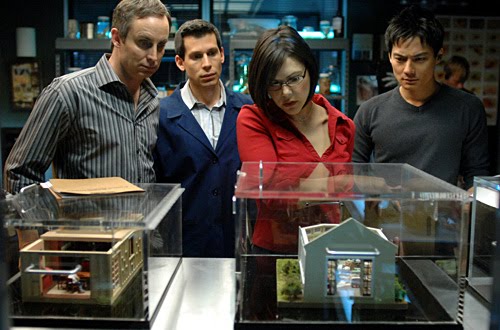
I had lunch recently with a friend in the DA’s office, who was bemoaning the “CSI Effect” on a case she was prosecuting. For those unfamiliar with the term, it refers to how the popularity of shows like CSI have caused jurors to expect high tech evidence to be presented in every case. And absent that evidence, there’s a tendency to assume that the police didn’t do their job.
Which, of course, isn’t necessarily the case. DNA evidence, even when it is collected, faces a huge processing backlog. Plus, there’s the simple cost/benefit analysis. All of those fancy tests are expensive, so law enforcement needs to pick and choose which cases merit that kind of expense. And sadly, with most, they just can’t afford to put that fancy equipment (most of which is several generations behind what you see on TV) to use.
Here’s a personal example. A few years ago, my father’s car was stolen. The police came, took the report…and somewhat miraculously, found the car (an old Volvo station wagon, on its last legs) abandoned in a bad section of town. When my dad picked the car up, he noticed a discarded cigarette box in the rear passenger footwell. Being an aficionado of crime shows, he knew exactly what to do. Carefully using a pair of tweezers, he picked up the box, placed it in a baggie, and trotted down to the station with his evidence.
“What do you expect us to do with this?” The duty cop asked.
“Dust it for prints,” my dad said.
“But you got the car back, right?”
“Sure, but don’t you think maybe it might have been used in a another crime? It’s not an expensive car, they probably used it to haul something…from a burglary, maybe.” (On a side note, clearly the apple didn’t fall far from the tree. When he told me this story, I immediately envisaged all sorts of terrible crimes being committed with the help of Bessie the Volvo).
“Yeah, maybe,” the cop said. “Hand it over.”
On his way out the door, my dad turned back and saw the cop toss it in the trash can.
Now, I’m not bashing law enforcement here. It’s likely that the local department simply didn’t have the resources to pursue the case. I watched a show last week where an entire unit spent weeks trying to solve the disappearance of a prostitute in a major city, using all sorts of high tech toys to assist them in their search. And that rarely happens. While researching BONEYARD, I stumbled across the term, “the Missing Missing.” When certain people- prostitutes, runaways, illegal immigrants- fall off the grid, the cases are rarely pursued. But if a twenty year-old honors student vanishes, chances are it will be a constant news loop for at least a few days. In reality law enforcement resources aren’t always applied equally or fairly- there isn’t enough money invested for it to be. So if you’re serving on a jury for a burglary, chances are you won’t see 3-D renditions of the crime scene and a slew of DNA evidence entered against the defendant. Luckily, as my cops friends always say, most criminals are stupid. They’re caught literally holding a smoking gun in their hands.
My favorite example from the local crime blotter this week. Mind you, I didn’t insert the “duh,” that was a nice touch by the SFPD:
On July 15th at 5:20 pm, The Plainclothes Team was patrolling in the
area of 3rd and Quesada when they came upon a group of subjects walking
down the street. The cops recognized some of the members of the group as
active members of a local violent street gang. One of the subjects
recognized the officers as well and alerted his associates. They
immediately split up into smaller clusters. One of the groups ducked
down behind the parked cars at the curb and continued to walk in this
crouched manner to avoid detection. Duh, they were unable to avoid
detection and were stopped. There was a good reason for all the
crouching and hiding nonsense. The officers located a loaded .9mm
handgun, along with a full box of ammunition, that was tossed by one of
the subjects into a driveway. This incident resulted in the arrest of
three individuals on gun and gang charges.
Chalk up another win, thanks to good old fashioned police work, no high tech toys required.
Down the rabbit hole…and back
Landscapes as Characters
By Clare Langley-Hawthorne
Having just visited six national parks (Sequoia, Yosemite, Death Valley, Grand Canyon, Zion and Bryce Canyon) I have a renewed appreciation for the power of landscape (and, I might add, an intimate knowledge of all their junior ranger programs!).
Using landscape and location is critical to my own work, but I think there is a fine line between setting an evocative scene and going over the top. I have no doubt many landscapes make powerful characters in their own right, but they should never be allowed to overwhelm the story. Readers want to know about people not about rocks and trees. For new writers I think using landscape effectively can be a challenge and, for what it’s worth, I have a few tips that I’d like to share…
First, I do not subscribe to the “write what you know” philosophy. I believe you should write about any place you want to, whether or not you have been there. I would add the caveat, however, that if you do write about a place you have never been you must do your research very, very thoroughly. Readers need to be confident of the setting you have created, so misnamed places, inappropriate plants etc. will only undermine that confidence.
Secondly, use description sparingly. No one needs to read a travelogue and often I think it can be harder to write about a place you know intimately than one with which you have only a passing acquaintance. Sometimes it is, quite literally, too hard to tell the wood from the trees.
Thirdly, consider a new aspect or angle to your use of landscape. Use something about the place that is unusual or surprising, which illuminates something meaningful about the characters or plot. I try to make the landscape reflect mood, character or theme.
Finally, abandon the clichés as much as possible. Nothing is more yawn inducing than paragraphs filled with really obvious or trite descriptions. Keep it fresh.
Anyway, as I am still on the road, this post is another short one but I would like to hear your comments and thoughts on using landscape. What in your view are some of the most egregious mistakes made in terms of overdoing use of landscape?
– Posted using BlogPress from my iPad
Envy
E-Books & Kindles & Hardcovers, Oh My! by Joe Hartlaub
I find myself here through the good graces of John Miller, who has honored me by inviting me to post in his place on alternate weeks, with a wonderful introduction to boot. Thank you, John, for both. As I look at the company I am in I feel a bit like the undergraduate student who finds himself at a table with a group of learned professors and who hopes that, if he stays quiet and doesn’t embarrass himself, he will be permitted to stay. Staying quiet and not embarrassing myself are not listed among my ever-dwindling list of strengths, but we’ll see how it goes.
It has been an extremely interesting week in the publishing industry, with much talk of E-Books and Kindles and hardcovers, oh my! Despite what you may have read in self-styled newspapers of record this week, physical books are not dinosaurs and the comets aren’t coming. Not just yet. E-books (and their readers) are something more than another format, and something less than a total replacement. To put it another way: when Gutenberg rolled out his printing press, people didn’t stop telling each other stories.
Yes; in the second quarter of 2010, the good folks at Amazon sold more e-books than hardcover books. What happened in that second quarter? For one thing, a lot of fathers (including this one) received Kindles on June 20. And we felt duty bound to load them up with an e-book or twenty. What’s the point of getting a new gadget if you can’t test drive it? Amazon also instituted a price drop for their six-inch Kindle model on June 21. Similar spikes have occurred over in the music industry during holidays, when iPods, iPhones, and iPads need to be loaded up with digital tracks. Yet, CDs continue to outsell digital music tracks on an annual basis, though their share of the market continues to drop.
Do I love my Kindle? Yes. There are books I can buy for it that are not available in physical form, some of which are original works, others of which are out of print. Of course, there are other books — more than you might think — that you cannot obtain in e-book form. The issues of publishers’ and creators’ rights are not going to be easily resolved and things are probably going to get nasty (actually, they have already) before they resolve. And pricing? Let’s save that one for another discussion. If Kindle and other e-book readers are going to be serious contenders, in the long-term, there is going to have to be some sort of uniform standard put in place in terms of editing, particularly for self-published works, to match that which traditional publishers have established. I’ve read some e-books that appear to have been carefully groomed for presentation, while others seem to have been written without coming within one hundred miles of spell-check software. And how will authors get their needle to stand out in a market of thousands of haystacks without the might and majesty of a marketing department — or a helpful bookseller — to make it jump out at a potential reader? It is difficult enough to keep track of and keep up with the embarrassment of literary riches that appear every month. At the end of the day, there is still going to be a need for mainstream publishers who are willing and able to adapt their business models for this brave, and yes, scary, new world. I am impressed with what some publishers have been doing already. Baen Books, for one, has a very cool webscription e-book site. Maybe that will be a model.
Is there a trend toward e-books? Certainly. Does it mean the end of the hardcover book? Unlikely. Physical books continue to have much to recommend. There will always be companies similar to this book printing company Printivity that will continue to print hardcover books. I don’t know if I can properly explain this, but there is a comfort level with a physical book that I don’t get with plastic. There are also a host of practical issues. Physical books don’t break when you drop them, for one thing. A physical book doesn’t have a battery that will run low on you when you’re in a hotel room in Breaux Bridge, Louisiana and its cord is in Westerville, Ohio. You don’t have to worry about scratching a book cover. You can drop a book on a spider and crush it; spiders laugh at Kindles (don’t ask me how I know this). And if you throw a book across the room, it will forgive you. A Kindle will never speak to you again. We may someday see the end of the hardcover book when you can do all of those things with a Kindle (oh, yeah, don’t use one as a coaster, either), and physical books may become collectors’ items, but I’m not going to go out and buy twenty copies of THE PASSAGE on speculation just yet.
One of the most intelligent people I know is a gentleman named Tom Leavens who has been active in the music industry for decades. When the digital era began to impact the manner in which music was distributed, sold, and consumed, he compared it to the beginning of creation, stating that after the smoke, noise, and confusion had settled, things would slowly begin to sort themselves out. Just so. In this case, the world is not ending; it’s just changing. It always has.
Skin Like Leather
We always tell up-and-comers that they’ve got to have a thick skin if they’re ever going to break into the publishing business. As the rejections pile up, it’s hard not to lose faith in your own abilities. When the news finally turns good, and an agent wants to see the manuscript, and later when an editor decides to buy it, you feel vindicated. Ha-ha and neener-neener, you think. Clearly all those rejecters were wrong.
What clearer affirmation of talent can there be than a publishing contract, right? If you’re not careful, you might start rubbing aloe on that leather-tough skin, thinking that it’s time to shed the bullet-proof coating.
Oh, that it were true.
Earlier this month, I won this year’s award at Thriller Fest for the Worst Review Ever, for an opinion of Nathan’s Run that appeared in an upstate New York newspaper: “The glue boogers in the binding were more captivating than Gilstrap’s torpid prose.” If the quote seems familiar, I’ve posted that review in this space before. That it followed dozens of major market rave reviews from around the world softened the blow quite a bit. I laughed out loud when I read it at the time, and now I treasure my award, which is a lovely wooden box that contains a fossilized dinosaur turd. All in good fun.
So, here I am again in the early stages of a new book launch (18 days straight in the Top 30 in Amazon’s Kindle store), blessed with a starred review from Publisher’s Weekly. I’m very proud of the book. Frankly, I think it’s my best work, but then I always think that when a new book comes out.
I almost took out the aloe again. Not so fast.
This is the age of the amateur Internet review, where the opinions of casual readers wield influence equal to that of professional critics. Among many very positive reviews, one fellow calls my book “surprisingly decent.” Another expresses surprise that this “second tier suspense writer” has had such a long career. I have been chastised for leading with my left-wing politics, and I’ve been chastised for leading with my right-wing politics. One reviewer chastises me for coming off as stupid because I can’t seem to keep my own politics straight.
Interestingly, several reviewers have accused me in an online forum of writing my own raves, one of them going so far as to praise my ability to change my writing style to accommodate my various fictional identities. (For the record, I’ve never done such a thing.)
God bless them all. Once the book is written and I’ve launched it out to the world, it belongs more to the reader than it does to me. It’s the nature of art that perception trumps intent. A review is a review, after all, and since the major media markets have decided that books are no longer worthy of ink and newsprint, I’m just happy that someone’s paying attention.
The need for thick skin doesn’t end at the impersonal review, however.
Nine times out of ten, people are wonderfully supportive of me and my work. It’s not about fawning. With the exception of certain engineered opportunities—book signings, etc.—I have no desire to be the star of a social setting. I’d much rather discuss current events than the mechanics of writing. Among these friends, the launch of a new book warrants a congratulations and a couple of signed books and that’s about it. Just as it should be.
Then there’s the remaining one out of ten who just sort of baffle me. Consider my relatives who ostentatiously don’t read my books (even though I think they do), yet ask me to autograph editions for their friends. A colleague of mine goes out of his way to tell me the stores he’s visited where none of my books are in stock, and another rarely misses a public opportunity to express shock that my books are currently doing as well as they are. It seems sometimes that people go out of their way to be hurtful. What am I supposed to say in response to such things?
Over the years, I’ve come to understand that none of the rudeness—whether by acts of omission or commission—are in fact intentionally hurtful. The family stuff is weirder than the collegial stuff, but I’ve decided that artistic success—even when it’s second tier—makes some people feel both empowered and uncomfortable. The public nature of book writing empowers people to criticize, while public success—and the minor celebrity that comes with it—can upset the balance of an insecure relationship.
I’m not talking jealousy here—far from it, in fact. I think it’s more akin to keeping the artist from becoming too big for his britches. I suppose that’s a noble goal, but I do wish it could be accomplished with fewer awkward moments.
Am I alone here? Do you folks encounter people who seem intent on deflating your balloon? How do you cope with it?
Co-Writing Dreams and Nightmares
On our Open Tuesday discussion this week, someone asked about co-writing. Joe Moore is our resident expert on the subject, so he can elaborate on the positive aspects of that type of collaboration. Today I’ll outline the alternate scenario, when it doesn’t go particularly well.
I have a close friend who has always wanted to be a writer. Over drinks one night, she proposed that we work on a project together. I’d had a screenplay idea milling around the back of my mind for awhile, and it seemed like an ideal project to tackle together. After all, screenplays are shorter than novels, primarily dialogue, and can be easily divided up into individual scenes. We sat down and hashed out the plot over the course of a few days, decided which scenes each of us would tackle, and set to work.
Within a week I had most of my scenes written. My friend stalled: stuff to do around the house, she hadn’t been able to find time…understandable. A few weeks later, after I pressed again, she came back with a single scene.
And it was terrible. Really, truly, awful. All the characters sounded alike- in fact, they all sounded like her. The dialogue was clunky and forced, the jokes fell flat. It was a mess. Not unsalvagable, mind you, but rough.
Now, I don’t claim to be the best writer out there–far from it. But I suddenly realized that while I’d spent the past decade writing nearly every day, learning what worked and what didn’t, and being heavily edited by pros, she had not. The scene felt like something handed in for a freshman writing class–which, essentially, it was. It threw me, because I didn’t know how to handle it. I realized that this project wasn’t going to be a few weeks of work that I could sneak in between book deadlines, but would require months of tough conversations and editing.
In the end, we abandoned the idea.
And here’s what I came away with. If you are going to work with a collaborator, ideally it should be someone as dedicated to the craft and on roughly the same writing level as you are. At nearly every cocktail party I’ve attended in the past decade, someone declares that someday, they’re going to write a book. Most people think they’re capable of such a thing, if only they could find the time. The truth is, there are people who have worked demanding full time jobs, raised small children, and found the time. Heather Graham used to type one-handed while she cradled a baby in her other arm. Allison Brennan worked late at night after her kids had gone to bed. Khaled Hosseini worked at 5AM before his family woke up and he had to head to the hospital for work.
Given time and effort, my friend might turn out to be a great writer. The ideas she came up with during our brainstorming sessions were fantastic, things I never would have thought of. The problem was that she lacked the experience to translate those ideas, and, worse yet, didn’t have the drive to work on it every day. And without that drive, and the understanding that what we do is not easy but requires a serious dedication of time and effort (and a thick skin), it simply won’t happen.
I’m about to undertake another co-writing project on a screenplay. This time, I’ll be working with a friend who has written several scripts, and had one produced. I’ll admit to some trepidation regardless–after all, she is a friend, and nothing can strain a friendship like working together in any field. But I’m hoping that this time things will go more smoothly.