About Joe Moore

#1 Amazon and international bestselling author. Co-president emeritus, International Thriller Writers.

Author Mentoring: The Art of Paying It Forward

By: Kathleen Pickering


I spent most of this past week at The Myrtles, a haunted plantation in Louisiana, with my mentor, the award winning, New York Times Best Selling author, Heather Graham. Luckily for me, Heather is not only my mentor, but my dear friend. (I don’t even know if she knows she’s mentoring me!)

I accompanied Heather and her family “on location” to shoot the new book trailer for her upcoming “Krewe of Hunters” series with Mira Books. As my mentor, Heather showed me how to set up a script, find a location, hire a videographer and assemble a cast of actors (with costumes) and work within a budget to accomplish in one afternoon what promises to be an exciting and entertaining introduction to her next book series.


Heather Graham on location at The Myrtles, St. Francisville, LA

I enjoyed all of this instruction while having fun. I came away realizing that while mentoring doesn’t always lead to friendship, friendship surely leads to mentoring. Mentoring is an important facet of any role in life, not just writing. Many corporate mentoring programs involve software such as the TogetherApp, an employeee mentoring software that tracks the progress between the mentor and the mentee(s). In writing, mentoring is an organic essence of a writing community. Joining Florida Romance Writers, Romance Writers of America, Mystery Writers and Thriller Writers has immersed me in conversations with other authors from which I have come away a better writer—just by sharing information. Many times, I’m lucky to make friends with some of my most favorite authors. In turn, when I meet new writers, I answer their questions, offer them help with works in progress, or point them in whatever direction I can to help further their career.
Mentoring is an author’s way to “pay it forward” or in other words, to do good for someone in advance of good happening for you. When we pay it forward, we take mega-leaps in our own careers, as well. Heather showed me how she uses her skills and years of experience to create media content. In turn, I followed the cast around the plantation, videoing behind the scenes. (With equipment I bought through more mentoring from Fred Rae, a member of Mystery Writers.) To thank Heather for the fun—and the lessons, I plan to create up to 20 (depending on the quality of my photography!) short “behind the scenes” videos for YouTube, Facebook and iTunes to help herald Heather’s upcoming series. (I’ll be sure to post them on my website, as well.)
Why? Because I am delighted to “pay it forward” for my friend—and not just because she’s teaching me. It feels good inside to know I’m building my career on good intentions. Helping create an Internet buzz for Heather works in symbiosis with my learning how to create media. It’s all good. After all, in the author’s world of mentoring, what are friends for?
So, let me ask you. How do you contribute as a mentor in your writing world?
Love and Murder

by Clare Langley-Hawthorne

After a wee bit of drama last week and the flooding of the downstairs of our house, I am finally back to blogging – and I love that I get to blog on Valentine’s Day! It’s not just because I am a hopeless romantic, it’s also because I think writing an emotion such as love is one of the trickiest things to do well.

In crime fiction ‘love’ can connote a whole range of things from sexual chemistry and romance to justification for murder. To make such a complex emotion believable can be a major challenge. I’ve lost count of the number of crime novels I’ve read that were great on action and suspense but a real let down when it came to love. Handled badly, it’s an emotion that can be soppy and overwrought or just plain gag-worthy. Handled well and a reader can’t turn the pages quickly enough. Love is compelling. Just look at the novel Twilight by Stephenie Meyer – for all it’s flaws, it handles the emotional angst and pain of teenage love skillfully and readers have responded accordingly.

One crime author that I believe handles love exceptionally well is Tana French. I have read all three of her books, In the Woods, The Likeness, and Faithful Place. Each, I feel, really handles the facets of love to great effect. In her book Faithful Place, she captures the sweet yearning of young love and the devastation of loss – making the crime in the novel all the more poignant. I think that many mystery and thriller writers could take note of Tana’s use of emotion to make their own books richer.
What does she do, that helps propel her evocation of love beyond the banal?

Well, in my mind it is her ‘evocation’ that is all important. She doesn’t simply tell you about the emotions stirring within her characters, she shows you it in every observation and interaction.

So on this Valentine’s Day, I thought I would offer just a few tips on writing about ‘love’ –

  • Make it unique to the characters. Avoid the cliches ‘eyes like deep pools’ or the stock standard ‘hate at first sight’ approach. Make the characters emotions uniquely their own. Think of the subtleties involved in falling in and out of love.
  • Be restrained – Crime fiction is not romance fiction and I truly think most mystery readers prefer ‘love’ to take a back seat to the crime aspects of the story. That being said I think a well-drawn relationship can add depth to a mystery and there’s no doubt that love is one of the greatest motivations for crime as well:) Nonetheless, I do think that the standards are different and that emotions can be more heightened in a romance novel than in a mystery or a thriller. It’s a fine line between ‘heightened’ and ‘overblown’ and I think to be successful in describing ‘love’, less is often more!
  • Evoke the sense of love- nothing indicates depth of emotion that heightened sensory awareness. I love reading novels that bring these senses to the forefront so the reader starts to suspect a character’s emotions from their sensory appreciation of sight, sounds and smell;

  • Have realistic sex scenes. The most amazing sex ever starts to get a bit dull even in the best of books – far more interesting to make the event as realistic as possible (though not many readers probably want to read about truly boring, horrible sex!).

What other tips would you add to the list – which crime novelist do you think handles the emotion of ‘love’ best?

Oh, and Happy Valentine’s Day!

Going E

James Scott Bell

Today I announce my first E book exclusive.
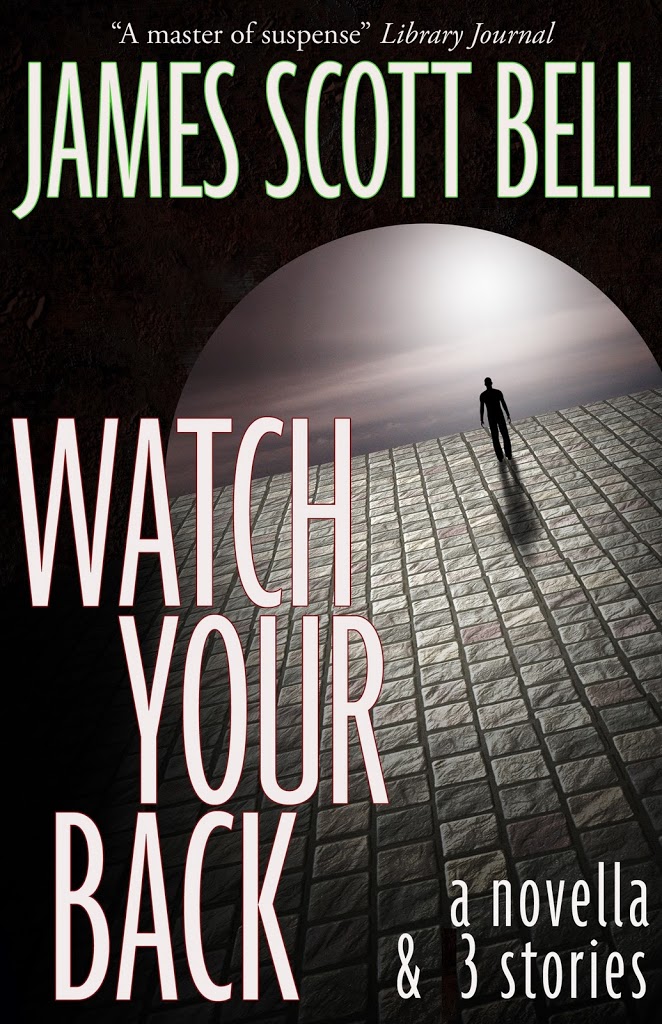
Watch Your Back is all new material, a novella and three stories of suspense. Page turning stuff. At least, that’s my claim. For less than a Starbucks latte you can test that claim for yourself. I’d love to hear from you if I’ve done my job.
It’s available for the Kindle and the Nook.
This is all an exciting development for me. While I’m still working under a traditional contract, I see this arena as a way to complement that work. I’ll be growing new readers and giving my current readers more product. What’s not to like about that?
But mostly it’s about the writing. 
See, I always wanted to do one thing, since I was a kid: write stories. Write books. The kind of books I loved to read. Page turners. Twisty plots. Up all night stuff.
I had to work hard to get there, but I did. And I’ve appreciated every moment of the ride.
There were some years I put out two novels in a year (and once or twice with a non-fiction writing book thrown in). But that had to be it, because of publishing schedules, limited shelf space in the stores and so on.
Now I don’t have to wait 18 months for a book see the light, or worry about getting more than spine-out shelf space once it does. I can have a book out there as soon as I think it’s ready. And readers can have it in their hands in seconds.
I always admired the pulp writers of the golden age. The era of Black Mask and Chandler and Hammett and Cornell Woolrich, guys writing fast and furious for a penny a word, providing stories for a voracious public. Turning out some of the greatest examples of American suspense ever written.
I wanted to write in that tradition, and now I can.
It begins here, with Watch Your Back.
In the title novella, hotshot IT guy Cameron Cates seems to have it all. A secure job, a fiancée who loves him and the prospect of a steady life ahead. But then he sees her.  The new woman at work. And like watching a car crash in slow motion, Cam knows he can’t turn away and is powerless to stop what happens next. A tale of lust and greed and corporate America––and what happens to dreams that become all too real.
Fore Play is the story of the world’s top golfer and the trouble that follows his off the course activities. Let’s put it this way: his game will never be the same.
In Rage Road, a nice young couple thinks they’re out for a smooth ride through some lovely country. The truck behind them has a different idea.
Married man Frank Dabney has learned to listen to his wife, Susie. But in Heed the Wife he finds out he may have listened one too many times. 
For Watch Your Back I hired cover designer Jeff Gerke (if you’re interested in his services you can contact him by going here. Tell him I sent you). I had beta readers read and edit the content, and hired out the text formatting.
But the stories are mine and it’s an absolute thrill to be able to share them with you now. There’s more to come.
Is this a golden age for writers or what?
So allow me to consider this a launch party of sorts, for Watch Your Back and my future e-books. I’m just sorry I can’t offer you a glass of wine and some gourmet cheeses. But I’ll hang out here today and read your comments and answer any questions you might want to sling my way.
And thanks for stopping by.

Anonymous, go suck a whirlwind

John Ramsey Miller

There’s this new book, O, about President Obama that was written by an anonymous author, just as the book PRIMARY COLORS was published with the author being the anonymous columnist Joe Klein. I mean PC was supposed to be fiction, right? It wasn’t actually about Bill Clinton, who was one of the best Republican presidents ever. I’m sure it’s a marketing ploy (since who needs another book about a sitting president?) just as I’m sure the publisher will swear that the reason for the anonymous tag is to insure truthfulness. I’m sure that was done because Obama would have the NSA black-baggers disappear the author if they could somehow discover who he or she is. Because it’s a huge secret on the order of who really killed JFK. I can think of lots of books that should have been written anonymously, like THE PROPHET by Kahlil Gibran or anything by Stephenie Meyer. Jus a’ kidding Steph. Seriously, anonymous is a punk-out. Stand up and take your medicine.

When I was young, my father was a Methodist minister, so I was a hellion of the first order. (stop me if I’ve told you this before). I didn’t get into trouble, I lived in trouble. I believed it was my calling. I got caught at it with amazing regularity due to my youth and inexperience, but I got better at evading detection as I grew older. Luckily I aged out of hell raising as an art form, having done no lasting damage to anyone, or to myself. The point of this confession is to say that after having done something actionable, someone sent my father a letter detailing my marauding one evening. It was perfectly written and should have convicted me to a severe grounding, except for the fact that they had signed the letter, “A concerned citizen”. After reading it to me, my father tore up the letter and tossed it into the trash, saying that if the person didn’t have the spine to sign the letter, he could not take it seriously. Being a liberal, I suspect he felt that I had the right to be confronted by my accuser. I also suspect that a Baptist minister would have, in similar circumstance, whipped his son, happy to take the word of a cowardly vigilante.

Another reason I’m talking about “anons” is because my daughter-in-law has a beauty salon and it’s a first class operation, and she’s a very talented hair stylist. She even does my hair with all my cowlicks––that’s how good she is. She is listed on a local site that highlights commercial businesses of note, and there’s a place for customer comments underneath, and you get stars just like an Amazon rating system. Well she was nominated for “Beauty Shop of the Year” and the next day someone wrote a nasty review saying that she smelled like cigarettes, dressed in trashy outfits, talked behind her customers backs, made lewd jokes about passersby, left “bleed marks” from a bad dye job, etc… It was signed anonymous. My son’s wife, the most wonderful and hard working person I know, has fifteen excellent reviews below that one. She is sure the comment was left by her main competitor because some of the detractor’s comments included beauty shop trade terms, too technical for a patron to use. There’s this beautician who hates my daughter-in-law due to losing a huge wedding party of a bride and her bridesmaids gig–but that’s another story involving my youngest son who’s getting married in June. But she’ll never know and she can’t get the comment taken off even though it’s totally a lie. And, it’s a small southern town we live in.

I agree with my father, who died on my birthday three years ago. Anybody who won’t sign their name and take responsibility for their words, is more than likely a coward and is probably just throwing monkey crap through the bars at the audience. If you can’t use your name due to the fact that you might be fired or set upon, then I say keep your damned opinion to yourself and live with it.

I tend to say idiotic things that I shouldn’t say and put my name on it. I once traded six columns to my local newspaper in exchange for an antique granite body slab that came out of a funeral home. What I wrote lit fires all over the community, but that’s another story. My wife (and more than a few others) tell me that some of my critical social filters must be clogged with dust balls. I am cognizant of the fact that a lot of my opinions would be best left unshared, or anonymous, but I’m not apt to do anything at this point in my life that makes sense.

By the way, as of last week my first novel THE LAST FAMILY, published in 1996 is now an eBook, which means that all of my novels are available in electronic format from Bantam/Dell. And I don’t have to worry about the pages yellowing.

Books and Movies: Forever Entwined

By John Gilstrap
NOTE: I’ll not be much of an active participant in my own blog day today because I won’t have access to a computer or even my iPhone.  Why, you ask?  Because I will be getting a VIP tour of the Navy SEALs compound in Virginia Beach, and they don’t let you take cell phones with you.  For the record, that’s not a moast.  That’s a pure neener-neener outright brag.

Now, on to today’s post:

Reading Joe Moore’s excellent post on Wednesday about the importance of setting, it was interesting to see how many examples of setting were in fact taken from movies.  In the context of Kathryn Lilley’s great post about Finding Your Voice, I got to thinking about how much movies have influenced books over the years.

As a writer of commercial novels (not to be confused with lit’rateur (read that word with a New England elite accent)), I am obsessive about pacing, imagery and snappy dialogue–the holy trinity of screenwriting.  I think in scenes, making every effort to begin and end on action.  I believe in jump cuts, taking the reader from one scene to another quickly.  Even my contribution to the voice discussion focused on “camera placement” as a means of keeping POV consistent.

So, how does a writer fulfill the goals of pacing, imagery and snappy dialogue?  It’s all about voice, baby.  And voice is inexorably linked to point of view.  Consider these two descriptions of the same scene:

1. Finally, he arrived at the desert.  He stepped out of the car, stretched his back and closed his eyes, letting the heat and the dry air soak into his skin.  If he used his imagination, he could smell the aroma of purple coneflower and Easter lilly cactus carried on the constant breeze.

2. He’d arrived.  There was no putting it off anymore.  He climbed out of his car into the blistering moonscape, somehow sensing that he’d stepped two rungs lower on the food chain.  Between rattlesnakes, scorpions and a climate that sucks the moisture from your bones, this was a place for the dead, not the living.  It’s no wonder that we tested nukes here.

To my eye and ear, those examples illustrate how an author’s voice simultaneously drives action, imagery and characterization–in this case in the form of inner monologue.  At least, I think that’s what it’s called.  Through description alone, filtered through the voice of the POV character, we get a glimpse at two entirely different personality types.  In both examples we learn that we’re in the desert, and that it’s hot.  The rest is all characterization.

And for me, all else being equal, I have all I need to know about the setting for this moment in whatever story this would turn out to be.  I’ve given the reader enough to take it from here and develop it further in his or her imagination.  This is a stylistic thing for me, but once that scene is set, it’s time for the character to do something, lest the pacing slow.

People are used to experiencing thrillers–my genre–on the screen.  In order to compete, I need to provide that same kinetic experience on the page, but with the addition of deeper character development.

What do you think? Do movies affect the way books are written?  Is our addiction to entertainment from the screen the reason why thrillers from the past feel sorta slow when we read them today?

Quirky Ramblings on E-Books, Self-Publishing and the Consumer

USA TODAY had an interesting article on authors who have struck it big with their self-published e-books. The article featured 26-yr old Amanda Hocking of Minnesota who got tired of being rejected by traditional publishers and self-published last year. In 2010, she sold 164,000 books, with most priced between $0.99 and $2.99 per digital download. And in January, 2011 (after many readers got e-readers for Christmas), she sold 450,000 copies of her 9 paranormal titles, with three of her titles making their debut on the USA TODAY’s Bestseller list.

Her percentage of that sales price range comes in at 30-70%, respectively, but she’s making money at it. And she promotes on Facebook, Twitter, and word of mouth—and credits the popularity of the paranormal genre for much of her success.

And another paranormal e-novelist, who sold 70,000 copies since July 2010, got noticed by Random House and just signed a three-book deal.

I bring this up because of a talk I had with a neighbor this week. She got me thinking about digital download books. My neighbor had received a Nook for Christmas and was downloading books online. She was feeling pretty tech savvy, for sure. And she wanted a trip down memory lane when she used to read simple sweet romance novels, easy reads that made her happy.

Instead, she bought erotica by mistake. Now her online booksellers are sending her recommendations for the same steamy stuff she just purchased. (I’m chuckling as I write this. If you knew my neighbor, you would too.) She actually had to call the online bookstore to see if they could stop sending those recommendations to her Nook, but since it was such a new product, they couldn’t help her. But she was willing to download a book that she knew nothing about other than it was a romance and she had virtually no knowledge of the plot. She only knew it was a bargain. And she’s not alone. I’ve heard on blog posts and other places that many readers are willing to try a new author for $0.99-$2.99/book.

Now I’ve resisted buying an e-reader so far. I’m not sure the technology is there yet and I like the feel of a book in my hands. Plus I spend way too much time in front of a computer writing that I think reading off a display might make my quirky eyesight worse. But I can see why a reader might like the option of downloading a book quickly, read it immediately without paying shipping, and maybe get it for a bargain. And I also have a couple of manuscripts “under my bed” that are only playthings for my cats. Maybe it’s time to do something with them and test the new marketplace of e-books.

I’d like to hear from anyone who has an e-reader. How do you like reading off it? Has owning one changed your book buying habits? Do you still buy print books? And is there a price point that might tempt you to try a new author?

And if you’re an author who has sold your e-books online through Amazon’s Kindle Direct Publishing, Barnes & Noble’s Pubit, Lulu, Smashwords, and other locations—how has that worked for you?

Finding your voice as a writer

Sometimes it’s hard to find the right voice for a story.

During the two years it took me to write the first book in my series, I struggled mightily to find the narrator’s voice.  My first writing efforts were dry and objective–the chapters sounded like they’d been written by a former journalist (which I was). In despair I hit the bookstores, looking for inspiration. Ultimately I came across a new (to me) genre called “chick lit”. As I read the first few pages of a random book, I grew excited.

“I can write like that,” I thought.

After going back to my manuscript, I injected it with the snappy, snarky rhythm of the chick-lit style, including (hopefully) lots of humor.  And voila! Dying to be Thin was born.

My new WIP is a thriller–and once again, it was a struggle to find the right voice. This time I  read Michael Crichton, Dean Koontz, and Lincoln Child, among others, for inspiration. I studied the way they pull off their narrators’ voices, trying to find techniques that would work for me. I visualized how how their various styles would work with the particular story I’m  writing.

In the end it was no one particular author, but an amalgam of techniques, that worked. 

Joe had some good technical tips about creating voice in his post, “Look who’s talking,” and Jim has more suggestions in his post, “How can I learn to write like…“.

How about you? Do you struggle to find a voice in your stories? What are some of the techniques that you use?

No blog post today due to flooding

My apologies but there will be no blog post today. After over 4 inches of rain fell in 12 hours our house flooded so we are trying to get it all sorted out. Will be back next week with an update but, most importantly, my family and I are all fine.
Clare

– Posted using BlogPress from my iPad

Top Ten Writing Influences

A common interview question for writers is, Who were your literary influences? I’ve given it some thought over the years and have come up with a list of my top ten. Here they are, in no particular order:
Franklin W. Dixon
This was, of course, the cover name for the Hardy Boys series. Several authors did the actual work (a Canadian named Leslie McFarlane was the first). From The Hardy Boys I learned that you could make readers read on by ending a chapter with an exclamation point! Today I don’t use the actual punctuation mark, but try to achieve the same feeling—so readers have to turn the page.
The Classics Illustrated comic books guys
I loved the old Classics Illustrated series. I got acquainted with much great literature that way. The Hunchback of Notre Dame, The Count of Monte Cristo, The Adventures of Robin Hood, Men of Iron and on and on. Beautifully illustrated and written. I learned pure storytelling from these little gems.
Edgar Rice Burroughs
My first “grown up” novel was Tarzan of the Apes. I loved the experience of being pulled into a big story and then not wanting it to end.
William Saroyan
My beloved high school creative writing teacher, Mrs. Marjorie Bruce, encouraged me to read more than sports biographies. At a book fair she got me to buy My Name is Aram, which is still one of my favorite collections of short stories. I love Saroyan’s whimsical voice.
Ernest Hemingway
In college, Hemingway knocked me out. I think he is the greatest short story writer who ever lived. His style is easy to satirize, but no one has ever been able to do it better—not even the lionized “minimalists” of current fashion. I am very proud to have been a semi-finalist one year in the Imitation Hemingway Contest.
Jack Kerouac
I think most college guys who are into literature go through a Kerouac phase. I ate up On the Road and Kerouac’s idea of  “be-bop prose rhapsody.” Even now I try to follow some of his writing techniques, like:
–  Submissive to everything, open, listening
–  No time for poetry but exactly what is
–  Believe in the holy contour of life
Raymond Chandler
Oh man, when I discovered Chandler, I was in heaven. Still the best prose stylist of any hard boiled school you want to name. Nothing more needs to be said.
John D. MacDonald
Storyteller supreme. Great stylist of “unobtrusive poetry.” I’m thinking mainly of his 50s stand alone novels. The Travis McGees are enjoyable on their own and have much to commend them. But his output before that was amazing and the top quality of the paperback writers of the day.
Dean Koontz
I learned a lot from Koontz about how to write a flat-out page turner. Koontz also wrote a superb book on the craft, How to Write Bestselling Fiction. It’s out of print and goes for about $200 on the open market. I got mine off a library giveaway shelf and still refer to it.
Stephen King
King puts it all together. A great stylist, plotter and character creator. I read King and sometimes just shake my head at how good he is. Please don’t bring up the fact that he also sometimes seems to be the king of F-bombs. He succeeds in spite of, not because of, that little fact.
So writers out there, who are some of your writing influences? What is it about them you like?
If you’re primarily a reader, what writer would you pick as someone you’d recommend to a writer to learn from?

Why?

It has been an extremely interesting week, one of highs and lows. I had a wonderful professional and personal high that is still playing itself out, a circumstance where I was able to help a kind and decent person at a time when they needed it. You can read about that elsewhere http://www.dispatch.com/live/content/life/stories/2011/02/04/you-and-me-writer-identified.html?sid=101 if you wish. But let’s talk about the “low” here, at length. I have sometimes forgotten in the course of my postings that this blog is called The Kill Zone, so I will get back on track here and now.

I read crime fiction because I am fascinated with the battle between good and evil. I know that the lines are often blurred, but not necessarily to the extent that they are indistinguishable. Yet every bad guy, if you will, represents a failure on some level, perhaps unavoidable, perhaps otherwise, but a failure and a tragedy still. We all know a number of folks who for one reason or another — or for perhaps no discernable reason at all — fall off of the rails.

My younger son, who is now in his late 20s, had a childhood friend who I will call “Todd” for purposes of this discussion. Todd, when he was attending grade school with my son, gave little indication that he would have troubles later in life. He was raised in an intact family with loving parents, and if he occasionally experienced some impulse control problems, they never reached the stage that would portend the disaster his adult life has become. My son and Todd lost touch when we moved to a different school district in the area, even though I kept in contact with Todd’s parents as they intermittently relayed tales of what was turning into a slow-motion train wreck. Todd was barely into his teens when he was arrested for shoplifting. Other troubles followed. He began to have trouble with drug use; his folks placed him a tough rehab program which, to all outward appearances, he successfully completed. They took him to South Carolina over a Christmas weekend to celebrate his success. They had been there for two days when Todd‘s father called me, almost hysterical. Todd had gone out with some friends to walk the beach and within a half-hour had been arrested for armed robbery. Charged as an adult, he spent six months in a jail awaiting trial. By the time Todd finally returned home, his course seemed to be set. Trouble seemed to dip and swirl around him. When Todd’s father died of cancer, Todd could not attend the funeral because he was sitting in an Ohio prison, having been convicted of yet another offense. His mother, a sweet and kind person who devoted her life to her son and husband, had the appearance and demeanor of someone who had been shell-shocked. Just so.

Todd was in the news again this week. The area had been plagued by a period of gas station robberies and Todd was charged as the alleged perpetrator. In his booking photo, wearing a dirty wife beater and a scripted tattoo across his left arm and chest, he bears but a faint resemblance to the little boy who with my younger son played with Transformers and shared respective bedrooms like brothers. In the picture it is Todd who looks shell-shocked this time, vaguely dazed, perhaps by the state of his life at this point, perhaps wondering how and why he wound up on the downhill road he is on. Or perhaps I am projecting my own questions, wondering why him, and not my own son, since they were so alike in so many ways. The chill I have felt since seeing his picture, however, has nothing to do with the weather. And I doubt that there is a book that I could read that would conclusively answer my questions.