

by Debbie Burke
Crime fiction has multiple story lines. Readers see the story on the page, but important events also unfold behind the scenes that the reader may not see. TKZ’s own Jim Bell has a terrific term for this, “the Shadow Story.”
The shadow story follows the antagonist’s actions to thwart the hero. The hero (and the reader) may not be aware of what’s happening offstage as the villain lurks in the shadows, scheming and wreaking havoc.
That’s why the author must always keep track of antagonists and/or villains. (For this post, I’m using the terms somewhat interchangeably).
Stories require conflict. Antagonists cause conflict. Therefore, antagonists are as necessary, if not more so, than heroes.
If you lose track of your villain, you’ve lost the story’s primary cause of disruption and distress.
Here are five tips to monitor what antagonists are doing offscreen.
- Create two documents, parallel stories with one for the hero, one for the villain.
The hero’s story is what the reader sees on the page.
The shadow story tracks the villain offstage. This may or may not ever be visible to the reader.
In traditional whodunnit mysteries, the villain is hidden and not revealed until the end. The point of view is often limited to the hero’s, either first person or close third person. The parallel shadow story will not be shown on the page. Rather it is a working document for the author’s eyes only.
In suspense and thrillers, the reader may know or quickly learn the villain’s identity. With a known villain, the shadow story can be visible on the page in parallel with the “onscreen” story. Multiple points of view can include the villain’s. That’s how I write my thriller series, with POVs alternating among several characters.
- Track your shadow character with a baby cam or your phone. An imaginary baby cam keeps a constant watch on your villain. The locator dot on the phone screen blinks along the street map to follow the villain’s movements.
- Think of two TVs side by side. One is showing the hero’s channel. The other plays the villain’s channel. The timeframe is the same, but the locations are different. Flip back and forth between them.
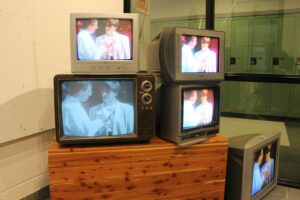
Photo credit: Annette Dawm, Pexels
4. Use a calendar or appointment book. Log the day, time, and location for each character in each scene.
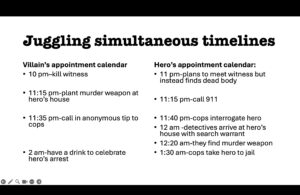
Screenshot
In time-critical scenes, like a bomb ticking, you may need to detail the action minute by minute, or even second by second.
5. Use index cards or sticky notes in different colors (blue for hero, yellow for villain, green for secondary characters, etc.). Write a short summary of each scene (time, place, characters present, what happens) on the appropriate color card or sticky.
Another alternative is a white board using different color markers.
When the draft is complete, lay the cards out on a table. Kay DiBianca puts her stickies on closet doors in her office.
Study the color pattern. This visual review points out potential problems. Are there too many scenes in a row in one color? Do you need to rearrange the order to improve pacing or balance the characters?
Are there missing scenes? Or scenes that could be cut without hurting the story’s forward momentum?
Our creative brains all work differently. To keep track of multiple characters and story lines, some writers prefer programs like Scrivener (which Jim Bell uses), Memory Map, Wave Maker, and Fantasy Calendar.
I’m more visual and tactile-oriented so it’s easier for me to stay organized with physical appointment books, calendars, and index cards.
The method doesn’t matter as long as the author always stays aware of what the antagonist is doing in the shadow story.
Because that’s the wellspring of your story’s conflict.
~~~
TKZers: How do you monitor characters in the shadows? Do you use time-tracking programs? Low tech tools like calendars and index cards? Or another method? Comments welcome below.
~~~
Today’s post is based on The Villain’s Journey-How to Create Villains Readers Love to Hate.
“Debbie Burke has filled a critical gap in writing craft instruction. We needed a book of solid advice for creating compelling, three-dimensional villains. This is it.” – James Scott Bell
“5. Use index cards or sticky notes in different colors (blue for hero, yellow for villain, green for secondary characters, etc.). Write a short summary of each scene (time, place, characters present, what happens) on the appropriate color card or sticky.”
While I have done physical cards before, it’s not practical in my current living space. However reading this this morning gave me an idea for another way to electronically do the same thing — I can create a Google Sheet, create a table & summarize each scene in each cell of the table, then use the “background color” feature to shade each cell according to hero, villain, secondary and still get that same snapshot look at how the scenes and story are flowing.
Thanks for the inspiration!
Brenda, that’s brilliant!!! Thanks for coming up with this great idea!!!
I’m like James Scott Bell (how I wish I was like JSB) in that I use Scrivener. I’ve tried color coding , sticky notes, index card, but those things just don’t work for me. I seem to have a sense of pacing.
I usually have my villain’s point of view on the page, but not named.
Pat, I took three classes in Scrivener and still couldn’t “get” it. Glad it works for you.
I remember the unnamed “shadow” characters in your books. That’s the best of both worlds—keep the reader guessing about their identity but also show their thoughts and machinations the hero isn’t aware of.
Ha!
Yes, Scrivener for me. I like viewing my “cards” on the corkboard. I give the shadow cards a red color to distinguish them, and embed them under a scene card. That way I see what’s going on offscreen as well as on.
Good ideas, Debbie. If I wrote thrillers, I’d be sure to use them. I used to use a foam core board and colored sticky notes, and I’ve used calendars/day planners, but now it’s a spreadsheet to track what’s happening in scenes, like the when, where, who and what. Of course, half the time I leave out a detail that turns out to be important.
Thanks, Terry.
Spreadsheets work well but they remind me too much of my past working life.
Oh yeah, there’s always that one sneaky detail that hides from you. But you always ferret it out in time.
Good Morning, Debbie,
I’m a mess. I have a combination of sticky notes on the wall, typed pages on the closet doors, a large calendar with notes scribbled reminding me of what happens on each date and torn shards of paper with key words that came to me at church or some other location. It’s inefficient but somehow it works. That’s all behind the scenes stuff for my benefit.
One point you made that I think is so important for the reader is how you use multiple POV in you chapters to inform the reader of the shadow story while the hero remains clueless. That sounds like a great way to build suspense.
Chuck
“It’s inefficient but somehow it works. That’s all behind the scenes stuff for my benefit.”
That’s all that’s important, Chuck. Everyone’s creative brain works differently. I’ve tried various systems over the years. I incorporated some tips and dismissed others. If it doesn’t help productivity, forget it.
Going into the villain’s POV was the turning point that moved my books beyond rave rejections to publication.