Hell in all its fury

by Clare Langley-Hawthorne
http://www.clarelangleyhawthorne.com/

I had no intention about blogging today about bushfires but events over the weekend have compelled me. Just outside the city I grew up in, Melbourne, Australia has just experienced the worst bushfire in Australian history. The death toll currently stands at 130 with over 750 homes lost. Some towns have been razed to the ground and, as the Prime Minister, Kevin Rudd, said yesterday “Hell in all its fury has visited the good people of Victoria.”

I am grateful that all my family and friends are, as far as we know, safe and well, but some of images (like this one) brought home just how close this tragedy has come to Melbourne. This view is from Doncaster, the suburb of Melbourne where my sister-in-law lives, and you can see the fires raging on the horizon. These bushfires occurred as Melbourne sweltered under the hottest day on record – it was 115 degrees on Saturday with gale force winds.

I have to reflect that the weather is now so unpredictable – snow in London, 115 degrees in Melbourne, floods in far north Queensland – extremes that are rare but stunning in their impact. I fear with global warming that such freakish weather patterns are only going to get worse as well as continue.

I was in Melbourne when the last bushfires of such magnitude occurred on a day in 1983 that is now remembered as Ash Wednesday. While the bushfires never reached Melbourne, I remember walking into our backyard late that night and smelling the smoke, feeling the ash that was literally raining down on the city. On that day some 47 people died in Victoria – which still pales in comparison to the number lost this weekend. I cannot even post some of the photographs of this weekend’s devastation as they are just too awful to bear. People died without warning in their homes or in their cars fleeing the fires. It all happened so fast that for many there was no way of escaping.
So today’s blog has nothing to do with writing mysteries but is rather a reflection on the fragility of our lives as well as our planet. Whenever a tragedy like this strikes it’s hard not to feel isolated and helpless – even if we lived in Australia I’m sure we would feel the same. I know my sister and brother-in-law (both doctors in hospitals in Melbourne) are no doubt fighting the second ‘front line’ with the injured. My thoughts and prayers go out to everyone as they recover from what must have been an unimaginable hell. Even as a writer I could not even begin to describe how it must have felt to have witnessed this and, as fires continue to rage across Victoria and the investigation crews start combing through the ruins, we still do not know the full magnitude of this tragedy.

Sunday Writing School (normally Guest Sunday)

We’re trying something a little different today–there’s no scheduled guest blogger today, so the Killers are holding "Sunday Writing School." We’ll open with a writing question, provide an opinionated answer, and then you can post more questions in the comments. As the day and night goes on we’ll all pick up questions from the comments and update the post with any more questions that come in, and add our (sure to be) very opinionated responses.

Question #1 (from ZenGirlWorld):

I’m working on my first mystery but I can’t settle on a point of view. Which one is best? I want to use first person but everything come out sounding like a bad Humphrey Bogart movie.

Kathryn: ZenGirl, you’re right in thinking that the selection of the right POV for your story is key.

I think it’s tempting to use first-person POV, but a drawback is that your character has to be in every scene, and that gets to be awkward. Plus, if you use a first-person POV, make sure that character doesn’t "know" anything in the story that he or she hasn’t seen, read, or been told. Sometimes authors have to do backflips to get around this constraint.

I’ll let some of the other Killers jump in while I’m thinking some more about this POV question…

Hi, ZenGirlWorld. Gilstrap here. I stay away from the first person for several reasons. First of all, as Kathryn says, storytelling can become a real pain when you have to develop every detail through the eyes of a single character. By telling the story through shifting points of view, I find it easier to build the tension because the reader can know things that the characters don’t. In first person, you simply don’t have that luxury. Most importantly for me, though, is the fact that first person narrative guarantees that the narrator lives. I don’t ever want a reader to feel comfortable about that.

Kathryn again: You’re talking about multiple third person POV, right John? There’s also limited third-person POV, which lets the POV be shown from both inside and outside the character’s head (I had to go back to my writing books to look that term up)!

Gilstrap’s turn. I actually don’t know what to call what I’m talking about (limited vs. multiple 3rd person). I’m pretty much self-taught, so the terminology escapes me. I always just ask myself, "Who’s scene is it?" If I’ve got a killer sneaking up on a helpless victim, I have to whose POV provides for the best thrill ride for the reader. When I’m writing from Bad Guy’s perspective, all the observations, and even the narrative voice are exclusively his. He (and therefore the reader) can only feel his own feelings and observe the actions that he can see, smell, hear, taste and feel.

Let’s say, for the sake of illustration, that Bad Guy is hunting Good Guy, but doesn’t know yet where he is. In that circumstance, while I’m in Bad Guy’s POV, it would be a huge cheat for me as the narrator to throw in a line like, "Only fifty feet away, Good Guy tried to make himself invisible." While I’m locked in BG’s POV, I can’t have the knowledge.

If it’s important to the story, however, that the reader be aware of cowering GG only 50 feet away, I’ll have to switch to GG’s point of view.

Question #2 :Sarah asks:

I also am writing my first mystery, I normally write Urban Legend. I started with one character as the main focus, but quickly realized that she was not where the real story was. Although she does hold some of it. So I changed to the partner being the MC and he is in 1st person. But I also have his partner Devin and others POV’s written in third. I don’t mix them, if it’s from Detective Michael’s pov, it stays on his in first. If it’s 3rd person from Devin’s or the killers, it stays in theirs. Is that okay?

I don’t think it’s confusing, but how often is that done?

Kathryn: I think one question to ask yourself about your story, Sarah, might be whether you’re writing a mystery or a suspense thriller. It sort of sounds to me like you might have more of a suspense story, but that’s just my first impression. I think the other Killers could give you more insight on that if we knew more about your story. (Author Carolyn Wheat has a great sixteen point comparison between mystery and suspense, and if I can find a link to it I’ll add it).

(Couldn’t find the link to the tips but here’s an article with Carolyn Wheat – her book will have the tips I’m sure!)

Certainly some stories have used mixed POVs, but the POV has to be handled very carefully to control the POV. In the book Writing the Thriller by T. Macdonald Skillman, MacDonald mentions Michael Connelly’s The Poet as one example. One effective technique is to use third-person POV for the protagonist and other major characters, and then use first-person POV for the unidentified killer. It gives the story a very creepy effect.

Gilstrap’s advice: You’re attempting to do a very difficult, non-traditional sleight of hand that is fraught with potential pitfalls. I’ve said for years that there are no rules in this game, and that every writer should steadfastly stay the course for any strategy that is crucial to the story. In my experience, fancy stuff is rarely essential, and can often distract from the reader’s experience. Only you can make the call as to what works and what doesn’t, but as you make your evaluation, I encourage you to think like a reader, not like a writer.

[ See the Comments for more advice from the Killers!]

~~~~~~~~~~~

So what are your writing questions? Post them in the comments and the Killers will do our best to answer!

CALENDAR OF UPCOMING GUESTS

Mark your calendar for the following guest bloggers at the Kill Zone:

Jordan Dane, February 15
Michael Palmer, February 22
Mario Acevedo, March 1
Cara Black, March 8
Robert Gregory Browne, March 15
Neil Plakcy, March 22
Liz Jasper, March 29
Eric Stone, April 11

If it wasn’t for denial, just imagine how bad things would be.

John Ramsey Miller

I’ve been busy lately––really busy––and I let Saturday slip up on me. I woke up an hour ago, discovered it was Saturday morning and so I’m writing this before Gilstrap emails me to ask where my blog is. Not that I don’t take this blog seriously, because I take it as seriously as most bloggers possibly can. I know people read it, but I’m not convinced anybody really sits around all week waiting to see what I have to say about anything. Life has just flat been taking up all of my time. I’m sorry. So kill me.

The publishing news is all downbeat. All the news is downbeat or insane. They are finding out that depressed people read less, and flogging people with doomsday scenarios hourly doesn’t seem to be raising spirits at all. Imagine that.

The good news has become depressive. Normally a woman has eight babies at one time and it’s “Joy To The World” time, and people flood the parents with cash, give them a reality show, build new rooms on the house, neighbors volunteer to help change diapers, pay millions for pictures… Goo. Goo. Ga. Ga. Not any more. Yesterday there was the woman who had the octupletinos, or whatever you call eight babies (other than a litter). After a couple of days, the media turned on her like wolves. She’s got six kids already but she’s lonely so she wants as many children as she can shoot out. I’m thinking Queen ant here. She can somehow afford to have eggs implanted by some “irresponsible” clinic run by a mad scientist. Only six eggs, but two eggs made twins! The newscast says the medical bill could run one to three million dollars. I’m sure she’ll pay that bill if it takes three billion years. This single mother says she is not only going to raise fourteen children, but she’s going to take this opportunity to go back to college. In good times she’d be untouchable––a virtual saint and media darling. This story was, according to the media, a wolf in sheep’s clothing.

What planet do they find these people on? Maybe she’ll run for congress. God knows she’d fit right in. And if she waits and gets all of her kids to vote for her, she’s a shoe in.

Michael Phelps smoking marijuana. So what?

The media (this was on Today) is already comparing President Obama with Jimmy Carter. Remember that administration?

North Korea has a new long-range missile to hang a nuke on.

Foreign fighters have lost in Iraq, so they are flooding into Afghanistan.

And the Russians want to get back into Afghanistan to help us.

Congress wants to run the financial end of our country like they’ve run the government.

I think I’ll quit watching the news. I mean what’s the point? It’s like watching a train wreck from inside the train.

Now is the time to write fiction.

The whole world is fictional.

I feel better now.

Things I don’t Get About Facebook

By John Gilstrap
http://www.johngilstrap.com

I say once you’ve got a good blog topic rolling, stay with it.

I’m a part of two “social networking” sites, on of which is Facebook. On the positive side, I’ve rediscovered enough long-lost friends to make it a valuable experience overall. So I’m really not complaining. There’s just so much of it that I don’t get.

Why, for example, would I want to post something on someone’s wall instead of sending them a note? When someone posts something on my wall, why can’t I respond? I can do the wall-to-wall thing, but when you do that, my reply shows up as a non-sequitur because the context of the original wall-posting isn’t there.

I hate chain letters. As a result, I know I’m doomed to die young and destitute, but I refuse to perpetuate that which I loathe. The whole “25 things about me” thing came as close to tantalizing as any of those things have come, but I didn’t participate because I didn’t want to burden my friends—even my virtual ones—with a chain letter.

And the “groups.” What’s with them? I was hoping to recapture the halcyon days of the old AOL Writers Club, where there was a real—albeit virtual—community of writers who cared about each other. Through that Writers Club I met and became real-life friends with dozens of people, including Miller. The writers groups on Facebook, such as they are, seem to me to be an endless string of marketing pitches. It’s shocking to know how many charlatans there are who are desperate to steal people’s money under the guise of “self publishing.”

And the poke. WTF?

Okay, maybe I am complaining. Actually, as I read this, I realize I’ve come dangerously close the whining.

But I don’t have time to change anything. I have to go update my “status” page.

Unsettling Self-Revelations Gleaned on Facebook

by Michelle Gagnonfacebook

Normally, I ignore about three-quarters of the stuff that arrives in my inbox from social networking sites. Don’t get me wrong, I’ll friend pretty much anyone, and love reading people’s updates. But a lot of it is just downright puzzling, and frankly I don’t have time to garden, be a pseudo-vampire, or poke people (the pokes! Good God, the pokes! I’m never sure what the point is. If they were real instead of virtual I’d seriously be black and blue.)

But I’ll confess, I was swept up in the latest Facebook craze. You’ve probably heard of it, the "25 Things About Me" lists. I thought it was an interesting concept, along the lines of the "six word memoir" (my friend Lisa’s was great: "I always thought I’d be taller.") So I jumped on the proverbial bandwagon, and in the process learned some rather disturbing things about myself. Here, then, is the list of "unsettling self-revelations gleaned while composing my 25 things list." (not a very punchy title, is it?)

  1. I have what some might term an unhealthy preoccupation with food. In fact, unless I’d exercised some restraint, nearly all of my 25 things could have been food-related, from likes to loathes. As it stands, I managed to keep it to four. But the original list? Twenty out of twenty-five.
  2. I might possess a somewhat-inflated self-image. For example, I’ve always suspected that given a few weeks training, I could hustle pool. And that I’d make a great spy. This from a person who can’t hold a gun without trembling.
  3. Although I don’t gamble, 3 out of the 25 are gambling-related. Helloooo, Vegas.
  4. Many of them turned out to be things not so much about me, but about who I’d like to be, or what I’d like to be able to do. Which is kind of depressing when you think about it.

So I’m curious to hear what others think about this navel gazing. Of course, no sooner had I posted my list than one of my gracious friends kindly forwarded me this sardonic take on such lists. Thanks, Ian. Now I feel much better about the half hour dedicated to composing it.

My challenge this week: let’s hear those six word memoirs. Here’s mine: "Years of constant rejection, one success."

And for anyone who is curious, I give you…my 25 things:sushi

1. I loathe salmon. And no, you can’t prepare it in a way that I’ll actually love it. Many have tried. None have succeeded.
2. Also, not a fan of sushi. I still can’t figure out when it switched from being weird to eat raw fish, to being weird not to.
3. I still hold the Rhode Island State JV High Jump record.
4. I have an unpublished first novel that is self-indulgent and horrible and will never see the light of day.
 goat 5. I love goats. If I ever have a farm, I want a whole herd of fainting goats.
6. I’m a Unitarian Universalist.
7. I have an Irish passport.
8. I never get tired of watching the original Star Wars film.
9. I eat cheese every day.
10. I have a Mixology degree
11. I’ve always wanted to be able to do a back handspring
12. I’ll watch anything with Jackie Chan in it. Love those out-takes.
13. I once lived in Cleveland Heights, OH.
14. Despite numerous attempts, I never managed to finish reading Moby Dick.moby dick
15. I’ve always wanted to be a pool shark. But I’m terrible at the game.
16. I don’t gamble.
17. I can never remember what beats what in poker.
18. I smuggle my own popcorn into movies, since what I make is infinitely superior to the sorry excuse they serve.
19. I always thought I’d make a great spy.
20. I own a set of commemorative Elvis plates.
21. I recently got hooked on Sudoku. But I’m terrible at it.
22. I never studied calculus.
23. The only class I ever failed was ballet in college. Because I thought I’d dropped the class, never went, then discovered when grades came out that I was, in fact, still enrolled.
24. I once sang in a gospel choir. Even though…
25. I can’t sing.

and a bonus one…

26. I’ve only had gin once in my entire life. Drank nearly an entire bottle during a visit to a friend’s college, spent the night seriously regretting it, haven’t been able to stomach the stuff since. Shame, I know.

Judging a book by its cover

By Joe Moore

My co-writer Lynn Sholes and I have been very fortunate to have our books published in different languages. Although most of the foreign covers are similar to the domestic versions, we’ve had some interesting surprises along the way. Inside the book, it’s the same story just translated into another language, but outside is a different story altogether. It’s obvious that each publisher must know and market to their unique audience. And in many cases, there’s a huge difference in the visual presentation and interpretation of our stories. Here are a few unique examples:

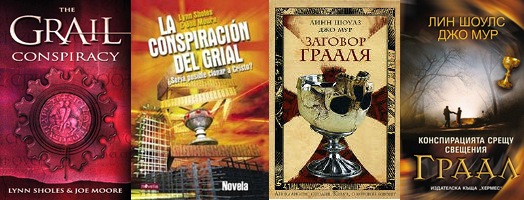
Our first book in the Cotten Stone series is THE GRAIL CONSPIRACY (2005) with a central theme of human cloning. The original cover is on the left followed by Spanish (Latin American), Russian and Bulgarian.

tgc-coves-1


The main object on the English cover is the ancient symbol of the Knights Templar whose descendents are the bad guys in the book. The Spanish version looks like a space ship taking off while the upside down skull chalice is very cool in the Russian cover. I have no idea what’s going on in the Bulgarian version.

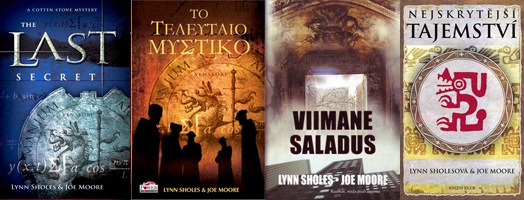
Our second in the series is THE LAST SECRET (2006). It deals with quantum mechanics and the ability to be in two places at once. The English cover is followed by Greek, Estonian and Czech.

tls-covers1c


On the English cover is the emblem of the Venatori, the secret intelligence gathering arm of the Vatican and the oldest spy organization in the world. On the Greek version are a lot of sinister looking people standing around in front of the Venatori shield. Not sure what they’re doing but it appears serious. The Estonian cover is kind of vague, and the symbol on the Czech cover looks Aztec or Mayan but your guess is as good as mine as to what it means.

Number three is THE HADES PROJECT (2007) about a plot to use a quantum computer to wreak havoc on the world’s infrastructure. The domestic cover is followed by the Lithuanian, Bulgarian and Slovakian versions.

thp-covers1


The symbol on the English cover is a pentagram because there’s a lot of devilish stuff going on inside. I think the Lithuanian cover is just plain weird like a strange Southwestern fire god, while the Bulgarian is spooky, and the Slovakian looks conservative and regal. Not sure why there’s a compass in the picture.

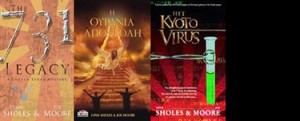
Number four is THE 731 LEGACY (2008), a scary story about state-sponsored terrorism and the reassembling of an ancient retrovirus that is carried in all human DNA. Here’s the English cover followed by Greek and Dutch (a bestseller in the Netherlands).
 731-covers1


The domestic cover shows a modified Japanese war flag since Unit 731 was a WWII Japanese organization that performed terrible atrocities against their enemies. The Greek cover looks like "Stairway to Heaven" and the Dutch publisher decided to change the title to THE KYOTO VIRUS, although they did keep the Japanese flag in the background.

So can we judge a book by its cover? Each publisher must understand their market and audience, and know what kind of visual impression is needed to make a customer pick up a book. I like all the versions of our covers for different reasons and I think it’s really interesting to see how our stories are interpreted in various languages and cultures with the cover art. But most of all, I really like that Russian skull chalice.

If you’ve had foreign language versions of your books published, was the art work similar to your domestic version or did the artist take off into La-La-Land? What was your reaction when you saw the covers?

Lost in outer-writer space


Speaking of Writer Hell, as Michael Haskins was in our Sunday funny, I had one of those days in Hell yesterday. It was so bad that I completely forgot to write my blog. I have no excuse except that I’m in the final throes of Draft Two of Makeovers Can Be Murder, the third installment of the Fat City Mysteries. This is the time when my brain becomes a bowl of guacamole, littered with random creative-chip debris. I am literally walking into walls. People who encounter me on the street probably think I need to be committed, or at least routed into some kind of 12-step recovery program for the fuzzy-brained.

But no, it’s just me during the last-gasp phase of the creative process. It’s final deadline.

I’m working my way through my editor’s notes right now. How do like your editor’s notes? I love my editor, but I always wait for her notes with nervous anticipation. I feel like I did when I was sixteen years old and waiting for the college acceptance letters. When it does arrive and I read through it, I usually do a little dance because it’s inevitably far kinder than I could have reasonably anticipated. Then I settle down and address the notes one by one. They’re always right on.

What kinds of experiences have you had with editors in your career? And hey, if your an editor, what kind of experience do you have with writers? Are we a bunch of whiners? You can post as Anonymous and tell us the real scoop.

Can we dish?

Toxic Writing Friendships

By Clare Langley-Hawthorne
http://www.clarelangleyhawthorne.com/

Like most writers I rely on a group of friends and family to give me much needed support as part of my writing process. I have those who are happy to provide input early on in the drafting process, those who are great proof readers, and those who are just ‘cheerleaders’ from the sidelines. Last year, however, I discovered the dreaded ‘toxic’ writing friendship – and though it’s a sensitive issue to explore, I felt the need to investigate this insidious issue. (It could also be that the NyQuil I now need to function courtesy of my infectious disease incubator sons is kicking in and making me want to vent!)

When I wrote my first book, Consequences of Sin, I did so under a veil of semi-secrecy, because not many people outside my writing group even knew I wanted to be a writer, let alone that I was writing a novel. I had a few friends who were the ‘writers’ amongst our social group – unpublished and with plenty of horror stories behind them – and I felt a little uncomfortable when I got my offer from Penguin, simply because I had never been regarded as one of the ‘them’. They also considered themselves to be ‘literary writers’ so I thought hmmm…what am I going to say when the project I affectionately called ‘my bodice ripper’ had actually managed to get published?!
At first it all went smoothly (well, cool but smooth). I tried to be low key about it all – not wishing to offend ‘the writers’ and I found myself putting up with stuff that was just unbelievable. One such ‘writer’ actually distinguished us because she said (with a sniff ) that I was writing ‘commercial fiction’ not ‘literary fiction’ which somehow meant my publication didn’t rate quite as highly (and justified her failure to be published as well).

I suddenly realized I had a noxious writing friendship on my hands. So what was I to do now?? At first I was worried that I’d pissed off every friend I’d ever had by inviting them to book signings or sending quick updates on my latest book news. Then, after others reassured me that wasn’t the case, I started to wonder – was my experience typical? Was getting published a sure fire way to alienate my other non-published writing friends? Were there really ‘literary writers’ whose tortured souls somehow trumped mine?
I started to question the value of my writing – you know the kind of thing – ‘Oh, I guess, yeah, I only write mysteries…’ but thankfully, I soon had a WTF revelation and pulled myself out of it.

So what about you – have you had the dreaded writing friendship turn toxic? How did you handle it?

NB: Needless to say I have mentioned no names and hey, my ‘toxic’ literary buddies would never stoop to read my blog!

A Writer Goes to Hell

This little nugget is courtesy of author Michael Haskins. Enjoy!gate_to_hell_1

A writer died, and due to a bureaucratic snafu in the hereafter, he was allowed to choose his own fate: heaven or hell for all eternity. Being very shrewd for a dead person, he asked St. Peter for a tour of both.
The first stop was hell, where he saw rows and rows of writers sitting chained to desks, in a room as hot as a thousand suns. Fire licked the writers’ fingers as they tried to work; demons whipped their backs with chains. Your typical hell scene.

"Wow, this is awful," said the writer, appalled. "Let’s see some heaven."

In a moment, they were whisked to heaven and the writer saw rows and rows of writers chained to desks, in a room as hot as a thousand suns. Fire licked the writers’ fingers as they tried to work; demons whipped their backs with chains. It looked and smelled even worse than hell.

"What gives, Pete?" the writer asked. "This is worse than hell!"

"Yes," St. Peter replied, "but here your work gets published."

Casting For New Readers Is A Rough Job, But It’s Just Fishing, More Or Less.

By John Ramsey Miller

With five authors (and guests) blogging on this site, there is going to be some overlapping since we are all thinking about similar things; our creative process, problems and the obstacles writers face on a daily basis including expanding our reader base. I’ve been thinking about the most important question after who is going to publish my book––how will I connect with my readers and what can I do to add more? How do I get a chance to sell my story to readers? How do I get through and make an impression they will act on?

Mind pictures help me, so I might imagine readers as fish swimming in a vast ocean. Each species of fish are fans of a genre, and they often swim through many schools of other fish of differing specie, eating what they are eating and then moving on to feed with various other sorts of fish. Food in the ocean is plentiful, and for the fish it becomes a question of which food they decide to open their mouths to take in. Imagine authors as a navy of fisher people, each in boats, trying to catch as many fish as possible. Each fisherman has to put their bait in front of constantly moving, well-fed fish who can eat whatever and as much as they like. Our dilemma is that the fish don’t need our bait, so we have to use some other way to entice them to try our bait, which frankly to the fish looks to be pretty much like the familiar bait they usually eat, and keep returning to. I love fish stories.

Given that there are tens of thousands of new stories to choose from, and readers are barraged with choices and they can only select so many, and the challenge is capturing their attention. I learned in advertising that it takes (I’ll say nine) impressions for a potential customer to act on an advertisement. This is more complex since most of us pass about a hundred thousand messages daily, and our brain (which sees them all) simply blocks out the ones that do not pertain to our needs or wants as a form of protection and I suppose to keep our brains from filling up (think computer ram). So if I am open to new tires, brain will tell me when it sees something related to the tires I’ve decided I want. If I like Good Time Tires, when I read the newspaper or watch TV or pass a Good Time Tires sign, my brain will shout, “Look, they have your tires right there! DO something!” And then I may buy, or I might just be nearing the time I have to make a decision, and my brain says, “Oh, they sell your tires. We’ll have to remember that.” Now at some point my brain will know that it is time and I’ll act and actually call someone who sells my tires, or pull into a dealer with the sign over the building. So, it’s the same with reading material. If I admire President Jimmy Carter, when I see a book by him or about him I might be more open to buying a book on him, and not one about Hoover, McKinley, or my favorite president, Jefferson Davis.

So, if you read the whole fish thing, it is a matter of finding our readers by capturing their attention, and at the present time everybody is thinking about a lot of things besides what to read. Our products are medicine for the mind and offer the client a way to escape their own problems and fears by getting involved and invested in someone else’s life or death dilemma, and best of all someone who doesn’t actually exist. And in most cases they get to see an underdog face impossible odds and actually come out on top, which gives them hope.

So how do we get to potential fans and convince them that our story is preferable to that of someone they know already, or several someones who have pleased them? How many of us have heard a reader say, “I loved Art Goobertug’s first book, but I haven’t enjoyed any of the last six he wrote.” After you close your mouth, you might well ask, “Why do you continue to buy books you don’t like. There are thousands of choices of authors who write good books, and maybe authors who write better books every time they write another.” These loyalists may say any number of things, and I have heard most of them, but it boils down to the experience they had the first time they read them, and they sincerely want to recreate that (might I use the word) experience again. I think it boils down to this––they bonded with that author, and, although they have been disappointed by the subsequent offerings, they haven’t given up on that author, and they hate to face searching the stacks for another author to enter into a relationship with.

Why are some authors more successful than others? Some few authors will become a James Patterson and others will remain Fred Futzwiggin. What’s the difference? You tell me. If you can, you’ll be rich… As best I can tell it’s a matter of bonding with readers and you can’t explain that.

The question I want to ask is, do you as a writer know how to form a mutually beneficial relationship with readers––and more importantly and firstly a way to get them to open your book for the first time and let your story into their minds? Can you do what Patricia Cornwell, Harlan Coben, John Grisham, and other successful authors have done and continue to do? The answer is, perhaps. Well, you have their kind of talent, but can’t seem to connect with large numbers of potential readers on a meaningful level, and then, as they do, figure out new and innovative ways to get your work out of the stacks and piles, and into hands. The worst part is even though successful authors will often share their secrets, but the formula is always shifting.

We all have to keep trying new things and methods to better our chances in an ever-changing world, and we have to do that ourselves because the plain truth is, nobody else will. Any secrets to share?