Page One, Chapter One. Again.

By John Gilstrap
www.johngilstrap.com

You’d think I’d get used to it, sooner or later. With Hostage Zero in the can and due to arrive in stores in July, 2010, it’s time to push the elation and sense of accomplishment aside and get back to the business of writing another book. This will be Number Eight in my personal bibliography and Number Three in the Jonathan Grave series. I don’t have a title yet (regular readers of this blog know how titles do not come easily for me), but I know what the story will be.

This idea came to me out of nowhere—as they usually do—at a time when I was looking for one, and when it arrived, it came fast, in the form of a terrific opening set piece that ties into a very cool larger story. I even have the new characters well formed in my head. All of this after just a couple of days of development. We’re talking Writer Nirvanna here.

Given the above, you’d think that it would be a snap to sit down and start writing, wouldn’t you? Having done it so many times in the past and with relative success, you’d think that I’d be ready to start the coming journey at a dead run.

Not so. It’s the damn cursor. It mocks me.

I’m staring down the pipe at something like 120,000 words, and none of them are written yet. It’s all looking good in the outline, but I know that there are tough times coming–as they always do around page 200. I know that there will be some huge plot holes to be backfilled, and character motivations to be reconsidered. I know that I will, somewhere in the process, throw out several days’ or several weeks’ work because I will have surrendered to temptation and pursued a new angle on the story that proved to be a waste of time. It always happens, so I’ve come to accept it as part of my process.

I know that I am going to become obsessive, and that as my new deadline approaches, I will become a pain in the ass to live with. There’s a lot of frustration on the way, and I’m bringing all of it onto myself. At present, I’m out of contract, so it is within my power to simply fold up my laptop and not write a word.

Except I couldn’t do that.

You see, I’ve got this story in my head now. I see characters and conflict and compelling action sequences, and such images cannot be ignored. In nine months or a year, I will hold a stack of pages in which all of it will have come to life.

I know that about the time when Hostage Zero is hitting the stores, I will be more or less at the end of the new book, and, God willing, I’ll again experience the thrill of writing that favorite of all phrases, “The End”, only then to face the challenge of discovering my next idea.

It’s frightening to face all of that work, but I suppose that any new adventure should be a little unsettling. I think I know where I’m going, but I can never be sure. It’s damned exciting, when you think about it.

All I have to do is stuff some letters behind that incessantly blinking cursor.

What about you? Every writer, published or unpublished, faces this same challenge at the beginning of a new project. Any secrets to share? Any coping strategies to make it easier? Does the daunting nature of the task ahead keep any of you from starting your journey?

Come on and share. We’re all friends here.

Big Ticket Giveaways

by Michelle Gagnon

I promoted my last book release by holding a drawing for a Kindle reader. People called me a fool. Even my agent expressed concern that I was overdoing it, that there was no guarantee that a big ticket giveaway would translate into sales.

Perhaps. After all, the old marketing adage is that fifty percent of what you’re doing will work. The trouble is, chances are you’ll never know which fifty percent.

So where in the scheme of things did my Kindle promotion fall?

It definitely helped. All someone had to do to enter the drawing was sign up for my free newsletter. My newsletter mailing list grew exponentially during the months that I was promoting the giveaway. Granted, there’s no guarantee that subscribers even read the newsletter, never mind bought the book. But having thousands of people receive updates on my next release was far better than hundreds.

A large chunk of the marketing budget of major corporations is devoted to establishing brand recognition. Similarly, my goal was to get my name and the title BONEYARD out there, to build familiarity so that when people saw the book in stores, they would be more inclined to purchase it.

And in terms of actual sales, my second thriller outsold the first by nearly ten-to-one. Not that all of that was necessarily attributable to the Kindle giveaway, but I don’t think it hurt.

Additionally, I promoted the contest through other marketing avenues. I featured it on Facebook and MySpace ads. I pitched it at signings and conferences. I mentioned it on every stop of my twenty-four blog tour.

Now, there was one criticism, and it came mainly from booksellers who were understandably loathe to support the Kindle. Personally, I think that ereaders such as the Kindle have the potential to increase readership across all formats. After receiving one as a gift, I’ve ended up buying more books each month than I did in the past. And I wanted the giveaway to be linked to reading and writing in some way, shape, or form.

However, I understood the complaint. For that reason, this time around I chose something that hopefully everyone could get on board with: a MacBook laptop computer (well, okay, maybe not Bill Gates. But nearly everyone else).

Again, I received a flood of emails from people telling me that I’m nuts. I respectfully disagree (although I concede the point is debatable, but for other reasons). For one thing, I did come up with a way to (hopefully) link the drawing to sales: anyone who answers a question that relates directly to two of my books receives ten additional entries in the contest.

Also, when I look back on the marketing budget for my first book, I spent far more and gained less. All things considered, pooling your resources into one big ticket item that draws some attention, and which you can cross-promote for free on blogs and social networking sites, is far less expensive than hiring a publicist. There are nearly 15,000 books published EACH MONTH in the United States alone. It’s hard to stand out among all that noise.

Recently someone told me that Joseph Finder gave away televisions at bookstore appearances on his 2006 tour. Televisions! I have no idea if this is true (or, if it is, how the heck he afforded it) but apparently that spurred his book on to the bestseller lists (and I’m sure his events were packed, which always makes the booksellers happy).

Hmmm, televisions. Maybe next year.

Is email dead?

by Joe Moore

A recent article in The Wall Street Journal talked about the topic while discussing alternative forms of communication such as Twitter, Facebook messaging and similar services, and how social networking and instant messaging are surpassing old faithful: email.

Before you say “no way”, think back to those distant dark ages when one of the main forms of business communication was the fax. How many faxes did you send last month?

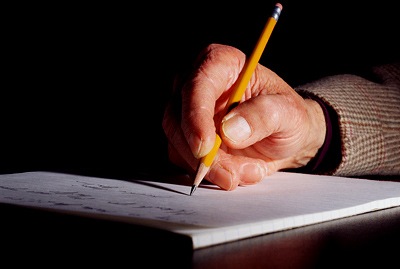
And if you really want to get into the “way-back” machine and visit historical communication methods, let’s consider letter writing. Anyone remember that. While some used a gadget called a typewriter to compose letters, the shocking truth is that others actually wrote letters longhand using an analog marking device commonly known as a pen (or pencil). I know, it’s crazy but true.

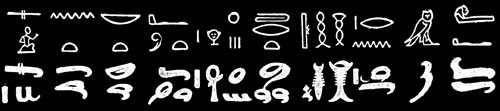
Many of us are still using email everyday and are perfectly happy with it. But technology is constantly moving forward, with or without us. It’s well documented that Egyptian Pharaoh King Tut once proclaimed, “I’m still using hieroglyphics everyday and am perfectly happy with it.” But as the article points out, email is a function left over from the bad old days of logging off and on and checking stuff in globs. Today, everyone is “always on” with the latest generation of mobile communication devices and smart phones.

As an example, my son travels a lot. We both have Google Talk installed on our PCs so we can chat. Rather than emailing me a question, comment or a simple hello, he sends me an instant message. I hear a ping and within seconds I’m chatting with him anytime in real time. Last week, he sent me an IM from 30k feet over the Midwest on his way to Washington, DC now that airlines are installing in-flight wideband WiFi.

With services like Twitter and Facebook, you can answer a question before anyone even asks it. Rather than sending me an email wanting to know how my latest thriller is selling, I can update my status to declare that it’s selling somewhere under a million copies—way under.

But like the WSJ article asks, does the new generation of hieroglyphicscommunication services save you time? Or are they eating up your day? Now that we have so many methods to instantly communicate, are we going to spend more time doing so? Or are we already wasting more time in the process? What do you think? Is email dead at your house or are you still using hieroglyphics and staying perfectly happy with it? Send me an IM and let me know.

“Grading” your author’s web site?


By Kathryn Lilley

My latest book, Makeovers Can Be Murder, has entered its early trials–a 12-week, Darwinian period during which the books are cast upon the shelves of bookstores across the country. Newly published books are typically given 12 weeks–3 months–to live or die. If they “live,” this means that all the books sell out, and then customers order more. If the books “die,” well…we call that Remaindered Hell. Remaindered books are sent back to the publisher, where they languish in warehouses, or are simply destroyed.

During this 12-week period, most authors make frantic efforts to promote their books–a process that typically includes sprucing up their author’s web sites.

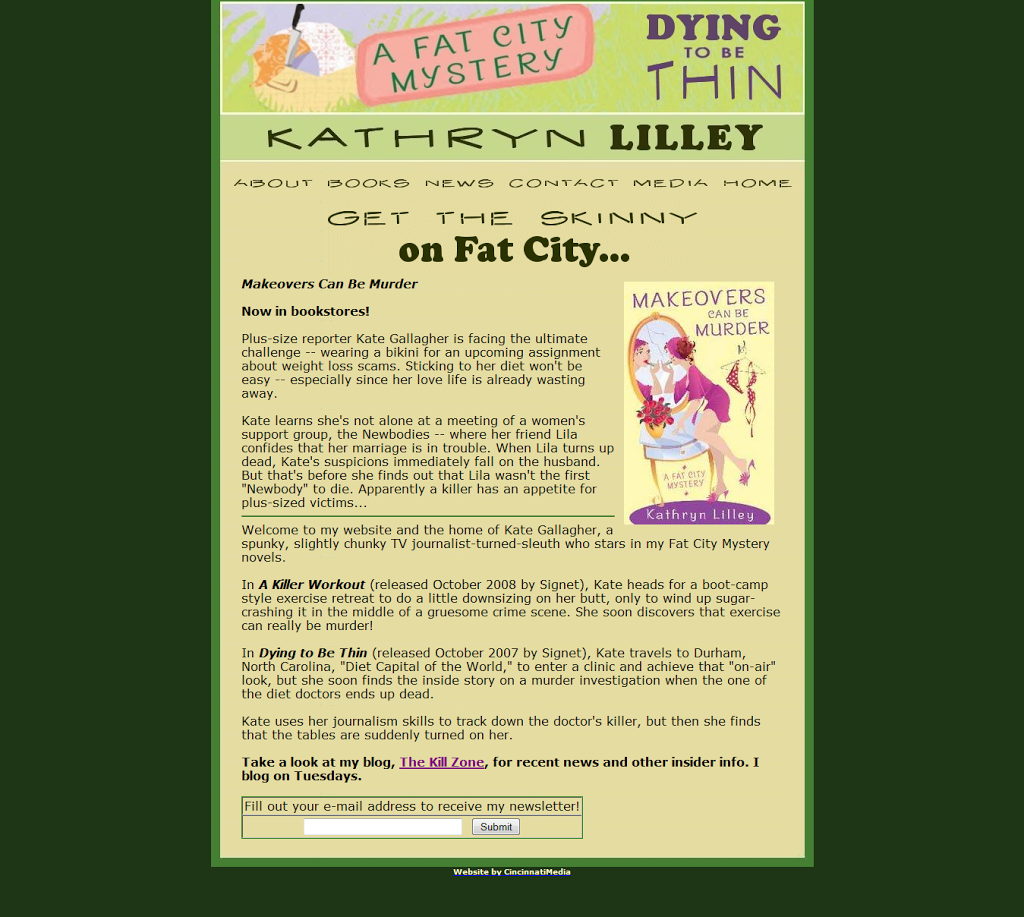
For most of the year, I tend to ignore my web site, www.kathrynlilley.com; I lag behind in making updates (except for the Twitter app that automatically displays updates). Recently I noticed that I’d even let my newsletter account expire. (This may be due to the fact that, because I don’t like getting newsletters, I assume other people don’t like getting them–even the ones who sign up for my newsletter. Or it might be just laziness on my part–I hate writing ’em).

But from time to time I make solemn vows to improve the site. Recently I ran my URL through Website Grader, an SEO service that grades web sites according to various criteria, including meta data, inbound links, and a bunch of other things that I barely understand. It also compares a given site to similar sites. My web site had a score of 47. Now, when I went to school, a 47 was a big, fat “F”. The site also had a Google page rank of 3. That’s probably not good either, although I have no idea what is considered a “good” Google page rank.

The Website Grader issued a report that suggested various ways that I can improve my statistics: Adding a page title, metadata, and listing the site on web directories, among others. I’ve since heard that those suggestions for revisions are based on “old” technology, and no longer valid. But honestly, I have no idea. I’ll take a stab at making the improvements, just to feel like I’ve done something useful.

As an author, how much attention do you pay to your web site? Do you let it languish like an unwanted stepchild, or do you nurture yours? If you’ve done a major overhaul, have you been pleased with the result?

Surprise!

by Clare Langley-Hawthorne

How much do I love surprises? Let me count the ways…

I’m sitting in a hotel on Maui typing this blog all because my husband has a great knack for surprises – this one is an early birthday present and it’s also the first time in five years we’re having a vacation together…alone…(well if you don’t count my laptop and current WIP which I carry with me like surrogate twins…) so you can imagine how much I love this surprise!

I also love books that surprise me. I love it when an author can genuinely deliver not just the shocks but also the delightful out-of-left-field moments which cause me to smile. I remember the first time I read Jasper Fforde’s Thursday Next series and how surprised I was that his brand of lunacy actually worked. I also remember reading the first Harry Potter book and catching hold of the same sense of magic I felt as a child reading. The element of surprise is one that I relish in a book. I love how Carlos Ruiz Zafron’s Shadow of the Wind captures the essence of Gothic surprise that imbues the glorious Victorian novels that I adore and how Neil Gaimon’s books (and quirky imagination) continue to delight and amuse me.

Surprises can be powerful things – they can draw a reader into a book in a way that is (I think) often more powerful than a mere plot twist or a shocking ending. They can take the form of an unsuspected insight into a character, a happy coincidence, or just the details of a world created that transports the reader’s imagination. The element of surprise is however much harder to achieve than suspense or the power to shock and I think (in terms of craft) it requires:
  • An appreciation of language – the beauty of a turn of phrase that can delight as well as surprise should never be underestimated.
  • An understanding of the nuances of the human condition – many of the best surprises occur only because an author has a grasp of the full idiosyncrasies of characters (both real and imagined).
  • An ability to create parallel worlds full of quirks and charms that allow a reader to suspend disbelief.
  • And, finally, the bravery required to take a book into rough uncharted waters…
I certainly don’t believe I have mastered any of the above but when a book truly takes me by surprise, the effect is magical.

So when did a book last surprise you?

No Title Comes To Mind

John Ramsey Miller

Writing a blog is sort of like having a weekly column in a newspaper. In fact that’s what it is, only without the publisher paying you for it, or having newspaper for priming your fires after you’ve read it. Don’t get me wrong, I get a kick out of it or I wouldn’t do it. The blogs here are mostly about writing thrillers, defining our craft, and I try to blog about my writing process, the rules, what I’ve learned and the shortcuts to being published and becoming best sellers, which all published authors are sworn not to share with laboring inspirons. Often I blog here about what I do when I’m not writing, which is sometimes the better part of a day. I know it can make dull reading, but when I judge contests for ITW or MWA awards I always have to read the bad as well as the good.

Let’s be honest here. At this point I have served up everything I know about writing that came to mind in some form since I began writing this blog. Here’s what I have to write about:

A) Writing process, technique, style, character, story, plot, re-writing, setting mood, place as character, dialog, promotion, working with editors, etc…

B) Growing older. I just turned 60 last week, but I feel a robust fifty-seven. My hair is turning gray, I’m more easily winded than I used to be, and my eyesight is no longer eagleish. I am also more cynical, have a lower threshold for annoying things and boorish people, am more interested in making my time and effort count, spending more time with my grandchildren, and my animals, whom very likely could all care less.

(C) For more blog subjects, I have my wife, my three children, their spouses and six grandchildren, three dogs, 75 chickens, close friends & casual acquaintances, problems we all have, and problems only I could have, and hunting and stalking game a few times a year to get wild organic meat for our table so we can stay healthy and trim.

Life is filled with great moments. Sunday our youngest grand baby kept spitting out her pacifier, and her four-year-old cousin kept putting it back in the baby’s mouth. After repeating this five or six times, the four-year old looked at me exasperated and said, “It won’t stay in her mouth because she doesn’t have any teeth. I don’t know why she didn’t get any.” Life is filled with moments like that if you just slow down and take the time to open your eyes and ears.

After so many years on the planet, I have learned a few things, and it has never been more apparent that I have a lot more to learn. I know that things you don’t need, but merely want because they call to your ego, are not important and you will probably be happier without the added complication. I’ve also discovered that nobody with an ego wants to hear it. I never did when people told me the same thing.

I am a far better writer now than I ever have been before because I’ve learned as I have written along over the years, and as I have read more good (and bad) books. I have experienced more, and I’ve figured out more of what makes people tick and know better how to get that on paper.

The only thing I’ll say, is that getting older is great experience if you just pay attention as you do it. So, are any of you getting older too?

Politics and Dinner: Necessary Bedfellows?

By John Gilstrap
www.johngilstrap.com

This post is a little late because it is not the one I had intended to put up today. That one was already written, but then I experienced something yesterday that I thought would make a way better topic: Political Discourse. You know, something light and nonconfrontational.

I’m at Bouchercon this weekend, one of my favorite events. I like the conference environment. Lots of smart, talented people hanging out with each other, discussing smart topics in intelligent ways. Writing is by definition about ideas, right? It’s about expressing ideas and tolerating the opposing views of others. Until, it turns out, the topic wanders toward politics.

I dined last night with a new group of friends. There were ten of us, and the evening was a lot of fun. Toward the end, one member of the party (I swear it was not I) started saying, a propos of nothing, ugly things about people who occupy the right end of the political spectrum. The presumption was that every thinking person would agree. As one whose politics run maybe ten degrees to the right of center, which put me at least ninety degrees to the right of the group, I saw trouble on the horizon, so I found an excuse to announce that I was more conservative than liberal, and the I thought the current administration could be in real trouble if some important things didn’t start turning in their favor.

Two things happened instantly. One, the sense of disgust that someone of my ilk would be breaking bread with them was palpable (not from all, but from more than one); and two, it was announced that it’s time to stop talking about politics. I tried to point out that my intent was not to shut conversation down, but rather to talk about the strategies that will be necessary for the Democrats not to take a significant shelacking in the mid-term elections. Voices were never raised, and no one got ugly. I was trying to trigger the kind of discussion I frequently have with my colleagues in Washington, where politics is every bit the spectator sport that football is (and given the performance of the Redskins this year, a way more enjoyable one).

Nope, no politics.

Okay, fine. I was good with that. We moved on to other stuff, the check came and we went off on our own. No harm, no foul.

But then I started thinking. Is it possible that the current polarized, scorched-earth nature of politics these days is directly attributable to non-discussions like the one last night? The overarching message there was that political discussion is only unacceptable if there’s an opposing point of view. Firing broadsides against an ideology or against a large group of people is fine so long as the other group is not present to defend their point of view. It’s the Rush Limbaugh theory of discourse, and I think it’s doing great harm in this country.

As mentioned above, Washington is an epicenter of intelligent political discussion. I explore issues all the time with colleagues who are on the other side of what I believe, and through rational (sometimes passionate) discussion, opinions really can be influenced. Certainly, stereotypes can be dismantled.

It’s no secret that the current administration’s politics don’t agree with mine, but the fact that people I admire are huge fans gives me solace, born of the knowledge that the opinions on the other side are well-reasoned; something I wouldn’t understand if we hadn’t discussed the issues. If groups of us don’t start having these discussions, if we don’t start discussing issues intelligently, and airing differences, how will we ever undo the polarization?

If we don’t invite opinions from the other side–or worse yet, if we reduce the other side to ugly stereotypes–how can we ever grow, either as individuals or as a nation?

Still Better than Google

by Mark Arsenault

Today TKZ is thrilled to welcome author Mark Arsenault, a Shamus nominee and former newsman. Booklist gave his latest release LOOT THE MsortofstandingOON a starred review, describing it as, “a top-notch crime novel.”

We all remember the newspaper, right? That once ubiquitous part of daily life, now on a fast slide toward an exhibit at the Museum of Obsolescence, where it’ll join the butter churn, the buggy whip, and customer service? (For binary-only types who can’t remember the newspaper, it was like a daily printout of the on-line news. Pretty handy!)


Well, the newspaper still whups the laptop as a fireplace starter and a birdcage liner, and here’s one more—the old fashioned newspaper is the best tool I’ve found for researching historical fiction. For time periods dating as far back as 150 years or so, old newspapers preserved on microfilm beat the Internet as a research tool, and that includes the digitized archives some large newspapers offer on-line. And, no, I have not been hanging around at the polyurethane convention.


When I’m researching a time period for a fictional setting, I might scan old newspaper headlines for factoids, but what I’m really looking for is the advertisements. You can learn a lot about life in another era by what people were buying and selling.
I’ve been researching life on the East coast around 1917 to set a novel. It was a fascinating time period, just 36 years after the gunfight at the O.K. Corral, yet people talked on telephones and drove sporty little cars. How can I be sure? Because I found a great advertisement for the Davis Light Six Roadster, a bargain at $1,095, featuring adjustable seats for “the utmost comfort in motor travel.” For an additional $700, the Hudson Super-Six could top 100 miles-per-hour.


A picture in a bike advertisement shows me that bicycles have barely changed in more than 90 years. I can infer from a dentist’s ad that “pain-free” was a still a selling point in 1917, something we take for granted now.


lootthemooncover I would have guessed that men carried only pocket watches in 1917, but there are also ads for wristwatches with glow-in-the dark “Radiolite” dials. On one old page I recognized a character I’ve known all my life: Mr. Peanut, the tuxedoed nut who peddles for Planters. I had no idea Mr. Peanut was WWI vintage.
Old newspaper ads reveal the attitudes of a culture. Americans in 1917 were modern and naïve at the same time: People played phonograph records back then, went to the movies and drove big Cadillacs. They also paid good money for miracle pills and powders that claimed to cure everything.
Gender roles are obvious in this text from a chewing gum ad: “The high salaried secretary of the big business man knows how important it is to keep her high-strung employer well supplied with Adams Pepsin, the original chicle gum. So she keeps it where he can get it at once without having to ask.”
That pitch probably wouldn’t sell much gum today.


Many libraries keep old newspapers on microfilm. You have to use the microfilm viewer machine, which I call The Vominator because it can make me seasick. But that’s a small price for such a rich resource.


Microfilm may seem too primitive when you can literally download photos from Mars to your phone, but just imagine all those newspages as one big, searchable database. You just search through them one page at a time.


This November’s edition of Ellery Queen’s Mystery Magazine will have a short story of mine set in 1973, a very groovy year. The 70s are my favorite time period for fiction. I love the clothes, the slang, the hair, the cars, the crazy politics. With the Watergate coverage, the 1970s may have been the high-water mark for American newspapers.


Does anyone else have a favorite time period for stories? What makes it your favorite?

Mark Arsenault is a Shamus-nominated mystery writer, journalist, runner, hiker, political junkie and eBay fanatic who collects memorabilia from the 1939 New York World’s Fair. His new novel is LOOT THE MOON, the second book in the Billy Povich series that began with GRAVEWRITER, a noir thriller praised for a fusion of suspense, humor and human tenderness. With 20 years of experience as a print reporter, Arsenault is one of those weird cranks who still prefers to read the news on paper.

In the beginning . . .

By Joe Moore

They say that the most important part of any novel is the beginning. Arguably, it’s the most re-worked portion. I know it seems like I rewrite the first chapter a hundred times before I’m done. But no matter what the story is about, I believe there are a few critical elements that should be present to create a strong beginning. Here they are.

You should always start by showing your hero as a central focal point. Don’t worry too much about detailed descriptions on the surroundings, the weather, and the setting. That can come a page or so later. Just zero in on the protagonist’s state of being.

Firmly establish the situation the protagonist is in. Is she relaxed, nervous, happy, or angry? Consider making the first scene a mirror of what’s to come so that the reader knows right from the get-go what type of person the protagonist is. For instance, if the hero will have to deal with killing someone later in the story, have her see a report of a murder on the news or in the paper and react to it. Is she repulsed by the taking of another’s life or does she think the person on the news got what he had coming? It should be like watching a preview of a coming attraction at the movies. You know what to expect from the character when you get to the meat of the story. So let the opening scene in some way reflect the overall conflict in the book and perhaps specifically predict or foreshadow events to come. Allow the first scene to set the tone for the rest of the story.

Next, give the protagonist something to do that is a primary “tag” to identifying their make-up, their inner core beliefs. You only need one, but it should be a mark of their character that will play a role later. As an example, if the protagonist is able to step in and calm an argument between two co-workers, and do it in a logical manner, it’s a tag that they can solve bigger conflicts later and that their mind works well at problem-solving.

Now comes a vital element in the beginning sequence of any story. You must establish that the protagonist has something important to lose. Conflict must be established from the very first scene. It doesn’t matter what kind of conflict or what’s at stake, but it must be something important to the protagonist. Something the hero cares about has to be threatened. Although some books start with a big scene, perhaps with violence or personal danger, the thing that’s at stake for the protagonist can be as small and personal as forgetting to send a birthday card or neglecting to tell her daughter that she loves her. This shows she has feelings and emotions that are on a basic human level and can be related to by the reader. Even if the big opening scene is a threat on the protagonist’s life, the real thing that’s at stake must be a loss from within her heart, her soul.

Starting with something as big as a threat on her life usually doesn’t work as well because the reader hasn’t had time to get to know the hero and there’s no reason at this early stage to care. Action by itself does nothing to increase the concern the reader has for the protagonist. But regretting that last, missed goodbye sure does. It sets up a relationship between the hero and the reader—a connection of human understanding and emotion that helps the reader care about the character later.

If your book is science fiction or fantasy, it’s a good idea to establish the rules of the road as soon as possible. If the rules say that people can become invisible, go ahead and establish that real quick. The reader must know the rules. Don’t wait until halfway through the book to decide the antagonist can read minds. We need to know about the mind reading thing right away.

Another element that should be present in or near the beginning of your book is the story question. You might think that the story question deals with the protagonist defeating the antagonist. That’s really a plot issue. The story question is much deeper than that and usually deals with an inner want and need of the main character. For instance, in SILENCE OF THE LAMBS Agent Clarice Starling has to find the killer known as Buffalo Bill. But what’s the story question? Can Clarice overcome the childhood trauma she experienced when her policeman father was murdered, then having to deal with living on her uncle’s farm and listening to the terrible screams of the sheep being slaughtered. The story question is answered at the end of the book when Dr. Lecter writes Starling a letter asking her if the lambs have stopped screaming. In the final scene Starling is sleeping quietly and peacefully at a friend’s vacation house at the Maryland seashore. The story question has been resolved.

You should also establish during the beginning of the book your character’s wants and needs. Asking the story question can reflect on what the protagonist wants and what she needs. Clarice wants to catch the killer but she needs to find internal peace from her childhood demons.

Lastly, you should begin your book by establishing your voice and setting the tone and pace of the story. The mood must be nailed down from page one. Your opening scene sets up all of these elements and lets the reader know what to expect from there on out. At this point, you are establishing a contract with your reader to deliver a story that maintains a tone, fulfills their preliminary expectations, and resolves all questions amicably.

What other elements do you think must be present in the beginning to keep your reader turning the pages? Do you always know the story question before you write the beginning of your book? Have you ever bought a book only to find that the author didn’t live up to the contract established in the beginning?