Opinions, Please

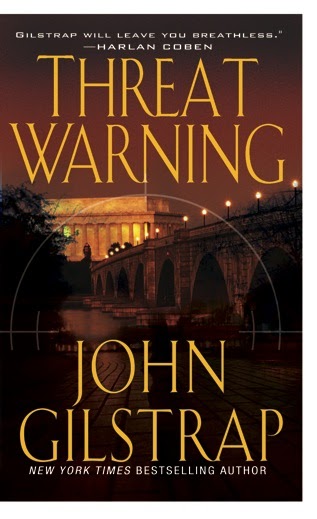
This week, I heard the words that every author lives to hear from his editor: “I love it!”  This in response to reading my new entry in the Jonathan Grave series, to be published next July.  The title is Threat Warning, and the opening scene features two young people opening fire on gridlocked traffic on the Woodrow Wilson Bridge, one of only two Beltway Bridges over the Potomac River.  When the shooting is over and the panic is building, one of the shooters carjacks a mother and her son, launching a series of events that prompt Jonathan Grave to implement his very special skills.
Previously, there’s been a considerable delay between manuscript submission and cover design, but this one came faster than most.  The picture above is the concept they sent to me.  What do you think?
My only concern at first glance is that the picture is not of the Woodrow Wilson Bridge, but rather of the Memorial Bridge.  Of course, at the time when people are responding to the cover and picking the book up off the rack, they won’t know the significance of that.
Share your thoughts, and please be honest: Would this cover jump out at you from a rack at the store?

Thinking about Theme

theme (Small) We often discuss the different elements of writing fiction here at TKZ. Topics such as plot, narration, characterization, dialog, and point of view are just a few that come up now and then. But a topic that’s not touched on as often is theme. Theme is usually a global statement on what a book is about. Theme goes beyond plot by conveying the message that supports the structure of the story. In many instances, it expresses a lofty idea usually revolving around human emotions or life in general.

A good starting point in determining a book’s theme is to first establish its subject or topic. This is normally expressed in a one-word description such as love, revenge, jealousy, fear, deceit, betrayal, etc. The theme can then be found by turning the subject or topic into a short, focused statement.

So for instance, if the subject of a novel is fear, the theme could be fear exposes the true nature of an individual. If the subject is revenge, the theme could be by taking revenge, you become just like your enemy. If the topic is betrayal, the theme might be that betrayal only hurts the ones you love.

A book’s theme can teach or preach. The former is preferred. No one wants to be preached to. But we all desire to build upon or confirm our beliefs. The theme can address “big” issues such as the meaning of life. Or something more manageable like crime doesn’t pay.

Whatever the theme, all stories have them. How well they come across without being “in your face” relies on the skill of the author.

What is the subject or topic of your favorite book(s)? And what was the theme? Did you feel the writer was teaching or preaching? How about your own work? Do you knowingly have a theme before you start writing?

Writing rituals

Most writers have rituals, little warm-up routines that we must complete before daily writing commences. Our personal writing rituals, which can sometimes be elaborate, are considered sacred to the creative process. Victor Hugo reportedly wrote in the nude. Ben Franklin is said to have written in his bathtub. When he was working as a lawyer, John Grisham rose at 5 a.m., arrived at the office by 5:30, and then wrote a daily quota of 1 page per day.

When I was working a day job, my ritual was similar to Grisham’s. I would rise by 5 a.m., get the coffee going, then sit down at the dining room table and work until I had at least one page done. Then on to my day job.

Now that my day job has been offshored to China (thank you, globalization), and I find myself with much more free time, my writing ritual has inflated like a CEO’s salary. In addition to coffee I now do some Internet surfing before settling down to writing. Depending on my level of motivation, surf’s up anywhere from 20 minutes to 2 hours. I also feel a strange compulsion to sharpen every pencil in the house before I hit the keyboard. I think it’s a leftover ritual from high school, when I would rise at 4 a.m. to do my homework. I never did any work at night, and still don’t. My pencil-sharpening compulsion isn’t nearly as time-consuming as the ritual of a friend of mine, who is a successful writer. A major procrastinator, she cleans her entire house before settling down to work. If the house is already clean, she’ll organize her drawers.

Here’s a little ode to ritual by MsWriteNow. And then tell us–what is your writing ritual, and how important is it to you in terms of getting your work done?

The Fame Game

by Clare Langley-Hawthorne

So who amongst us hasn’t fantasized about being a rich and famous author? I have to confess to an occasional daydream, usually involving owning:
(a) A penthouse apartment overlooking Central Park

AND…

(b) A house in Mayfair, London


AND…

(c) An Irish castle on a windswept coast


AND…

(d) My very own tropical island

AND…

(e) A villa in Italy.

I don’t ask for much really…
When it comes to fame, though, I have only one goal – and that is to make it into Vanity Fair magazine – it doesn’t have to be the cover (though how cool would that be!), it doesn’t even have to be a big article (just a side column, snippet or photo would be fine) but for me it is something akin to a rock band’s lust for making the cover of Rolling Stone. I don’t know what it is about Vanity Fair, but if I could make it into one magazine that would be it.
I suppose if I was more erudite I would aim for the New Yorker or some other literary magazine, but I don’t. There’s just something juicer somehow about Vanity Fair and highbrow enough that my family wouldn’t be as embarrassed as if I graced the cover of, say, the National Enquirer…though of course, knowing my luck, that’s just where I would end up if I ever got a whiff of fame (or would that be infamy). The headline would no doubt be something horrid like, Famous Author’s Alien Lovechild Revealed!
Which would serve me right, for playing the fame game…but who can resist indulging in a little harmless ‘what if’?

So what ‘rich and famous’ daydreams do you indulge in? If you could be written about in just one magazine what would it be? The New Yorker? Fortune? Sports Illustrated:) ?

The Stress Free Query


The writing game is tough enough without stressing about minor things. Like how to structure a query.
“But,” you shout, “a query is something worth stressing over, because there are four hundred things that can go wrong with it! I know, because I just read a blog titled ‘The Four Hundred Most Common Query Mistakes.’ So I have every reason to stress out!”
Okay, let’s sit back in our chairs and take a nice, deep, relaxing breath. You would think from all that is out there that query writing is like the cave at the beginning of Raiders of the Lost Ark. You know, one false move and a dozen arrows ventilate you, or you get impaled by spikes, leaving you as a rotting carcass with no agent and no prospects.
Instead of focusing on all the things you can do wrong, why don’t we just look at the simple basics of a query and how you can get them right—every time?
After the salutation which addresses the agent or editor by name (i.e., not Dear Sir or Madam or To Whom it May Concern), three paragraphs are all you need.
The Opening Paragraph
Your plot, starting with the Lead character’s name:
[Lead character] is a [occupation or vocation] who [life situation].
Now write four to six lines which give the ka-ching factor of your plot. Write this paragraph as if it were a 30 second movie spot.
Here’s an example taken from the back cover of Side by Side by TKZ’s own John Ramsey Miller:
Winter Massey is a former U.S. marshal who has made too many enemies on both sides of the law. Lucy Dockery is a judge’s daughter who’s never had to fight for anything in her life. But now Lucy and her young son have been kidnapped and sentenced to die-unless her father agrees to set a vicious criminal free. Massey is the closest thing to salvation they have, but he doesn’t know that the beautiful FBI agent who brought him into the case may be playing a chilling double game — and that a circle of treachery has begun to tighten around him. For Lucy, the time has come to scratch and claw for survival. For Massey, it’s time to stop trusting the people he trusts most. Because in a storm of betrayal, there’s only one way out.
Train yourself to write this way be reading the back cover copy of books in your genre (or the editorial descriptions off amazon.com).
I advise starting off with the plot paragraph because you want to show the agent you can grab readers from the start. Most queries agents see start off with some meet-and-greet stuff. There’s nothing really wrong with that, but since agents see this all the time, why not stand out from the crowd?
The Background Paragraph
Now give a paragraph with the title, genre, word count, and relevant parts of your background. Writing credits are good if they are “weighty” credits. By that I mean a reputable publication. Something a bit more than your local grocery store newsletter. It’s better to err on the side of no credits than a string of flimsy ones. There’s no hard rule here, just put yourself in the reader’s place. Does it truly indicate anything about your writing chops? If you got an award or grant that’s prestigious, or earned an MFA, by all means mention.
Experience in the field you’re writing about is good. Where you were born and how much you love writing is not good. How well you think you’ll do on TV interviews is horrible. Worst of all is saying your book is the “next” anything [James Patterson; Harry Potter] or is definitely going to be on the big screen as a major motion picture, and don’t you, Ms. Agent, want to get in on that action?
Don’t waste any time on how you came to write the story, what your grandmother and critique group think of it, or how you the publisher should market you.
If you had some interaction with the agent or editor at a conference, or heard them speak, or read something good on their blog, you can mention that. Briefly.
[Title] is a 95,000 word thriller. I’ve been a practicing lawyer for fourteen years. This is my first novel. I heard you speak at the Greater Downey Writers Conference and think this project would be a good fit for you.
And please, don’t get cutesy with this paragraph, as in:
Your blog post on queries was almost as good as Dave Barry, LOL! He makes me laugh, you made me laugh, and I’m sure we’ll have both a lot of laughs when that first contract comes in! 😉
You get the idea. Here’s why you don’t have to stress about your bio. The thing that’s going to sell you in the query is your plot paragraph. Let your background paragraph do its work and get out of the way.
The Thank You Paragraph
This is tricky:
Thank you for your consideration.
Then put your name and contact phone number.
Now that wasn’t so hard, was it?
Since most queries are now electronic, and agents don’t generally want attachments, put the query in the body of your email, using the default font and block paragraphs (no indents; single spaced). Put two spaces between the paragraphs.
The subject line should have QUERY in it. There have been reports of none-too-clever attempts to stand out from other emails by putting in fake headlines, e.g., End of the World Clues Here!
Don’t do that. It’s unprofessional. While it might not scuttle your chances of getting a request for you manuscript, it’s a bit of a turnoff. Why make it harder on yourself?
There you go. No stress, no strain. Now you can concentrate on your writing. 
(For more on queries and proposals, see The Art of War for Writers).  

Bookstores: An Endangered Species

John Ramsey Miller

About a year ago a couple opened a bookstore in Locust, NC, a picturesque small town a few miles from here. They were personable, energetic and did most everything the right way. They had an accessible and central location in the downtown, put out word to area readers, contacted authors and advertised signings, kept up by newsletter with their readers and customers, hosted a book club, had author events by the score, and generally gave it their all. I had asked them to sell my books at a fund-raising event for the supporters and alumni at a local University, and they readily agreed. Yesterday I received an e-mail that, since they were closing immediately and selling out their stock the next day, so they would not be able to sell my books at the event. They apologized for any inconvenience and I sent a note of understanding and condolence. The only thing they did wrong was to open a bookstore in a disastrous environment.

We write here often about the troubles and the demise of small independent bookstores. Every author has seen their favorite booksellers fail as the mega sellers rose and ate them one by one. When the ARC for my first book, THE LAST FAMILY, was sent out, John Barringer owned The Little Professor in Charlotte. He liked it enough that he sent out a personal letter to all of the Independent Booksellers on his list. At that time he was the president of the League of Independent Booksellers of the Planet Earth, or something like that, and he sent hundreds of letters of recommendation to booksellers on his list. Nobody asked him to or paid him to do it, and at that time he didn’t know I wrote that book while I was living around the corner from his store and was a customer at that time. I’d never spoken to him, but I used our common zip code in the book, which he caught. He tracked me down through the publisher and called me to praise my work and to set up a signing. He and his staff hand sold a good three hundred of my books in his store and God knows how many through his recommendation letter. A few years back John sold the store and retired due to health issues. The store is still going strong and changed its name to Park Road Books (still a Little Professor franchise). They remain in business because they have a history of excellence, a great atmosphere, the staff works hard, they hand sell, and they have a fairly loyal customer base (that in itself is a rarity). I have never done a signing in an independent book store without buying books from them to show my appreciation in a meaningful way. And I’ve never asked for a discount.

Now the e-book is an additional (and serious) threat to booksellers––even the big chains. I suppose they will have to find a way to get in on that market or more will fail. I’m not sure how that would work since the publishers can do that themselves without any second party being necessary for distribution. I love my Kindle, and although I love browsing in book stores, I am now ordering books in electronic streams. I will say that there are some books that will never work as ebooks on Kindles––most notably books for children (Golden Books) and art books. Of course I may well be proved wrong

Big box stores are sterile and I get the feeling that the younger staff members are working for the money and I doubt most of them are even readers, much less book lovers. Forget hand selling. The majority of staff at some stores are just clerks standing at registers and would be equally at home there, in supermarkets or in bait shops. A real shame. Independents would never put up with that.

Most of us authors (especially the older ones) have had great experiences signing in amazing stores. We all have our favorite bookstores. Aside from the Little Professor in Charlotte, my best signing experiences were at Square Books in Oxford, MS and Lemuria in Jackson, MS.

Bad Guy Boot Camp

By John Gilstrap
Good morning, everyone. Welcome to Bad Guy Boot Camp. Please take your seats so we can get started. Yes, it’s good to see you, too, Dr. Lecter. What’s that? Oh, no thanks. While your snack looks delicious, I’m still full from breakfast.

Um, Mr. Morgan? Dexter? Please don’t sit so close to Dr. Lecter. Okay, I’m pleased that you’d like to get to know him better, but you can do that after the session. The lounge downstairs has a very nice wine list. I recommend the Chianti.

Let’s get right to it, shall we? I think I speak for all of us when I say that I’m sick and tired of the good guys getting all the credit in fiction. Without us, all those stories would be pretty darned boring and I think that . . .

Um, Mr. Dolarhyde, please turn off the camera. We don’t allow filming of these sessions, and I believe you know why. Thank you.

As I was saying, I think it’s about time that we started taking more pride in our work. For me, it’s about craftsmanship and respect. For example—and please take no offense—several of you were taken down by a quadriplegic detective. I mean, really. That’s embarrassing. Yes, we all know that it’s the hot chick doing all the leg work (no pun intended), but the quad is the headline, and that makes us all look bad.

Let’s start at the beginning. If you’re going to be a bad guy, be a freaking bad guy. Do your crimes, get them over with, and quit making it so easy for the good guys. If we frustrate those detectives enough, they’ll quit being so glib.

Let’s start with you serial killers. I know you’re crazy and all, but try to stay focused on the goal here: sexual gratification through unspeakable mutilation. Everything else is secondary. You’ve got to quit it with the notes and clues. I know that for some of you, the creative process requires spewing DNA, and I suppose you gotta do what you gotta do, but how about leaving that as your only direct pathway to arrest? It’s about risk management. In a perfect world, you should keep all your body juices to yourself, but for heaven’s sake, do without the notes and the videos.

And here’s a suggestion for everyone: Stay out of Miami, Vegas and New York. They’ve got CSI teams there that are unlike any I’ve ever seen. As some of you know all too well, they’ve got a hundred percent catch ratio, and the average time from incident to arrest is only an hour. Really, an hour. I recommend keeping to the heartland, where all the local police are incompetent and depend exclusively on the FBI or on passing private investigators to get anything done.

Any questions? Okay, great.

Let’s move on to marksmanship and gunplay. Folks, as a group, we really need to sign up for some NRA courses to learn how to shoot. I notice a trend developing in which you’re very accurate at the beginning of your crime spree, but then something happens once the star sleuths get involved. Folks, you’ve got to settle down and shoot straight. When you whiff the shot and hit within inches of your target—and we do that a lot—we end up alerting the good guys to our presence, and we lose our advantage.

Look, the odds are already stacked against us as it is. The good guys are on the opposite talent trajectory from us. They tend to whiff their shots the first time we run into them, but then get better toward the end of our relationship. Many of them have weapons that never need reloading, cell phones that operate everywhere, all the time, and an uncanny ability to fight on even while critically wounded. We need to close the deal on these folks the first time we see them.

Here’s the key: When in doubt, shoot. If the moment comes when you’re muzzle to muzzle with the good guy, don’t negotiate, shoot. Why do you care if he drops his gun? You’re a bad guy. Act like one. Just pop him. Same goes when you have the good guy captured and immobilized. Why are you tying him up to begin with?

Sorry, Dexter, that doesn’t apply to you, but unlike most of the others in the room, though, you put the ropes and knots to good use. The rest of you use that opportunity to chat. For crying out loud, quit doing that! Let the SOB go to his grave wondering why you’re doing what you’re doing. That can all be part of the torture.

Yes, Dr. Moriarty, you have a question?

Actually, I’m not sure I agree that murders have become less civilized over the years. You should bring that up with Lizzie Borden during her lunchtime keynote this afternoon . . .

Translating bestsellers to the screen

by Michelle Gagnon

I stumbled across this piece the other day in the LA Times, which dovetailed perfectly with a conversation a friend and I had recently about the pros and cons of getting your novel optioned. Several current NY Times bestselling writers were virtually undiscovered until their book was made into a film (Douglas Preston and Lincoln Child with THE RELIC come to mind. On a side note: great book, terrible movie).

For many authors the possibility of having their work made into a film, whether the end result is a masterpiece or not, is the dream goal. Because if nothing else, the amount of free advertising garnered by a film release exponentially outpaces what most of us receive from our publisher’s marketing departments.

Yet paradoxically, all too frequently a book that was a runaway bestseller on its own flops at the box office.
Why?

I can give a few examples. Let’s start with THE LOVELY BONES, hands down one of my favorite reads of the past several years. I thought the adroit manner with which Alice Sebold handled such a difficult storyline was absolutely astonishing. Having a murdered young girl watch her family deal with what happened from the vantage point of heaven could have been unbelievably trite, cliched, and painful to witness. Yet she was so skilled and deft with the story that it worked. It remains one of the only books I’ve ever read that moved me to tears.
When I heard that it was being made into a film, I recoiled. Even though the director was someone whose other work I loved. Because for me, this was a story that I’d experienced so viscerally on the page, nothing onscreen could match it. And so much of what Sebold accomplished had little to do with the actual story, and everything to do with the way in which she wrote it.

THE TIME TRAVELER’S WIFE is another example. Constructing a linear narrative via a plot that jumped back and forth through time, frequently showcasing different decades on the same page–that was simply astonishing. I became invested in the characters despite the fact that from the opening pages, I knew something terrible was going to happen. But did I want to see Eric Bana and Rachel McAdams as those characters? Not really. Again, they’re two actors whose work I generally enjoy. But it felt as though watching someone else’s interpretation of the book would taint a reading experience that was extremely cathartic for me.

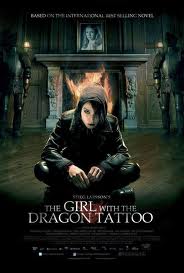
The flip side of the coin is books that actually worked better onscreen. As I wrote in an earlier post, I was underwhelmed by THE GIRL WITH THE DRAGON TATTOO. Interesting characters and one interesting plotline (out of two), but any positives for me were lost in what appeared to be an unedited manuscript.
The screenwriter did the smart thing by focusing on the main storyline, eliminating unnecessary details, characters, and red herrings, and condensing it all into something that I thoroughly enjoyed.
Granted, it’s rare, but those few times that a filmmaker manages to improve upon a book, the end result is remarkable (I still think that the cinematic ending of ABOUT A BOY was superior to Hornby’s original). One of the listservs I frequent is currently engaged in a heated debate about the casting for the film version of Evanovich’s ONE FOR THE MONEY. Is Katherine Heigl the right actor to portray Stephanie Plum? She’s not what I imagined for that character, but given her comedic flair, she might surprise me. And how about Angelina Jolie as Kay Scarpetta? Apparently so far Cromwell’s fans are voting 10-1 against the casting. But is the issue that they think she’s wrong for the role, or that they just can’t imagine any actor matching what their imagination conjured up for that character?

So which books would you never want to see on the big screen? And conversely, which movies do you think in the end produced a superior experience?

Technology and You

Overdrive software ( http://www.overdrive.com/) allows patrons to download ebooks and audio books from their local library. It’s not necessary to own an ebook reader. Anyone can download these files to a computer, smart phone, or Apple device.

I’m happy that my out of print books reissued in ebook format are now available for this market. As for me, all I can do on my cell phone is make calls, send text messages, and go on the Internet for brief intervals. Would I really want to check out a virtual book from the library for 21 days to read on my phone? Would you? And what happens after your three weeks are done— the book vanishes from your device? What if you haven’t finished the story?

An article from the Sun-Sentinel titled “Libraries go high-tech with audio, e-books” by Doreen Christensen says you can read ebook library titles on the Sony and Nook readers and soon on the iPad. Or on your phone, if you have an iPhone, Droid, or Blackberry. This is great for old folks or people who can’t get around, but do they possess these devices? If not, that leaves it up to tech savvy young’uns and middle agers to download ebooks and audio. Young people today are growing up with these devices, but what about the rest of us raised in the day when computers didn’t exist?

In addition to computer classes at our libraries and adult education schools, I think we need to add hands-on workshops on How to Work the various gizmos. Here are some topics I’d suggest:

  • How to Choose a Smart Phone.
  • Which Ebook reader is for you?
  • How to download a pdf file to your Ebook reader.
  • Playing an Audio Book on your Handheld Device.
  • How do you convert your doc format into a readable file that works on your device?
  • What else can you do on your phone besides make a call?
  • What’s an App?
  • I want to check movie listings and order a pizza. How can I do it on my device?
  • How to browse the library shelves from your home office.

We have all these wonderful options now, including borrowing books from the library by a simple download onto our smart phone or ebook reader. But the more technology advances, the more we need someone to demonstrate what we can do with these wondrous devices. What kinds of questions would you want answered?

Promotion versus privacy

The importance of online privacy is an emerging issue for the public at large, including writers, read more about why that is here. Recently Newsweek ran an article about American authors, including J.D. Salinger. A photo of the famously reclusive writer shows him in his bedroom. As the article points out, the viewer can’t help noticing the industrial-strength lock on his bedroom door. The image of the lock underscores the way Salinger guarded his privacy ferociously for nearly a half century.

I don’t know whether Salinger owned a computer (we’ll probably find out in the upcoming biography, The Private War of J. D. Salinger, by Shane Salerno and David Shields), nor do I know what he thought about the way most authors go the opposite way today. We typically court publicity (and sales) by using social networking, publicists, and other self-promotion strategies. But I’m sure he would have frowned on the loss of privacy that follows in the wake of becoming “known,” even to a small degree. Before their first published book hits the store shelves, authors are often advised by publishers: Get a web site; get on Facebook and Twitter; start a blog (The Kill Zone, by the way, is one byproduct of my being given that advice by my own editor).

What is the privacy downside of all this online activity during an age in which almost everyone has a “public” face? For children, the threat of Internet predators is an obvious concern. But what about the rest of us? I’ve had my own minor brush with the downside of posting too much information online. A few years ago, someone reached out to me via my web site’s email; we exchanged some pleasantries. Then, the day after Christmas, as my family gathered in the living room in the traditional post-holiday food coma, the doorbell rang. A messenger delivered a package–inside the box was a gigantic, framed portrait of me. It turns out that my “friend” had commissioned a painting based on a web photo of me, and had it delivered to my daughter’s house(!). As we put the thing on the couch and gaped at it in all its life-sized  glory, my brother-in-law said, “That’s just wrong.”


With that incident serving as an alarm bell, I started reducing my online footprint. I haven’t gotten to the point where I lock my Facebook and Twitter posts, but I’ve tried to raise my awareness of the unintentional information that can be mined from online activities. One thing I’m grateful for is that my pen name is different than my married name, so there’s a slight privacy firewall between my social and professional identities.

Whether you’re a writer or not, here are some things everyone should consider when posting online:

According to the NY Times, burglars have targeted houses based upon people’s Facebook updates.

When you upload a photo that was taken with a smart phone, people can determine your location. For a demonstration, see I Can Stalk U. (You can turn that GPS function off, but many people don’t know it’s there.) This one’s really scary to me. If you click on the “Map It” link, you can see where the people posting their Tweets work or live, and they probably have no idea.

Sometimes one social network can “out” your identity from its sister site without your knowing it. In one example, people who thought they were playing music privately online were actually broadcasting their musical selections to their entire network.  More here. So imagine if all your cool friends discovered that you actually listen to Neil Diamond. The horror!

The most recent privacy-scare story I heard came from one of my friends: He joined a service that was supposed to manage all his social networks from a single point of control. His wife was linked to it, and as soon as it was turned on, all his past Tweets, plus every message he’d ever posted to chat boards, started scrolling before her on the screen. These missives included several to women that she considered to be…questionable. The poor guy had to endure a lengthy, detailed grilling about each and every one of them. He never unsubscribed from something so fast, he said!

How about you? Have you had any funny, odd, or horrible stories related to online privacy? Is privacy a big concern of yours?