The Self-Pub Adventure

I am about to dive in where others have gone before. I’ve finished revising my last backlist title. It took me quite a while, as the doc file is over 500 pages and I made lots of changes. Now comes the next stage, which is to hire a cover designer.
Wait, not so fast. First, I need to determine the back cover copy. That’s not so hard. I can use the same one that’s on the original paperback with a few heading changes. But inside the book are more challenges. There are several introductory pages containing an excerpt, review quotes, and a dedication. I ditched the latter, as those people no longer apply to my current career. The excerpt and quote are reusable with some slight modifications. But what now? Do I add them to the front of my doc file? Should I include a title page? Maybe on Smashwords, these things are delineated, but I haven’t gone there yet to read the requirements. First I have to get a cover.
Getting a cover will probably necessitate filling out a description of the hero/heroine and a suggested background scene. I already have a list of cover artists garnered from other authors’ online posts. But now I must prepare these materials for when I contact one of them. Hopefully the artist will determine the proper fonts and where to put my name and book title. And I have to remember to state somewhere that this book was previously published and written under a pseudonym.
This whole process seems daunting, but I’d like to use this book as an experiment. Because who knows, if my current works on the market fail to sell, I may choose to go this route. Or I may just get tired of waiting for a response and then waiting another year or two for the book to be published.

It’s a scary thought for an author who has only sought traditional publishers or legit e-book pubs before. Plus, self-published works are still not accepted by many reviewers or booksellers for signing events, so there is a certain loss of prestige.
I know some of you have already cast off the shackles of print publishers and ventured into this new territory. Are you happy with your choice? How many of you have done it for original works?

Cyborg Author: Not Another Conspiracy Theory!

By: Kathleen Pickering

I can enjoy a good conspiracy theory, just like any other paranoid earth-dweller. Today, however, I discovered that an author’s worst nightmare has come to life: A Robot Writer.

thumbnail[3]The conspiracy? They say this new cyborg writer, just born in late 2010, was developed to turn statistics and sports writing into entertaining information, but I just know there is a Dr. Frankenstein out there building my double in robot form. I am seriously thinking about taking my writing arm underground before they invade the matrix and find me through my computer!

The company? Narrative Science, out of Chicago. (I hate to say their name out loud for fear they’ll hear me and discover my hide-out! After this point we shall call them, They who shall not be named. Or, for short: TWSNBN)

The reason for my dismay? The damned cyborg is good! It’s writing was put up in a contest against a rookie sports writer and won. Here was the robot’s take on a ball game:

“Tuesday was a great day for W. Roberts, as the junior pitcher threw a perfect game to carry Virginia to a 2-0 victory over George Washington at Davenport Field.

Twenty-seven Colonials came to the plate and the Virginia pitcher vanquished them all, pitching a perfect game. He struck out 10 batters while recording his momentous feat. Roberts got Ryan Thomas to ground out for the final out of the game.

Tom Gately came up short on the rubber for the Colonials, recording a loss. He went three innings, walked two, struck out one, and allowed two runs.

The Cavaliers went up for good in the fourth, scoring two runs on a fielder’s choice and a balk.”

See? I’d have to give ol’ Robo an A+. Not good! I visited TWSNBN’s website. This is what their creator says:

We tell the story behind the data. Our technology identifies trends and angles within large data sources and automatically creates compelling copy. We can build upon stories, providing deeper context around particular subjects over time. Every story is generated entirely from scratch and is always unique.

Sorry. That sounds like fiction writing to me. I just know they’re planning on hunting us authors down, will carve out our brains and make body doubles of all of us.

Beware, my author friends. Articles already written about TWSNBN state that their Cyborg’s talents will make some writing by humans obsolete. I can just hear my editor now: “Um, Kathleen, you know we just love you, um, but, we have to let you go. I’d like you to meet your replacement:

thumbnail[4] Kataborga Pickerbot. No hard feelings. Really.”

We’re doomed, I tell you! Sigh . . . and to think, I just got started in the writing world. Talk about bad timing!

Gender in Writing (or VS Naipaul’s Talks Tosh)

by Clare Langley-Hawthorne

Last week VS Naipaul inflamed a fair bit of controversy when he declared that there was no female author whom he considered his equal. Setting aside the sheer stupidity of such a statement (and the question of his own mental state) I found it interesting that he felt that he could tell “within a paragraph or two” whether a piece was written by a woman. According to Naipaul women have a sentimental, narrow view of the world which comes across in her work as “feminine tosh” in his view (yes, my hackles are rising as I type this).

Now our very own Kathryn Lilley raised the issue of ‘gender detection’ in writing in a blog post a while back and, if memory serves me right, we all submitted a paragraph to a website (possibly gender genie) to have a computer program evaluate an author’s gender based on the words used. I also seem to recall that this so called assessment misdiagnosed a number of pieces – so I continue to wonder, can you really tell if a woman or a man wrote something??

For my part, I doubt I would be able to distinguish a thriller by our own Michelle Gagnon from those of her male colleagues (except that I obviously have read her work and know it). Indeed many female writers have been mistaken for being male writers (some deliberately choosing to adopt male pseudonyms as well) so you have to wonder what planet Naipaul is on. I wouldn’t know that PD James was a woman from reading her Adam Dalgliesh novels just as I wouldn’t have guessed that a mother and son were the mystery author ‘Charles Todd’. There are also just as many book written by men that, had I not known that, would have assumed were written by women (Snow falling on Cedars and Room with a View, to name just two). Even in the literary sphere has Naipaul not heard of Currer, Ellis and Acton Bell or George Elliot??

But, rather than continuing to rant (VS Naipaul isn’t worth it), let’s focus on the nitty gritty – can you honestly tell if a novel is written by a man or a woman?

Doing the Asimov

James Scott Bell

Fiction writers are nuts. Crazy. Not right in the head.
           
You have to be, at least a little bit. I mean, you want to make stuff up and expect to get paid for it? You want people to give you money for lying? You could go to law school for that. Why write?
You want to invest years of time plugging away at fiction with no guarantee of return? You want to endure the looks of pity and scorn you get around the Thanksgiving table when it’s your turn to talk about what you do?
           
Yes, we’re all more than a little unhinged in this game.
           
Sometimes, it gets even crazier. Like now.
           
I’m doing “The Asimov.”


Isaac Asimov was one of the most prolific authors of all time. Something north of 500 books. Not just fiction, but science, history, Shakespeare scholarship, biblical studies, jokes. Sheesh, how did he do it?
           
By having no life, that’s how (he said so himself). Asimov had several typewriters around his New York apartment, each with a different project in it. When he tired of working on one he got up, stretched, walked across the room and went to work on  another.
           
He’d “snatch time.” If he had a fifteen minute wait for something – say, guests to arrive –– he’d write.
           
Writing madness, that’s what possessed him. And I fully understand it.
           
I’ve been working for days on edits of a manuscript, brainstorming new scenes for a novel in progress and reading pages for two projects on which I’m a consultant. This morning I revised a story and hammered out final details on my seminar. I looked at the clock. I thought an hour had gone by. It was lunchtime.
           
I made myself a steak sandwich and parked in front of the TV to watch a little ESPN while I ate.
           
I also grabbed my AlphaSmart Neo, the nifty, light, dedicated word processor that runs on AA batteries, upon which I am typing this essay.
           
Type. Eat. Watch. Stupid Dodger owner. Type. Eat.
           
Cut to:
           
The steak sandwich is gone. And I’ve got a blog entry almost done.
           
That’s The Asimov.
           
I have some writer friends who say they cannot do this. They can only concentrate on one project at a time. Personally, I think they’d find The Asimov refreshing. Taking a “rest” on one project lets the brain cells work on it under the radar.
But who knows? Brains are wired differently. That’s why we have Jersey Shore and Masterpiece Theater coming out of the same box. 
What about you? Can you work on more than one project at a time, with the same intensity? Or do you think that’s a ticket to madness?


It’s time for some ice cream now. Excuse me.

Best Advice Redux

By John Gilstrap

In the interest of full disclosure, I must confess that today’s post start as a response to Michelle’s post from yesterday regarding the best and worse writing advice we’ve received. Michelle pretty much nailed everything on the head, but there’s one more that plays to the heart of this whole author-as-marketer thing.

When my first book, Nathan’s Run, was published in 1996, the Internet as far as I knew it, consisted of the AOL Writer’s Club—singularly the best virtual writers’ hangout I’ve ever been affiliated with. Those were the days when you paid for online time by the hour. Between the newness of my writing career, the newness of the technology, and the overall coolness factor of it all, I spent a lot of time with my friends in the Writer’s Club. Enough time, in fact, that it prompted my editor at the time to issue the following bit of advice:

Don’t let being a writer interfere with actually writing.

Writing the next book is the single best thing you can do to gain support for the previous book. After a while, an author’s body of work becomes sort of a self-sustaining marketing tool. The poster child my editor named as the antithesis of this advice was Truman Capote, whose writing quality was, he believed and I agree, inversely proportional to his fame.


This advice resonates loudly with me every year when conference season rolls around. Properly selected and managed, I think that conferences are the single greatest marketing tool available to writers—both budding and established. The real work is done in the bar, whether you’re a drinker or a teetotaler. You just need to screw up the courage to talk to people. It’s not the place to pitch your books, but it is the place to meet and impress fans and industry people alike.

Even though I recognize the value of conferences, it would be entirely possible for an author to spend 75% of his annual allotment of weekends traveling the country and talking about himself. There comes a point of diminishing returns. I have my favorites—ThrillerFest, Bouchercon and Magna Cum Murder—which I try to make every year, and I might throw in one or two more if I’m invited or if it’s close to home, but that’s it. It has to be.

Standard book signings are to me a waste of time. Ditto book tours.

Facebook and Twitter are great as tools, but I believe they work best as subliminal pleas for business. If you post and say something smart, I might try your product. If you send me a direct request, the likelihood drops dramatically. For the life of me, I don’t understand why writers flog their work on writers’ boards. One or two posts per day on social media are ideal because I don’t think anyone does more than two things per day that are interesting enough to tweet about.

When all is said and done, I think the truth about effective book marketing is harsh news for new writers: You’ve got to build a fan base, and the only way to do that is to churn out a consistent stream of good product that is appropriately priced. Every minute of self-promotion that takes away from your ability to churn out at least one book per year (but probably no more than two), is doing so little good as to perhaps be doing harm.

The Best and Worst Writing Advice I Ever Got

by Michelle Gagnon

On June 12th, bright and early Sunday morning, I’ll be offering suggestions on how to run great book presentations and events at the California Crime Writer’s Conference in Pasadena. Which I’m excited about, despite the fact that it requires me to dust off my poorly honed Powerpoint skills. (And the fact that although I like to believe that I’ve given some great book events, others have been merely mediocre, and there was one memorable time when Simon Wood and I sat alone in a store playing Scrabble for an hour).

But today, I was offered yet another panel at the conference. In my opinion, an even better one entitled, “The Best and Worst Advice I Ever Got.”

The only problem is that it’s a mere hour long. And honestly, after just five years as a published author, I could probably hold forth for at least a few hours. I’m sure that Jim, Gilstrap, and Miller could carry it along for at least twice that long (in fact, perhaps we should host an impromptu version of the panel at the Bouchercon bar in St. Louis).

So I’m going to use today’s post to start consolidating my thoughts. Let’s start with the positive, shall we?

Best Advice:

  • Don’t quit your day job. Of course, if you received a seven figure advance, you might want to consider quitting it. But it’s a good idea to wait and see how that first book sells before you march into your boss’ office and hand in your resignation along with a few choice words about where he/she can stick it. Far too many authors have fizzled out after a few books (particularly those who didn’t even come close to earning out those huge advances).
  • The majority of the marketing burden rests squarely on your shoulders. At the first conference I attended, many of my illusions were shattered when I learned that it was highly unlikely that my publisher would organize (or pay for) a book tour, advertising, or even bookmarks. Sure, it happens. But more often, it doesn’t, which means that much of your writing time gets devoted to figuring out whether or not people really want magnets of your book cover (more on that later, in the “worst advice” section).
  • Don’t spend your entire advance on marketing. Seriously, don’t. There are people who will tell you to do just that (so let’s consider that an addendum to the “worst advice” column). If the advance is just gravy to you, then sure, it might be worth it. But the sad truth is that most marketing dollars end up getting wasted. It’s all a matter of picking and choosing. And hey, you’ve managed to get an advance. Go out and buy yourself something nice with at least part of it, preferably something other than magnets.
  • Use the Social Networks Sparingly. In January, Sisters in Crime released a comprehensive study of what influences mystery readers to purchase books. And the social networks (including book specific sites such as Shelfari and Goodreads) came out at the bottom of the list, below author newsletters and postcard mailings. If you use these websites as your virtual water cooler (as I tend to), then enjoy them. And yes, you will occasionally sell a few books thanks to them. But they won’t help you hit the bestsellers list, and they tend to suck away writing time like an out of control roomba.

Worst Advice:

  • Send a quirky mass mailing to every independent bookstore. This advice came from an renowned author who claimed that sending a copy of a profile piece from a major paper along with a personal note to booksellers propelled him into the top ten on the New York Times list. Who could argue with that? So for my debut novel, I spent a serious chunk of my marketing budget (and countless hours) coming up with a cute, quirky tie-in to my storyline (wood chips burned with runes, if you must know), and a letter introducing myself and the basic plot. It was during the third event on my tour (the tour I organized, of course) that the bookseller gave me a blank look when I asked if she’d received the mailing. She proceeded to pull out an oversized garbage can, pointed to it, and said, “I fill this up twice a week with the crap people send us. We don’t even bother opening it anymore.” Ouch. Lesson learned.
  • Flog that book on the social networks like it’s a half-dead mule carrying twice its body weight up a mountain. Okay, no one actually ever told me to do this, but apparently someone is offering that advice. Because every day someone on Facebook adds me to a group created solely to promote their book, or adds my name to their newsletter list, or tweets repetitively about it. I’m not saying that there isn’t a place for some BSP, but there is definitely a line, and far too many people are crossing it these days. I finally stopped participating in Amazon reading groups because half the postings were shameless plugs. Enough already. As noted above, a grand total of 4% of book purchases can be credited to Facebook and Twitter.
  • Hire a publicist. Oh, how I rue this one. Even more than the rune mailing. Because unless you’ve got a hardcover book coming out with a major hook, and the cash to hire a serious promotional firm (five figures, not four, generally speaking), a publicist is a tremendous waste of cash. Thanks to mine I ended up on a radio call-in show based in Tuscaloosa whose host was a conspiracy theorist with a fondness for sound effects, particularly air horns. And I was a guest on the show for two solid hours before finally asking, on air, how long I was supposed to keep talking. When he said, “All night, baby, we’re just getting started,” I hung up. They weren’t all that bad- but I very much doubt that anything the publicist did helped.

And now it’s time for audience participation. Let’s hear it: the good, the bad, and the just plain ugly advice…

Tips on Pitching your Manuscript

By Joe Moore

At this year’s ITW ThrillerFest VI (July 6-9) we’re once again featuring a portion of the conference called AgentFest. AgentFest is a perfect example of why ThrillerFest is and will always be held in the heart of the publishing industry, NYC. Why? Because this year, we have 60+ top agents and editors from the biggest New York houses ready to hear your pitch and find new talent. This number could not come close to being achieved in any other location or city.

We all know how important it is to prepare when pitching a manuscript to an agent, whether it’s at AgentFest or any other occasion: look professional, act professional, be able to summarize your premise in a couple of sentences, and know that not every book is right for every agent (most of the time, that’s why they say no).

But what about those things you don’t want to do; those things that could wreck you presentation or turn off the agent? Here are a few pitfalls to avoid:

Never refuse advice or feedback. Even if the agent or editor is not interested in your book, many times they will offer suggestions or advice on making it more marketable. Never have a closed mind and think that it’s your way or the highway. Professional agents know the market and are aware of what the publishing houses are looking for at any given moment. Also remember that just because an agent is not interested in your book doesn’t mean the book is not publishable. It’s just not for them.

Don’t begin your pitch by saying that “everyone loves your book. Of course they do, because everyone is probably your family and friends, and the last thing everyone wants to do is hurt your feelings. If they were completely honest with you, it would be like hitting your ego with a sledgehammer. Now on the other hand, if Dan Brown, Ken Follett or Stephenie Meyer read your manuscript and loved it, I would mention that somewhere right after "hello".

Don’t be a pest. By that I mean sending the agent multiple emails, phone calls, letters, presents, or anything else that would quickly become annoying. If the agent says no, the likelihood of you turning them around with a box of Godiva chocolates is not good. Send it to me instead.

Don’t suggest that if the agent wants to know all about you they can visit your website or blog. It doesn’t matter if Michelangelo designed your graphics, James Patterson wrote your text, and Lady Gaga composed the music for your book trailer. The agent doesn’t care. All she wants to know is: who are you, what is your idea, and can you present it in a logical, concise and professional manner.

Even if your manuscript has been rejected before, don’t volunteer that information. As far as the agent is concerned, they’re getting the first look at your idea. They’re also realistic and know it’s probably been pitched before. And the fact that you’re standing there means that if it was, it was rejected. Always remember that rejection is as much a part of the publication process as line editing or cover design. It happens to everyone. Move on.

Don’t claim that no one has ever written anything like your book before. If that’s really true, there’s probably a good reason no one has. But trust me, claiming that what you’ve written is a brand new idea is as compelling as claiming you have the winning numbers for tomorrow’s lotto. What you might want to do is suggest that you’ve completed a unique and original treatment of a well-established theme or premise. That will make sense to the agent.

Never say that your book is going to be the next blockbuster or that it should be made into a movie. The top professionals in the publishing and motion picture industries cannot predict with certainty what will be the next blockbuster or bestseller. Neither can you.

In general, always assume that an agent or editor has already heard every variation on a theme there is, because they have. Much of your success in capturing the attention of an agent is you, not your story. Be enthusiastic but not obnoxious, knowledgeable but not condescending, proud but not conceded, prepared but not pushy. And most of all, be friendly and professional. Your presentation is a foreshadowing of what it would be like to work with you. Agents don’t want to spend a year or more in a wrestling match with a jerk.

Remember that literary agents and editors are people, too. Yes, they can have a tremendous impact on your writing career, both positive and negative. But just like the rest of us, they get excited when they hear a great idea. Treat them as people, not gods.

If you practice all these tips and you have a killer idea for a book, there’s a good chance the agent will hand you her business card and ask for a partial. And if by chance, she asks for a full, go celebrate. You’ve accomplished more than most ever will.

Any other pitching tips out there?

————–
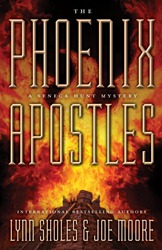
THE PHOENIX APOSTLES is now available online. In stores June 8.

Reflections on the “R” word

Note: Like Clare, I’m in a topsy-turvy environment this week–a beloved family member has come to live with us (my father-in-law, who is 93 years old). I’m entering a brave new world, trying to make sure we can successfully manage his needs in our hectic household. I’m not sure our rambunctious Lab puppy has gotten the memo–he’s already torn up a pair of Dad’s slippers.

Meanwhile, I’ve been thinking a lot recently about what rejection means to writers. At the writer’s groups I attend, people frequently talk about rejection. Someone will mention that an editor, agent, or magazine has rejected a submission. When this happens, everyone at the table nods in sympathy. They make encouraging comments like, “Keep sending it out. You have to go through a lot of rejection to get published.”

I’ve been sitting silently during some of these morale-boosting sessions. In these cases, I know that the submitted work wasn’t  publishable quality. Yet I’ve watched the writer toil over it in our group  sessions, rewriting and revising the work, sometimes for years. And it just hasn’t gotten to the level it needs to be.

Recently a member came to a meeting in tears. She’s been working on a novel for years. After laboring over the story with us, she showed it to a friend who is a published author. The friend went ballistic in her comments.

“She sounded so angry about the writing,” the woman said at our meeting. “Outraged, like how could I have been so stupid to think this was good?”

This woman felt blind-sided and abused by her friend, but I couldn’t help agreeing with the critique. The novel isn’t ready to submit–it’s nowhere close. And yet in our group sessions, we have this polite way of focusing on the good, while regretfully, almost as a postscript, mentioning things that need  to be fixed.

I think we let each other down by doing that. We have let this writer spend years on her novel,  thinking that it’s getting better, thinking that it’s going to be published, when there’s no chance whatsoever of that happening.

I don’t know what the best approach is in these cases. What do you do when someone’s writing doesn’t improve no matter how hard they work at it? Should you continue to encourage, or hit them over the head with a sledgehammer like this woman’s friend did? In the end, I think it was our group that let her down, not her critical friend (to whom she’s no longer speaking, by the way). We should have been more honest with her all along.  The problem is, you can lose a lot of friends and critique group members that way.

If you’ve made every suggestion you can think of and the writing hasn’t measurably improved, do you simply say, “This needs a page one rewrite–I’m afraid it’s not working at all.” I honestly don’t know what the right approach is.

What do you think?

The perfect panel

by Clare Langley-Hawthorne


While we continue to be in the midst of renovations (and eventually getting new floors from when we flooded earlier this year) I am trying to fit everything in while juggling workmen (not as sexy as it sounds), internet access and finding space to write (my office still contains most of the furniture moved in said flood), so blogging today was a bit of a challenge – and how can I possibly hope to follow on from Jim’s procrastination exercise yesterday?! By continuing the fun of course…

I thought we could come up with fabulous and funny panel topics and panelists for an imaginary writers’ conference entitled No, you really don’t want to be a mystery writer!

My contribution is for a conversation between Joe Konrath and Barry Eisler on the topic ‘The digital age apocalypse’ and a panel comprising our own John Gilstrap, John Ramsey Miller, Michelle Gagnon and Joe Hartlaub on ‘the bloodstained cozy rules’ or ‘why we secretly love mysteries involving fluffy kittens and little old lady detectives’.

So if you could, what panel title, and panelists would you chose?

Now back to those pesky renovations…be creative folks, I need a good laugh…sigh…


– Posted using BlogPress from my iPad