
The recent Edward Snowden affair reaffirms my belief that a) nothing in fiction is any where near as strange as reality and b) a good spy/traitor (is he/isn’t he) story is even more compelling in real life as it is in a story. As a mystery writer I love contemplating ‘what if’ scenarios and recent events such as these always make me look back at history and consider how I would craft a story based on some of the key events and people involved in ‘exposing’ state secrets or engaging in various levels of subterfuge or espionage.
No matter what you might think of the current Edward Snowden affair, it’s hard not to argue that it doesn’t have thriller appeal. It has a potentially unreliable narrator, the disclosure of secret and classified material, a desperate flight to an old cold war enemy, and the likely involvement along the way of various secret service agencies. It reads just like a thriller – no?
And with all this going on, I got to thinking about some of the more notorious spies and potential traitors in history and how it would be interesting to explore their stories. Indeed the inspiration for my third Ursula Marlow novel, Unlikely Traitors (due out in late fall – more on that later in the summer!), was Roger Casement, who was hanged as a traitor in 1916 for inciting rebellion in Ireland (and involving a possible collusion with Germany). I would also love to explore the story of another spy of the same era, Sidney Reilly, the so called “Ace of Spies”, because the ‘truth’ behind both these stories are so elusive.
So for all you thriller writers, which spy (or alleged spy) would you most like to write about and why? What era/personalities intrigue you the most? Is there any real life story that you are itching to tell because, as with Edward Snowden, the truth is even more bizarre than fiction?
We Are All Long Tail Marketers Now
by James Scott Bell
@jamesscottbell
The traditional book publishing industry, God bless it, is hacking and wheezing its way toward the uncertain future. At the moment, the digital transition has given the industry a revenue infusion. Where a hardcover sale has been replaced by an e-book sale, the publisher makes more per unit (under the current industry-wide royalty structure. See also the discussion led by Porter Anderson here). Challenges remain, of course, as authors and their agents press for a larger slice of the electronic pie, and more and more authors head straight for the self-publishing forest.
But for all who are in the book biz (be they traditional, indie or hybrid) now is the time to understand that we are entering the age, permanently, of the “long tail.”
What is long tail marketing? Very simply, it holds that the profitability of a business (usually small business) is directly proportional to the number of products it has for sale over time. The more products—factoring in quality, of course—the longer the tail. Instead of looking for the next, big thing, a business may sell “less of more.” The term Long tail marketing was popularized in a 2004 article in Wired magazine, and looks like this:
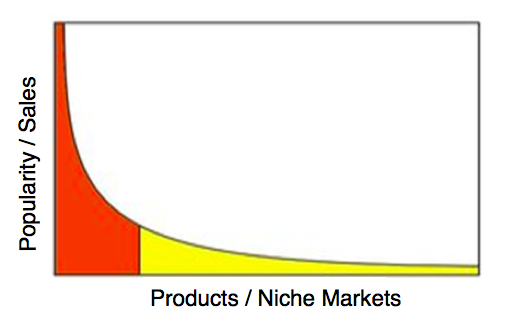
Old school thinking focuses on the red zone of the diagram. The frontlist. The blockbuster. The big roll out. Backlist is largely left alone.
Self-publishing writers, the ones who are making some good money at it, go at it the other way. Volume is the key. That’s what wags the long tail.
Traditional publishing is beginning to recognize this, and thus is asking its A list writers to produce more, faster, and even to supplement front list with shorter works.
In other words, we are all long tail marketers now.
Many self-publishing writers miss something, however. I hear and read laments from writers just starting to self-publish and who haven’t seen substantial sales. They think that means failure, or that the game is really about “luck,” or that there’s no way through the “discoverability” barrier. But that’s old school thinking. The long tail is not about a title or two spiking its way up the Kindle list a month after release. That’s nice when it happens, but the real meat is quality product added over the course of time.
As I put it in my book on self-publishing, the final “law” of success is to repeat the production-publication cycle over and over for the rest of your life. Why not? If you’re a writer, this is what you do until you can’t do it anymore, right?
Yes, you need quality control. That’s a law, too. But here’s another aspect of the long tail: single title “duds” are not fatal to a career. All writers in the traditional world know that they are only a dud or two away from being unemployed. Innumerable are the tales of authors getting nice advances, having the books disappoint the sales department, getting dropped by their publisher and not being able to find another (or having to go to with small, niche publisher) because of lousy numbers.
Self-publishing’s tail is the reverse of that scenario. If a book or two is a “dud” it doesn’t mean that you can’t produce a better book next time. It doesn’t mean “career over.” It is just another opportunity to get stronger.
Further, you can try out new niches for a spot on the long tail. In old school thinking, you are tied to a single brand. In the new school, you can play. You can create works of any length. You can start a series based on a lark and let the readers decide if it continues. And know this: even something that doesn’t sell all that well can still make you Starbucks money. No harm, no foul!
Some other things the long tail means:
You don’t need to win awards.
You don’t need the approval of critics.
You don’t need co-op or front of brick-and-mortar store placement.
You don’t need blurbs from star authors.
You don’t need co-op or front of brick-and-mortar store placement.
You don’t need blurbs from star authors.
You don’t need to be #1 on any list.
You don’t need a movie deal.
What you need is optimism, a work ethic and consistency. Then you will grow an audience that is fitted for you. You might even make a living at this eventually. But even if it’s only a supplemental stream of income, that’s a nice thing to have feeding your bank account every month.
If you are a traditionally published author, you need to at least set up a footprint in self-publishing. Talk to your agent and editor about this. Think in terms of non-competitive and complementary short-form work. That is platform building of the best kind.
If you are a traditionally published author, you need to at least set up a footprint in self-publishing. Talk to your agent and editor about this. Think in terms of non-competitive and complementary short-form work. That is platform building of the best kind.
That’s why all authors need to think long term, long tail. And keep writing.
[I’m teaching all day today, but I’d love to hear your comments. Have at it!]
[I’m teaching all day today, but I’d love to hear your comments. Have at it!]
The Opposite of Love
By Mark Alpert
In my last post I wrote about a novel I really admired, Billy Lynn’s Long Halftime Walk. And now, to be fair, I want to talk about literary disappointment.
I love buying books — it’s my only discretionary expense these days — but I’m picky about it. Before I purchase anything, I read the reviews in the Timesand the New Yorker. I ask friends and fellow writers what they’re reading. And even when a new novel gets raves from everyone, I don’t go running to the bookstore. Sometimes I’ll wait a whole year, till the paperback comes out. This kind of buyer behavior drives me crazy when I’m trying to promote my own novels. Why are you so reluctant, people? Come on, give my books a try! But that’s the crimped, cautious world we live in. We work hard for our money and we don’t want to waste it.
After conducting my usual due diligence, I was fairly certain I’d enjoy Wolf Hall by Hilary Mantel. It’s a work of historical fiction, focused on the 16th-century machinations of Henry VIII and Anne Boleyn, and I love reading about that period. The novel won the Man Booker Prize and the National Book Critics Circle Award, and it got a great review in the Times. And the book’s sequel, Bring Up the Bodies, was also widely praised. I was looking forward to reading both novels. As I turned to the first page of Wolf Hall I felt like a hungry diner at a five-star restaurant, about to tuck into a delicious gourmet meal.
Now I’m at page 200, about a third of the way through the book, and I’m feeling a lot less hungry. I don’t hate the book. I just don’t like it as much as I thought I would. The novel’s hero is Thomas Cromwell, a commoner who becomes an adviser to Henry VIII, and the fellow seems likable enough, full of interesting observations and unafraid to speak his mind. But I’m not really bonding with the guy. I feel like the author is hiding him somewhat, keeping him at a distance from me. Worse, I’m not seeing 16th-century England from his point of view. The place and time haven’t come alive. I’m getting the facts, but not the feeling of being there.
When something like this happens, when a much-praised book leaves me cold, I usually worry that it’s my fault somehow. Maybe I’m missing something. Maybe I’d really enjoy Wolf Hall if I knew more about Tudor England. Or if I had more of an English sensibility. But the novel’s flaws seem self-evident. It’s too damn slow. Characters are coming and going, but nothing is happening. And much of the narration is sketchy. Cromwell’s wife died long before I could get a good sense of who she was.
I’m going to keep reading the book. Maybe it’ll get better. I live in hope, that’s my motto. But I can’t get rid of the bitter taste of disappointment. Has anyone else out there felt this way? Not necessarily about Wolf Hall, but about any much-anticipated novel that fell far short of expectations?
Reader Friday: First and Last

First Page Critique – Bastion: The Last Hope

For your reading pleasure, we have what appears to be the start of a futuristic thriller focused on the military. Enjoy and look for my critique on the flip side. Share your thoughts in a comment that would help this brave author fine tune their intro.
Bastion: The Last Hope
A Web Serial
Chapter 1
Gunnery Sergeant Marianne Beaubien, USMC
Day: E-Day +2
Time: 0300 hrs CST / 0900 hrs GMT
Location: An airfield outside Madison, Wisconsin.
She was cold. Though the weather had been unseasonably warm for December, the temperatures at night still dropped into the forties, or “the singles” as she would have called them back home. Marie wrapped the blanket around herself a little more and refused to open her eyes. To save fuel, they had shut everything down, robbing her of the familiar hum of the engines. After their last close call the decision had been made to forgo putting the plane to bed which, while logical in the circumstances, still left her uneasy. Curled up in bits of survival gear, her cheek against the troop bench of the KC-130J air transport, falling asleep had been hard enough the first time; she had no desire to hamper its return.
She turned her head away from the rough straps and took another long breath of the cold air. The cargo ramp was opening, allowing the northern air to sweep up and down it at will. She forced her eyes shut. Sleep should not be a challenge. In the last two days she had totalled eight hours of rest, catching brief naps in between the mad dash to refuel after landing, and taking off again an hour or so later.
“Gunny.” A firm hand shook her shoulder. The shake was unnecessary. Her eyes snapped open as a surge of anxious energy filled her with the evocation of her rank.
“Sir?” The grim face of Maj. Thompson, the plane’s Aircraft Commander, stared back. He was a serious man, a dyed-in-the-wool-Marine-for-life. She respected him and all he had done for her over the last few years. Even now, she knew that he understood what was going on enough to see the crew through this.
“Wheels up in twenty eight minutes. We’ve got another storm coming.”
He did not say anything else, instead moving up the cargo bay and into the flight deck, presumably to begin preflight. She looked across the aircraft. One of her two crewmen, was wrapped in his poncho liners and completely asleep. Standing, she stretched and resolved to allow him another few minutes of sleep. His name was Cable but everyone called him Larry. She and Frias, who they all knew as Lefty, had managed the ground operations on their own, before she was ordered to get some sleep. It took a bit longer, but the tanks were filled, the fuel truck a fair distance away and all was in order for a quick departure. Frias was sent off to scavenge for parts and she was ordered to bed.
She looked at her watch and stifled a groan. 0300. Two hours of sleep was the longest she had managed since the first wave of meteors had hit.
My Critique:
Generally I am a fan of the intro tag lines that help a reader get an instant time and place setting, but too many lines and too much information (that I’m personally unfamiliar with) could have the potential of a reader skimming over what could be an effective tool to escalate the tension. (This reads like a futuristic setting with the reference to E-day+2, but I’m not sure without a year reference.) One of my favorite books where tag lines played an effective part was Tami Hoag’s NIGHT SINS. In the dead of winter in Minnesota, a child goes missing with the temperature dropping as the hope to find the kid alive diminishes with every passing minute. I found myself reading every tag line, watching the temp drop and the tension ramp up.
In the tag line set up, her name is Marianne, but in the intro, the name Marie is used. I’m not sure which to use in my critique, but I went with Marianne.
The opening sentence (She was cold) is “telling” the reader what she’s feeling, rather than finding a more effective way to “show” it. With Marianne wrapping tighter and shivering in a blanket, unable to get warm, that would say it. She could feel the urgency of needing to sleep, but unable to turn her mind off, waiting for an order she dreaded. (Haven’t we all been there and back.) That would put the focus on her and set the stage for the mystery of what her mission might be and why she’s roughing it, trying to sleep in a plane.
The line about the unseasonal weather is a snippet that took me out of her shivering misery before I really got a feel for her. Plus I was confused by how temps in the forties could be “singles” somewhere else and had to read the line again. She may be from Joe Moore’s neck of the woods, where everyone owns a dock out their back door. Where they drink alcoholic libations with little umbrellas, dress like Jimmy Buffett, have sand in every nook and cranny of their swim trunks, and call the dead of winter, “being in the singles.” (Joe-Don’t disappoint me. Do you have Buffett-wear? Speedos?)
The “to save fuel” line had me wondering what type of engine they had to shut down (the plane engine or a generator of some sort). I’m sure this is my ignorance, but an author needs to provide enough information that any reader can gather the gist of the story, at least in context. The fix would be simple by stating they’d shut down the plane engine. Also, they had shut down the engine, but in the next sentence it’s mentioned that they made the decision to forgo putting the plane to bed. Isn’t that a contradiction?
Also there is a reference to “the last close call” where they had made that decision to forgo putting the plane to bed. Hinting at a back story (that’s still slowing the pace here) without a fuller explanation of the danger they are in, isn’t presented in a satisfying way for me as a reader. I would tend to skim over this part to get at the meat of the situation and what she is all about, but I wouldn’t find those details in this short intro. There’s too many details that take away from what should be the focus of a more dynamic start.
This is a small inconsistency that took me out of the reading. In the first paragraph she “refused to open her eyes” and in the next paragraph, she “forced her eyes shut.” I can understand her being restless, but these statements are emphatic and perhaps should be less so, in order to show she can’t sleep.
The paragraph after she gets the “wheels up” order is again another slow paragraph laden with back story, crew information and nicknames,and functions for departure that are thrown at me. For me, that’s more to skim I’m afraid. It’s not until I see the last line about “first wave of meteors” hitting that I know something about why she is there. The author can savor that choice tidbit and save it as a means to draw the reader into the next action of the crew’s take off, but in my opinion, there needs to be a laser sharp focus on the uncomfortable conditions, the restless tension of her and her crew, the anxiety needs to be there, before the reader learns about the meteors. Instead we get details on sleeping patterns, too many crew member names (with short back stories) who haven’t played a part yet, and military jargon and procedures that slow the pace and distract from the story.
I’m wondering if this is the right place for this book to start. I can see the timing almost there, but the focus needs to be on the human element and the tension that keeps her awake, until she gets the order to move. Then it should be hit the ground running, get the reader into the action as they deploy in a rush.
I would have a hard time turning the page of this story as is, except that the idea of meteors hitting the earth and what the military can do about that, would intrigue the hell out of me. I think this author has a very compelling premise that I would love to read, if this intro could have better pace with more laser focus on the human story of Marianne, her crew, and earth’s peril.
In a nutshell, my advice would be to stick to the action and explain later.
What do you think, TKZers? Comments please.
Beta Readers
by Joe Moore
Recently, we received an email from Beth MacKinney, one of a TKZ friends, asking the question: “I’d like to know what guided questions an author can give to her beta readers to get the most helpful feedback from them.” I posted a blog on beta readers back in March, 2011. Below is a revised version of that blog to answer Beth’s question. Since many of my TKZ blog mates also use beta readers, I’m sure they will chime in with additional thoughts and tips.
A lot of writers including myself rely on beta readers to scrub our WIP and find all the plotting holes, mistakes, and general stuff that doesn’t work. So what is a beta reader? Should you go looking for one? How do you find and qualify them? How do they differ from a critique group? What are the things to look for in their feedback?
The term beta comes from software designers who use the term alpha and beta for different stages of program development. Alpha is the rawest stage—incomplete and untested—and beta is still under development but a small number of copies are released to the public for testing. In novel writing, this might be the first completed version of the manuscript where the author has made at least one pass through to edit and tweak.
A beta reader is someone whose opinion you value, who’ll take the time to read your manuscript in a timely manner, and who’ll give you an honest assessment of your work. For starters, I would mark off your list of potential beta readers anyone who is related to you, works with you, or lives in your immediate neighborhood.
Should you utilize a beta reader(s)? It depends on whether you’re working on your first unpublished manuscript or are further along in your writing career. Most beginning authors are searching for anything that will build up their ego and confidence, and keep their hopes alive. And most new authors have manuscripts that are littered with flaws and mistakes—it’s part of the learning process. Weak or unqualified feedback from others can cause a new writer to become confused and/or discouraged. And their hopes and dreams can be crushed by negative feedback. Or their egos are so artificially inflated that negative criticism can cause friendships and relationships to crash.
At the same time, established authors know the value of real, honest, sincere feedback and will react in a professional, business-like manner. Beta readers are a solid tool toward writing a better book.
In recruiting beta readers, try to line up at least three to four that are willing to take the time to not only read your work but give you constructive feedback. It’s also good to mix male and female readers. In general, try to find age-appropriate readers that are familiar with your genre. A female teen may not give you the feedback you’re looking for if your manuscript is male action/adventure. If you write YA, a retired senior citizen might not be the best choice, either.
Try to choose beta readers who are not acquainted with one another. And they don’t have to be your best friends. In fact, casual acquaintances could work better since there might not be a hesitation that they will hurt your feelings if they don’t like what you’ve written. There’s a good chance they’ll take the whole process more seriously than a relative or close friend.
Don’t ask your beta readers to line edit your manuscript. Tell them to ignore the typos and grammar issues. What you’re interested in is: Does the story work? Does it hold together? Are the characters believable? Can you relate to them? Are there plot contradictions and errors?
Beta readers differ from members of a critique group in that they measure the WIP as a whole whereas groups usually get a story in piecemeal fashion and focus in on a chapter at a time. Most critique groups also deal with line editing.
So once you round up your bevy of beta readers and send them your WIP, then what? Start by listening to their feedback. If your beta reader has a problem or issue, chances are others will, too. And most important is when numerous readers raise the same issues. That should be a red flag that there’s a major problem to address.
Other tips: Don’t be defensive. Sure, we all love our words—after all, they’re hard to come by. But comments from your beta readers are meant to be helpful and constructive. Don’t take offense. Take what they say to heart. Think about it for a while. Consider that they have a valid point and are not trying to tear down your writing.
Finally, always remember that it’s not personal. If it is, you chose the wrong beta reader. Regard the feedback as if you were giving input to a fellow writer.
How about the rest of you guys. Do you use beta readers? Are you a beta reader for someone else? Any additional qualifiers to choosing a beta reader?
Are rules made to be broken?
By P.J. Parrish
Imagine you have just bought a novel. You haven’t read this author before but the cover was enticing, the back copy juicy. So you took a chance on a new writer. You are ready to be thrilled, chilled and transported to a place you’ve never been before.
Then you begin to read Chapter One. It’s written in the first person so the protag is identified only as “I.” I love first person novels because the reader-writer-protag bond is immediate and intense. Remember how Steve Hamilton opened his first novel A Cold Day in Paradise? – “There is a bullet in my chest less than a centimeter from my heart.” You gotta read more after that, right?
But what if you read page after page, chapter after chapter, and you never find out who “I” is? You never get the protag’s name. You don’t even get what gender “I” is. The only thing you finally learn about “I” is that “it” is a PI. And what if this goes on for the entire book?
It gets worse. What if you are never told where the story takes place? Or what year (or century!) it is. How long would you follow “I”? And how transported would you feel?
Okay, this is not a hypothetical. This is a real author. When I asked why this author chose to take this approach the author told me, “I did it on purpose. I didn’t want the reader to know his name or where it was taking place.”
Why? I asked.
The answer: “I’m trying to do something different because I want to stand out from the crowd. I didn’t want it to be the standard PI story.”
Well, this author had a point. It has always been hard to get noticed and get published traditionally. It’s even harder today. And it’s hard, even if you are self-pubbing via eBooks to get heard over the noise. And even if you do get published, it is hard to distinguish yourself in crime fiction as an original voice.
So where did this author go wrong?
This is just my opinion but I think it boils down to something very basic. This author tried to break the rules before he/she even understood them.
Quiz time. Who painted this:
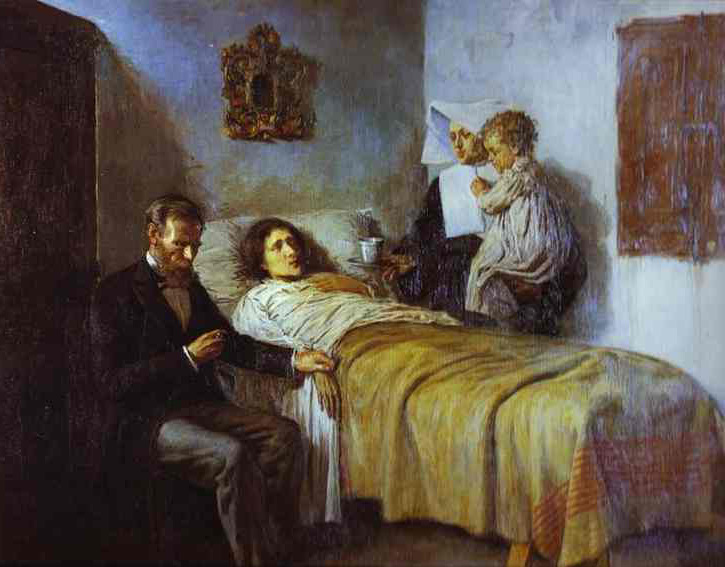
Yeah, that’s a hard one. Here’s an easier one. Who painted this?

Anybody guess Picasso? Well, he painted both. The first was done when he was sixteen. The second when he was fifty-six. My point is, obviously, that even Picasso mastered all the basic elements of his art, got his craft under firm control, before he was able to find his unique innovative style. When he himself said, “It takes a long time to learn to be young” he was not taking about finding his joie de vivre. He was talking about absorbing the rules and then finding the courage to throw off their shackles.
All artists know this. The great choreographer George Balanchine created traditional story ballets in the style of “Swan Lake” before he developed the plotless style that revolutionized dance. Acting teacher Stella Adler famously said, “Craft makes talent possible.”
But let’s get back to our author. I so understand his/her impulse. We all want to believe we are different. But one of the points of fiction – maybe the main one – is to communicate and connect. And if you break that rule, you have broken the near sacred bond of fiction.
Yes, rules are made to be broken. And no, you should never ape someone else or slavishly cleave to the dictates of a genre. But until you know the rules of good craftsmanship, you will never be able to, in Picasso’s words “learn to be young.”
Can I leave you with one more thing on this subject? The following comes from Emma Coats, a Pixar storyboard artist. They are “rules” and I found them really inspiring and pretty darn useful for us bookish types. Read, digest and talk amongst yourself!
Pixar’s 22 Rules of Phenomenal Storytelling
1. You admire a character for trying more than for their successes.
2. You gotta keep in mind what’s interesting to you as an audience NOT what’s fun to do as a writer.
3. Trying for theme is important, but you won’t see what the story is actually about ’til you’re at the end of it. Now rewrite.
4. Once upon a time there was______________. Every day____________. One day__________. Because of that__________________________ until finally _____________________________.
5. Simplify. Focus. Combine characters. Hop over detours. You’ll feel like you’re losing valuable stuff but it actually sets you free.
6. What is your character good at, comfortable with? Throw the polar opposite at them. Challenge them. How do they deal?
7. Come up with your ending before you figure out your middle. Seriously. Endings are hard, get yours working up front.
8. Finish your story and let go, even if it’s not perfect. In an ideal world you have both, but move on. Do better next time.
9. When you’re stuck, make a list of what wouldn’t happen next. Lots of times the material to get you unstuck will show up.
10. Pull apart the stories you like. What you like in them is a part of you, you’ve got to recognize it before you can use it.
11. Putting it on paper lets you start fixing it. If it stays in your head, that perfect idea, you’ll never share it with anyone.
12. Discount the first thing that comes to mind and the second and the third and the fourth and the fifth. Get the obvious out of the way. Surprise yourself.
13. Give your characters opinions. Passive, malleable might seem likeable to you as a writer but its poison to the audience.
14. Why must you tell THIS story? What’s the belief burning within you that your story feeds off of. That’s the heart of it.
15. If you were your character in this situation, how would you feel? Honesty lends credibility to unbelievable situations.
16. What are the stakes? Give us reason to root for the character. What happens if they don’t succeed? Stack the odds against them.
17. No work is ever wasted. If it’s not working, let go and move on. It’ll come back around to be useful later.
18. Coincidences to get characters into trouble are great; coincidences to get them out of it is cheating.
19. You have to know yourself. The difference between doing your best and forcing the story is testing not refining.
20. Here’s an exercise: take the building blocks of a movie you dislike. How would you rearrange them into what you DO like.
21. You gotta identify with your character’s situations. You can’t just write cool. What would make YOU act that way?
22. What’s the essence of your story, the most economical telling of it? If you know that, you can build out from there.
Oh No! It’s Typo!
I’m nearing the July 1 release of my new book, THE LOCH NESS LEGACY, and the last step was to share the book with a few select beta readers so they could send me any typos they found. I didn’t think they’d find too many considering the book had already been copyedited and proofed by Little, Brown UK, which is publishing the book in the UK, Australia, and New Zealand (I’m self-publishing it in the US, except for Audible’s audiobook version).
My readers didn’t discover one or two typos as I had expected. They found over three dozen. To be fair, Little, Brown UK had already corrected some of them in their final version (I hadn’t transferred those corrections to my self-pubbed edition) . However, there were still a dozen that had escaped notice.
It’s infuriating, but a great lesson that I need to have others find the typos I’m blind to after reading the book over and over. And this isn’t a new problem for me, unfortunately. Check out the blog I wrote on my website four years ago, and then post a comment about your own exasperating typos.
——————————————
I hate typos. Despise them. They are vermin to be wiped from the face of the planet, ranking just below tapeworms and just above spammers trying to sell me herbal V1@gr@.
The irony is that, as I have discovered this past week, typos love me. They can’t get enough of me. Apparently, they get so distraught if they do not appear in my novels that they insert themselves without my knowledge just so they don’t feel left out of the fun.
After I posted my complete, polished novels to my web site and the Kindle, several alert readers notified me that they’d come across a few typos, which I’m grateful to know about so I can go back and fix them. That doesn’t mean I don’t need a moment to gather myself after finding out about them, because my reaction is usually something like this:
ARRRRRRRRRRGGGGGGGGGHHHHHHHHH!
I add in some very bad words if I want to be even more articulate.
The reason for my frustration is that I proofread my books very carefully to make sure they are as error-free as possible. I spend hours reading and rereading the novels until my eyes glaze over and I can’t see straight. I don’t see how that method can fail.
And yet, it does. My most frequent typos are of the mixed-up variety. I type “their” instead of “there” or “your” instead of “you’re.” Of course, this kind of error can lead to some amusing outcomes. A few years ago, when some striking union workers felt they were being taken advantage of by management, they didn’t help their cause by carrying placards saying, “The managers think your stupid!”
But I can see how I might miss something like that. What I can’t understand is how I used a word like “valediction” in place of “valedictorian.” I’ve never used “valediction” in a sentence in my life. In fact, I had to look up what it meant (Val*e*dic*tion: a word Boyd never uses).
The worst typo I found, all by myself, was when I used “astronomist” instead of “astronomer.” Now, “astronomist” is not, technically, a word, so how both I and spellchecker missed it is a mystery, although some other people in the same situation might make wild accusations. For example, I would never start the rumor that Microsoft Word randomly inserts nonsense words into a person’s writing just for the enjoyment of programmers who get hilarious emails every time someone sends out a document with the word “squatful” inserted into it. That would be irresponsible.
Besides, I can’t depend on spellchecker because it’s not always reliable. It hasn’t happened lately, but it used to be that when I typed “Boyd Morrison” into Word, it would underline the words in red, diligently alerting me that I had misspelled my own name. When I asked spellchecker for a better suggestion, it came up with what should have been so obvious to me: “Body Moron.” Perhaps it was suggesting a new pen name for me.
I can take comfort in the fact that even NY Times bestselling authors have books with typos. My friend, James Rollins, whose books are epic action-adventure stories that I gobble down in about a day, wrote The Last Oracle, the cautionary tale of what happens if you stand too close to a molten nuclear reactor (hint: it involves the words “brain” and “tapioca”).
Toward the end of The Last Oracle, I found the sentence, “Her entire form shook as teats spilled in shining streaks of joy.” Jim, of course, meant “tears”, but when I tried to imagine the scene as written, I laughed so hard that the person sitting next to me on the airplane thought I had a medical condition.
When I wrote an email to Jim with praise for the book, I also told him of the typo. He emailed back just one sentence: “I read your kind words with teats in my eyes.”
So I suppose, like Jim, I should keep a sense of humor about typos and their affection for me. I mean, what’s the worst that could happen? It’s not like I could get saddled with some kind of ridiculous nickname just because of typos.
Sincerely,
Body Moron
A Key to Creating Conflict in Fiction
Today’s post is brought to you by Conflict & Suspense, two things every novel needs. Yes, every, no matter the genre.
I’m not just talking about plot here, but characterization, too. It’s this latter aspect that some writers fail to take full advantage of. To illustrate, let me talk about one of my favorite movies of all time.
12 Angry Menis the 1957 film directed by Sidney Lumet, written by Reginald Rose (based on his play). The plot is disarmingly simple. Twelve jurors deliberate in a capital murder case. The entire drama, save for a short prologue, takes place inside the jury room.

At first, the verdict seems like a done deal. All the early chatter is about how guilty the defendant is (he’s a slum kid, accused of stabbing his father). One of the jurors (Jack Warden) has tickets to the ballgame and would love to get out early. Others don’t see the point in spending a great deal of time actually deliberating.
They take an initial vote. And only one juror, Number 8 (Henry Fonda), votes Not Guilty. Everybody else grumbles.
And for the next hour and a half, we sit in on the deliberations.
The movie violates all the currently fashionable, postmodern, ADHD stylistic conventions. No quick cuts or explosions or overbearing music. It’s all talk. It’s even in black and white, for crying out loud!
Yet, no matter where I happen to come in on the film when it’s on TV, if I start to watch I have to finish.
Why? Because inter-character conflict works its magic. What Rose did was bring together twelve distinct characters, each with their own background, baggage and personality, and throw them into what is essentially a great, big argument.
Therein lies the real untapped secret of creating conflict: orchestration. That means you cast your characters so they have the potential of conflict with every other character.
In 12 Angry Men, for example, there’s a Madison Avenue ad man (Robert Webber) who spouts bromides and tosses out suggestions, just like he would at a brainstorming meeting at the office. “Let’s run it up the flagpole and see if anybody salutes.” He’s amiable, easy with a laugh. But he never makes a final decision. He vacillates. Finally another juror (Lee J. Cobb) gets fed up. “The boy in the gray flannel suit here is bouncing back and forth like a ping pong ball!”
There’s a mousy bank clerk (John Fiedler) who automatically draws satirical comment from the macho salesman (Warden). There’s a coldly rational stockbroker (E. G. Marshall) who arrogantly dismisses all reasonable doubt, until backed into a corner by Fonda. There’s a young man who grew up in the slums (Jack Klugman) who, at one point, turns to E. G. Marshall and asks, “Pardon me, don’t you sweat?”
“No, I don’t,” Marshall says. There is nothing more to that exchange, but the line is memorable because of Rose’s superb orchestration, knowing the personalities and quirks of all his characters.
Then there’s the bigot (Ed Begley) who in one unforgettable moment alienates everyoneelse on the jury.
But it is, finally, the main conflict between Cobb and Fonda that is the focus of the drama. Cobb wants to get this kid executed (for reasons that become heartbreakingly clear at the end). Fonda wants to give the kid his due under the Constitution––the requirement of proof beyond a reasonable doubt.
And that’s another lesson about conflict: the stakes. They have to be high. In fact, I hold that death must be on the line. Not just physical death, mind you. There is also professional and psychological death. Unless you have one of these overhanging, your story is not going to be as gripping as it should be.
In 12 Angry Men, physical death is on the line for the kid, but more importantly it’s a matter of psychological death for each of the jurors. After all, they could be sending an innocent man to the chair. In addition, each of them has some inner baggage to deal with. Like the old man ignored by his family (Joseph Sweeney), and the newly naturalized citizen trying to make it in America (George Voskovec).
Orchestration for conflict is essential in any genre, including comedy. Especiallycomedy. Think of, say, City Slickers.You have three friends from the city going on a cattle drive out west. They are very different from each other – one is a joker, one is macho, one is just a loser. Then they come in contact with someone who is unlike any of them – Curly, the ramrod. The comedy flows naturally out of the conflict between the different personalities.
So as you’re getting ready to write, you would do well to create a chart of all your important characters, a grid like the one produced below (taken from my article “Vitamin C For Your Thriller” in the July/August 2013 issue of Writer’s Digest):
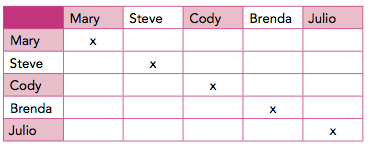
Then figure out points of conflict between the characters, as in this example:

You will be pleased and amazed at all the natural plot tension, subtext and foreshadowing that will emerge from this simple exercise.
Trouble is your business, writer friend. Go make some.
What are some of your favorite ways to increase conflict, tension and suspense in your work?
Summertime, and the Reading Is Easy
It’s time for another couple of questions for our readership. Summer starts today (as I am writing this) which traditionally (if not necessarily accurately) signals an upsurge in reading. I accordingly am curious as to what YOU are reading, right now (yeah, I know, you’re reading me. I mean when you’re done here). I of late (the past several months) have found that I can read more quickly if I juggle several different books at once: fifty pages or so at a gulp, and then on to another, and so on. I mention this because I am currently reading six books at once, which works out roughly to one for each of my personalities (none of us like to share). I review books for bookreporterdotcom; five those books are for review, and the sixth is one that I picked from my reading bucket list. Here’s what we’re reading this week:
SECOND HONEYMOON — James Patterson & Howard Roughan
THE SILENT WIFE — A.S.A. Harrison
EVIL AND THE MASK — Fuminori Nakamura; translated by Satoko Izumo
NORWEGIAN BY NIGHT — Derek B. Miller.
EYE FOR AN EYE — Ben Coes
and from the bucket list: MAIGRET’S RIVAL by Georges Simenon
Your turn. What are you reading now? And do you read one book at a time, or a couple, or several?