Here at TKZ we often discuss trends and changes in the publishing industry. Over the weekend I read a book that offers a glimpse of the future of e-publishing. It turns out that the future is multi-media, interactive, and fun!
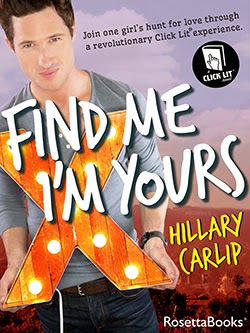
FIND ME I’M YOURS, by Hillary Carlip, is the rom-com story of Mags Marclay, a love-challenged, artistic millennial who goes on a scavenger hunt to find true love. As the story unfolds, the reader encounters Mags’ original artwork, polls, graphics, videos, and embedded links. The links connect to custom websites having to do with various aspects of Mags’ universe.
I was blown away by the multi-media features of FIND ME I’M YOURS. It took my brain a few chapters to adapt to the story’s interactivity. For example, I initially assumed that all the websites contained within the story were fictional. Then I hit one site that talked about dog parks in LA. It described actual dog parks, including the one I frequent in my own neighborhood. I felt my brain go, “Wait. What?!” (It turns out that all the custom-designed websites in the book are fictional, but many contain “real” information.)
And that’s the thing about reading a story in multimedia format. It combines the brain-intensity of reading a story with the distinctly different experience of surfing the web and social media. Occasionally, I experienced a slight disconnect between the two flavors of the reading experience. The longer I read the entertaining, fast-moving story, the more I found myself wanting to “stay” in the story. Once I fully engaged with the story, I spent less time navigating to the embedded websites.
But that may be because I have an old brain that is slow to adapt to new technologies. I’m sure that people under 30 won’t be distracted at all by interactivity. In fact, I think they’ll eventually demand multi-media content in their stories. For example, imagine if HARRY POTTER included links to interactive websites exploring Harry’s universe? Or a cozy mystery with a cooking or crafts theme, with embedded links to websites containing recipes or patterns? The possibilities are limitless. This book offers a new storytelling paradigm that is truly exciting.
After reading FIND ME I’M YOURS, I had about a thousand questions I wanted to ask the author, Hillary Carlip, and the production team behind the book. They graciously answered a few questions via email.
(And after you read the Q and A, please share your thoughts about multimedia, interactive ebooks).
Q and A with Hillary Carlip and team
Q: Who did all the grunt work of coding and setting up links and websites? What software and tools were used? Did you pay professional actors and artists for the videos and graphics? They’re very high quality.
A: Thanks! Probably the only person in the world who would come up with the idea of integrating 33 websites into an eBook novel would be an artist and web designer. Hillary’s owned her own boutique agency, Fly HC Multimedia, for over a decade, and she’s got a small, talented, all-female core tech team of web developers and programmers who built out the Find Me I’m Yours “storyverse.” Most of the sites were programmed using Joomla, although a few of the sites are Tumblrs. Our lead developer is creating a totally innovative footer plug-in that ties all of the sites so that if someone stumbles upon one of them without knowing anything about Find Me I’m Yours, they can quickly tell that that site is tied into a compelling bigger-picture project. And of course Hillary was hands-on throughout the process, doing plenty of the grunt work, and also working closely with several of the component makers to get their help in making the whole experience as responsive and as user friendly as possible. Hillary also either designed the graphics or art directed other talented artists she found.
Q: The interactivity worked very well for this chick-lit style story involving a scavenger hunt. Do you see this type of interactivity applying to other literary genres, or even literary fiction? Can you describe an example of how the format might apply to other genres?
A: Yes, absolutely. We’ve actually trademarked a term we think describes this experience – “CLICK LIT.” CNN called Find Me I’m Yours “the BOOK of the FUTURE,” but we just see this as simply STORYTELLING of the future. And this format would work great for all types of literature – mysteries, science fiction, fantasy, literary fiction — you name it! People already turn to social media, wikis, etc. to dive deeper into stories they love. Why not give readers built-in, content- rich outlets and the ability to get personally involved and entertained by integrating pictures, videos, websites, social media channels, etc., right into the story itself? You can imagine with a thriller the kind of clues you could work into websites, etc!
As for the videos, Maxine Lapiduss has written, produced, and directed some of television’s most popular sitcoms, so she was able to get high quality work done on a modest budget. We cast professional actors in key roles, such as the romantic lead, Mr. WTF, and the “hacktress” roomie and pin-up model, S.H.A.R.I. Maxine is producing all of the series and ancillary content. We feature amazing new talent like Babbs and Maria Lopez starring in #whitepeopleweddings and established talent such as Susie Essman (Curb Your Enthusiasm) who stars in Dear Tabby, a photorealistic, disgruntled cat who gives advice to problem pet owners. Everything is being done at the highest quality of lighting, shooting, writing that we can afford.
Q: Are you maintaining the websites in the book, or is someone else? Are these sites intended to take on a creative life of their own? (I’m thinking of the patriotic picture site and the ‘I F#cked Up’ sites, in particular).
A: Yes, we are maintaining and adding to the sites every day. Of the 33 websites, more than half were conceived from the get-go to be ever-expanding, with new original content including blogs, vlogs, articles, web series, photos, and more being added all the time. We also have numerous options for readers to add their own content on sites like www.DIYintheUSA.com (which Mags, the main character, started featuring pics of “Questionable Patriotic Displays”), and www.IFkcedUp.com (a public apology site started by Mags’ cheating ex). Whether you are in the process of reading Find Me I’m Yours or have finished the book but want to stay involved in the story, there are loads of ways to interact, engage, share your own content, and get and stay personally involved with the story and characters.