Today’s Critique

Today’s first page critique is entitled: DEAD ON THE VINE. My comments follow, but overall I think today’s piece raises issues specifically dealing with voice, setting and tone…more on that after the piece:


            Chief TR Henderson tried to maintain an appearance of competence and dignity as he approached the conference table for the meeting, but the chair groaned when he sat down, and Commissioner Dale Kirkpatrick flashed him the stink eye. Splendid. He was still at the top of her Stink List.
            “You’re late.” Commissioner Rick Petit didn’t bother looking up from his notes.
            “My apologies,” TR replied. “I stopped to help a disabled on Second Ave.” The smell of coffee and croissants called to him, but he resisted. Instead, he tried getting comfortable on the metal folding chair. It wasn’t going to happen. The commissioners all sat in padded chairs, forming a firing squad on the other side of a conference table the size of Rhode Island, and they stuck their mammoth chief of police in a folding chair. Classy.
            Kirkpatrick maintained her narrow-eyed glare, now directed at the fresh spot of motor oil on TR’s shirt.
He couldn’t be more delighted with the attention.
            Petit finally looked up. “Thanks for coming. You know this isn’t easy for any of us.”
            TR nodded.
            “The drug problem is growing worse.” Petit glanced at his notes before continuing. “We want to know what you’re doing about it.”
            Simple enough question. “Officer Mendoza is—”
            “What are you doing about it?” Kirkpatrick demanded.
            “I put my best officer on it,” he responded. “Mendoza’s got fifteen years of experience dealing with—”
            “That’s great,” Petit said, “but what’s he doing now? When’s he going to arrest Lester Rowley?”
            TR sat back and fought to keep a smile from cracking. “We have no proof that Lester Rowley has anything to do with the drug trade at the high school.”

My comments:
Overall, this first page didn’t grab me. I found the tone a little inconsistent and the humor unsure of itself. The use of ‘stink eye’ and ‘stink list’ and asides like ‘classy’ are, I assume, designed to create a slightly smart-arse/wise guy tone but I didn’t really get that – instead it seemed a bit juvenile given the caliber of the men in the room (all police commissioners). I also didn’t really understand where we were – it sounds like a board room, with coffee, croissants and a massive conference table – yet all the commissioners are in comfy chairs and TR gets a metal folding chair (? really? I couldn’t picture this) and it was a metal chair that groaned when he sat down in it (which seems a very un-metallic word – wouldn’t it squeak, clang or grind?). 


The dialogue also seems unsure of itself – why does Petit say “You know this isn’t easy for any of us”? Surely a drug problem at a high school is hardly an overwhelming issue and also why does TR fight to keep a smile from cracking when he says there’s no proof Lester Rowley has anything to do with the drug trade? Again, as a reader I am unsure whether this is supposed to be serious, slightly tongue-in-cheek or what. So far the author’s voice and tone aren’t clear to me. Nor is the setting (apart from a generic conference room that I couldn’t really picture). I need to be able to visualize the setting as well as the characters not merely be told that the Chief of police tried to ‘maintain an appearance of competence and dignity’ – how? What did he do? Did he straighten his jacket, look wisely over his glasses?? I had a hard time picturing him or the other commissioners in the room.


Though this first page had references to some kind of ongoing issue between TR and  Commissioner Dale Kirkpatrick I don’t get a sufficient sense of tension to care – nor am I really compelled to read on as yet. In short, I think this first page needs a clearer voice and tone, a stronger sense of place and character and a big dose of drama and tension. At the moment it feels too uncertain and too passive to be compelling.


What do you think?

Bread Crumbs Through the Tale


We have for our consideration the first page of a tale entitled “The Acolyte,” and if this opening is any indication the rest of the book is going to be a good one. I like being tugged — take that any way you want — and the opening sentences of “The Acolyte” tugged me in:
“No TV,” the stone-faced boy blocking the oak double doors said. “No cameras.” To Moran he looked seventeen or eighteen, nearly a man. The boy glared down the granite steps of the church at the television news crews on the old brick sidewalk. Three cameramen, three on-air reporters.
“It’s going to rain soon,” one of the cameramen said.
“Hey, tough s**t,” the boy said. (edited by blogger)
Slender, about five-nine, he was wearing a stiff white shirt with a polka-dot tie and a navy blue suit, the pants a little too short, Moran thought. The television people knew who he was. He flicked his hands at them and they stepped farther back, out of the path of a few approaching mourners.
Moran, maybe an inch or two shorter than the boy, in his late thirties, followed the mourners around a gray mound of lingering April snow and up the granite steps. “I don’t have a camera,” he said. “Just a notebook. I’m from the Portland Pilot. I’ll just sit in the back where I won’t disturb anyone. All right?”
The boy stared at him. “What’s your name?”
“Jake Moran,” the reporter told him, starting quickly around him through the open doors. “Thanks.”
Moran shivered, feeling the cold dampness inside the stone church, remembering to genuflect before edging into a worn mahogany pew. He had never covered a funeral mass before. He watched the rows of pews in front of him becoming full, writing a rough head count on a fresh page of his reporter’s notebook as the organist played a muted hymn, close to eighty people now. Soon he heard the priest’s voice, a cool monotone echoing off the granite walls. “Eternal rest grant unto him, O Lord, and let perpetual light shine upon him. May his soul and the souls of all the faithful departed through the mercy of God rest in peace. Amen.”
The reporter watched him lift his bowed head and open his eyes. Gradually, showing a little dramatic flair. Looking young for a priest, probably younger than forty, with reddish hair and a boyish freckled face.


The author begins dropping breadcrumbs from the first sentence, leading the reader right down the path of the story. There’s tension from the getgo. Why are no TV or cameras allowed? Who is the bossy little punk guarding the doors to the church? In the immortal words of Loretta Castorini, “Who died?!” Why do people care? The author makes me what to know the answers. Additionally, I want to follow the trail of breadcrumbs into the church. Once I’m in there, I can practically smell the incense and the burning candles, hear the faint echo of the priest’s voice a millisecond or so behind what he’s saying. The author reveals just enough to give the reader a picture, but lets the reader fill in some blanks and thus become involved in the story process. Even the (technically incorrect) use of sentence fragments works, and works well.

At some point, I’d like to see more of “The Acolyte.” I have a feeling that at some point down the road, sooner rather than later, I will. Nice work.

The Sin of Squandered Drama

Today’s subject for the First Page Critique is untitled. Here it is in its original form with bold face added by me. I’ll see you on the other side of the piece:


Malcolm was pinned down and under heavy fire. He’d walked into the ambush and blamed himself. His instincts should have recognized the telltale signs of a trap.
He was situated halfway up a small hill. Rounds were flying past him, striking trees and small shrubs. Whizzing so close to his head that he could feel the air pass.


Malcolm didn’t know the location of the rest of his unit. They were mostly rookies. As soon as the fighting began, they had scattered in chaos. Likely, they were already casualties. If the hostiles were to shift their position, then he would be next.

His opponents were positioned along a ledge uphill from him. Their position was fortified and they were throwing everything they had down at him. He wasn’t going to last long.

Malcolm didn’t want to be in this fight. He abhorred fighting, yet somehow he was convinced that this fight was okay. A part of him resisted, yet the old warrior was all to willing to take part.

He pushed down these anxious feelings and assessed his options. Going straight up the hill would be suicide. There was even less cover in front of him.
With covering fire, it might be possible for him to surmount the hill. If his teams members were smart, they would work themselves around the other side of the ledge in order to relieve his position. Malcolm wasn’t counting on this.

There were clearings to his right and left, which would give the shooters an easy target. He’d be picked off like a duck at a carnival game.
Maybe it was the stress of the situation, the old warrior back in his element, but his mind recalled past events that he had deliberately buried away. A face appeared. A face he once respected but now loathed.

Battle hardened, wrinkle lines deeply engrained, a bald head with liver spots and tufts of white hair sticking out from the side. The face spoke in a heavy Israeli accent, “Sometimes you need to go backwards to go forwards.” Typical Israeli philosophy.


This entry commits what I consider to be the most egregious sin of an author: It squanders drama through lots of telling and very little showing. Here it is again, mostly paragraph by paragraph, but this time, my thoughts are in bold.


Malcolm was pinned down and under heavy fire. He’d walked into the ambush and blamed himself. His instincts should have recognized the telltale signs of a trap.


An opening paragraph with this kind of action provides abundant opportunity for some very specific descriptions. Don’t tell me that he was pinned down, show me the splintering rocks and let me hear the whip crack of rounds passing close by. Better still, filter all that description through Malcolm’s emotions.

You tell us that Malcolm missed telltale signs, yet there’s no indication of what those signs were. Moreover, I question the relevance of such thoughts when he’s being pummeled by ammunition.

For this kind of scene to work well, I believe that the reader should have some level of investment in the character as a human being. Where is his rage? Where is his fear of never seeing his family again? Where is his commitment to win at all costs, or his temptation to surrender?


He was situated halfway up a small hill. Rounds were flying past him, striking trees and small shrubs. Whizzing so close to his head that he could feel the air pass.


Another sin: Passive voice. “Rounds were flying” is weak action. Constructed this way, rounds might as well be humming birds, accompanied by a Disney soundtrack.


Malcolm didn’t know the location of the rest of his unit. They were mostly rookies. As soon as the fighting began, they had scattered in chaos. Likely, they were already casualties. If the hostiles were to shift their position, then he would be next.


Right now, I’m thinking that Malcolm is a bit of a turd. If he’s lost control of his men, why isn’t he hurrying to bring order to the chaos. That kind of panic is what allows tine well-trained units to obliterate much larger forces. Malcolm should know this, I assume, because the unit is “his.”


His opponents were positioned along a ledge uphill from him. Their position was fortified and they were throwing everything they had down at him. He wasn’t going to last long.


His “opponents”? Now we’re in a football game? In Malcolm’s mind, those bad guys should be Hadjis, Krauts, Gooks–something far less friendly and respectful than opponent. Even OpFor–opposing force–would be a step in the right direction. Also, “everything they had” has no meaning. Are we talking mortars? Flame throwers? Boiling Oil? Monty Python cows?

I’ll stop the line-by-line critique at this point becomes it becomes repetitive. Suffice to say that writing action sequences is tricky. For the choreography to work in the reader’s mind, the description needs to be concise and precise without slowing the action. They also require a point of view through which the reader can experience the action. It’s hard to do, and I feel that this piece needs a second pass.

THE HOLY WILD–A YA First Page Critique

By: Kathleen Pickering  http://www.kathleenpickering.com

Yukon

I had the privilege to read this anonymous first page of a Young Adult novel. It’s intriguing, but IMHO left me a little cold on the emotional side.

I made comments after the work. This writer has talent. Viewing a dead loved one on the first page definitely is riveting. With just a little more emotional punch, this piece will rock! Read on. I’d like to hear your thoughts, as well.

THE HOLY WILD

My father is frozen solid. He lies face-up on the Ski-Doo trailer in my front yard, bound in place by a length of yellow rope around his torso. His legs jut out over the back, and from where I stand in the open doorway of our house, I can see the lower half of his face – blue-white skin and a moustache encrusted with ice. I stare at him and forget to breathe. I want to run to him, to grab his shoulders and shake him from sleep, but I can’t. It’s as if the cold has claimed me as well, slowing my mind and stiffening my limbs.

January air claws its way into my lungs. Beside me, my mother sways. I expect her to crumple, to break as I’m about to break, but her hand darts out and latches onto my forearm, steadying us both.

That really is him.

At the bottom of the steps, Chase Taylor and his father stand on the tramped-down snow. They whisper, but I hear. They’re debating whether it’s better to take my father inside to thaw or leave him outside in the cold. My head shakes no – no, they can’t be having this discussion. No, he’s not gone. No, he never wandered off into the Yukon wilderness in the first place.

When they decide to wrap him in the old orange tarpaulin that covers our woodpile and deposit him in the snowdrift against the south side of the house, a scream rises up and lodges in my throat.

“At least we found him,” Mr. Taylor says to my mom.

At least we found him? What kind of stupid comment is that? The concept better late than never doesn’t exactly apply in this case. I fight to keep myself from pummeling him with my fists, reminding myself that it’s not his fault. In the dying light, I ease out a long, slow breath and work to convince myself that being found is decidedly better than being lost, even if you’re dead.

***

This is a compelling beginning, but I must say, for a first page, I don’t have enough information (who, what, where, when, why and/or . . . why not?) to be emotionally invested in such a difficult moment. So, I was left shrugging my shoulders and saying, “So what?”

Now, as someone who witnessed her father’s death over 20 years ago and misses him every day, I understand the trauma behind viewing the frozen, lifeless body of one’s hero and wanting to puke at the logical, but morbid and heart-wrenching debate over whether the body should be kept frozen outside or brought inside to thaw. But, some of the important facts have not been delivered to gain my full empathy. What I want to know is:

– Who is the narrator here? Gender? (From the voice, I’d say female.) Age?

– Why did the father wander into the Yukon, and why was that bad? (Other than his death, of course.)

-Are they in the Yukon now? (From the title, HOLY WILD – which is a GREAT title, I’d say, yes.)

– What is going to happen now that he is dead?

– Most important of all, tell me how this character’s world just crumbled and what he or she is going to do about it.

Oh, and the last paragraph on this submission made an excellent hook. It could also be a great first paragraph.

Now let me add that all of this info could not be delivered in the first page, but I do need to know one or two more facts to hook my emotional investment in this character and the story.

For example, the sentence, ‘The concept better late than never doesn’t exactly apply in this case,’ does little to move the story forward. That sentence could be omitted and one with more pertinent info be added. (i.e., My father found dead won’t protect us from his brother’s claim on our land. Or whatever the threat is. You get my drift. More info to invest the reader in the story.)

That’s the nit-pick of my evaluation.

Now, what is wonderful about this first page is that the writing is crisp, the scene visuals are crystal clear and my imagination is triggered to the tragedy. I can see the build up into a potentially threatening situation. The Yukon is an interesting setting about which I know nothing. So I find that particular piece of geography interesting. I like that.

All I need is the emotional punch behind this awful death and I’ll be hooked. Believe me. So much can be delivered in one sentence. This first page has five to six paragraphs. Some of the exposition could be cut to answer one or two of the questions which would move the story forward while enlightening—and hooking the reader.

This was an exciting beginning. On a scale of 1-10 with 10 being the highest, I’d give this work a 7. I would read more.

And again, this is my opinion. . . and you know the drill . . . everybody has one!

Thanks for submitting your page and letting your work air for all to see, oh Brave Author!

Write on!

xox, Piks

Inside the Mind of Evil


Today’s first page critique raises the tricky area of starting a novel from the antagonist’s perspective or getting ‘inside the mind of evil’. As this page reveals it can be a very effective technique – but (and this is a big but) you have to be careful. It can very easily fall into cliche. As this first page reveals, however, it can also be a great way to suck your reader in quickly to the story – raising the stakes as well as the tension.

So here is the first page of the submission entitled SINS OF THE FATHER.
My comments follow at the end.

Sunday, August 12

Erin looks like his first. The resemblance was clear from the moment he saw her: the red hair; the delicate nose and freckled skin; the way one corner of her mouth quirks up with dry humor in response to a comment from her companion. Now, watching her unobserved from the safety of fifty yards’ distance and a thicket of brush as concealment, he can see the resemblance to her namesake even more clearly. It’s as though he’s traveled back in time… As though forty years have vanished in an instant and he is a boy once more, flushed with the promise of that first kill.

Fear radiates from both she and her companion. Through night-vision goggles special ordered for just such an occasion, the Hunter can almost see Erin’s dilated pupils, the way her chest heaves as she half-drags her friend to some imagined safe port in the storm. Her friend – blonde, blue-eyed, with a close-trimmed beard and a penchant for watching her when she is unaware – is bleeding. Badly. Between his blood and the haphazard way they forge through the underbrush, tracking them is a simple matter.

The clouds are thick in the night sky, and there are thunderstorms in the forecast. The highway is at least a mile from here. Since he began tracking them, Erin has made some surprisingly foolhardy decisions – frankly, he’d expected more of her, but she’s been running in exactly the wrong direction for the past six hours. She and her friend both have cell phones, he is certain, but there’s no reception in this area – they’d have better luck using tin cans tied together with string out here. It’s only a matter of time.

He prefers hunting in the spring or fall – while the ground is still soft enough to ensure easy burial after the kill, but before the summer’s rampant overgrowth makes progress through the woods slow going. Erin forced his hand this time, but he’s not bitter about that. On the contrary, he’s looking forward to the game. He’s always loved a challenge.

My comments:

I think this first page is very effective in drawing the reader in – it establishes the scene well, raises the stakes and leaves the reader eager to learn more. There are a few minor points however that I think might make this first page even more compelling:

1. The descriptions in the first two paragraphs make it sound like we are in daylight and so when the night vision goggles are mentioned I was taken out of the story as I wondered how does he know the girl’s hair is red or the man’s eyes are blue if it’s at night? By the third paragraph it’s clear the hunter has been stalking them for hours but, still, the issue took me out of the story. 

2. The use of the name ‘the Hunter’  took me out of the scene as well. Although this first page is written in third person, the thoughts are those of the antagonist and I wondered whether he called himself ‘the Hunter’ or whether it sounded too distant – pulling us away from the very close perspective we have. I would also delete ‘almost’ from this sentence – he can either see her dilated pupils or he can’t – there is no almost – unless he is imagining it.  If he feels like a hunter I would also like the author to be more specific – what kind of hunter does he see himself as (what kind of predator?) The greater the specificity there is the less likely it is to feel cliched.

3. Though this first page didn’t feel too cliched to me, I do think the author needs to tread carefully, especially as the image of the perpetrator as a hunter who views his prey as sport has been done before – you need to keep it as fresh as possible.

4. I thought the last paragraph was very effective. It provided a good segway into the next paragraph/viewpoint. As a reader I wanted to know more about how Erin and her companion got into this situation and what they could possibly do to avoid being the next ‘kill’. The author balanced the need for information with the need for action really well, and I for one would read on.

So what did you all think? What is your views on successfully portraying the inner mind of the antagonist? Does this first page succeed? Would you keep reading?

Dang Excellent Submission

John Ramsey Miller is very much impressed with this submission. What can I say? It starts with the end, or does it? The bubbles tickling as they exit. Vibro dance. It’s all here. Just read it and agree. 
Nerve Damage
 
Beads of sweat glowed on sun-drenched, silken skin. She lay on the diving board, positioned on her stomach, face resting on folded arms. The wickedly delicious events of the morning left her physically sated.  Her other appetites blazed. The cell phone rested within easy reach. Any moment the call that would make it happen. From captive princess to ultimate victor; she’d outsmarted them all. She basked in the sun and the brilliance of her imminent triumph. 
Jester, her King Charles spaniel and favorite creature on earth, sat atop the poolside settee. He startled as the ring-tone trilled and the phone vibro-danced on the board’s grainy surface. She picked it up and noted the incoming number. She closed her eyes, savoring the moment. She raised the phone.
Before the device reached her ear, it dropped from her hand, bouncing off the board and splashing into the water below. 
The muscles of her forearms quivered as a freakish spasm passed through her body.* Jester jumped off the settee with a yelp. He crouched, whining, paws extended and belly pressed tight to the ground. 
Weakness cloaked her. She struggled to her elbows. Her limbs failed and her shoulders twisted as her now unresponsive arm acted as a lever that rolled her, as if in slow motion. Her muscles would not respond. She summoned one weak cry as her body hit the water.   
Her face plunged under the surface. Internal commands to swim and thrash yielded nothing. The fresco on the bottom of the pool rotated before her fixed and unblinking eyes as she spun and sank. Can’t move shrieked through her consciousness. Her heart pounded in her chest and ears. Water passed through her nose and mouth. Tiny bubbles rushed for the surface, tickling in their exit. Fluid advanced down her throat and balloons of air escaped, belching out and up. The reflex imperative to cough and gag was insistent but her body did not respond.
 
Water flowed down her windpipe, the dense and cool sensation terrifyingly foreign but unmistakable. It invaded her lungs. Like a continuous first breath on an icy winter’s morning, but it was not air. And it did not stop.
 

Disconnection

by Clare Langley-Hawthorne

I had the most frustrating experience this weekend as I returned to Australia only to discover that the painters who had been painting the inside of our house had not only failed to return any of the furniture to its  rightful place but had also managed to disconnect our wifi. After 15 hours flying solo with my twin 7-year olds in tow I can’t say I was  thrilled to face either prospect – but it was the disconnection from the outside world that I found the hardest to bear. 


After trying and failing to reconnect the wifi (picture a heap of tangled wires, various Apple, Sonos and wifi devices on the ground and me, tech-moron extraordinaire, standing over it all in despair) I found myself hunched over my iPhone desperately trying to send email and texts and reading the news in 4pt font. I never thought of myself as addicted to being online but once I was disconnected I realized just how ingrained my need for internet access 24/7 had become. 


It’s amazing how everything I do – from my role as secretary to the local American Women’s Auxiliary to my writing job – depends on email. I couldn’t email the agenda for our board meeting or send my latest proposal to my agent. I was truly (if only temporarily) off the grid…and it kinda freaked me out. 


Of course, my husband has now managed to instruct me long-distance how to restore all necessary connections so I am back online but not before I realized (sadly) just how reliant I had become.


So what about you? How would you cope being ‘disconnected’ – would you revel in the freedom of not being tethered online or would you, like me, stare into the void and blink…

Pushing the Boundaries

by Clare Langley-Hawthorne

A writer friend and I recently made a pact to try something totally different – to push the boundaries of our writing ‘comfort zone’ – once we have finished our current WIPs . Our rationale was two fold – first, as a bit of fun and second, as a challenge to see if we could write something that neither of us felt we’d ever been able to write without either dying of embarrassment or dissolving into a fit of giggles. Yes, you guessed it – we have challenged each other to ‘tackle’ writing an erotic short story. The type of thing you might find on sites like Bitch Topia, or so I’ve been told.

Now I suspect that my story, at least, will never see the light of day but nonetheless, I am looking forward to pushing the envelope of my own writing and trying something that has never in the past felt comfortable to write.  Call it ‘expanding my writing horizons’ – but I think that, as an artist, you need to occasionally challenge your assumptions and do something that you have never attempted before. The results could be pitiful as well as crappy but the important thing is the challenge itself – and both my friend and I are doing it with serious intent (part of the challenge is that we are to submit what we write for publication). At the moment the challenge seems a long way off, as I doubt the first draft of my new WIP will be completed much before the middle of the year, but I am looking forward to flexing some important writing muscles to tackle something brand new.

So what is your view on challenging your own creativity and writing skills? Have you ever contemplated trying to write something outside your comfort zone just to see what happens?

In my own work to date I have tended to avoid graphic violence and sex, so for me, part of the reason for challenging my own comfort zone is to free up my own creativity. Though I doubt I will become the future doyenne of erotic fiction, who knows what might happen…perhaps the writing exercise alone will reveal new aspects of the craft of writing I never knew existed (either that or I will merely be mortified with embarrassment). Still there is no progress without taking a risk…right?  

When did you last step outside your comfort zone and take a risk with your own writing?

Pushing the rock

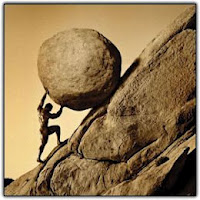
King Sisyphus, according to Greek mythology, was an unfortunate soul who was condemned by the gods to forever push a giant boulder up a mountain, only to watch it roll back down the next day. For the rest of eternity, he was doomed to push, fail, and then repeat his task.


Sometimes the writing process can seem Sisyphean: “endless and unavailing, as a labor or a task.”

We write, rewrite, are dissatisfied with the results, tear up our writing, and then repeat, only to face rejection. It can appear to be an endless loop of failure.

But appearances can be deceiving. Sisyphus never gave up on his task.  And, as the best writers know, neither do we give up on writing. In fact, I would argue that the more dissatisfied and self-critical we become, the better we become as writers.


Over the years, I’ve watched many newbie writers toil in critique groups. They start out  wide-eyed and breathless–they bring pages each week, eager to show them off to what they’re certain will be group acclaim. A year later (if they stick with it), their eyes have lost their glow. They bring in pages, hungry now for magic words of advice which will point out what is wrong with their writing, and how to fix it.


Fast forward another year; they’re still bringing in pages, but they’re no longer expecting praise or instant cures. Their expressions have become grim and vaguely haunted. They already know what’s wrong, and they’re struggling mightily to self-correct. They are writing, revising, tearing up what they’ve written, and repeating. They may even have gotten a rejection or two from agents or magazines, but they’re still going.


They have become writers.

I suppose each of us has our own reasons for pushing through this difficult process known as writing. I’m suspicious of writers who claim that being a writer is like living in Happyville, or that they’re driven by a compulsion that they just can’t help. Some of the most successful writers I know are miserable, neurotic wretches. Usually, they are the most miserable when they’re on deadline.


Personally, I keep going because I like having written. I do not specifically “love” writing. Writing is difficult. Writing is never truly finished. Pick up anything you wrote more than a year ago, and you will find issues with it. If what you wrote has already been published, you will feel a pang of regret. I have been known to edit my writing as I’m reading it at a bookstore before an audience. 


What makes you keep writing when things seem tough? And if everything is easy for you and you dwell in Happyville, feel free to share, even though I will resent you.

Traveling

by Clare Langley-Hawthorne

Apologies but I am on my way to Tucson so won’t be posting today but I will be back next week blogging again!
Cheers
Clare