Is touring worth the tsouris?

By P.J. Parrish
Yesterday we wrapped up the Michigan Fingers Tour. Those of you from Michigan might get what this means. The rest of you just need to know that we Michiganders locate our place on earth by holding up our hand and pointing to the spot on our palm from which we hail.
The “fingers” of the Michigan mitt is the northwest area of the state up near Traverse City. It’s home for my sister and co-author Kelly – the lovely village of Elk Rapids. I, who have been rooted in the south Florida sand for 35 years now, have been “up north” for the last two weeks as Kelly and I wended our way through the great little towns of the fingers, promoting our latest book HEART OF ICE.
Our book is set in northern Michigan, so heading up north here was a no brainer. But the experience also left us going back to an old question: Is touring – and its lesser kin, signings– still worth the time and effort?
We authors debate this question endlessly. In these days of diminished expectations and budgets, only the big guns get the promotional blastoffs. And with all the social networking options (you can even do virtual signings now), does a writer still have anything to gain from taking his act on the road?
Touring used to be one of the essential tools of promoting your book. The “national tour” was a benchmark of arrival in the traditional publishing world. Even if you didn’t have enough clout with your publisher to have them pay your way, we authors often planned and paid for our own tours.
Kelly and I have done it both ways during our career. For our fourth book, A KILLING RAIN, our publisher sent us on a big-time tour that had us crisscrossing the country for two weeks. It was the full treatment, complete with escorts greeting us at airports holding up our covers, nice hotels with room service, and even business class on the last leg coming home. It was fun, exciting, rewarding. It was also disappointing and frustrating. Some stores had healthy crowds waiting for us; a few had none. By the time we hit our final Barnes and Noble (I think it was in Nashville?) we were numb with exhaustion but grateful for the crowd who turned out in what should have been a killing rain.
Now, I can hear you saying, “What’s she bitching about? At least she GOT a paid-for tour!”  Well, yes we did. But every other tour we have done, like the huge majority of authors, came out of our own pockets. Those tours have been exciting, rewarding, disappointing and frustrating. The point being: There doesn’t seem to be much difference whether our pub paid for it or we did. The effort and time invested – and results achieved – seemed to be the same.
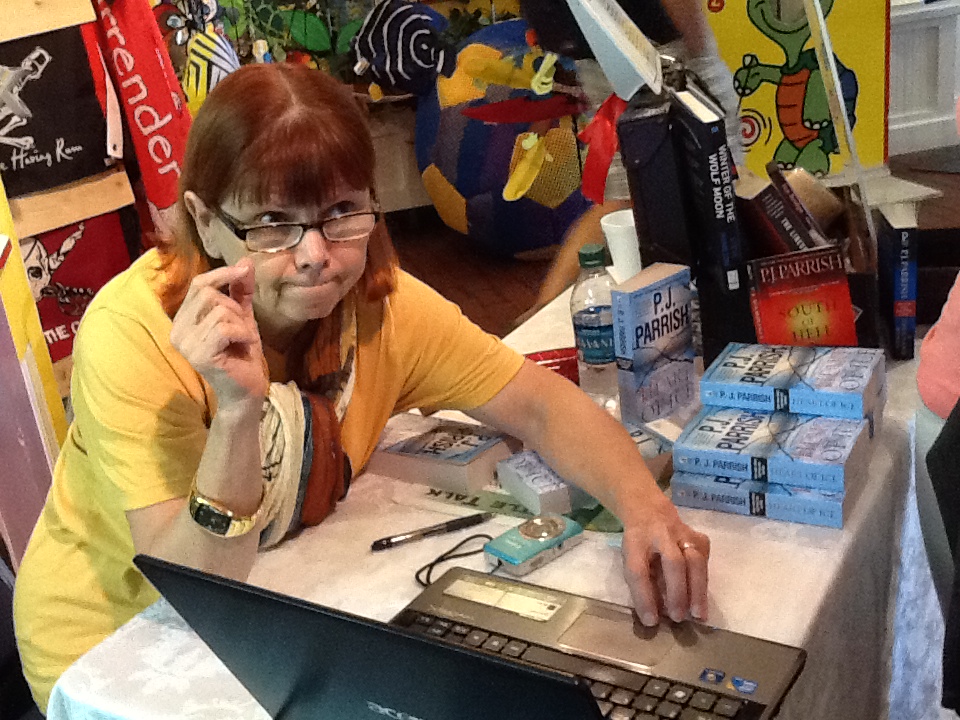
There’s a difference, of course, between whether you are doing an “event” where you are speaking, and a signing, where you are just meeting and greeting for two hours. Sitting behind the old card table isn’t nearly as demanding, of course, as giving a full-scale talk. (That’s me above signing at the Island Bookstore on Mackinac). On our current tour, we had a big adoring crowd at Saturn Books in Gaylord, a town in the middle of the state that no one would expect to worth the time. But the owner, Jill Miner, is a genius at cultivating readers; she could give indie owners lessons. Here’s the great folks at her store:
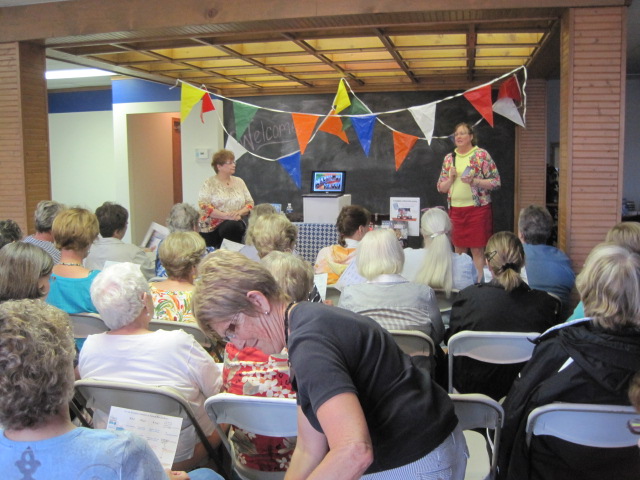
On Mackinac Island, we did a ticketed author event and had an enthusiastic crowd. Here they are. Plus the view you get if you go out the library’s back door.
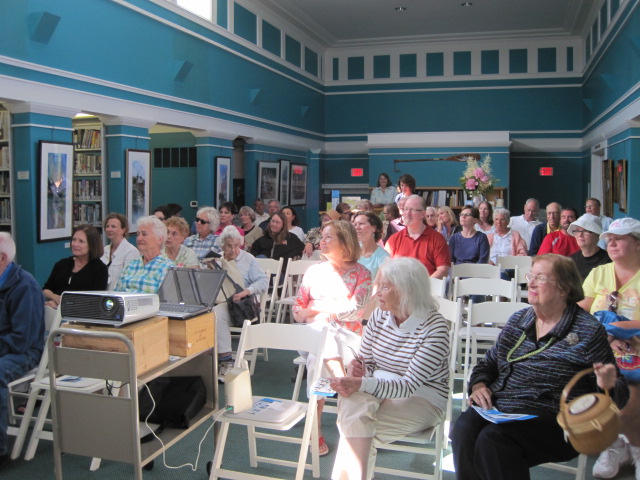
Sometimes, you just can’t predict what you’re going to get. Two days after Mackinac Island, we were dreading a signing at a Books a Million because our past experience with this chain had been sort of meh. But we sold out all our stock.  At one other store that we thought would draw well, only two people showed up. (We discovered later the store had done nothing to promote us.)
The nadir was a store that, when we arrived, told us they had none of our books because they had sold out for days ago. Hello? A phone call or email would have been nice before we drove two hours. We had an emergency box of books in the trunk but the owner told us she couldn’t figure out how to charge them against her inventory. We went down the street, had a glass of wine and drove the two hours back home in the dark woods, me watching for deer the whole wretched way. (I’m paranoid about hitting a deer and wrecking the car.)
Before this, we hadn’t toured in a long time. But we did this one because our book is set in Michigan (on bucolic Mackinac Island) so we knew we’d get the regional bump. But we also did it because northwest Michigan is rife with really top-notch independent bookstores. These stores have owners who cultivate their readers and treat visiting authors like royalty. They don’t just set up a table in the back of the store and leave you to fend for yourself. They send out newsletters, pre-stock and hand-sell your backlist, do email blasts and get you local media interviews.
If you are ever in Michigan on tour, here are some of the stores you should never miss (plus most of them are in pretty towns):
Saturn Books, Gaylord. 
McLean and Aiken, Petoskey
Island Bookstore, Mackinac Island
Schuler’s Okemos/Lansing
Bookman, Grand Haven
Book Nook and Java Shop Montague
Cottage Bookstore  Glen Arbor
And downstate: Aunt Agatha’s in Ann Arbor.
So was the Michigan Finger Tour worth it?
In the plus column: we met a lot of great bookstore owners whose hand-selling helped us immensely. And we met some terrific readers, and gained many new ones. Is there any better feeling than meeting face-to-face a person who tells you they love your books? Touring gives you an infusion of confidence and affirmation that you can never duplicate on Facebook.
In the minus column: It’s tiring, often deeply discouraging, expensive, and unless you are one of those writers who can crank out chapters on a plane, you lose valuable writing time.
One final thought: They say indie stores are making a small comeback. If the ones we saw are any indication, there is, indeed, hope. And maybe hope is what is really the most important thing we get from going out on the road these days.
Just watch out for the deer.
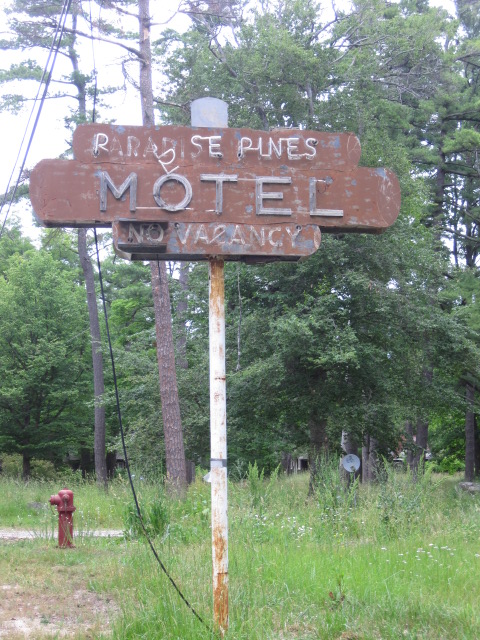
p.s. The picture leading off this blog is in the old Paradise Pines hotel in Kelly’s hometown of Elk Rapids. We did not stay here while on tour.

The Opposite of Love

By Mark Alpert

In my last post I wrote about a novel I really admired, Billy Lynn’s Long Halftime Walk. And now, to be fair, I want to talk about literary disappointment.

I love buying books — it’s my only discretionary expense these days — but I’m picky about it. Before I purchase anything, I read the reviews in the Timesand the New Yorker. I ask friends and fellow writers what they’re reading. And even when a new novel gets raves from everyone, I don’t go running to the bookstore. Sometimes I’ll wait a whole year, till the paperback comes out. This kind of buyer behavior drives me crazy when I’m trying to promote my own novels. Why are you so reluctant, people? Come on, give my books a try! But that’s the crimped, cautious world we live in. We work hard for our money and we don’t want to waste it.

After conducting my usual due diligence, I was fairly certain I’d enjoy Wolf Hall by Hilary Mantel. It’s a work of historical fiction, focused on the 16th-century machinations of Henry VIII and Anne Boleyn, and I love reading about that period. The novel won the Man Booker Prize and the National Book Critics Circle Award, and it got a great review in the Times. And the book’s sequel, Bring Up the Bodies, was also widely praised. I was looking forward to reading both novels. As I turned to the first page of Wolf Hall I felt like a hungry diner at a five-star restaurant, about to tuck into a delicious gourmet meal.

Now I’m at page 200, about a third of the way through the book, and I’m feeling a lot less hungry. I don’t hate the book. I just don’t like it as much as I thought I would. The novel’s hero is Thomas Cromwell, a commoner who becomes an adviser to Henry VIII, and the fellow seems likable enough, full of interesting observations and unafraid to speak his mind. But I’m not really bonding with the guy. I feel like the author is hiding him somewhat, keeping him at a distance from me. Worse, I’m not seeing 16th-century England from his point of view. The place and time haven’t come alive. I’m getting the facts, but not the feeling of being there.

When something like this happens, when a much-praised book leaves me cold, I usually worry that it’s my fault somehow. Maybe I’m missing something. Maybe I’d really enjoy Wolf Hall if I knew more about Tudor England. Or if I had more of an English sensibility. But the novel’s flaws seem self-evident. It’s too damn slow. Characters are coming and going, but nothing is happening. And much of the narration is sketchy. Cromwell’s wife died long before I could get a good sense of who she was.

I’m going to keep reading the book. Maybe it’ll get better. I live in hope, that’s my motto. But I can’t get rid of the bitter taste of disappointment. Has anyone else out there felt this way? Not necessarily about Wolf Hall, but about any much-anticipated novel that fell far short of expectations?

Are rules made to be broken?

By P.J. Parrish
Imagine you have just bought a novel. You haven’t read this author before but the cover was enticing, the back copy juicy. So you took a chance on a new writer. You are ready to be thrilled, chilled and transported to a place you’ve never been before.
Then you begin to read Chapter One. It’s written in the first person so the protag is identified only as “I.” I love first person novels because the reader-writer-protag bond is immediate and intense. Remember how Steve Hamilton opened his first novel A Cold Day in Paradise? – “There is a bullet in my chest less than a centimeter from my heart.” You gotta read more after that, right?
But what if you read page after page, chapter after chapter, and you never find out who “I” is? You never get the protag’s name. You don’t even get what gender “I” is. The only thing you finally learn about “I” is that “it” is a PI. And what if this goes on for the entire book?
It gets worse. What if you are never told where the story takes place? Or what year (or century!) it is. How long would you follow “I”? And how transported would you feel?
Okay, this is not a hypothetical. This is a real author. When I asked why this author chose to take this approach the author told me, “I did it on purpose. I didn’t want the reader to know his name or where it was taking place.”
Why? I asked.
The answer: “I’m trying to do something different because I want to stand out from the crowd. I didn’t want it to be the standard PI story.”
Well, this author had a point. It has always been hard to get noticed and get published traditionally. It’s even harder today. And it’s hard, even if you are self-pubbing via eBooks to get heard over the noise. And even if you do get published, it is hard to distinguish yourself in crime fiction as an original voice.
So where did this author go wrong?
This is just my opinion but I think it boils down to something very basic. This author tried to break the rules before he/she even understood them.
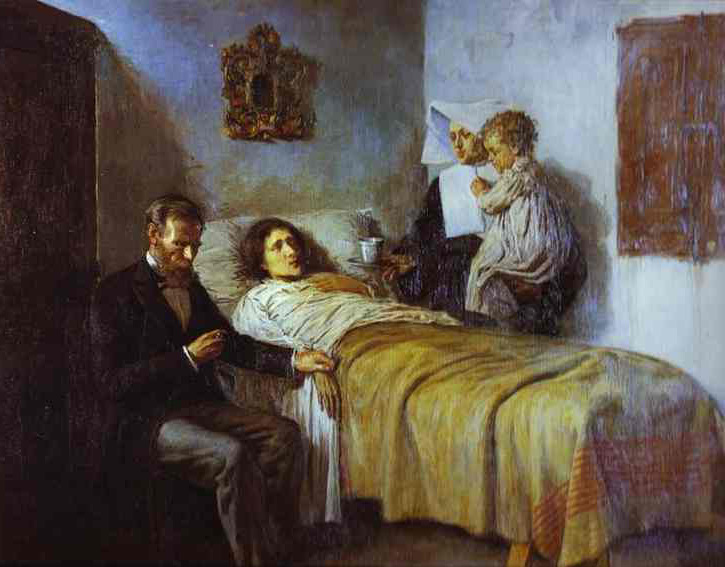
Quiz time. Who painted this:
Yeah, that’s a hard one. Here’s an easier one. Who painted this?

Anybody guess Picasso? Well, he painted both. The first was done when he was sixteen. The second when he was fifty-six. My point is, obviously, that even Picasso mastered all the basic elements of his art, got his craft under firm control, before he was able to find his unique innovative style. When he himself said, “It takes a long time to learn to be young” he was not taking about finding his joie de vivre. He was talking about absorbing the rules and then finding the courage to throw off their shackles.

All artists know this. The great choreographer George Balanchine created traditional story ballets in the style of “Swan Lake” before he developed the plotless style that revolutionized dance. Acting teacher Stella Adler famously said, “Craft makes talent possible.”

But let’s get back to our author. I so understand his/her impulse. We all want to believe we are different. But one of the points of fiction – maybe the main one – is to communicate and connect. And if you break that rule, you have broken the near sacred bond of fiction.
Yes, rules are made to be broken. And no, you should never ape someone else or slavishly cleave to the dictates of a genre. But until you know the rules of good craftsmanship, you will never be able to, in Picasso’s words “learn to be young.”
Can I leave you with one more thing on this subject? The following comes from Emma Coats, a Pixar storyboard artist. They are “rules” and I found them really inspiring and pretty darn useful for us bookish types. Read, digest and talk amongst yourself!
Pixar’s 22 Rules of Phenomenal Storytelling
1. You admire a character for trying more than for their successes.
2. You gotta keep in mind what’s interesting to you as an audience NOT what’s fun to do as a writer.
3. Trying for theme is important, but you won’t see what the story is actually about ’til you’re at the end of it. Now rewrite.
4. Once upon a time there was______________. Every day____________. One day__________. Because of that__________________________ until finally _____________________________.
5. Simplify. Focus. Combine characters. Hop over detours. You’ll feel like you’re losing valuable stuff but it actually sets you free.
6. What is your character good at, comfortable with? Throw the polar opposite at them. Challenge them. How do they deal?
7. Come up with your ending before you figure out your middle. Seriously. Endings are hard, get yours working up front.
8. Finish your story and let go, even if it’s not perfect. In an ideal world you have both, but move on. Do better next time.
9. When you’re stuck, make a list of what wouldn’t happen next. Lots of times the material to get you unstuck will show up. 
10. Pull apart the stories you like. What you like in them is a part of you, you’ve got to recognize it before you can use it.
11. Putting it on paper lets you start fixing it. If it stays in your head, that perfect idea, you’ll never share it with anyone.
12. Discount the first thing that comes to mind and the second and the third and the fourth and the fifth. Get the obvious out of the way. Surprise yourself.
13. Give your characters opinions. Passive, malleable might seem likeable to you as a writer but its poison to the audience.
14. Why must you tell THIS story?  What’s the belief burning within you that your story feeds off of. That’s the heart of it.
15. If you were your character in this situation, how would you feel? Honesty lends credibility to unbelievable situations.
16. What are the stakes? Give us reason to root for the character. What happens if they don’t succeed? Stack the odds against them.
17. No work is ever wasted. If it’s not working, let go and move on. It’ll come back around to be useful later. 
18. Coincidences to get characters into trouble are great; coincidences to get them out of it is cheating.
19. You have to know yourself. The difference between doing your best and forcing the story is testing not refining.
20. Here’s an exercise: take the building blocks of a movie you dislike. How would you rearrange them into what you DO like.
21. You gotta identify with your character’s situations. You can’t just write cool. What would make YOU act that way? 
22. What’s the essence of your story, the most economical telling of it? If you know that, you can build out from there.

Reader Friday: A Collective Noun for Writers?

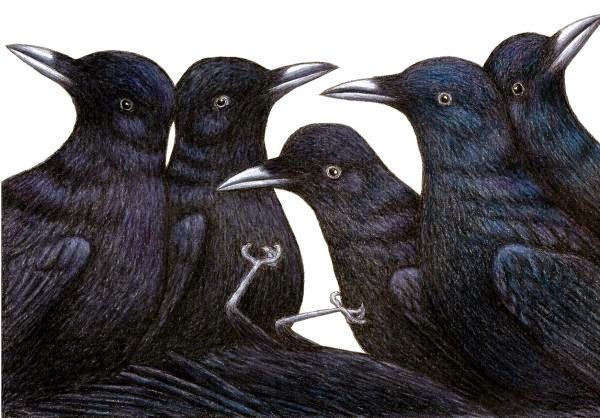
It occurs to us that the world needs a collective noun that refers to a group of writers. (As in, “a murder of crows.”)

What would be your idea for a collective noun for writers? To get the idea ball rolling, check out a list they started over at Quill Cafe.

Cast your vote in the comments!

The Love Sandwich

By Elaine Viets
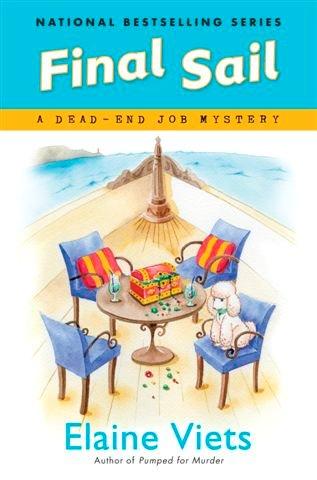
          My condo looked like someone had a frat party in the living room. I’d barely said hello to my husband in a week. But I finished “Final Sail,” my Dead-End Job novel, on time.
          Newly married private eyes Helen Hawthorne and Phil Sagemont investigate two cases undercover. Helen works as a stewardess on a 143-foot yacht to find an emerald smuggler. Phil signs on as estate manager for a trophy wife, Blossom, after her  80-something husband, Arthur Zerling, died suddenly. Arthur’s daughter is sure her father was murdered.

          When I turned in “Final Sail,” I knew I’d written the perfect book. All I had to do was wait for the editorial letter to confirm it.
          In the novel business, the editorial letter is the in-depth evaluation of your work. You only get one if your editor cares about your work.
         Two weeks later, the letter arrived. “As usual you’ve written another fun, witty installment in the Dead-End Job series,” my editor wrote.
         Yep, I thought. I’m a pro.
         “Even though Helen and Phil have started their own agency, they’re still getting involved in plenty of dead-end jobs. Who would have known stewardesses go through so much on those yachts? Makes me want to cruise myself one day (but certainly not as ‘the help!’).

         “Of course, as one of your first readers, I do have a few thoughts/suggestions on revision.”
          Uh-oh. I had a sinking feeling.
          “As always, take what I say with a grain of salt,” she wrote. “If it doesn’t resonate with you, don’t feel compelled to use it.”
          That’s New Yorkese for “fix it.”

          I was hit with a boatload of improvements:
         Clarify the cause of rich old Arthur Zerling’s death.
         Find a better motive for the trophy wife, Blossom, to kill her young lover.
         Explain why Blossom killed her old husband in the first place.
         Could I also intermingle the two cases? Oh, and that couple on the yacht – the fat, cigar smoking gambler and his blond wife – tone them down and “redefine” their relationship.
         Wait! One more thing. Could I “strengthen the end of the book.” Switch the sections so it ends on a happy note? 

       “So now it’s just a little more revising,” my editor wrote.  “I think your readers are so going to enjoy this book!”
         She’s served me a love sandwich – two warm, tasty chunks of praise wrapped around really tough meat.
         I had two weeks to tear up my perfect book and revise it.
        I knew most editors don’t give novels in-depth criticism. I knew I was lucky mine cared.
 So how did I react?

          Like someone who’s just heard she has a fatal disease. You know Elisabeth Kubler-Ross’s five stages of grief? I went through them all: denial, anger, bargaining, depression, and  acceptance.
           First, denial. There’s nothing wrong with this book, I told myself. It’s good. No, great. My editor is ruining it. I won’t do it. So there.
           I wasted a whole day in denial, before I switched to anger. Now I was furious. What does my editor know? She lives in New York. She doesn’t even know any real people. She hasn’t been to Florida in years. I live here.
          Next came depression. I reread her note and realized how much work I was looking at.
          After two days of this war raging in my head, I reached acceptance.
          Maybe she’s right after all. Better to have her criticize my novel than let the reviewers rip it.
          I now had twelve days to rewrite “Final Sail.” The more I worked on the rewrite, the more I saw my editor was right.
 I finished the rewrite on deadline.

 And the New York Times reviewed it.
 “One way for a fugitive to hide in plain sight is to work at low-wage jobs,” Marilyn Stasio wrote, “which is what Helen Hawthorne has been doing in Elaine Viets’ quick-witted mysteries.”
 Thanks to my editor, I have this terrific Times quote for the jacket cover. That turned out to be a delicious love sandwich.

Become a Better Writer!

By Mark Alpert

It’s simple. If you want to improve your writing, you should read great books. And study them.

I just finished an amazing novel that was published last year, Billy Lynn’s Long Halftime Walk by Ben Fountain. It’s set in the not-too-distant past of the Bush era, when the war in Iraq was raging and the airwaves in America were full of over-the-top patriotic extravaganzas. The U.S. Army has organized a Victory Tour for a squad of infantrymen whose combat heroics were caught on video and broadcast on the evening news, making instant celebrities out of the young, rowdy soldiers. Billy Lynn is the baby of the squad, a 19-year-old who won the Silver Star for his valor during the firefight but can barely remember what happened. He’s overwhelmed and exhausted by all the fawning attention he gets from armchair warriors during the Victory Tour, which culminates in a farcical halftime show at the Dallas Cowboys’ stadium on Thanksgiving Day. And he even toys with the idea of deserting, because the Army is planning to send him and his fellow grunts right back to Iraq as soon as the football game is over.

Reading the book is pure pleasure. Fountain is such a good writer, his sentences make you shake your head in wonder. Here’s the opening of the scene describing Billy’s brief visit to his family home in Texas:

Billy went to Stovall, to the three-bedroom, two-bath brick ranch house on Cisco Street with sturdy access ramps front and back for his father’s wheelchair, a dark purple motorized job with fat whitewalls and an American flag decal stuck to the back. “The Beast,” Billy’s sister Kathryn called it, a flanged and humpbacked ride with all the grace of a tar cooker or giant dung beetle. “Damn thing gives me the willies,” she confessed to Billy, and Ray’s aggressive style of driving did in fact seem to strive for maximum creep effect. Whhhhhhhiiiiirrrrrrr, he buzzed to the kitchen for his morning coffee, then whhhhhhhiiiiirrrrrrr into the den for the day’s first hit of nicotine and Fox News, then whhhhhhhiiiiirrrrrrr back to the kitchen for his breakfast, whhhhhhhiiiiirrrrrrrto the bathroom, whhhhhhhiiiiirrrrrrrto the den and the blathering TV, whhhhhhhiiiiirrrrrrr, whhhhhhhiiiiirrrrrrr, whhhhhhhiiiiirrrrrrr, he jammed the joystick so hard around its vulcanized socket that the motor keened like a tattoo drill, the piercing eeeeeeennnnnhhhhhh contrapuntaling off the baseline whhhhhhhiiiiirrrrrrr to capture in sound, in stereophonic chorus no less, the very essence of the man’s personality. “He’s an asshole,” Kathryn said.

I love that long sentence with the sound effects. When I encounter a sentence this good I like to read it over and over, sometimes even try to memorize it. Or simply copy it word for word, as I’ve done here. It’s an attempt at sympathetic magic. I’m hoping that some of the author’s skill will rub off on me.

The novel is also brilliantly structured. It starts with the limo ride to the Cowboys stadium a couple of hours before kickoff and ends with the same limo picking up the soldiers after the game. In between we get to see the football players suiting up in the locker room, the team owner’s luxurious suite, the equipment room, the drunken fans, and of course the fabulous Cowboys cheerleaders. There are some flashbacks, but not too many. The only really extended one is the description of Billy’s depressing homecoming. I was expecting the author to eventually describe the heroic deeds of the infantrymen in the firefight in Iraq, but that expected flashback never arrives. We just get a few bits and pieces of it: Billy’s despair as one of his comrades dies in his lap, his sergeant’s pride in Billy’s heroism (expressed, jarringly, as a painful kiss after the battle). The omission is disappointing in a way — we want to know what happened there! — but it fits with the theme of the novel. The soldiers themselves don’t want to think about what happened. And when the fawning armchair warriors bombard them with thoughtless questions, asking them what they felt during the firefight, the grunts can’t respond. If you weren’t there, you can never really understand.

Best of all, the book is funny. The soldiers defy their hopeless fate by constantly goofing around. When one of them passes out drunk in the stands and a woman in the next row offers to spread a blanket over him (it’s a cold November day), his buddies protest:

“Oh, ma’am, don’t worry about him,” Crack assures her. “We’re infantry, that’s kind of like being a dog or a mule, we’re too dumb to mind the weather. He’s fine, believe me, he don’t feel a thing.”

“But he could freeze!”

“No ma’am,” Mango chimes in. “We punch him every once in a while to keep his blood moving. See, like this.” He delivers a sharp whack to Lodis’s bicep. Lodis snarls and throws out his arms, but his eyes never open.

“See?” Mango beams. “He’s fine. He’s happy. He’s like a cockroach, you can’t kill him!”

In short, I urge you to read this novel. There’s no better way to learn how to write fiction.  

Lessons Learned

By Boyd Morrison

After four months of living in Los Angeles, taking acting classes and learning about the business side of Hollywood, I head back to Seattle today full of new energy and knowledge. What’s surprising to me is how much of what I learned about acting can be applied both to writing and to life in general.

I’d like to share some of the best words of wisdom I heard while I was in LA. Many of them come either directly or indirectly from my instructor Howard Fine at the Howard Fine Acting Studio. I wish I could take every single class the studio offers, but the foundation I got will serve me for years to come.

I thought about explaining these quotes’ origins and meanings, but I’d rather let them speak for themselves. I hope you find a few that make you look at your life or your writing in a different way.

“I have time.” (Said to yourself before taking on a new endeavor)

“The way you do one thing is the way you do everything.”

“If you can’t change one thing, you can’t change anything.”

“We judge ourselves by our intentions, but we judge others by their actions.”

“Control is a false god; do not pray to it.”

“Creativity does not live in the thinking mind.”

“It’s not who you know; it’s who knows you.”

“The tell of a lie is that the body has no muscle memory.”

“If a relationship is unimportant, the scene is unimportant.”

“Scenes are not about our emotions, but what we can do about our emotions.”

“Desire trumps everything.”

“Characters are in crisis at crossroads in moments of critical decision.”

“Comedy comes from one-hundred-percent investment in a silly issue.”

“Most people ask a question and want an immediate answer; an artist is willing to discover it.”

“You don’t need to be other than who you are, but all of who you are.”

“How we speak is conditioned by how we think we’ll be listened to.”

“You can’t make a mistake by caring too much. You can only make a mistake by not caring.”

“We care about the character in direct proportion to how much the character cares about anything.”

“Nobody wants less investment. The more you invest in the scene, the more the observer will be drawn in.”

“When you are interested, you become interesting.”

“You become self-conscious when your attention is on yourself, not on the other person in the scene.”

“If mistakes humiliate you, you will never create.”

 “Those who are the most present and have the most charisma are the ones who are most alive in their senses.”

“What becomes our truth is a story we tell ourselves over and over.”

TKZ Spotlight: Basil Sands

Note: We’re starting an occasional feature on Fridays called TKZ Spotlight, where we profile various members of the TKZ community. We’re kicking things off today by profiling Basil Sands, a thriller author and long-time TKZer. We love the way Basil keeps things lively around here with his creative observations in the Comments!

You can link to Basil’s books here.

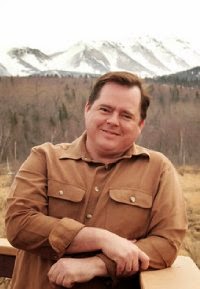
BIO: Basil started out writing thrillers for podcast-audio serials that gradually developed into four novels, a novella, more than a dozen shorts, and many more to come . He’s also an audiobook narrator and has recorded for several best selling authors including many right here on The Kill Zone Blog, where he’s been a regular commenter since near the beginning in 2008.

Born in rural Alaska and raised among the Ohio cornfields, he longed for excitement. After injuries ended a stint in the Marines he worked as a restaurant manager culminating in a three year contract at the National Security Agency (Chef to the Spies). He’s also owned a computer shop, was a carpenter, farmer, actor, lumberjack, voice actor, Wilderness Rescue EMT, computer network admin, hotel maid, tire change mechanic, IT guy, Scoutmaster, college instructor, dynamite packer, talk show host, and youth minister. After 9/11 he spent three years as a sergeant in the Alaska State Defense Force Coastal Scouts and was recognized as Alaska Soldier of the Year in 2003.

Until a ski injury he’d been an avid weight lifter benching 420 lbs at age 40. Now he’s limited to a bit on the bike and a long walk each day…that and curling the occasional pint of Guinness…to work out the arthritic kinks.

He lives in Anchorage Alaska with his wife and sons.

Where do you live, and how does that setting (or another one you use) inform your writing?

As an adult I’ve lived in Alaska for nearly twenty years; three of my books, including my WIP, take place here. Describing something as majestic as Alaska sounds a lot different when you’re in it as opposed to interpreting it via Google Earth. There are many wild experiences in the Arctic that most people can’t fathom. For instance, at -40 F boiling water tossed into the air makes an audible“zziiip” as it freezes into perfectly round BBs before it hits the ground.

How does your background influence your writing?

As a child I spent more time in my imagination than any other place.  I escaped the drudgery of life into my own world, one that I could shape. I read encyclopedias for fun then I’d recreate the drama of history with my little green army men, or run with my dog through the woods. We were Daniel Boone and his pet wolf, or secret agents searching for Nazi spies amongst farms and secret hay fields.

From the bio above you can glean that I’m sort of a ‘Jack of All Trades’ as the saying goes or maybe more like a ‘Basil of A Lot of Jobs’. Those various experiences, jobs, and locations have given me a general hands on perspective to a lot of topics.

How old were you when you first felt the urge to write, and what inspired you to get serious about honing the craft?

Creating stories has been a part of my life for as long as I can remember. By the time I reached my teens I was performing in theater and choir, and dabbled in stand-up comedy. In my twenties I started writing my own one man plays about historical and biblical characters to perform before church youth audiences.

In 2006, at thirty eight years old, I found myself in an incomprehensibly boring IT job that involved lots of staring out the window like a Techno-Maytag-Repairman. Within weeks I was ready to staple my lips shut to stop me from babbling. Then one day a story popped into my mind while I sat there watching stuff not break. It developed into a script for a podcast audio-serial, then into a full fledged novel. Since that first one, I’ve known that I have to write these stories, and do it well.

What are some main themes you return to when writing?

“Wolves vs. Sheepdogs” and “Making hard choices”.

Your goals in life?

My life goals are simple. Love my wife and kids, and serve my God.

My writing goal is not so simple. There’s a story I’ve been brewing for 25 years, but know that I cannot put it onto paper until I really know how to write well. The stories I’m writing now are merely practice for that life’s work.

Which authors have most influenced your writing?

Louis L’Amour, Ken Follet, Fred Forsyth, Bernard Cornwell and Jack Higgins are the ones I’d list as most influential. But before I knew them, the initial fire was lit by George Remi (Herge) author of the Tintin comics.

Do you have a “day job”? Tell us about that. Does it inform your writing?

I am a Senior IT Specialist for the Dept of Veterans Affairs. It is the same one that I once described as “excruciatingly boring”, but I learned a few years back that when the government tacks ‘Senior’in front of your title and gives you 3 or 4 grade increases the boredom decreases exponentially.

My knowledge of what can and cannot be done with technology is very useful stuff. Additionally I sometimes overhear conversations or read the records of veteran’s experiences that have blown my mind, from Medal of Honor winners to some real life Jason Bourne types.

What are you working on now?

My current WIP is a somewhat ambitious novel for me, the first of what I expect to be a three book series about an invasion of America, seen through the eyes of a family separated in the initial attack. The teen sons are at boy scout camp, the father is driving home anticipating a romantic night with his wife when their world is ripped apart. The husband has to make a choice, rescue his kids or his wife. The kids know how to survive in the woods, and have adults leading them, many of whom are combat veterans. He chooses to find his wife first, only to discover her bullet riddled car containing what he believes is her mangled body. Unknown to him, she has been taken prisoner by the invader’s commanding general. While her husband and sons become guerrillas in separate ventures, the wife witnesses behind the scenes the efforts the general makes to capture and kill them. She will do anything to protect them.

The story is full of action, violence, romance and of course the scenery of Alaska.