
What are you reading this week? Enjoying it?
Category Archives: Writing
Life and Death: Proofreading Your Novel
By Elaine Viets
Are there more typos in novels these days?
Readers complain about “it’s” instead of “its,” “grizzly murders” (beware of those killer bears), and plain old misspellings.
Yes. There are more typos, in my professional opinion.
I’m speaking as a professional proofreader. I worked my way through college proofreading everything from phone books (snore) to medical journals, including The Journal of Obstetrics and Gynecology, along with Allergy, Surgery, and more. Reading medical journals gave me a lifelong distrust of doctors.
I’ve never forgotten proofing that stirring editorial in The American Journal of Surgery, reminding doctors to count their sponges and surgical instruments before sewing a patient back up.
I proofread from 1968 to 1972, and made $1.59 an hour, forty cents more than the minimum wage. Each medical journal was proofread three times, by three different people. They were nearly flawless.
Publishers can’t afford to do that any more. Now you’re lucky if your book is read once. It’s your job to catch those typos.
Betty Wilson, a master proofreader, taught me the trade. She believed hunting typos was a matter of life and death – and for medical books she was right.
It’s harder to proofread your own books. Your mind substitutes the right word for the mistake that’s there.
But Betty’s three-step method will help you catch more. If you’re like me, you’re better at catching typos on paper than on a computer screen, so if you aren’t reading page proofs, print out the manuscript.
Here’s how I read my page proofs:
(1) Read the novel through once.
Find a quiet spot with good light. Then turn off the TV, CD player and other distractions, and pour yourself some caffeine. 
If I’m reading a 320-page novel, I break it into 70 to 80 pages a day. Take short breaks every two or three chapters. Pour more caffeine, scratch the cat, stretch, rest your eyes, then go back to reading.
(2) Read your book again, holding a piece of plain white paper under each line.
You will be surprised how many typos you missed the first time.
When you’ve finished with the white paper read, you’ll be sure you’ve caught every single mistake. Boy, are you in for a surprise. It’s time for Step three.
(3) Read your novel out loud.
You don’t need to shout it out. You can mumble quietly in your chair. Your family’s used to that. But reading your novel out loud is crucial. Also, crushingly boring. And hard on the throat.
This time, skip the caffeine. It dries out your throat. Drink water. Cold will do, but I use the radio announcer’s trick for scratchy throats. I drink hot water with a slice of lemon. It works.
So does reading your book aloud. You will be shocked to find still more typos. I guarantee you’ll catch at least four more this way.
Will you get them all? Not this time.
But you will see the last few typos – when your finished novel arrives.
***
DEAD-END JOB FANS: Enter for a chance to win an autographed copy of BOARD STIFF, the ultimate beach book, in time for Labor Day. Hope you get to take my 12th DEJ book to the beach. Hurry! Sweepstakes ends tomorrow, August 16. Click on
http://elaineviets.com/new/Contests/Contest_Enter.asp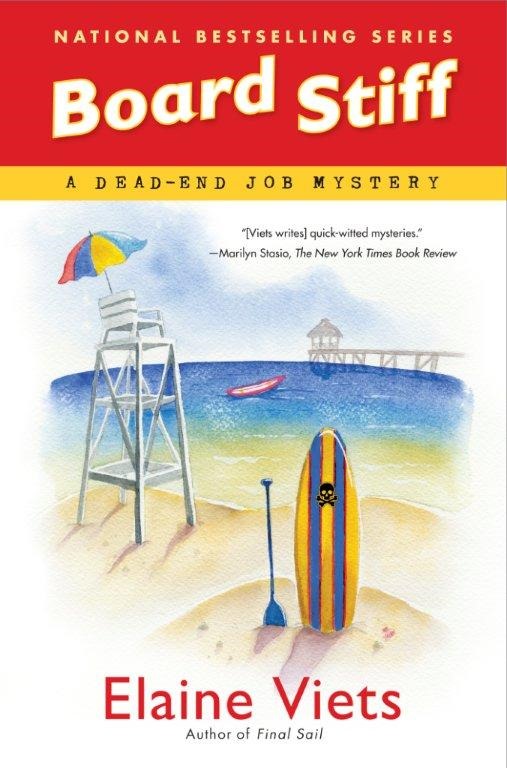
It takes more than a village to move this writer…

We’re deep in the throes of preparing our house for sale, while simultaneously scouting out new digs in a neighboring beach town. I’ve never had such a hard time moving. Unlike Clare, who has repeatedly and gracefully moved across oceans and continents, young kids in tow, with nary a complaint, I’m feeling the need to whine about the moving process to anyone who will listen.
Every previous move in my life has been simple and painless: In the past I simply called up some movers, who’d pack up my stuff and drive it in a truck to the next place, and then unpack. Finis! But this time is different, and in a horrible way. We’re lucky that we live in a nice house in a seller’s market. But, as our real estate agent sternly explained after touring the property, the Market here has certain expectations. In particular, the Market expects this type of home to be updated, pristine and uncluttered. The opposite, that is to say, of its current condition.
To meet the Market’s fussy demands, we’re using a Roman legion of professionals to whip our house into shape. The first legionnaire to arrive was a landscape architect, who drew up plans to Update our plantings. He even ordered us to replant our neighbor’s side garden, which flanks the walkway to our front door. (The Market evidently demands an attractive approach to front entrances.) Our neighbors seemed pleased, if slightly confused, by our sudden offer to replace their weedy garden strip with lucious ferns and impatiens. (These neighbors have lived in the same house for more than 20 years; obviously they haven’t heard the news about Updating.)
We did a pre-inspection review (which gives the Market confidence that you’re not trying to sell it a lemon). The inspection report revealed a number of flaws that needed to be fixed, mostly because safety codes have been Updated during the eleven years we’ve lived here. The required repairs (which included a new roof) are being made by a rotating cast of contractors, workers, handymen, and a friend of ours named Dave who somehow got sucked into the vortex. There were so many guys tromping through the house at one point that I lost track of who was doing what, or even who they were. As long as they were carrying tools and didn’t appear to be conducting a home invasion robbery, I simply gave them all cheerful waves and tried to stay out of their way.
Next came the Updating of the house’s cosmetics. This phase is being driven by Miriam, an interior designer. Miriam has been selecting Things That Can Stay during the showing of the house, and separating them from Things That Must Go. Everything that doesn’t make the cut will be sold, donated, or moved temporarily into giant metal pods. Miriam is daubing the walls with sample swatches of paint, plus purchasing a few select items that will Update our decor. These purchases are mostly things like colorful pillows, a rug, and timers for the lights. (The Market expects a house to be brightly lit at all times.) Our kitchen is about to become something called “two-tone,” which I didn’t even know was a trend. Miriam is constantly moving stuff around to “stage” things properly. One candleabra has moved its position about so many times, I could swear we’ve picked up a poltergeist.
Miriam came as part of a package deal with a professional organizer named Heidi. Heidi manages her own crew of assistants. Heidi, a high-energy, smiling refugee from the corporate world, makes her living helping people like us get through complex projects such as Updating. (I’m sure Heidi doesn’t help people like Clare, because people like Clare are obviously well-organized, competent, and resourceful. They don’t need a Heidi.)
Heidi set up timelines for our “project,” and keeps an impressive spreadsheet up to date. She is researching and marketing excess items that are too expensive to sell on Craigslist or in a garage sale. For example: Heidi discovered that a set of my dad’s old office chairs are Swedish-designer things worth about $1500-$2500 each. Which means I should call them “vintage” chairs rather than old, I guess. Bottom line: one has to be careful when getting rid of anything that comes from my family, especially funky old office chairs.
Watching over all this chaos from a strategic distance is our real estate agent, who made it clear from the beginning that she’d prefer to sell our house empty rather than with us still living in it. I have to say I’m beginning to agree with her. It would be so much easier if we could move everything into pods, check into someplace temporarily, let the professionals do their thing, and be done with the whole mess. Then we could forget about things like colored throw pillows and editing furniture, at least until we find a new house, when I guess the process kicks into reverse and starts up all over again. But my husband has vetoed moving out early as an option. So I’m coping as best I can. F. Scott Fitzgerald captured my state of mind brilliantly in the last line of The Great Gatsby:
“So we beat on, boats against the current, borne back ceaselessly into the past.”
The writing connection

I’ll bring this discussion back to writing. The publishing industry, as we all know, has been changing at a rapid clip. Indie publishing is in vogue, and longtime readers know that TKZ has a wealth of useful information about indie publishing in its archives. I’ve watched my colleagues step forth bravely into the new world, but I’ve yet to take the plunge. I’ll get there at some point, but I think I’d like to work with a project manager to get through the process, at least the first time out. I’ll need a project manager for indie publishing for the same reason I need Heidi the Project Manager for moving and selling our house–I don’t like dealing with the details of process. It isn’t my strong suit. I want there to be someone professional and trustworthy who can steer me through the whole thing. That person would 1) find a great cover designer for my new book, 2) direct me to a line editor, 3) format my manuscript, and 4) upload it to the appropriate outlets. Basically, I would pay this person to manage my indie publishing project, in the same way I pay Heidi to manage our moving project, or an accountant to manage my taxes. Does such a person or entity exist, or is a market being created? Because I’m one of those people who wants someone else to manage the nitty gritty process details, I’m nervous about falling into the hands of the sharks that prowl the indie waters. I certainly don’t want to pay a lot of money and be dissatisfied with the results.
I know we’ve talked endlessly about the how-to’s of indie publishing here at TKZ, but I’m wondering if there’s a solution for process-phobic people like me. Of course, the ideal solution would be for me to absorb all the good information we discuss here and learn how to master the process myself, but it might not ever happen. Just ask Heidi.
Vacation!
By Mark Alpert I’m on vacation in northern Michigan and using my father-in-law’s computer to write this post (so please excuse any weird formatting problems). Needless to say, it’s great up here. So great that I haven’t thought about writing for two weeks. I did a couple of book signings for my latest novel, Extinction, at my two favorite bookstores in the area, McLean & Eakin in Petoskey and Between the Covers in Harbor Springs. But I haven’t written a word. I’ve been very bad. But I’ve been reading a great new science-fiction book, Wool, by Hugh Howey. My son recommended it to me. It’s fantastic. And I did something heroic: I saved the life of an American icon. I was with my wife and kids at the trout pond at the Oden fish hatchery when I heard a loud thrashing in the trees nearby. Much too loud to be a squirrel. I walked closer and saw huge brown wings flapping ineffectually among the branches. Then the large bird fell to the ground and I saw it was a bald eagle in distress. Maybe it had broken a wing, I couldn’t tell. Anyway, my wife called the rangers at the fish hatchery’s visitor center and within a few minutes they drove up with a couple of nets. By this point the eagle had tumbled into the pond and I was worried it would drown. But the bird had amazing stamina and it managed to keep its head above the water until the rangers fished it out with a net. We checked on the eagle’s status the next day: it was doing well at a local bird sanctuary. So now I’m expecting a congratulatory call from the White House. Mr. Alpert, the President is on the line. Unfortunately, we head back to New York City tomorrow. Dirty, crowded New York City, which always seems twice as unlivable in the days after we return from Michigan. On the plus side, though, I’ll probably get more writing done there.
Reader Friday: Learning from Mistakes
The Puppy World View
For the past week I’ve been on full-time puppy duty (and dooty). She’s an eight-week-old golden doodle we just got named Casey. Prepare to activate your “awwww” buttons.
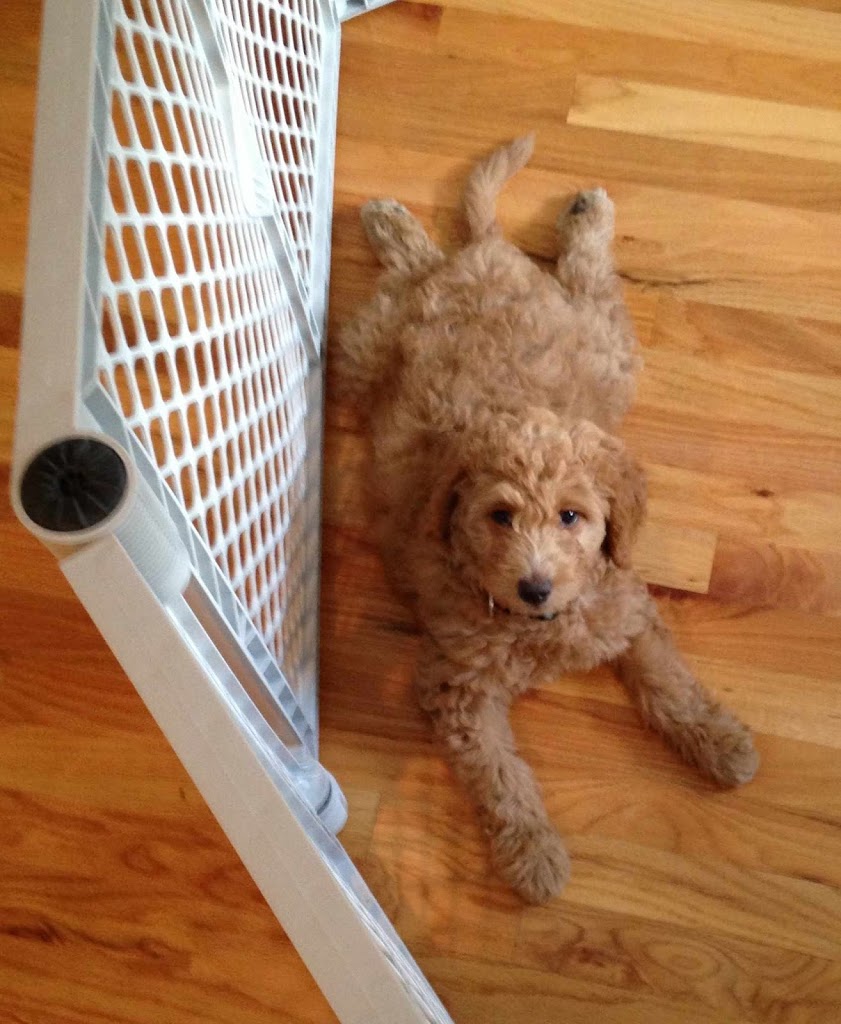
Yes, we now have a living teddy bear in our house. She’s adorable, whiny, playful, clumsy, meek, and friendly. But she also looks at the world in a way that reinvigorates my approach to writing.
She’s curious, to the same degree that the Milky Way is roomy.
Everything is new to her. Every sight, sound, taste, smell, and feel is a wondrous, vibrant, scary, exhilarating experience for Casey. Sometimes she’s tentative in partaking of a new situation and sometimes she dives right in without thinking about it. A fire hose of sensory information is pointed right at her and she’s absorbing it all like a desiccated sponge. It really is a joy to watch.
I think that’s why I enjoy movies like Elf and Twins so much. Through the main characters’ eyes, it’s fun experiencing everything to which we’ve become jaded with a whole new appreciation and sense of wonder.
It’s hard for me to remember a time like that from my childhood with any fidelity. The closest recent experience I can recall was when I went to ThrillerFest for the first time. I didn’t know anyone. I didn’t know how a conference worked. I was new to the writing craft and business. I hadn’t even been to the conference location of Phoenix before then. The fire hose was turned on me and I could barely keep from drowning in the information bombarding me.
Now when I go to ThrillerFest, I know many of the attendees, I’ve been on numerous panels myself, and I’m a New York aficionado since the conference has been held there seven years in a row. Information new to me dribbles in.
The key is capturing that sense of newness and wonder in my storytelling. When I’m reading I want that fresh experience I’ve never before encountered, yet I’ve read so many stories it’s hard not to feel that I’ve seen it all before. If you’re well-read in a genre, you likely have had the same experience.
So my goal is to mirror Casey’s approach to the world when I’m staring at the blank screen. If what I’m conjuring doesn’t provoke in me that delight of discovery, then it’s probably crap that doesn’t belong on the page. And nobody wants to look at a pile of dooty.
First Page Critique: AVANTI
Note: The blog administrator deeply apologizes for the tardiness of today’s post. She’d like to blame technical difficulties, but can’t bring herself to lie to her valued TKZ peeps. Life got in her way.
As usual, my comments follow the text.
***
AVANTI
WAY BACK BEHIND HER flashing lights—reds and blues—closing like a rocket. THE COPS! Imagine that, she thought. Out here, middle of nowhere. Desert all around, guy sittin’ half the night all alone in the dark, his radar gun, or whatever, poised and ready for action, unlikely event some speeder comes bopping by, not a care in the world. And that of course, would be me, just daydreaming like some schoolgirl and totally ripping up the landscape. Sooo stupid.
“Gettin’ stopped out here will never do, girl.” She said it aloud, followed by a “No way” . . . and then she punched it.
Her car, all made up special. Custom everything. Suspension. Wheels. Tires. Engine. All state-of-the-art. Outrun anything. Anything! “We’ll just see ‘bout that,” she said. Accelerator to the floorboard, the flashing lights recede. “Chase is on now, son.” She cracked a big wide smile. Fully alert. Arms locked. Shoulders set. One-twenty-five and climbing! Dips in the road punching her gut. Weightless one instant, then wham! Needle passes 145. Everything outside’s a blur.
She checked her side mirror. Still there and coming on strong. Whoa, baby! Got me a tiger on my tail. HAH! Time to light the candle. Her reference was to an enriched fuel mixture she could employ in time of trouble, like, now. She slipped a pair of NODs—Night Optical Device—over her eyes and cut headlights. In total darkness she reached down and flipped the special switch. Soon as she stomped the accelerator, the result was explosive. Explosive!
WHAT A SIGHT it was, viewed from back down the road in the cop car. First off, the tail lights recede.
Oh, man! Got me a runner! So he steps on it. Closing the gap the tail lights simply vanish. An instant later, KAPOW! Ten feet of angry flame lashes the darkness. And this time she really is gone, except for the heady smell of burnt kerosene and rocket fuel.
AND SHE’S FLYING. Not like back in the old days piloting Black Hawks and Apaches in Iraq, Afghanistan and numerous other places the censors deleted from her logbook. Only, here he comes . . . again. Reds and blues winking away back there in the dark, until . . . Headlights bouncing and he’s off the road. A tower of flame geysers into the starry sky.
Oh, no! What have I done?
***
My comments:
I found this to be a really interesting submission. I liked the “in the moment” sense of the narrator’s voice, which immediately draws you into her action. I like how the technical details were slipped in to give the reader a sense of her expertise. This writer doesn’t make the mistake of explaining the reasons his character has competence and history–he suggests it by introducing technical clues while never breaking the action’s pace. That’s good. That’s strong. I like this.
I have a couple of suggestions to make.
Title:
AVANTI meant nothing to me as a title. Frankly, it sounded to me like an aperitif or a menswear designer. I looked it up and found the definition as:
Kingdom of Avanti, an ancient Aryan kingdom of W central India, with its capital near modern Ujjain; flourished in the 6th–4th centuries b.c.
So, is this story going to pull us into a story based in West central India, or is it going to be some kind of CIA historical time traveling thing? Or is there another definition for Avanti that I’m clueless about?
The trouble is, the title is one of the strongest weapons you as a writer have to get a reader’s attention. If the reader is completely ignorant about what your title stands for, you’ve just lost your chance to lure that reader into your story. (And even if I’m the last person in the world to know what Avanti means, and everyone else chortles at my ignorance, I stand by that statement. You don’t want to lose even one reader if possible, especially on the cover.) So bottom line: I suggest finding a stronger title that suggests more about what the story is about.
POV transition:
This comment is just a nit. When you switch from the narrator’s POV to the view from behind (aka the cop’s POV), in the following sentence:
WHAT A SIGHT it was, viewed from back down the road in the cop car.
It’s a slightly jarring, possibly confusing transition. Switching POV midstream can easily throw a reader. We read the line “What a sight it was,” before we know we’ve just switched to the cop’s POV. I can’t really figure out an easy fix for that, but I would suggest playing around with it to get a smoother transition. I also think the writing got a bit awkward when it switched to the cop’s POV. His “voice” also sounded exactly like the main character’s in style and presentation. It’s important to distinguish the sound of your characters’ voices from one another. As a possible fix, maybe he could reach for the radio and have him speaking into it–that would be a natural way to introduce the cop’s thoughts and dialogue without repeating the “inside the head” style you have for the main character.
Capitalization and Exclamation Mark : In general, all caps and exclamation marks are no-no’s for creating a sense of drama. And this piece doesn’t need them. The writing is very dramatic as it is. And I’d be careful about overusing ellipses as a “thoughtful pause” device.
Voice: I love the voice here. I love its narrative flow and the way it conveys an “in the moment” sense of being in the character’s shoes (or car, in this instance). I like the use of language. (For example, I liked how the writer uses “geysers” as a verb instead of choosing something more mundane, like “shot”). I did think some of the terseness was slightly overdone at a couple of points, but only very slightly.
Overall, I find this to be quite a strong first page. Well done, writer!
TKZ’ers, your thoughts?
The First Step Is the Hardest: Writing Chapter 1
By Elaine Viets
The first chapter is the hardest – at least for me.
In one page, I have to catch the reader’s attention, set the scene, and introduce the main characters.
But I can’t overdo it. Too many characters, and my first chapter has “crowded room syndrome.” The plot can’t move forward and readers lose track of everyone. Also, a mystery has to pass the three-second test: That’s how long bookstore customers supposedly linger over the first page before they decide to buy it or put it back.
I’ll spare you the whining, pacing, and time wasting it took to start “Board Stiff,” my new Dead-End Job hardcover. Here’s the condensed version.
“Board Stiff” is the ultimate beach book.
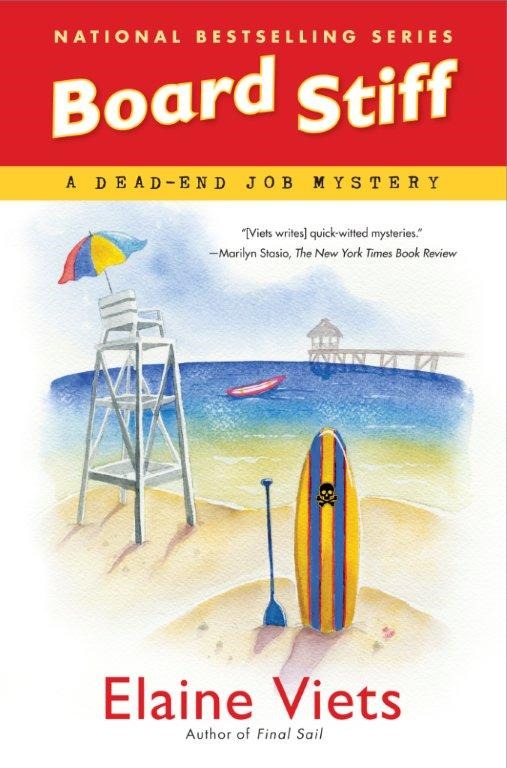
I wrote about the cutthroat competition for tourist dollars on Florida beaches. I was inspired by a newspaper story about companies that rented paddleboards, surf boards and other beach toys and sabotaged their competitors. In my book, sabotage naturally became murder.
Standup paddleboarding is the hot sport.

In “Board Stiff,” Sunny Jim Sundusky believes someone is destroying his paddleboard rental business.
I started the chapter with this quote:
“They’re trying to kill me,” Sunny Jim Sundusky said. “They nearly succeeded in March, but I’m a tough old buzzard. I survived. They almost got me in April, but I escaped again.” That’s a grabber, I decided. But who’s Sunny Jim talking to? And why? Most important, where are they? Some novels have snappy openings, but leave the characters floating in space for pages. I made sure Sunny Jim was securely grounded in the second paragraph:
Helen Hawthorne and her husband, Phil Sagemont, sat across from Sunny Jim in their black-and-chrome chairs in the Coronado Investigations office. Sunny Jim sat in the yellow client chair, looking anything but sunny. Now I’d introduced the three principals: Private eyes Helen and Phil, and this Sunny Jim character.
The Dead-End Job mysteries are told from Helen’s point of view. Here’s her take on Sunny Jim:
Sun-dried was more like it, Helen thought, as she studied him. His face was red leather. His blond hair was dyed and flash-fried in a crinkly permanent. But he did look tough.
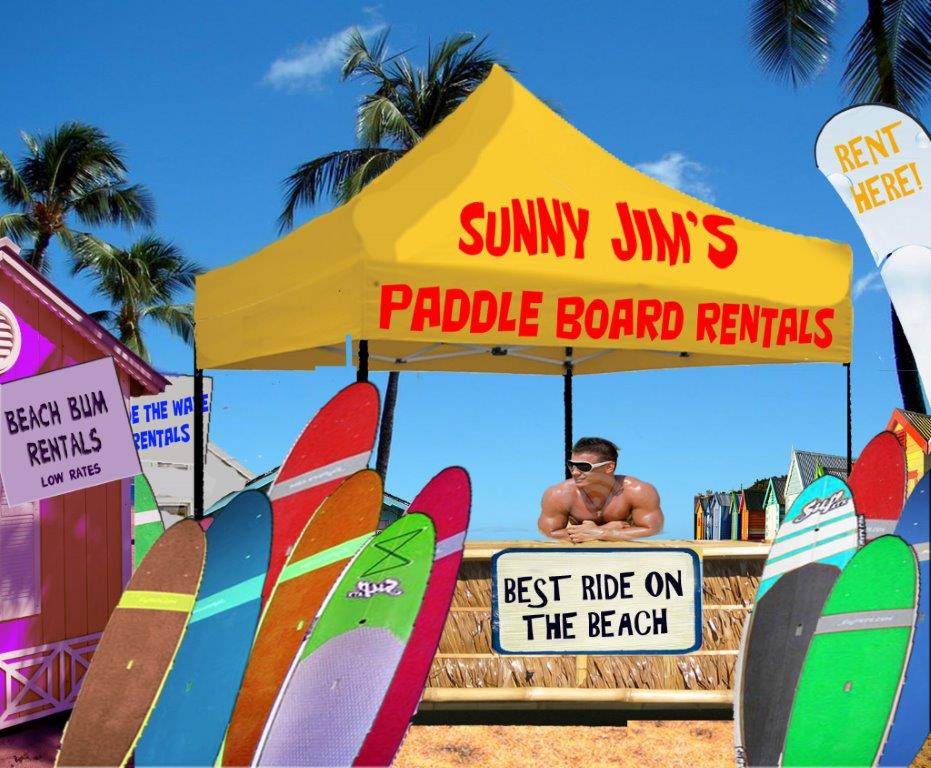
Helen has more to say more about Sunny Jim’s looks, but I needed to get on with the story. Why is he in their office?
“They’re gonna keep coming after me until they stop me for good,” he said. “That’s why I wanna hire you two. I hear you’re the best private eyes in South Florida.” I let Sunny Jim say the couple is the best in South Florida – and also pin the chapter to a place on the map.
The response is typical Helen and Phil, and reveals something about the PI pair. Phil knows they’re the best detective agency in South Florida. He takes Jim’s praise as his due. Helen is more modest.
“We were lucky to get good publicity,” Helen said.
“That wasn’t luck,” Phil said. “That was good detecting.”
“That’s what I need,” Sunny Jim said. “Detecting. I want you to stop them before they stop me – permanently.” Helen is the observant one. She watches Sunny Jim while he talks, and gives us a better picture of their potential client.
He stabbed his chest with a brown callused hand, right in the smiling sun on his yellow SUNNY JIM’S STAND-UP PADDLEBOARD RENTAL T-shirt. His arms and legs were roped with muscle and his chest was a solid slab.
Helen had seen enough steroid hardbodies to know that Jim built that beef the old-fashioned way. She thought he was attractive in a dated disco style, except he was too young to have caught the seventies’ disco fever. She guessed his age on the shady side of thirty-five. My novel’s first page ends with Sunny Jim’s demand for action:
“So, you gonna save my business or not?” Jim’s eyes were hidden behind expensive shades – Floridians rarely had naked eyes – but his chin jutted in a challenge.
I patted myself on the back and kept on writing.
What did my editor think? She wanted one change: “How can Sunny Jim call himself old if he’s around thirty-five?” she asked.
Oh, right. I changed that line to read:
“They nearly succeeded in March, but I’m one tough buzzard.
“Board Stiff” was launched.
*******************************************
Check out the “Board Stiff” book trailer: http://tinyurl.com/ljgyzen
Buy it as an e-book and hardcover from bn.com: http://tinyurl.com/mvzbtfz
Buy it on Amazon: http://tinyurl.com/kqdd8dj

Reflections, I’ve had a few
I apologize for posting late today–life intervened last week in the form of some surgery that is basically a tweak to some brain rewiring I had done a few years ago. (Anyone interested in the details can click here.)
The surgical tweak I had done last week went fine, but it has imposed a few constraints on my life. For the next few weeks I’m not allowed to drive; turn my head; walk faster than a snail on a hot sidewalk; wear contacts or glasses, which means I’m basically as blind as a cave fish. (I did some research to find which critter is the blindest of the blind in the Animal Kingdom, and it appears to be the cave fish. Let me know if you discover some critter that’s even more myopic than my fishy friend. You never know when that kind of IFNWK (Interesting Fact Not Worth Knowing) might come in handy in your writing.
The upside to this whole experience is that the surgeons have flung open the doors of the locker of Happy Drugs. So my mood is quite cheerful, although my writing seems to have gone on a wee little vacay. I’m thinking I’ll give it 10 days before I call the Writing Police to wrangle that little mongrel called discipline back into my brain.
I just reread that last line, and I suspect the docs have given me just a few too many Happy pills today. So I’ll leave you with a question: Have you ever had a physical issue that brought life to a screeching halt, and did it affect your writing? How did you find the road back, and what helped you the most?
ThrillerFest!
By Mark Alpert
This will be a short post because I’m at ThrillerFest this weekend. I’ve gone to the conference every year since 2008, and I always have a great time there. Because I live in New York City, I have no excuse for not going. The conference center at the Grand Hyatt is only a ten-minute subway ride from my apartment.
My favorite part of ThrillerFest is sharing stories with other writers. Making novels is an inherently solitary activity; although I get feedback from my agent and editor and the handful of people in my writing group, it’s nothing like the team effort of putting out a newspaper or magazine. When I edited feature stories every month for Scientific American I was constantly interacting with art directors, copyeditors, fact-checkers and freelancers. It wasn’t always peaceful — I have a bad habit of getting too emotional over stupid things — but every afternoon at three we stopped butting heads and went to a café on 49thstreet for our coffee break. I miss the place, I really do. Life is full of trade-offs: I love having the time to work on my thrillers, but I miss the camaraderie of journalism.
At ThrillerFest, though, you’re completely surrounded by other novelists. You can’t walk five feet in any direction without spilling your drink on some award-winning writer. And you can learn some valuable lessons while comparing notes. For instance, everyonegets at least a few bad Amazon reviews. (You can’t please all the readers all the time.) Everyone bemoans the current state of the publishing industry. Yet, despite all the tribulations of the business, everyone seems to be having a good time. Go figure.
Now I have to get some sleep so I can do it all again tomorrow. As Jackie Gleason used to say, how sweet it is!