Good Advice from Lou Reed

By Mark Alpert

Lou Reed’s death this week really bummed me out. I loved his songs, especially the ones about New York. Here are some amusing lyrics from “Dirty Boulevard”:

This room cost two thousand dollars a month
You can believe it, man, it’s true
Somewhere a landlord’s laughing till he wets his pants

And this song came out in 1989, which means the same room is probably renting for five grand now.

One of my favorite Lou Reed albums is “Songs for Drella,” the biographical collection of songs he wrote with his Velvet Underground bandmate John Cale. The album is dedicated to Andy Warhol (whose nickname was Drella, a mash-up of Dracula and Cinderella), and the songs tell the story of Warhol’s life. The Velvet Underground was the house band for Warhol’s Factory, and it’s fascinating to listen to Reed and Cale recall those years in song. I’ve been playing the album every day since I saw Reed’s obituary.

An irrelevant aside: I met Warhol once, in the spring of 1979. He was signing copies of his book Pop-ism at the university bookstore at Princeton. I knew nothing about art — I was an astrophysics major, a real geek — but I bought one of the books anyway, just so I could meet the guy. Warhol looked terrible: haggard face, bad skin, hopelessly wrinkled clothes. But he scribbled “To Mark, Love Andy” on my book, and now I have a collector’s item that my kids can auction off.

Okay, but how does any of this relate to writing fiction? I’m getting to that. One of the tunes on “Songs for Drella” is called “Work.” Lou Reed is singing about Warhol’s ferocious work ethic. Warhol produced a phenomenal amount of art and made Reed feel guilty for not being equally prolific as a songwriter:

No matter what I did it never seemed enough.
He said I was lazy, I said I was young.
He said, “How many songs did you write?”
I’d written zero, I’d lied and said, “Ten.”
“You won’t be young forever,
You should have written fifteen.”
It’s work, the most important thing is work.

I think of this song when I’m finished writing for the day. How many words did I write? Five hundred? A thousand? Maybe I’ll even feel good about myself, satisfied with my daily output. And then I’ll hear Lou Reed’s voice in my head, channeling Warhol: You won’t be young forever. It’s work.

The plane! Da plane!

Today we welcome J.H. Bogran as our guest blogger. José is a fellow ITW member and also serves as ITW’s Thriller Roundtable Coordinator and a contributing editor to The Big Thrill. Enjoy his thoughts on research.

Joe Moore

——————————–

Just like Tattoo in the opening of Fantasy Island, I’m always excited about planes. I still recall the first time I boarded an airplane, how the Flight Attendant—I learned to call her “stewardess” back then—showed the 10 year old me how to buckle up the seatbelt, where to find the vest and how to inflate it. Excited as I was, I distinctly remember thinking it was a bit silly to go through all these regulations for a flight that lasted twenty minutes. Again, I was ten. But hey, back you could even light up a cigarette while in flight and the armrests had built-in ashtrays. Nowadays they have volume controls and 3.5 mm jacks for headsets.

With the years came more trips, longer ones, but the little thrill remained. I’m afraid my fascination with jets has transpired into my fiction. The opening chapter of TREASURE HUNT deals with the kidnapping of a Boeing 727 in mid-air, a demand for ransom, and a getaway that included a daring parachute jump, not unlike D.B. Cooper.

Back in 1997, while doing the bulk of the research for Treasure Hunt, I took advantage of the then-pioneering Internet mostly populated with corporate sites that listed their general information. I was lucky to find that Boeing took their site seriously and had pages and pages dedicated to their current and older models. Altitude, range, velocity, cabin configurations, even pictures of the instruments in the cockpit, all I need to know about a jetliner to write a novel was there. You can read the resulting scene here.

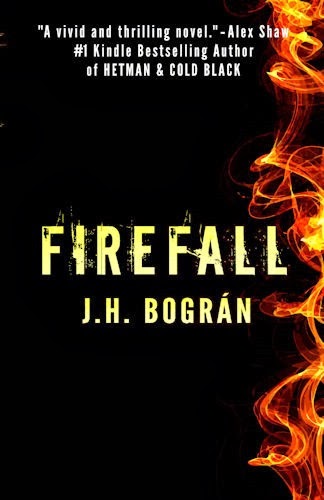
FIREFALL COVERAs if that was no enough, in my second novel FIREFALL, the life of my main character takes a twist for the worst when his wife and son perish aboard, you guessed it, a plane. I’d say it has a different approach from the previous work because the accident depicted this time is loosely based on one in real life that happened in 1972. I was born that year, but it has nothing to do with that decision, honestly. Suspense Magazine did me the honor of posting the aforementioned scene as an excerpt in their blog.

In fear of becoming “that author that always writes jetliner accidents,” I made the deliberate decision of not including a major scene aboard any aircraft in my current work-in-progress. Well, okay, I confess there is a very short one where the main characters arrives to New Orleans, but only because it was more convenient for him to fly there than to drive all the way from Houston!

As you can deduce, I love research. To me, that’s the fun part of beginning of a new project. Or maybe I’m just a frustrated pilot, or a pilot-wannabe as the current way speaking goes. It’s a fact that I can’t start the engine of my car without having plotted the entire route to my destination in my head. Something my wife is grateful for, especially during long trips as she hates reading maps as much as I hate a GPS device ordering me where to turn.

So, how about you? Do you have any pet-peeves you’re always finding ways to write into your stories?

———–

About J. H. Bográn

J. H. Bográn, born and raised in Honduras, is the son of a journalist. He ironically prefers to write fiction rather than fact. José’s genre of choice is thrillers, but he likes to throw in a twist of romance into the mix. His works include novels and short stories in both English and Spanish. He’s a member of the Short Fiction Writers Guild and the International Thriller Writers where he also serves as the Thriller Roundtable Coordinator and contributor editor their official e-zine The Big Thrill.

Website at: www.jhbogran.com

Facebook profile: www.facebook.com/jhbogran

Facebook author page: http://on.fb.me/ZJwEq0

Goodreads author page: http://bit.ly/1a9d07V

Amazon author page: https://www.amazon.com/author/jhbogran

Twitter: @JHBogran

Fall Break

A combination of heavy lifting prior to a major house remodel (we get to spend 2 months living in the basement…) and a fall break adventure with my boys at Legoland means that this week’s blog post is MIA. Sorry! See you back here in a couple of weeks – hopefully by then I will have recovered!
Clare

The role of publicists in indie publishing

Recently I received an email from a TKZ’er. He wanted to ask a follow-up question about our post discussing the Recomended Resource List for indie authors:

I have  a problem not addressed in your post–help with marketing. A clean  manuscript with a great cover means little without knowing how to  get the word out. I am more than willing to do my part in terms of  marketing my books, but as an older writer who isn’t savvy about  social networks, etc., I need someone in my corner. Can you offer  any suggestions or guidance? Thanks a lot.

I might not be the best person to address this topic since I haven’t used a publicist in a few years. But since the question came to me, I’ll give it a shot.

When I first signed my contract with a Big 6 Publisher a number of years back, I knew that the large publishers have in-house publicists who handle author promotion. But like many of you, I’d heard horror stories about new authors who’d been ignored, neglected, or otherwise left to rot on the vine by their in-house publicists. I decided to get proactive. I hired an independent publicist. The PR company I hired offered its publicity services “A La Carte”. Clients paid for a specified number of print interviews, broadcast interviews, book reviews, signings, speaking engagements, etc. I liked that approach.

Here’s what I got out of the experience of using a publicist, the good and the bad:

PRO

Reduced need for self-promotion
I don’t like selling myself. So I loved how the publicist freed me from the burden of arranging my own book signings and interviews. And so what if most of those interviews were with minor outlets in places like Kalamazoo? I was a newbie, so it wasn’t like I was expecting Oprah to be banging down my door.

Time saver
I had spent years writing my first book, and all of a sudden I had to adjust to the demand of producing another manuscript within nine months. Had I been left to my own devices, I probably wouldn’t have done a single promotional event that year.

Organization
The publicist kept everything on track for me, emailing me nifty little calendars with every event’s details outlined. 

Re-introduction to media

Even though I have a (distant) background in broadcasting, it was extremely helpful to do all those radio shows (plus the rare TV appearance). I was able to hone my “author act” during those events. And it was fun. I loved talking to overcaffeinated radio hosts during their drive-time morning shows. (Since I live on the West Coast, the timing meant I usually had to down a couple of Red Bulls to project enough peppy “author energy” at 4 a.m.)

TKZ dividend
When I decided to start a writing blog in 2008, I didn’t know many other writers. My publicist gave me the names of many of the writers who joined me in launching TKZ. I’ll always be grateful for that assist!

Con

Cost
The publicist’s services didn’t come cheap. It cost about $4,000 to have them arrange a semi-active calendar of book-related events. Considering that the average new author’s advance (for those who even get advances anymore) is somewhere in the neighborhood of $5,000 to $15,000, that’s a considerable chunk of change.

Bang for the Buck
Did all those paid-for radio interviews, book signings, and other events translate into increased book sales? There’s no way to know, frankly. I certainly felt like I was doing a lot to spread the word that year. But there’s no real way to judge the effectiveness of all that activity.

Final question: Are publicists useful for indie authors?
Could some of you here, legacy, indie, or some combination thereof, share your experiences with using a publicist? How do you think paid PR fits into the evolving indie publishing landscape?
And if you’ve had a positive experience with using an independent publicist, let us know in the comments. And if you’ve had a horror story about paying lots of money for little outcome, please share that as well. (Although it would probably make sense to omit the publicist’s name in that case!)

Note: I haven’t mentioned the name of the publicist I used in the past, only because I’m not sure how active she is in the industry anymore. If I get an update about her status, I’ll let you know.

Inspiration on Two Wheels

By Mark Alpert

I used to bike in Central Park, but it got too crowded. The tourists, so blessedly oblivious, don’t look where they’re going. They step into the bike path, gawking at everything except the cyclist bearing down on them. You can try yelling, “Watch out!” but it never works. It only startles them. They stand there in the middle of the path with their eyes wide open and their mouths agape. After experiencing several near-collisions, I realized I was fighting a losing battle. So I started biking in Riverside Park instead.

The bike path in Riverside runs next to the Hudson. I ride about five miles north, from 72nd Street to the George Washington Bridge, then turn around. There are good views of the river and the Palisades on the New Jersey side. I can outrace the barges when they’re moving against the current (which sometimes goes north, sometimes south, depending on the tides). If I’m riding during rush hour, I blow past the cars stuck in traffic on the West Side Highway. And sometimes, if I’m lucky, I find inspiration. Herman Melville was right: New Yorkers are obsessed with the water surrounding their city. “Posted like silent sentinels all around the town, stand thousands upon thousands of mortal men fixed in ocean reveries.”

Last May I saw a corpse lying on the strip of grass between the bike path and the river. It was a Saturday evening and I was exhausted because I’d just gone fifty miles instead of my usual ten. My son’s baseball team (the New York Gothams, hooray!) had traveled to a tournament in Demarest, New Jersey, that morning, and I’d had the bright idea of biking there to watch the game. It didn’t look that far on the map. All I had to do was cross the George Washington Bridge and go up the bike path in Palisades Interstate Park. Suffice it to say, my knees were in great distress by the time I re-crossed the bridge and returned to the city. I just wanted to get home and lie down for the next 24 hours. But as I neared the part of Riverside Park that’s unofficially set aside for weekend barbecues (between 145th and 155thstreets, approximately) I saw a crowd of people standing around a heavyset, middle-aged African-American man who lay supine and motionless on the grass. There were several cops in the crowd but no paramedics. That’s a bad sign, I thought as I sped past. No one in the crowd knelt beside the supine man to give him CPR. They just stared at the body and kept their distance. My suspicions were confirmed a moment later when I saw a van marked MEDICAL EXAMINER parked about fifty feet farther down the path. I checked the newspapers the next day and didn’t find any mention of a homicide, so the man must’ve died from natural causes. Still, it freaked me out. Although I’ve finished off scads of unlucky characters in my novels, I haven’t seen more than half a dozen corpses in my life.

In August, Riverside Park gave me another piece of macabre inspiration, although I didn’t witness this incident firsthand. I read a newspaper story about a pack of muggers who’d strung a rope across the bike path, just south of the George Washington Bridge. They waited until they saw an expensive Cannondale bike come down the path, and then they pulled the rope taut to clothesline the cyclist, knocking him off the bike. He wasn’t badly hurt, but the muggers took his Cannondale, as well as his iPhone and the five hundred dollars he was carrying.

My first reaction to the story: Well, that could never happen to me. The victim was biking at 11 p.m. and I would never ride that late. Plus, no mugger would want to steal my bike because it’s a rusty, twenty-year-old piece of crap. And why the hell was the guy carrying so much money?

This reaction is so typically New York. Whenever anything bad happens in this city, we try to distance ourselves from it. We say to ourselves, “That guy got in trouble because he was an idiot. And I’m not an idiot, right?”

Just a few weeks later, another local news item shattered my complacency. An emotionally disturbed homeless man wielding a pair of scissors went on a rampage in Riverside Park near 65th Street. He slashed two joggers, a dog-walker, and a father pushing his two-year-old in a stroller. A bystander wrestled the man to the ground before he could attack anyone else. Luckily, no one was killed. My first reaction to the story: Thank God for New York’s gun-control laws. The carnage would’ve been a lot worse if the assailant had been carrying a semiautomatic.

It was much more difficult for me to distance myself from this crime. It happened at eight in the morning, less than a mile from my home. I could so easily see myself standing in the shoes of the father, throwing my body between the disturbed man with the scissors and the two-year-old in the stroller. I know that New York’s parks are, on average, very safe; that’s why the incidents got so much ink in the newspapers, because they were anomalies. Crime rates in New York have plunged to record lows over the past twenty years. Nevertheless, I felt a mixture of fear and fascination. And as we all know, those emotions are good fodder for thrillers.

Maybe I’ll start a novel with a scene in Riverside Park. “He didn’t see the rope until it snapped up to his neck.” “He didn’t realize he’d been stabbed until he saw the hole in his jacket.” Or maybe not. I’ll think about it some more the next time I go biking.

First-page critique x 2

By Joe Moore
@JoeMoore_writer

Today we present 2 first-page submissions– sort of a buy one, get one free or 2 for the price of one. You get the idea. My comments follow each.

CHAPTER 1.O

They say bad things happen fast but good things take forever, like saving up a hundred dollars one penny at a time.

I don’t know about that. Looking back it seems more like a cartoon avalanche that started with a pebble that hit a stone that hit a rock that hit a boulder that just buried me and everybody and everything I knew and loved.

Knowing what I know now I can see that it wasn’t a series of unconnected random events; even if that’s what they had meant for it to look like. Everything had been meticulously planned months – or maybe years – in advance.

They had contingency plans and had contingencies for contingencies.

The only thing they hadn’t counted on was Bill.

I like this one, particularly the voice. Although it’s short and there’s no sense of place or time, I know that the narrator is in trouble. “They” caused something bad to happen to him/her and others. There’s not a lot to pick at because it is so short. But I would definitely keep reading.

Friday, 3:08 am

Dan Taylor sat in the wingback chair next to his bed, watching the quietly dreaming form of his wife in the darkness. The pale sheets rose and fell ever so slightly as she breathed. Dreaming of starting a family, he was sure. Maybe that had been possible when they were living in Camden, but he couldn’t allow it now. Not until he felt safe in his work. He just wasn’t sure how to tell her that yet.

He hadn’t slept well since they moved to North Carolina. Vicki told him countless times how much she liked living in his hometown. She seemed really happy. He still hadn’t figured out how to tell her that he wasn’t. Not at all.

To be fair, Raleigh was a nice town. Always had been. And he had to admit that finally making detective at 33 was a relief.

Still, he left a lot of personal demons behind when he moved away. Every night for the last two weeks, they invaded his dreams to remind him they were still here. Lurking. The only solace he could take was that Vicki thought he slept as well as she did at night.

If only.

Glancing out the window, he watched the ghosts of past mistakes dance before him. Long gone, but still alive in his mind’s eye. He saw the anger, the handkerchief.

The blood.

He shut his eyes, but the images only became clearer. Too long ago, he thought. I should be over this. What the hell was he thinking, coming back here?

The blare of his cell phone in the stillness made him jump. He lurched for it, his pinky finger banging on the edge of the table. His eyes flashed at the sharp jab of pain. He bit his lip to stay quiet, involuntarily shaking the injured hand.

The phone rang again and Vicki twitched, groaned from somewhere in the depths of her slumber. He picked up the cell to keep it from waking her.

“You asleep, kid?”

Kid. Mark Harris, his partner, insisted on calling him that. Dan glanced at the face of his alarm clock, shining blue in the early morning darkness. He grimaced.

“Harris, it’s three o’clock,” he whispered. He considered going in the other room, but watching Vicki sleep was calming. Dan needed that calm right now.

OK, the good news is that I see this as strong writing. I feel the narrator’s pain. I have a vivid sense of place. I am aware of his mental and emotional tension including the conflict of family planning between the cop and his wife. Within a few sentences, I believe he is a three-dimensional character. There’s a wonderful sprinkling of backstory without explaining anything or slowing us down. And of course the proverbial call to action. We know there’s a dark past and more bad things are coming. We’ve been given a quick setup and now we’re ready. We read on.

Now the bad news. I’ve seen or read this central casting setup more times than I care to remember. Although it’s written well, it’s a cliché. There’s nothing fresh or unique or different here. Still, I see an excellent writer at work and would keep reading.

Thanks to both brave authors for submitting their work. Good luck to you both.

How about the rest of you Zoners? Any thoughts?

To She or Not to She

By Elaine Viets

    11849505-men-at-work-sign-illustration

When I was growing up, men were men and he meant everyone, men and women both. Not any more, bud. Now we want gender neutral writing.
    Too bad English lacks a pronoun that includes men and women both.
    I believe words have power, and using he to mean both sexes disenfranchises women. I weasel around the dilemma by using they. That works, most of the time.  When it doesn’t, I alternate between using he and she, giving separate but equal treatment to the sexes.
    I’ve tried to sneak in their as a singular pronoun, but my publisher’s copyeditors put the kabosh on that. Copyeditors put the “cop” in editing, issuing citations for breaking the rules.

pens

Recently, my copyeditor friend Les Weatherford addressed that issue. Most of this blog is stolen from Les.
    Les doesn’t like the term sexist. That word “seems a bit harsh, a bit accusatory.” Here are Les’s thoughts on what he calls “a significant hitch in the English language.”
    Consider this example: The president said success depended on everyone working as hard as ______ could.

menatwork
    How do you fill in that blank? “You can’t use it,” Les said. “That doesn’t refer to people. They? Grammatically incorrect. The subject of the clause is the singular.”
    He proposes these options:
    “Recast the sentence to make the clause plural: The president said success depended on everyone working as hard as they could. But the emphasis shifts from the individual to the group, which may not be the president’s intent.
    “Use two pronouns: The president said success depended on everyone working as hard as he or she could. That reads fine in a single sentence, but  becomes cumbersome when repeated over long passages.
    “Follow the rule that many of us were taught in grade school: He equals he or she: The president said success depended on everyone working as hard as he could. Problem: Sexist.” Er, not gender-neutral.
    “Be creative: The president said success depended on everyone working as hard as s/he could. Problem: It’s ugly. Says one writer: ‘That’s just god-awful. It might even imply some sort of gender-reassignment surgery has occurred.’

christine
    “Rules were made to be broken. Go with the flow: The president said success depended on everyone working as hard as they could. Problem: singular subject, plural pronoun. Purists will beat you to a pulp.
    “Persuade the academic authorities to come up with a neuter pronoun. Here is the sentence as it would be written with a pronoun set proposed in 1975 by Christine Elverson: The president said success depended on everyone working as hard as ey could.” Yeah, ey and eir. Look like typos, don’t they?
    “Problem:  Elverson proposed ey nearly four decades ago. When was the last time you used it in a sentence?” Never!
    Les popped the question to writers and editors. He read their responses and came to this conclusion:
    “The storytellers like their. Most formal writers prefer he or she or she or he but acknowledge that their probably is going to win and that they can live with that. The universal he hangs on with one vote. Nobody suggested creating a set of neuter pronouns.”pens2
    Les believes “their and they eventually will win. Only the people who say ‘It is I’ will stick to the universal he, and they are dying off day by day.”
    Thank you for your research, Les. You’ve proved Les is more.
    TMZ readers and writers, where are you on this issue?

TKZ-recommended Indie Publishing Resources List Posted, Dictionary of Vintage Crime Terms

In case you missed it: We’ve posted the list of TKZ-recommended Indie Publishing Resources as a link in the sidebar (“Indie Publishing Resources We Love”). The list, which was requested by readers during a Reader Friday discussion, includes indie publishing resources that have actually been used by members of the TKZ community. If you would like to add to the list or make corrections, please leave a comment in the list document, or in the Comments following this blog post. Thanks!

Found Treasures: Dictionary of 19th-century Crime Terms

“The Secret Language of Crime” is a delightful dictionary of vintage crime lingo. Written in 1859 by the Police Chief of New York City, the dictionary contains priceless words that cast a spell from the past: “barnacles” for handcuffs; “beau-traps” for fortune hunters;  “cheese” as a command to be quiet and listen. 

You can read more about resources for vintage words over at The New York Times. Take a look at the dictionary and tell us, which word do you think should be resurrected for modern use? My vote goes to “ambidexter,” for someone who befriends both sides of an issue. We could use some more ambidexters in Congress this week!