Reader Friday: Creating A Literary Monster

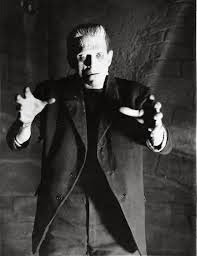
In 1816, during an unusually cold season caused by volcanic eruptions and circulating ash,  19-year-old Mary Shelley wrote a story about a monster as she and some friends struggled to stay warm. FRANKENSTEIN was born.

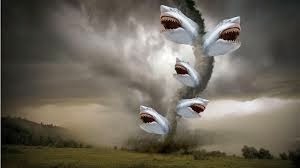
If you were to create a literary monster sprung from our own modern era of extreme and changing weather patterns, what would that monster be called? Can you describe it? (Be advised though, that SHARKNADO is already in the lexicon!) 🙂


Very Young Adult

By Mark Alpert

The drawbacks of the writing life are well-known. Long hours, low pay (if any). Frequent bouts of insecurity, hysteria, despair. And don’t forget the rejection letters and snarky reviews! But this profession has one wonderful benefit that almost makes up for all the pain and suffering. Writers are great at telling bedtime stories.

My kids are fourteen and twelve now, but we still do the bedtime reading ritual. My son prefers that I read out loud to him, usually from action-adventure young-adult novels. We’ve gone through the Maze Runner series, the Divergent series, and the I Am Number Four series. We’ve also read all the Lord of the Rings books and some adult sci-fi novels such as Wool. We recently finished Feed, an amazingly good YA novel about a dystopian future where all the teenagers’ brains are directly hooked to the Internet. I loved the teen lingo that the characters used in Feed. Whenever I finished one of the chapters, I’d start speaking to my son in that futuristic way. (“You are so null, Unit!”) Now we’re reading Ender’s Game, another great sci-fi novel. I can’t wait to see my son’s reaction to the surprise at the end of the book.

My daughter likes science fiction too — she loved Wrinkle in Time — but she usually goes for the more humorous books, such as Savvyand The True Meaning of Smekday, which features a lovably bone-headed alien who calls himself J. Lo. She also enjoys the earnest, realistic, middle-grade family-drama books, the kind I would never read if I didn’t have a twelve-year-old daughter. I have to admit, I’ve been pleasantly surprised by how good some of those books are. I loved The Romeo and Juliet Code, a novel about a British girl sent to coastal Maine during World War II. And I was choking back tears at the end of Eight Keys. (I couldn’t help it. The girl’s parents are dead but they left her a bunch of letters. Believe me, you would cry too if you were reading the book to your kid.)

Lately, though, my daughter has been asking me to invent my own bedtime stories rather than read books to her. This can be a challenge at the end of a long, trying day, but I’ve had a few successes. After we read Animal Farm last year, I concocted a similar story involving rebellious, talking pigs and sheep, but instead of taking over the farm and creating an allegorical Communist society my animals ran off to Atlantic City. The pigs played blackjack, the chickens crapped on the craps tables, the horses bet on the horse races and the sheep invaded a luxury clothing boutique and carried off a bunch of winter coats that they claimed were made from their father’s wool. Then the animals commandeered a cruise ship and set off for Europe, chased by the drunken farmer and the one animal that remained loyal to him, a homicidal goat.

Another popular bedtime story features a headless girl named Headless Hattie. Her parents have even stranger deformities: her father (Pantsy) is just a pair of pants, and her mother (Susan) is nothing but a brunette wig and a pair of sunglasses. Pantsy’s dream is to become a police officer, but when he goes to the precinct house to apply for a job, the desk sergeant laughs at him. “How are you going to shoot a gun, you don’t have any hands!” But Pantsy learns how to carry the gun in his pocket and pull the trigger by swinging his hips. He arrests a gang of bank robbers and becomes a hero. And so on and so forth. I keep making up new adventures until I run out of ideas. When I get desperate I try to work President Obama into the plot. (For an example, consider the recent episode “Pantsy Joins the Secret Service.”) In my stories, Obama is an amusing figure, easily exasperated by Headless Hattie and her truncated father. As if he doesn’t have enough problems already!

A few days ago my daughter informed me that the Headless Hattie series of stories had “jumped the shark” and I needed to invent something new. So I started a new series featuring a girl named Peggy who has a very small man living inside her belly button. His name is Herman and he’s barely visible, only an eighth of an inch tall. He was a normal-size man two thousand years ago, during the heyday of the Roman Empire, but he wandered into some Italian cave and ate a weird mushroom. The fungus stopped him from aging but also started the slow shrinking process that gradually miniaturized him. For the past few hundred years he’s been living inside belly buttons, jumping from one person to another whenever he gets the chance, but he’s starting to tire of this nomadic life. He convinces Peggy to fly to Italy so they can find that mushroom-growing cave and try to undo the effects of the fungus.

Here’s the latest installment of the story that I told my daughter earlier tonight: Peggy is on the plane to Rome, trying to surreptitiously talk to the tiny man in her belly button, when the passenger sitting next to her overhears their conversation. Peggy claims she’s just talking to herself, but the passenger — a kindly old woman — winks at her. “Don’t worry, your secret’s safe with me,” she says. Then she lifts her shirt and points at her own belly button. “I’ve got a man in there too.”

Good cliffhanger, right? But I have no idea what will happen next.

First Page Critique: GAMES OF CHANCE

We have a first-page submission for critique today, titled GAMES OF CHANCE.  My comments follow.

***
As Callie crested the hill, the finish line appeared, lined with colorful flags – and then receded, as another girl thundered past.

Callie chased her on a gentle downhill slope, three hundred meters of fairway to the finish line of the State Championship. Through eyes hazy with exhaustion and the remnants of a cold, she could see Anna and Hanna, her twin teammates, sprint past the finish marker in a dead tie.

Two hundred meters to go and Callie could hear the gasping breath of another runner closing on her. Five strides later, the girl was beside her. Callie pumped her arms harder, willing her legs to move faster. Legs that could carry her for miles were failing now with the finish in sight.

Noise flooded both sides of the course and, penetrating over it, someone shouting her name. The cheers of the fans and coaches slid past her as she fought for position.

She saw the red singlet and slashing white diagonal as the last of the Fairchild Academy runners eased by her. Swearing, Callie leaned forward to gain momentum, rising up into a full sprint, her calves already starting to cramp, alternating with each foot strike, each spasm an opportunity to let the girl go, to quit.

Seventy meters and Callie still matched strides with the Fairchild girl.

At fifty meters, another girl caught both of them. She was a tiny runner from a small school up north, and her breath came in sobs.

The three of them closed on the flags at the top of the finishing chute. Callie felt the agony of each breath as it exploded from her lungs, too little air for starving muscles. The blood pounding in her head drowned out the runners beside her, and Callie’s vision squeezed down to a small circle focused on the white line that marked the end. She drew on the struggling efforts of the runners next to her, seeking just a small advantage.

The sobbing girl finished one step ahead, the last sob a moan as she collapsed. Instinctively, Callie dodged the fallen runner as she lunged past the line, a half-step ahead of the Fairchild runner.

Relief and exhaustion mingled with joy but a small doubt blossomed.

Was it enough?

***

My comments:

Update:

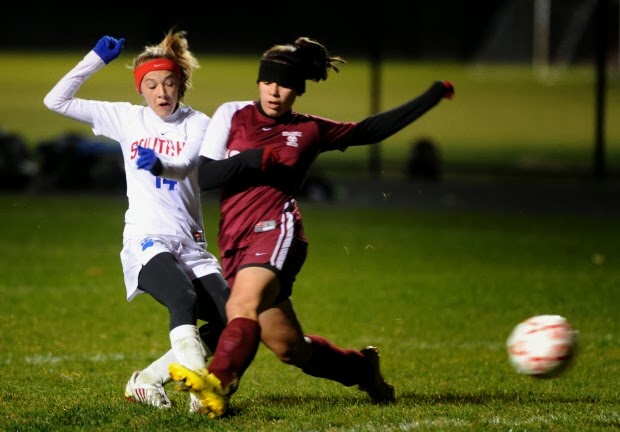
Clearly, I erred in attaching a soccer image to this story about a race! I formed a clear picture of a drive down a soccer field in the first paragraph and never let go of that image, despite counter-cues in the rest of the page. That shows how readers can go offtrack–which is a subject for another blog!

*** 

I appreciate the way this page describes Callie’s efforts during her  thundering drive toward the finish. The writing regarding the action, concentration, and her sense of being pursued by others was convincing.

I do think that the first lines lost a bit of impact due to their construction. “As”used twice in the opening paragraph. It’s important to vary your sentence constructions, especially in openers. Also–and this is just my personal opinion, others may disagree–starting a story with a sentence that begins with “as” is a weak way to open a scene. As readers, we don’t yet have any context for relating the “as” to anything.  The writer should the character’s main action, rather than introducing “as” right off the bat. 

While I enjoyed the way the running action was described, I do think we need to learn a bit more about Callie in this first page. As we’ve discussed so many times here on the blog, the first page of a story has to pull the reader into the character’s world. As currently written, we only get the idea that Callie is trying to score a soccer goal. (Update: Oops!) For me, that situation is not quite compelling enough for a first page. We need a hint about Callie’s character and motivation, as well as the story to come.

One nit: There were too many undifferentiated characters, I thought. To enhance the suspense, the writer might consider focusing Callie’s running battle on one particular opponent in particular–especially if that rival will figure later in the story. (From my Soccer Mom days, I predict that the opponent will be the Dreaded Goalie.)

All that being said, I think the writer displays a promising strength for conveying action. That’s a a real plus. Keep going, Writer! And thank you for submitting this page for discussion today.

TKZ’ers, what are your thoughts about GAMES OF CHANCE?


When Bad Things Happen to Good Books

By Elaine Viets

Install-A-Laundry-Chute-af

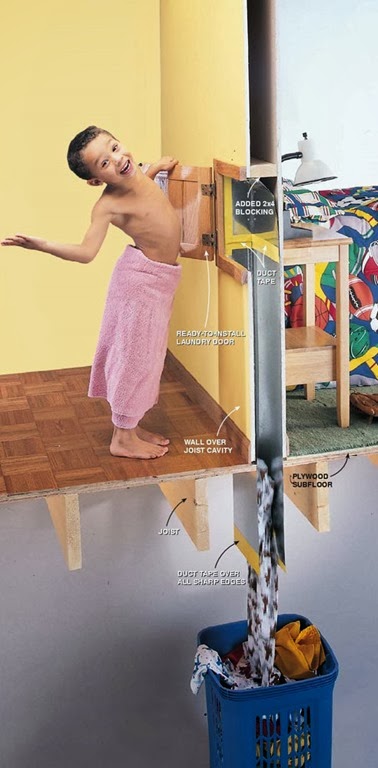
    So there I was reading my favorite blockbuster novelist, a writer with a shelf full of awards, kudos from critiques, a movie and more, when I was stopped by a stupid mistake. The angst-ridden hero tossed his clothes down the laundry shoot.
    Well, chute. What happened to this normally careful and precise author? Where were his editor and copyeditor?
    No, I’m not giving you this writer’s name. These mistakes happen to us all. Keep reading and I’ll tell you how I embarrassed myself in front of three hundred thousand readers.
    Let’s just say that homonyms happen.
    Here are a few common mistakes that make you look like an amateur. And no gloating, please. The next brain freeze could be yours.

 
– It’s bloody embarrassing when mystery writers have police and forensic experts talk about blood splatter. It’s spatter. Get the L out of there.

– Watch those bears. Grizzly murders are cringeworthy, unless the person was killed by a bear. Grizzly is another treacherous homonym.

– Triple threat. “Peaked,” “piqued” and “peeked” give writers three ways to go wrong. How often have you encountered versions of “this peaks my curiosity”? I didn’t want to see it, but I’d already “piqued” at the page and knew I wasn’t getting a “peek” literary experience.
 Heineken_Beer_Bottle
– Twisted. Beer drinkers know that Heineken does not have a twist-off cap, but many writers don’t. Your character needs a church key for those green bottles.  

jack daniels

— Jack’s possessive. Jack Daniel’s always has an apostrophe. I had a sobering discussion with a copyeditor who wanted to remove the apostrophe, but that’s when hanging around bars paid off. I knew Mr. Daniel was possessive about his Tennessee whiskey.

70_vw_beetle_500-thumb

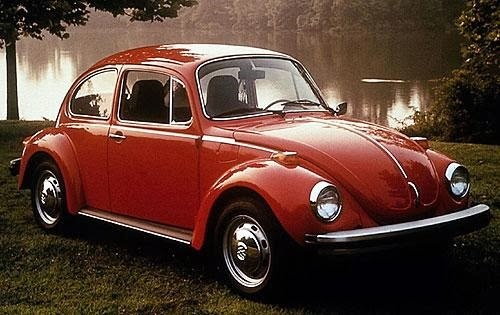
– How to drive readers crazy: Get car details wrong.  In 1968, hippies did not open the hood of their VW Beetles and check the engine. Beetles back then had rear-mounted, air-cooled engines. Check car details on the Internet.

– All wet. No, you do not “wet” your appetite. You sharpen it. Put that H to work.

— Lift that bale. No, you don’t tow the line. It’s not a rope. Webster says when you “toe the line” you “conform rigorously to a rule or standard.”

– Watch those foreign words and phrases. When I was a newspaper reporter, I wrote about a waiter who wore “liederhosen” at a German restaurant. Amazing, a reader told me. A man with singing leather pants. I should have had the waiter wearing lederhosen – leather britches.
    That extra “i” made a fool out of me.

lederhosen

Our Man in Santo Domingo

By Mark Alpert

I’m going to the Dominican Republic this weekend, so today’s post will have to be brief. The coach of my son’s baseball team is Dominican, and he invited all the boys (and a few dad-chaperones) to come to his hometown and play a few games with the local kids. The DR is renowned for its baseball talent, so we’re expecting to get creamed.

It occurs to me that this trip could be the setup for a comic spy thriller by Graham Greene: a bunch of clueless, middle-aged New Yorkers bring their teenage sons to Santo Domingo, bearing gifts of donated baseball gloves and bats. Crazy hijinks ensue, involving Caribbean drug lords, CIA company men and unscrupulous scouts from Major League Baseball.

If I were writing this thriller, I’d try to work A-Rod into the plot, too. Talk about screwball comedy!

Working title: Damn Yankees

White Meat

By Elaine Viets

Rockwell-Thanksgiving

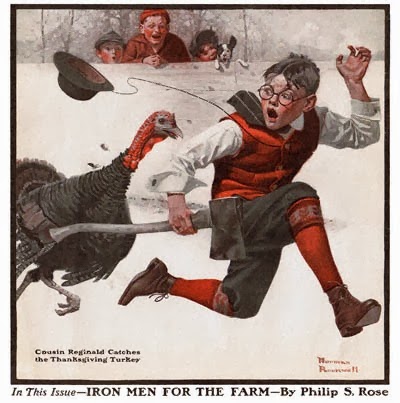
    White meat. When I was growing up, that was the best part of the turkey – and the most unattainable.
    In German-American families, children were seen but not heard, and the choicest pieces of Thanksgiving turkey were reserved for the adults. Grandpa carved the turkey because he was the head of the family, but he had a subversive streak. Grandpa would “accidentally” drop little slices of white meat on the kitchen table for us grand kids while he carved.
    But not too many. That delicacy was reserved for my mom and my aunt. My dad and my uncle got the turkey legs, Grandpa ate the wings and thighs and Grandma ate the pope’s nose – the tail. She’d grown up poor and “got used to eating it,” she said.
    But Grandma was determined that her grandchildren would know the finer things, including white meat on Thanksgiving. One year in the 1960s, when I was ten and still eating at the children’s table, she bought a Butterball turkey.
Butterball-Turkey
    The big-breasted bird was the talk of the family.
    When we visited her the Sunday before Thanksgiving, we went downstairs to the basement freezer to admire the prize. The burly top-heavy bird nested amid bags of the frozen peas.
    “Look at the size of that breast,” Grandma said. She never used that b-word  except to describe fowl anatomy.
    Butterballs boasted more white meat than any other turkey, according to the ads, and we didn’t know about animal rights back then.
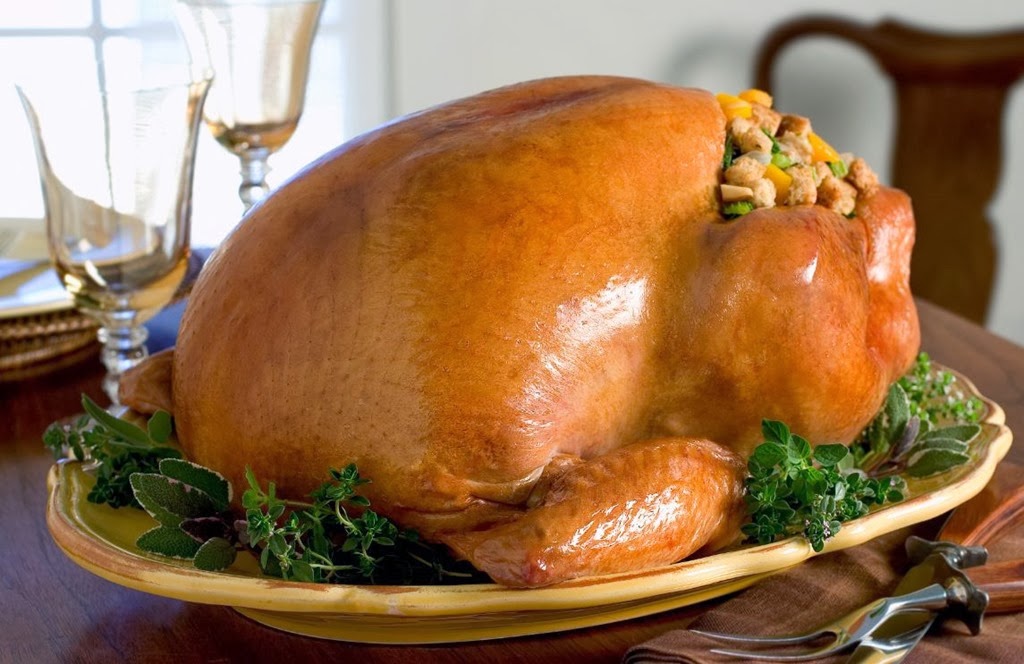
    At three o’clock that glorious Thanksgiving, Grandma triumphantly pulled her roasted Butterball turkey out of the oven: a busty golden brown bird.
butterball-turkey1
While the turkey cooled, she put the finishing touches on the rest of the holiday feast: giblet gravy, stuffing, cranberry relish, lima beans in cheese sauce, and Parker House rolls. A stick of real butter was enshrined in a cut-glass dish. Mom brought the screw-top bottle of Mogen David wine out of the fridge and poured everyone a thimbleful.
    The table sparkled with the best crystal and dishes, seen only on holidays. Even the kids’ card table got a real tablecloth.
    Grandpa started carving. First the legs were set aside on the platter. Next he sliced into the golden breast meat. “Oops, I dropped a piece,” he said, and placed a thick slice on the Formica-topped kitchen table. As the oldest, I grabbed it. (Hey, rank has its privileges, even among kids.) Yum. This was the tenderest white meat I’d ever eaten, a sweet promise of the adult privileges waiting for me.
    “Me, Grandpa!”“Me!” my brothers and cousins cried as Grandpa gleefully dropped slice after succulent slice of white meat and we kids scrambled for them like hungry pigeons.
    He was still giggling and giving us white meat when Grandma said, “Papa, how’s the turkey coming?”
    Uh-oh.
    Suddenly we noticed the turkey breast was as bony as a fashion model’s carcass. All the white meat was gone, except for a few scraps.
          Guilty, greasy-fingered grand kids slipped away.
    Now I can eat all the white meat I want, but it never tastes quite as good.
    So what lesson does this teach about writing?
    (A) Be on the look out when something special lands front of you – and use it.
    (B) Nothing. Have a happy Thanksgiving with delicious memories.
1917-12-01-The-Country-Gentleman-Norman-Rockwell-cover-Cousin-Reginald-Catches-the-Thanksgiving-Turkey-no-logo-400-Digimarc

Readers Aren’t Elephants

Elephants, it is said, never forget anything.

 
Readers, not so much.

I’m reminded of this memory gap frequently in my critique group. I’ll be reading a scene from chapter eight of someone’s draft, and suddenly a minor-sounding character pops up from out of nowhere to contribute a bit of dialogue. There’s no description that reminds me who this character is, or where he came from. There’s just a bit of dialogue, and a name. I have no clue who this character is.

Oh, I introduced that character four chapters ago, the writer says, a tad defensively, in response to my sheepish request for a reminder. How could I have forgotten?

I’ve forgotten your character, I want to scream at the writer during these moments, because A) You failed to introduce the character originally in a memorable way, and B) You didn’t re-establish him later in an effective manner. 

A Universal Truth of Writing: It’s Never the Reader’s Fault!

It doesn’t work to ignore a character for several chapters, or even one scene, and then sling him back upon the unsuspecting reader without proper re-introduction. To a reader, this type of assault feels a bit like a zombie attack from outer space. Readers need to be reminded about what your character’s been doing the entire time you’ve been focusing attention elsewhere.


Within a scene, the re-introduction of a character who’s been missing in action can be done with a single sentence. For example, let’s say you have a scene with three characters, and two of them have been having a heated argument. Now let’s say you need to re-introduce Character #3, who hasn’t said anything so far in the scene. This is one way you might do it:

Bertram, who’d been listening to us from his unsteady perch on the broken stool, cut in to deliver a verdict. “You’re both wrong,” he said.


If your character’s been missing in action for entire chapters, you’ll need to do a bit more work to re-introduce him. One thing you could do would be to show other characters reacting to your MIA’s re-arrival in the scene.

Best Practice Suggestions: 
Don’t lose your reader by ambushing him with improperly introduced details or characters from previous sections.  
Do re-establish characters from earlier sections with gentle reminders that help readers stay oriented in the story flow.

How do you re-introduce MIA characters in your work? Have you ever had to go back a few pages to remind yourself who a character is?

The Perils of Procrastination

By Mark Alpert

I have a son in ninth grade and a daughter in seventh, and the bane of their existence is homework. Their teachers assign way too much of it, four or five hours every night. And because the kids don’t come home from track practice till five or six in the evening, very often they’re still working at midnight, solving algebra problems or reading about the Roman Empire. They get far more homework than I ever got during my school days. Back in the halcyon Seventies I used to tear through my assignments in an hour or so and spend the rest of the evening reading my X-Men comics, listening to the Saturday Night Fever soundtrack, and watching Mary Hartman, Mary Hartmanon TV.

I blame globalization. The world economy has grown more competitive since the days of disco, and the striving meritocrats of America are desperate to save a slice of the shrinking money-pie for their children. In response, the schools in the wealthier districts have accelerated their curricula, trying to prepare their students to compete with the fiercely disciplined kids in East Asia. If the top achievers in Beijing and Seoul are working their butts off, then our kids should be doing the same, right?

Wrong. I’d rather see America forfeit this global rat race than continue to make our children miserable. Seriously, it’s not worth it.

The worst part is seeing the pernicious psychological effects that excessive homework has on my kids. The nightly burden is so great, it makes them depressed. They sense the unfairness of it, the futility. And they add to their misery by putting it off as long as they can. There’s too much homework to finish it quickly, so instead they delay starting it. It’s like a huge black mountain darkening all the hours ahead, and the last thing they want to do is begin the long, hard climb. So they go on Facebook or YouTube, or text their friends, or watch another Simpsons episode on TV. But all the while, the homework is still waiting for them, a looming threat.

I can imagine their feelings because I’ve felt them myself. Writing novels is more fun than doing homework — otherwise, why write them? — but sometimes I get confused about the direction of a work-in-progress and I start to wonder if the whole thing is a lost cause. At those moments I see the black mountain looming in front of me, and the last thing I want to do is climb it. So instead of writing the next sentence of the manuscript, I check my e-mail or the New York Times website. Or I go into the living room where the kids are watching the Simpsons episode and watch it with them. (It’s such a consistently entertaining show.) We procrastinate together, as a family.

I’m in that predicament right now, unfortunately. But I know that sooner or later I’ll sling my backpack over my shoulder and rediscover the path that goes up the mountain. With any luck, it’ll happen sometime this week. In the meantime, I’ll keep busy by nagging the kids about their homework.

Book Soup

By Elaine Viets
soup1
    Writing a novel is like making soup: We add chunks of our own experience, bits of research, boil it down, season it with imagination. We transform those ingredients into something that we hope is tasty, even nourishing, for our readers.
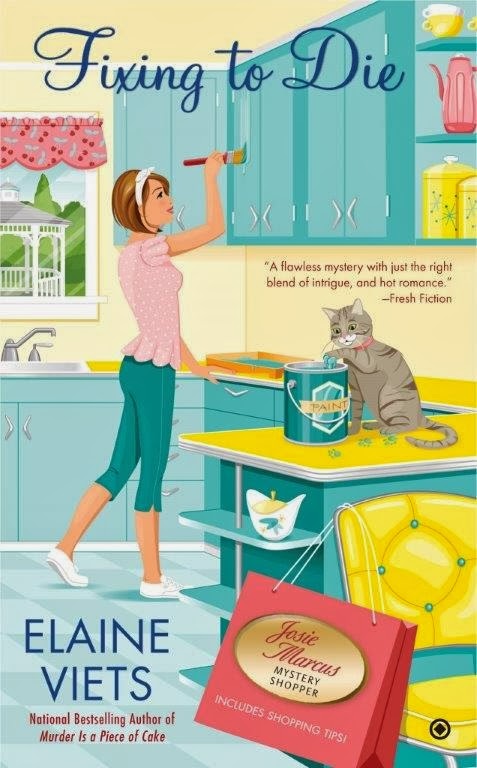
    In “Fixing to Die,” my new Josie Marcus mystery shopper mystery, I used an old encounter with a bully. Josie has a tween daughter, Amelia. Three mean girls at Barrington School create a Facebook page called the Bitches of Barrington, and put photos of Amelia and three of her friends in doghouse frames. Twelve-year-old Amelia is hurt and humiliated when her classmates see the BOB page. Worse, the other students bark and howl as Amelia and her friends run for their parents’ cars.
FixingToDie
    It’s hard to escape stories about bullying these days. The facts are dreadful. Dosomething.org says some “43 percent of kids have been bullied online and girls are about twice as likely as boys to be victims and perpetrators of cyber bullying. Worse, bullying victims are two to nine times more likely to consider committing suicide.”
    I grew up before kids used computers – and before mean girls had their own movies. Back then, we knew about boy bullies, but nobody thought girls could be, too.
    When I was twelve, I was bullied by a mean girl named Bonnie. She went to public school and I went to St. Sabina Catholic school. Bonnie beat me up on my way home from school. I started taking the long way home to avoid her.
    Now that I’m grown up, Bonnie’s bullying seems ridiculous. But my terror at twelve was real.
    Here’s how I used it in “Fixing to Die.” In this scene, Josie, her new husband, Ted, and Amelia, discuss bullying:
Amelia & Mean Girls
    “Technology has changed the bully business,” Josie said.
    “What’s technology got to do with bullies?” Ted asked.
    “When I was Amelia’s age,” she said, “I was bullied by Bonnie. Skinny girl with straggly hair. Bonnie was a year older and a whole lot bigger than me. She didn’t like that I used what she called ‘big words.’ Bonnie would wait for me about two blocks from school, and punch me in the gut. I started taking the long way home to avoid her.”
    “Did you tell Grandma?” Amelia asked.
    “No. Bonnie said her father was in the Mafia and he’d kill her.”
    Amelia giggled. “You believed that?”
    “Yeah, I was stupid,” Josie said. “Bonnie had a German last name. I don’t even know if she knew any Italians, but she had me shaking in my shoes.
    “Here’s the difference between me and Amelia. Once I was home, I was safe. Bonnie wouldn’t come to my house and nobody else knew about it. Online bullying is there twenty four/seven.”
    Bonnie quit tormenting me when I went to high school. I’ve lost track of her. But the memory of her jabs to the gut stayed with me.
everlast-laceless-boxing-training-gloves
Here’s the good thing about being a writer: No experience is ever wasted, no matter how painful.