13 Ways to Sell More Books

By Elaine Viets

I’m a woman with a one-track mind. Catnapped!, my 13th Dead-End Job mystery, is published May 6, and I’ve been thinking about easy ways to sell my latest hardcover. I’ve updated my Website and I have a new book trailer. Brace yourself for a storm of BSP. I’m using my Website as examples for many of these tips.
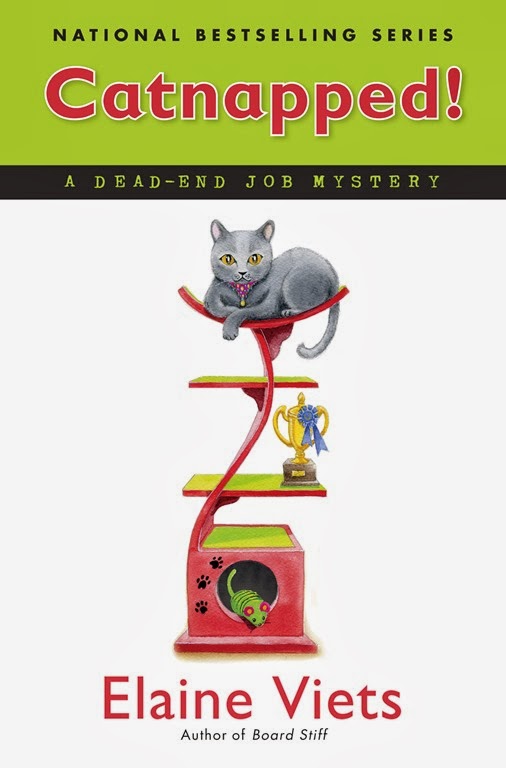
Catnapped!

1. Support your local bookstores throughout the year. Even if you publish only e-books, you need to hand sell your work. Cultivate bookstores. If you can’t afford a book when you visit, buy something you can afford – a cup of coffee, a bookmark or card.

2. Ask the store manager or mystery section bookseller if they’d like a copy of your novel or an ARC, an Advance Reading Copy or uncorrected proof. The key word is “ask.” Don’t just hand the bookseller a copy.  Bookstore offices and break rooms are piled high with books and ARCs. Sadly, many of them are never read.

3. Your publisher may ask you to link to Amazon and barnesandnoble.com on your Website. Also link to at least one independent bookseller. Better yet, link to IndieBound. Check out my Website at http://www.elaineviets.com

HomeMain_03

4. Check all your Website links often, including the ones to your books. You’d be surprised how often booksellers change those links. Your site could be sending readers to buy remaindered hardcovers or used copies of your books. You won’t receive royalties for those sales. I have 22 books in two series and I list them in order. Readers love to know the book order. Check out my Novels page. http://www.elaineviets.com/new/novels/default.asp

5. Keep your Website updated. Add your new books, awards, short stories, and large print editions of your work. Have bios ready in three versions: 50 words, 100 words, and expanded. I have a Press section. http://www.elaineviets.com/new/press/default.asp

6. Invest in professional author photos. I know, you hate having your picture taken. I do, too. And your husband/sister/talented niece takes good photos. But you need a public face. Suck it up, and get the photos. Women writers, get your hair done and have a pro do your make-up. And please, don’t go a “glamour shots” studio for your makeup. A wedding makeup artist is a better choice. Put those photos on your Website so they can be downloaded by the media. Here’s one of mine – and I’m wearing freaking false eyelashes. I suffered and you should, too. http://www.elaineviets.com/new/press/default.asp

Elaine

7. You cannot master all social media. Learn which ones work best for you – Facebook, Twitter, Good Reads, Pinterest – and don’t feel guilty about avoiding the others. My Twitter handle is @evmysterywriter

8. Your Facebook and Twitter posts should match your personality as a novelist. If you write funny novels, make your posts light and entertaining. Find me on Facebook at ElaineVietsMysteryWriter

9. Constant bragging and sales pitches can lose you Facebook friends. You’ll sell more books if you give your FB friends something to enjoy just for the heck of it.

10. If you can’t Tweet or post anything interesting, don’t post that day. Only your mom cares if you had a ham sandwich for lunch.

American-Ham-Sandwich

11. Never post anything on Facebook that you wouldn’t put on a billboard. Facebook friends are not the same as real friends.

12. Resist the temptation to make political Tweets or Facebook posts. Readers want to escape politics with a good novel – yours.

13. If you don’t like a bookstore’s public relations person, sit tight. PR people move on quickly, especially the bad ones. At a local bookstore, the PR person wouldn’t even allow me to leave a mysteryfor the staff. He’s gone, and the PR person who replaced him is an author’s dream. He’s asked me to do two events at his store next month. Things can change for the better.

Bryan Cranston!

Last weekend my wife and I went to see All the Way, the play about Lyndon B. Johnson that just opened on Broadway. The show has gotten a lot of press because it stars Bryan Cranston of Breaking Bad fame. I love this actor. I’ve never seen anyone do such a remarkable job of combining funny and scary. His Breaking Bad character, Walter White, is a totally pathetic clown in some episodes and a stone-cold monster in others. And sometimes he manages to be both at the same time. (SPOILER ALERT: I’m thinking of the scene where Walt shot Mike, in the fifth season. It was so stupid and petty of him.)

I’m happy to report that Cranston does an equally fine job of portraying LBJ in this new play. It would be so easy to play the 36thpresident as a caricature, either a goofy Southern good ol’ boy or a boring Tragic Figure, but Cranston deftly sidesteps both traps. His LBJ is amazing. You have to see it to believe it.

The problem is the rest of the play. It’s written like a high-school history lesson, an earnest, dumbed-down summary of the civil rights movement and the 1964 presidential election. Cranston’s performance is so good that you don’t really notice the play’s flaws when he’s talking. But when the other actors open their mouths, watch out! It was particularly painful to listen to the guy who played Hubert Humphrey, who was portrayed as a naive idiot. This was jarring, because I distantly remember watching Humphrey on TV when I was a kid. He was an idealist, but he wasn’t an idiot.

While my wife and I were talking about the play afterwards, she asked if I could think of any novels that had a similar problem — the main character is rendered exceptionally well, but the rest of the book is just so-so. I drew a blank at first. Then I started to formulate a theory. In most first-person or close third-person novels, I said, the main character is so intimately tied to the narration that it’s hard to separate the two. A character is excellent because his/her narration is excellent, and vice-versa. But in a book with multiple points of view, it’s very possible that an author could do a great job with one or two characters and much worse with the others. Then I tried to think of an example to back up my point.

I’m still thinking.

Classic Thrillers

Last month I read Anna Karenina for the first time. Truth to tell, I had mixed feelings about the novel. Many chapters were glacially slow. The descriptions of Russian rural politics couldn’t have been more boring. Worse, none of the main characters — Anna, Vronsky, Levin — was particularly likeable. Still, I got caught up in the soap-opera plot, the whole nineteenth-century aristocratic mating dance. And the book’s climax blew away. Every thriller writer can learn something from seeing how Leo Tolstoy handled Anna’s suicide.

It’s not really a spoiler to reveal that Anna kills herself, is it? It’s like the crucifixion in the New Testament — everyone knows it’s coming. In fact, the only thing that kept me going through the boring chapters was the anticipation of seeing Anna throw herself under that train. And Tolstoy didn’t disappoint me. The chapter showing Anna’s nervous breakdown in the hours before her suicide is brilliant. I loved her nihilistic, stream-of-consciousness observations as she rides in her carriage through the Moscow streets: “There is nothing funny, nothing amusing, really. Everything’s hateful. They are ringing the bell for vespers — how carefully that shopkeeper crosses himself, as if he were afraid of dropping something! Why these churches, the bells and the humbug? Just to hide the fact that we all hate each other.”

And then the fatal act itself, six pages later, described so pitilessly: “Exactly at the moment when the space between the wheels drew level with her she threw aside her red bag and drawing her head down between her shoulders dropped on her hands under the train car, and with a light movement, as though she would rise again at once, sank on to her knees. At that same instant she became horror-struck at what she was doing. ‘Where am I? What am I doing? Why?’ She tried to get up, to throw herself back; but something huge and relentless struck her on the head and dragged her down on her back.”

After finishing the book I tried to think of other classic novels that offer useful lessons for thriller writers. Here are four more canonical works that made a big impression on me:

Tale of Two Citiesby Charles Dickens. Mr. Ringel, my sixth-grade teacher, read this book out loud to our class over a period of several weeks. Reading a Dickens novel to a class of unruly eleven-year-olds was a pretty ballsy thing to do. I remember several occasions when Mr. Ringel had to yell at the miscreants in the back of the classroom who were whispering insults at one another instead of listening to his narration. But no one whispered when he read the scene in which Charles Darnay and his family make their perilous escape from Paris. It’s the great-granddaddy of chase scenes, and thriller writers have been unashamedly imitating it for the past 150 years: “O pity us, kind Heaven, and help us! Look out, look out, and see if we are pursued! The wind is rushing after us, and the clouds are flying after us, and the moon is plunging after us, and the whole wild night is in pursuit of us; but, so far, we are pursued by nothing else.”

Les Miserablesby Victor Hugo. This novel is long. It has a whole miscellany of odd things that got left on the cutting-room floor when the book was turned into a Broadway musical. There are learned disquisitions on medieval monastic orders, the sewers beneath Paris, and the nature of quicksand. And though I wasn’t terribly interested in these subjects, I didn’t mind wading through those chapters. I was so desperate to find out what was going to happen to Jean Valjean, there was no way I could stop reading. Hugo was a master of the cliffhanger.

For Whom the Bell Tollsby Ernest Hemingway. One of the most memorable battle scenes ever written is El Sordo’s hopeless stand against the Spanish Fascists. The Republican guerilla is badly outnumbered, but he holds off the Fascist soldiers by crouching behind dead horses and mounds of dirt. Then the enemy planes arrive and obliterate El Sordo and his comrades. But my favorite part of the book is Pilar’s description of the atrocities committed by her fellow Republicans when they killed the Fascists in her hometown:

“Then I went back inside the room and I sat there and I did not wish to think, for that was the worst day of my life, until one other day.”

“What was the other day?” Maria asked.

“Three days later when the Fascists took the town.”

Pilar doesn’t describe the even worse atrocities committed by the Fascists, but she doesn’t have to. Hemingway teaches us that less can be more. Some things are best left to the reader’s imagination.

All the King’s Menby Robert Penn Warren. This novel is the ultimate political thriller. It has all the classic elements: a power-hungry antihero, a brassy seductress, a compromised journalist, a capital full of corruption. But it’s also a morality play of the highest order. Willie Stark, the book’s populist Southern governor, is determined to do some good for the people of his state, even if he has to resort to every evil trick to do it. And Warren’s writing is pure momentum from the book’s very first pages, in which he describes the governor’s car tearing across the impoverished countryside: “For this is the country where the age of the internal combustion engine has come into its own…Where the smell of gasoline and burning brake bands and red-eye is sweeter than myrrh. Where the eight-cylinder jobs come roaring around the curves in the red hills and scatter the gravel like spray, and if they ever get down to the flat country and hit the new slab, God have mercy on the mariner.”   

Kneeling to a Higher Power

By Elaine Viets

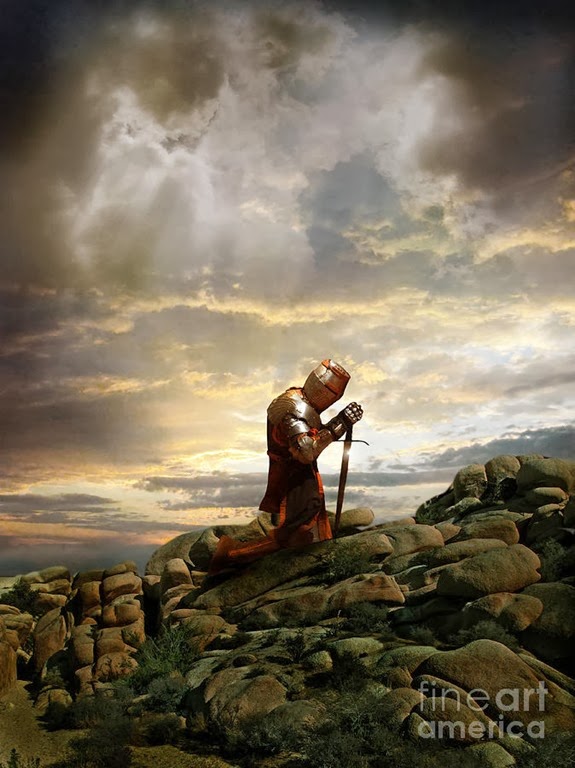
kneeling-knight-jill-battaglia

    “He knelt in church.”
    The Penguin copy editor had changed that sentence in my manuscript to “He kneeled in church.”
    What?
    That couldn’t be right. Copy editors have saved my bacon many times. Like the book where my character drove to an apartment, then walked home. I was grateful to the copy editor who mentioned I’d abandoned a car.
    But this was different. In high school, Sister Grace Edmund had taught me that the past tense of “kneel” was “knelt.” If anyone knew about kneeling in church it was a nun.

Nun_praying
    Publishers adopt odd style quirks, like spelling out 911. And they were good at catching my mistakes. But kneeled was plain wrong.
    I needed to appeal to a higher power.
    I found it in my big red Merriam-Webster’s Collegiate Dictionary.

dictionary
    Yes, I know there are online dictionaries. When I find Mr. Webster too stodgy, I’ve flirted with the Urban Dictionary. But I still find solid comfort in the 1,626 pages of Webster.
    Words should have weight as well as purpose. To me, a fat dictionary is reassuring.
    On page 1624, it says, “Merriam-Webster’s Language Research Service offers owners of Merriam-Webster’s Collegiate Dictionary the opportunity to take advantage of the editorial resources of America’s foremost dictionary publisher – at no cost. If you have a question about a particular word, such as who first used it or why it has not been entered in the dictionary, an inquiry to the Language Research Service will bring an accurate and concise reply from a Merriam-Webster editor – a member of the largest permanent staff of lexicographers in America.”
    The dictionary said I could either e-mail or send a self-addressed stamped envelope. I was on deadline. The manuscript was due.  I send this e-mail, confessing my problem:
   
    “I am a mystery writer for the Penguin Group in New York. My publisher’s style for the past tense of kneel is ‘kneeled’, as in, ‘He kneeled in church’.
    I prefer ‘knelt’ and find ‘kneeled’ irritating. Am I old-fashioned and out of date? If ‘kneeled’ is the preferred style now, then I will learn to live with it.”

John_William_Waterhouse_-_The_Missal

    Four days later, I got this response from Paul Wood, an assistant editor at Merriam-Webster. He said,

    “Knelt is the more common variant for the past tense and past participle forms of kneel. You are not old-fashioned or out-of-date in your preference for knelt. In fact, knelt is a relatively new addition to the English language. While kneel has been a part of the language since before the late 12th century, the past tense and past participle knelt does not appear to have been used until the late 19th century.”

    Mr. Wood’s words were comforting. I’ve bowed to my publisher’s old-fashioned ways. I even kneeled. 

Selling Your Books Worldwide


Although globalization has hurt a lot of businesses in this country, it’s helping American writers. Adam Smith’s invisible hand has reached across the oceans, opening up new markets for thrillers and mysteries made in the good ol’ U.S.A.Even if your books aren’t so popular in the homeland, you can sometimes find a fervent readership in another corner of Planet Earth.

For example: I’m a bestselling author in Taiwan. The Mandarin translation of my first novel, Final Theory, sold more than 50,000 copies there. I can make this sound even more impressive by noting that Taiwan has only 23 million people, or about 7.5 percent of the U.S. population. Using some creative math, I estimate that my sales in Taiwan are the equivalent of selling more than 650,000 books in this country. Move over, Grisham!

Why did the book do so well there? I really don’t know, but I think marketing had something to do with it. My Taiwanese publisher, Fantasy Foundation, printed some posters showing the very nifty-looking cover of the Mandarin translation. Better yet, they encouraged bookstores to display the posters. Best of all, they put the same image on a variety of giveaway gewgaws — tote bags, coffee mugs, flash drives. It’s old-school promotion, but apparently it works.

Fantasy Foundation also published my second and third books, The Omega Theory and Extinction. I was especially pleased to see the Mandarin version of Extinction (which was published last month) because most of the book’s plot is set in China — specifically, in Beijing and Yichang and the highlands of Yunnan Province. I knew the book couldn’t be published in mainland China; the thriller describes the mistreatment of political dissidents, a forbidden subject in the People’s Republic. But publishing the book in Taiwanat least opens the possibility that some mainlanders will read it. (Here’s a problem, though: the Taiwanese use traditional complex characters to write Mandarin, whereas the People’s Republic adopted simplified characters after the communists took over the mainland, making it difficult for the Taiwanese and the mainlanders to reach each other’s books.)

I love seeing the Chinese websites that are now promoting the translation of Extinction. I can’t understand a word of it, but the sites look so cool. I’ve tried using the Google translation program to decipher the characters, but usually the software just spits out gibberish. When I applied the program to a Chinese Facebook page I uncovered only one coherent sentence, which turned out to be a comment from (I think) a prospective reader: “This book looks terrible!”

I’m going to assume that in this case, “terrible” is a mistranslation of the Mandarin character for “awe-inspiring.”

Oops!

This post is late today because I overslept. I do most of my writing late at night, and I have to wake up early to get the kids off to school, so by the end of the week I’m usually exhausted. I try to make up for the sleep deficit by snoozing for ten hours on Friday night. Hence the delay.

I suspect I’m not the only writer who suffers from this problem. There are a lot of advantages to working late at night — it’s quiet, no interruptions, tons of existential despair. Plus, if you have a day job and you’re busy with the family in the evening, when else are you going to write?

I suppose I could’ve written the post in advance, but I’m also a procrastinator. Another common affliction. So please accept my apologies.

True Detective

by Joe Hartlaub

If you love crime fiction you simply must start watching True Detective. The first season of the eight episode HBO series premiered last Sunday, January 12. I watched it this morning under less than ideal circumstances — sitting in my car during a snowstorm, waiting for my ungrateful and unappreciative daughter — using my Kindle Fire, and you could have set my hair on ablaze while I was watching and I wouldn’t have noticed.  It’s that good.

Fans of Breaking Bad who have been wondering what to do for an hour or so that did not involve a death grip on a book should fine True Detective to be just the ticket. The story is going to be completed in eight episodes — a totally new story, with new characters, commences next year — so you don’t have to worry about a cliffhanger ending that will keep you wondering over the summer about who did what and to who. Waiting week to week will be bad enough, yes indeed. The storyline, set against the pitch-perfect backdrop of Gulf Coast Louisiana alternates on different time tracks, ping-ponging back and forth between 1995 and the present. Such might be confusing in lesser hands but it works perfectly here, as we watch two mismatched Louisiana State Patrol homicide detectives named Martin Hart (Woody Harrelson) and Rustin “Rust” Cohle  (Matthew McConaughey) investigate the unsettling ritualized murder of a prostitute named Dora Kelly Lange in 1995, while they are separately interrogated about the case in the present. Primary attention is given to the 1995 timeline. Hart is the “normal” one in the team (though he’s not; not really) with an understatedly hot wife and a pair of too cute daughters; he is indigenous to the area and knows the lay of the cronyish land well enough to go along to get along.  Cohle, for his part, is effin’ weird. He is known as “Taxman” due to his penchant for carrying an oversized ledger around with him in order to take copious notes and make crime scene drawings. Cohle is smart, maybe brilliant — a fact recognized by Hart — but he is a fish out of water, a transplant from Texas whose occasional existential pronouncements tumble extemporaneously from his mouth with a rapidity that are unsettling to everyone around him in general and to Hart in particular. Cohle’s statements are so fraught with literary angst that it is impossible to watch the show without stopping the action in order to rewind certain scenes for the purpose of writing down the dialogue (I would imagine — hope — that someone will be compiling Cohle’s statements as the season proceeds and post them on a website). Such would not, however, make him a fixture at progressive cocktail parties. His appearance and demeanor are such as to be unsettling, more so when he is silent and affixes his thousand yard stare at someone, or something, or nothing at all.

The first episode sets up a bunch of dominoes, which include Cohle’s past (and present) problems with alcohol and the tragedies of his past; the seemingly neglected disappearance of a young girl from the same area years before Lange’s murder, and which may or may not be connected to the homicide; and the assurance, almost certainly incorrect, that Hart is the stable one on the team. Actually, by episode’s end the only assurances we have are that 1) Cohle is no longer a cop; 2) he and the deceptively laconic Hart have had a falling out in the interim between their investigating, and apparently solving, the case in the mid-1990s and the present; and 3) in spite of their having solved Lange’s homicide and apprehending her murderer, someone is again killing women in the same ritualized fashion.   

There is no sex in this first episode of True Detective, and only second or two of mild violence, but there are some intense scenes, nonetheless. I will mention but two. One is the discovery of Lange’s body, laid out in a manner both repulsive and uncomfortably erotic. No one wants to look, but the body is where the clues are. And if the poor detectives have to look, so do you, the viewer. The second is an excruciating scene involving dinner. Hart, in the midst of the 1995 investigation, invites Cohle over to his house to meet the wife and family. Believe me, it’s in doubt as to whether Cohle will pass the shrimp etouffee or filet the entire family as they eat. The only certainty is that Cohle will not be invited back. You, the viewer, however, will not be able to stay away.

I am not suggesting that you steal an hour from your reading time to watch True Detective. Merely add an additional ten minutes per night for six nights to make up for it. But watch True Detective. It will be the best police procedural you have ever been able to read without turning a page.  

Novel Short Advice

By Elaine Viets

    How do you write a mystery?
    There are whole books on this subject.
    But the best short advice is in Grafton’s new Kinsey Millhone novel, “W Is for Wasted.”

Wasted
    Private eye Kinsey Millhone talks about how she started investigating two mysterious deaths. One victim was a sleazy PI and the other was a homeless man.

TheLees-trench-coats-for-men
     Kinsey was drawn into the mystery by a call from the coroner’s office. The coroner was “asking if I could ID a John Doe who had my name and phone number on a slip of paper in his pocket,” Grafton wrote. “How could I resist?”
    That had me hooked. But then Kinsey explained how to write a mystery:
    “Every good mystery takes place on three planes – what really happened; what appears to have happened; and how the sleuth, amateur or professional (yours truly in this case) figures out which is which.”
    There it is. The art of mystery writing in one succinct sentence. We writers are supposed to set up the story for the readers, help them find out what really happened, and tell it, giving enough clues to play fair but not give away the ending.

sue grafton
    Grafton gives us another dollop of advice in Kinsey’s next sentence:
    “I suppose I could put everything in perspective if I explained how it all turned out and then doubled back to that phone call,” she wrote, “but it’s better if you experience it just as I did, one strange step at a time.”
    New writers and experienced ones need to remember Kinsey’s advice: Tell the story, one strange step at a time.
    Many newbies try to be too clever. They don’t have the skills to deliver a twisted tale. They get lost in the maze they created.

maze
    Experienced writers get bored with the format after writing book after book. We try to start in the middle, or start at the end, or switch narrators, often to amuse ourselves. Too often, it simply confuses our readers.

Basic RGB
    Following the straight path, in Grafton’s footsteps, can be far more difficult.  But she kept me interested for 496 pages.  She also made me care about two people society considers worthless: a crooked PI and a homeless man who doesn’t even have a name.
    How did Grafton pull it off? Read it yourself.
    I guarantee your time won’t be wasted.

Honoring a Storyteller

By Mark Alpert

I had a great time over the holidays. We went to my brother-in-law’s house in Maine for Christmas, found a fantastic tea shop in Portland, read an amazing Alan Moore graphic novel (“From Hell”) about Jack the Ripper, went skiing at Shawnee Peak, and drank a lot of Oxbow beer. But when we returned to New York after New Year’s I saw a sad news item on my Facebook feed. Dave Martin, an extraordinary longtime photographer for the Associated Press, suffered a heart attack at the Georgia Dome football field while covering a New Year’s Eve bowl game and died shortly afterward. He was 59.

I met Dave in November 1985 in the newsroom of the Montgomery Advertiser. I’d arrived in Montgomery, Alabama, just the day before; I was 24 years old, and George Wallace was still the state’s governor. It was my first day as a reporter at the newspaper and the city editor was taking me around the newsroom, introducing me to everyone on the staff. At the end of the tour I met Dave, who worked for the AP but used the Advertiser’s photo room. He was tubby, ruddy-faced, perpetually smiling, and had a bushy mustache like Charley Weaver’s (remember him from Hollywood Squares?) This was our first conversation:

Dave: You’re the new guy, right? Listen, we’re gonna call you Astro.

Me: Astro?

Dave: Yeah, we heard you had a degree in astrophysics, so we’ve been calling you Astro for a couple of weeks now, ever since we heard you got the job.

Me: Okaaaay.

Dave: You don’t mind, do you? It’s a good nickname. And you can call me Mullet. That’s what everyone calls me.

His nickname referred to the fish, not the haircut. The mullet is a plain old bottom-feeder, plentiful in the Gulf of Mexico, not highly prized by the gourmands but not bad-tasting either. A proletarian fish, if you will. And the journalist named Mullet was a proletarian photographer. He chronicled the lives and passions of working people. He took heartbreaking shots of men and women staggering through floodwaters, weeping at crime scenes, huddling in emergency shelters. And he captured heartwarming moments of celebration, especially on basketball courts and NASCAR tracks and golf links and football fields. He was a storyteller, outshining all the journalists whose words framed his pictures. His photographs put our articles to shame.

He was also a party animal. He staged an annual shindig at his house called the MulletFest, which was by far the most debauched event that ever occurred in Montgomery. We shared a beach condo on the Gulf one weekend — my girlfriend at the time was friends with his — and we had so much fun playing cards that my girlfriend got ticked off and decided that our relationship wasn’t going to work after all. Mullet was hard to resist. He was just so absurdly cheerful all the time.

But Dave’s natural element was college football, especially Southeastern Conference matchups like the perennial Auburn-Alabama mêlée known as the Iron Bowl. His trademark photograph was the ritual Gatorade-dousing of the winning coach at the end of the game, and he always raced into the scrum of photojournalists on the field to get the perfect angle. If you go to this web page you’ll see a sampling of Mullet’s dunk shots. The first photograph on the page is the one he took at the Chick-fil-A Bowl on New Year’s Eve just moments before he collapsed. Right until the very end he did what he loved.

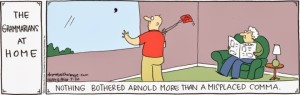
Where Have All the Commas Gone?

It’s cranky of me to kick off 2014 with a gripe, I know, but what the heck is going on with commas? They seem to be disappearing from the published word. According to the National Geographic’s style manual, “the modern trend is to use fewer commas than we were taught in school.”

Well, I don’t like that trend. The last couple of books I read were penned by authors who appeared to have an almost complete aversion to commas. These writers didn’t merely avoid using the debatable Oxford comma; they seemed to shun commas altogether.

For example, currently I’m reading a book about a major sailing race. The writer seems to be trying to conjure the effect of sailing into hurricane-force winds by her near-total omission of commas.

Here’s a random sentence from the book:

The wind had built continuously with gusts now approaching forty-five knots (about fifty-two miles per hour) and the sky had grown darker.

There’s nothing technically wrong with that sentence, I realize. But my reader’s eye (or should that be “ear”?) was exhausted and needed to take a break before it plunged into “and the sky had grown darker.”

Admittedly, as a writer, I overuse commas. (See?) I inject them into my manuscripts during the first draft stage as a stylistic device. I use them as visual indicators of where I want the reader to pause for breath. One of my final editing chores always involves going back through a draft to remove all traces of my over-exuberant fondness for  commas. (Ditto goes for my overuse of em dashes as well–I am a veritable Queen of Em Dashes. See our discussion in the Comments).

But, dang it all–as a reader, I like to see commas. I even resent writers who want to rush me through their comma-less paragraphs.


Has anyone else noticed the gradual decrease in the use of commas in popular literature? If so, are they destined to go the way of the semicolon in prose, do you think? As a writer, are you trying to use them less frequently these days? Or are you a recovering  over-user of commas, like me?