
by Debbie Burke
The 1988 Dustin Hoffman movie Rain Man introduced autism to a wide audience and won four Oscars: Best Picture, Best Director, Best Actor (Hoffman), and Best Screenplay.
It also created a stereotype for the face of autism as a humorless savant with uncanny abilities and a flat affect.
Three neurodivergent authors, Oliver Blakemore, V.L. Andromeda, and Mariah Ankenman, shredded that stereotype during their panel at the recent Rocky Mountain Fiction Writers Colorado Gold conference in Denver. They were articulate, intelligent, animated speakers who kept the audience laughing with wild, outrageous humor.
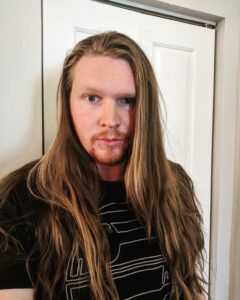
Oliver Blakemore author photo
Oliver gestured at the other two and himself, saying, “We’re like aliens.”
At the beginning of their panel, each shared their various diagnoses.
Oliver calls himself “a recovering intellectual and an undiagnosed neurodivergent” with anxiety disorder and a little autism.
V.L lives with OCD (obsessive-compulsive disorder), ADHD (attention deficit hyperactivity disorder), and PTSD (post-traumatic stress disorder), along with anxiety, depression, and “some other little things.”
Mariah deals with OCD, duplex autism with ADHD and anxiety, and audio processing disorder—difficulty making sense of what she hears despite normal hearing. “My mother always said I didn’t listen to her.”
The isolation and disruption of previous routines caused by Covid affected all three. That led to their increasing self-awareness of variations of neurodivergence.
Oliver requires structure and needs to schedule every hour to keep him from totally losing track of time. Each hour’s alarm is a specific musical piece that he associates with a particular task.
He describes his soon-to-be-published book City Song as: “Punk rock noir urban fantasy. Dealing with hard questions like, ‘What if I don’t believe in magic anymore?’”
His published short story collection Ragged Museum: Untidy Stories are wildly imaginative, off-kilter fantasy tales that could be called literary in style.
He works in marketing and communication with clients ranging from “baby rock bands” and authors to bars and large startups.
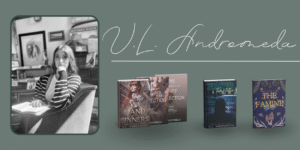
V.L Andromeda author photo
In contrast, V.L. doesn’t function well with routine and structure. Although her actions may seem scattered and disorganized, she says, “My least productive day is usually more productive than most people’s productive days.”
I can personally attest to her productivity. As a conference volunteer and Published Author Liaison, V.L. quickly, efficiently, and graciously accommodated my last-minute request to be included at the Saturday night book sale/signing.
V.L.’s Marks of the Broken series is a “nobledark, romantic fantasy.” Another series is a contemporary thriller romance. The first book Terabytes and Temptation is set in the complex world of cyberhacktivists and espionage where justice is achievable by unconventional means.
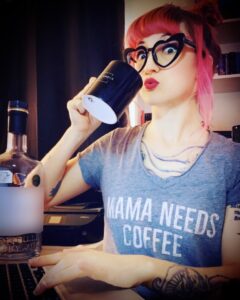
Mariah Ankenman author photo
Mariah depends on routines and structure. She creates “fake deadlines” for herself to complete tasks. She’s a plotter who uses photos to visualize her characters and plans out scenes with Dungeons and Dragons precision.
Her routine is obviously effective: she has more than two dozen published books she dubs as “sassy and swoon-worthy romance” from billionaire love stories to dark supernatural daemons.
The panel offered their opinions on TV and film depictions of neurodivergence. They all enjoyed “The Big Bang Theory” series. “Monk” turns his disability into a superpower to solve crimes. Mariah thinks “Scrubs” does a good job representing OCD, where Michael J. Fox continually washes his hands, saying “I haven’t done it right yet.” Oliver talks about “disability villains” but thinks authors shouldn’t blame the disability for bad behavior.
They joked about their challenges when writing neurotypical characters or “normies.” V.L. says, “Dealing with normies is annoying,” and adds the DSM (Diagnostic and Statistical Manual of Mental Disorders used by health professionals) is changing. Many formerly set diagnoses are moving toward a “spectrum” of various disorders.
In their own fiction each has a particular style when crafting neurodivergent characters.
Mariah intentionally writes neurodivergent characters and goes deep with them. Her website even features a page of “Disability Reps” and book titles that include them.
V.L. plays off stereotypes, making divergency funny with punchlines that sum up certain behaviors. Her characters with PTSD are featured as heroes with strong moral compasses struggling to do the right thing in a world that doesn’t value ethics.
Oliver strives for a “holistic understanding.” Neurodivergent characters play roles in his story worlds the same as they do in real life but are not necessarily spotlighted. He views stories as an opportunity to build empathy with readers about different ways of thinking than they’ve encountered before.
Even though all are high functioning productive artists, guilt was a surprising common theme expressed by them.
Mariah is trying to be forgiving of herself when she’s not as productive as she thinks she should be.
V.L. feels no matter how much she accomplishes, it’s never enough.
Oliver’s anxiety requires constant reminders to keep himself on task. He must be succeeding because he’s the 2026 honoree of the prestigious Jasmine Award for exceptional service to Rocky Mountain Fiction Writers.
The hour sped by. Afterward, I heard attendees talking about their own experiences with neurodivergence and how reassured and heartened they were by this open, forthright, articulate discussion.
Oliver, V.L., and Mariah are all savants with uncanny abilities whose intelligence and humor energized the room.
Not a stereotype in sight.
~~~
TKZers: Do you include neurodivergent characters in your fiction? Please share in the comments.