Concerted Amazon Attacks

by Clare Langley-Hawthorne

An article in the New York Times a couple of weeks ago raised an issue of the deliberate, concerted and malicious use of negative Amazon reviews to ‘sink’ a new book. 

The book in question was “Untouchable: The Strange Life and Tragic Death of Michael Jackson” by Randall Sullivan and apparently a group of Michael Jackson fans used Facebook and Twitter to solicit people to bombard Amazon with negative one-star reviews of the book in what appeared to be a concerted campaign to derail book sales. The result was that many favorable reviews were taken down and Amazon even removed the book from sale for a brief period. 

Needless to say the book did not achieve the book sales  anticipated (3,000 copies sold according to the NYT article compared to the 16,000 copies the publisher distributed to bookstores) despite high-profile promotion – the book was even selected by Amazon as one of the best books of the year. But books often fail to achieve anticipated sales, so who knows whether the 100+ one-star reviews were really responsible for the book’s poor performance. The author’s did however cite major concerns over the factually inaccurate nature of many of the negative reviews.  

Now there has been a lot of controversy recently about Amazon reviews, from authors using ‘sock puppets’ to write favorable reviews, to Amazon taking down or refusing to post genuine reviews. The specter of a deliberate and concerted campaign to attack a book muddies the ‘Amazon review’ water even further. There are those who state that it is almost impossible to distinguish a malicious campaign from genuine negative reviews and those who argue that people shouldn’t be able to make flagrantly false comments and attacks that in effect suppress an author’s right to free speech (then of course there are those who argue for the right of the reviewers to free speech). 

So what do you think? How should Amazon deal with the potential for deliberate malicious ‘review’ attacks?  How should authors deal with this issue and can Amazon really be expected to police this kind of thing?

Website Essentials

by Clare Langley-Hawthorne

Having done final, final, final edits for my agent on my latest novel (all smiles here on that front – and no small measure of relief!),  I am focusing on a much needed update to my author website (very much overdue I fear!) but, horror of horrors,  I’ve realized that the book world has altered so much since I set up my website, I am now at sea as to what changes I really should be making.  Sure, I have all the obvious tabs: Author bio, appearances, book news, links to blogs, excerpts/readings and ‘what’s new’, but what I really need is to focus on what additional elements that truly add value to my readers (and yes, I also know I need to update my news/appearances too…)

As a reader I know I enjoy websites that are beautifully designed, visually appealing, easy to read (no weird fonts or jarring colors) and which offer lots of value added information that keep me coming back. That being said, it’s often hard to translate that into what is needed for your own website (and also, it’s a slippery slope, I don’t want to spend all my time writing website content rather than novels!).

So as I so often do, I am turning to you, the Kill Zone experts to find out what you think works/doesn’t work on author websites. 

Here are some of the ideas/questions I am currently mulling over:

1. As I am venturing into YA territory should I have a separate tab for this on my current website or should I have an entirely different website designed – given that these are two separate genres?

2. How much ‘value added’ content is worthwhile including on a website. Given that I write historical fiction (for both my mysteries and YA books) does giving  information on the period provide a useful value add or would links to other websites and resources be sufficient. It’s always hard to know just exactly how much information/effort an authors should give to what is essentially background information.

3. Are giveaways and competitions really worthwhile?

4. What about books trailers or videos?

5. Do you (as a reader) appreciate any other value added elements/information on an author website?

And finally, have you got an examples of what you think are truly first-class author websites or ones which just don’t meet the mark?


To New Adventures

by Clare Langley-Hawthorne

Happy New Year from all of us at TKZ

2013 has already ushered in a new adventure for me and my family with us moving to Denver. My twin boys start at their new school today and so there is a palpable sense of nervous tension, excitement, fear and uncertainty in the air – all signals that we are embarking on an adventure indeed. In honor of this, I have also started reading The Hobbit aloud to them – but I have assured them that, as far as I know, they won’t be encountering any trolls, goblins or dragons here in Colorado.

This year I have decided to focus my new year’s resolutions on some of the aspects of my career that I fear were sidelined during my time in Australia. Being so far away from the principal market for my books as well as my agent meant was not necessarily a good thing as I missed out on valuable face-time at conferences and book related events. It was hard to justify the expense of flying over just to meet with my agent or to attend a writing conference and so I focused solely on my writing – which was not a bad thing – but I fear I did so at the expense of ‘driving’ that writing forward into the marketplace. 

It means that I face 2013 feeling like I don’t have very much to show for all my efforts – even though I know it is more a question of timing and patience than it is anything else. But it truly is time that I stopped being reactive and became the driver of my own career. In concentrating on my writing (and completing three manuscripts could hardly be considered slacking off!) I didn’t keep up the other aspects critical to keeping my career on track – I made bugger all changes to my website, did little or no marketing or publicity, and apart from  TKZ blog I didn’t keep up with guest posts or my own Edwardian-era focused blog. Mea Culpa indeed.

My goals for 2013 are pretty intimidating – not in terms of time or commitment but in terms of changing my mindset to make sure I regain a better sense of control over my career and come out of my hermit hole to promote myself rather than focusing solely on my writing to the detriment of everything else. In this ever changing marketplace I cannot afford to remain at shut-off from everything but the manuscript in front of me (and now, I don’t have the literal ‘tyranny of distance’ as an excuse, either). 

But here’s the thing – I’m not exactly sure how I’m going to achieve this change of mindset or  how to overcome the self-doubt that a few years of what feels like self-imposed exile has brought. So I’m seeking advice from you all. What goals have you set yourself and your writing career this year? I’m hoping I’m not alone in wrestling with all the challenges a new year and a new adventure can bring. So how are you going to overcome obstacles and achieve all that you want to accomplish this year?

Happy Holidays!

AWREATH3It’s Winter break here at the Kill Zone. During our 2-week hiatus, we’ll be spending time with our families and friends, and celebrating all the traditions that make this time of year so wonderful. We sincerely thank you for visiting our blog and commenting on our rants and raves. We wish you a truly blessed Holiday Season and a prosperous 2013. From Clare, Boyd, Kathryn, Kris, Joe M., Nancy, Michelle, Jordan, Joe H., Mark, and James to all our friends and visitors, Seasons Greeting from the Kill Zone. See you back here on Monday, January 7.

Low Down on The Numbers

by Clare Langley-Hawthorne

Janet Reid, a literary agent, posted an item on her blog last week on the issue of self-published authors querying agents in the hopes of getting a larger publisher to notice them. She emphasizes  that basically you need to have sold more that 20,000 copies of your book to have even a remote chance of having this happen. She went on to stress just how daunting this can be (no kidding!) and though she states that it isn’t her intention to dissuade someone from self-publishing, her main point is that self-pubbed authors need to be realistic about what they can accomplish.  Needless to say this blog post got me thinking…

  • So for all of you our there considering the indie route – what numbers are you aiming for? Are you considering this a first step towards getting an agent and a traditional publisher, a parallel option, or are you solely going for the indie route? What sales figures would you be content with?

  • And for those who have already gone the indie route – what kind of sales figures are we talking about? (if you don’t mind me asking – I confess to being clueless on this front). Do you agree with Janet’s statement that you probably need to sell in excess of 20,000 copies to get the attention of traditional publishers?


Janet also states that self-publication cannot launch a mystery series and I must confess, I don’t see why not – but perhaps some of you TKZers would like to weigh in on this as well!


Avoiding the Pretense

by Clare Langley-Hawthorne

I’m still on the road and by the time this post ‘airs’ I will probably be on a plane somewhere over the Pacific. It’s been a whirlwind week- long visit to Denver and not quite enough time for my body clock to reset (though after a week lazing on the beach in Palm Cove I can hardly complain!). We clocked 31 hours traveling last Sunday coming over here and I sincerely hope it won’t be that bad going back!

One thing traveling always highlights for me is there is no glamor in being a writer – or if there is it is fleeting indeed – and I chuckled over Mark Helprin’s article in the Wall Street Journal yesterday entitled ‘Skip the Paris Cafes, And Get a Good Pen.’ It was a fun reminder that the key to writing a great novel is sitting down and doing it, not posing at a cafe as if you are some kind of latter day Ernest Hemingway. This got me thinking of some of the pretensions would be writers might indulge in – and here are just a few that I’ve noticed over the last few years.

  • T-shirts announcing to the world that you are a ‘writer’ (thereby begging completely strangers to indulge your ego and asking about your novel)
  • The ‘faux-complaints’ about one’s agent, editor or book tour, announced in extra-loud tones in conference hallways or in disingenuous Facebook posts (e.g. I just got in at 3am after my first-class trip to see my UK publisher in London was delayed, ah, woe is me!)
  • And speaking of Facebook posts – you know the ones, the endless ones, that seem to spew forth relentlessly marketing someone’s latest literary offering
  • Posers on planes who heave out their manuscript, look around as if searching for inspiration among the throngs of economy seated passengers, and then wait for the tidal wave of approval (while not actually doing any writing or editing on said manuscript!).

So what kind of literary posing have you witnessed? What makes you sometimes want to just say – skip the cafes and the moleskin notebooks and just write the damn novel!

And in spirit of this post, I shall now apologize for not being able to respond to comments as I shall be in mid-air (though in economy…probably the last row next to the loos…)

Reader Friday: Meet our Muses

Last Tuesday we put out a request for pictures of your muses–we asked to see the people, spirits, or things that inspire you to keep filling the blank page with words.

We received some great results! Here they are, in no particular order:

Dave Williams: Twin Muses

Dave writes, “Besides my dog Merry Christmas, I can’t forget Davyn and Claira, our new twin grandbabies. I don’t get much writing done when they are here, but watching them study the world around them, stare wide-eyed at new things, and grin from ear to ear every time I see them inspires the heck out of me. Everything is new, everything is an adventure, and everything is grist for their little mills.And they make me want to write books that I can read to them as they grow up, so I can pass on my love of books and storytelling to them.”
Wait…you have two precious little angels to inspire you, and a dog named Merry Christmas? Major cuteness, Dave!
BK Jackson: Sunrise in the Desert 
BK sent us a spectacular photo of his desert-spirit muse. 

“My muse, Arizona, has many wonderful facets,” he wrote. “Here’s just one example of her splendor.  No wonder she inspires me.”
Donna Galanti: Star
Donna snapped a photo of her muse, Star the cat. 
“He must write with me every day,” she wrote us. “Star whips his tail at me to write if I stop typing. He even has the nerve to chew on my reference books as I write reminding me to write better. Plus he steals the best window view to stop me from daydreaming. But he keeps me here with my butt in the chair, where I should be. And that is a good muse. (plus see what good company he keeps next to my go-to writing resource as I fast draft a new novel!) 
Basil Sands: All in the Family

“Everyone joined in for the fun,” he wrote. “My wife Mia and my two younger boys.  The two lovely virtual muses settled their differences for long enough to smile for a snapshot, it’s slightly blurry but they are after all imaginary friends who primarily reside in my mind.” (For the back story on Basil’s virtual muses, see Tuesday’s comments!)  

Terri Lynn Coop: Scruffy

Terri sent us a picture of her canine muse, Scruffy. 
“This is Scruffy after a hard day of being my amusement, inspiration, first reader (he’s a great listener), and getting me out from behind the computer for walks,” she wrote. 
Sounds like Scruffy earned his nap, Terri!  
Clare Langley-Hawthorne: Hamish
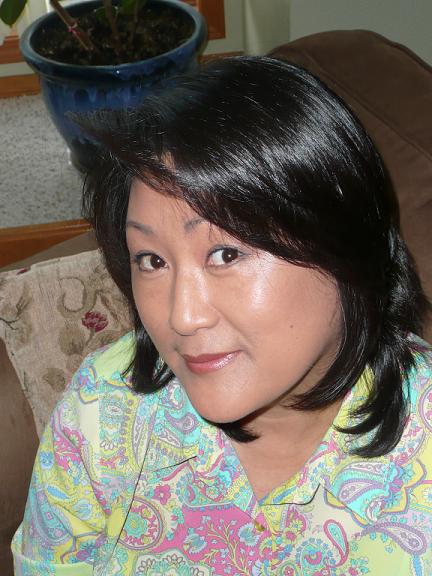
Clare’s muse is her elegant collie, Hamish.
Joe Moore:  Patio the cat
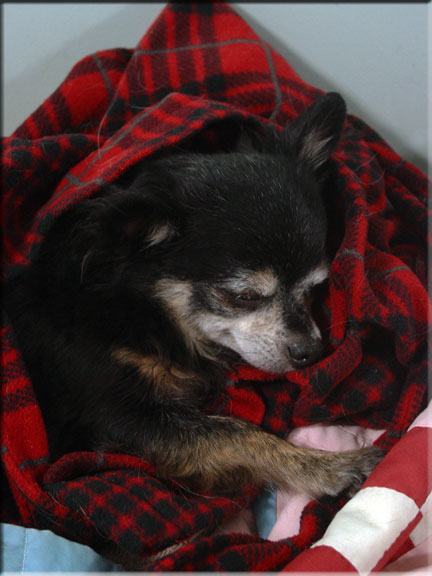
Joe’s muse is Patio, who is “determined to sleep his life away,” according to Joe.
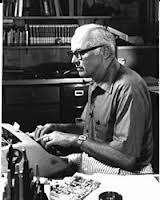
James Scott Bell: John D. MacDonald
Jim has an illustrious muse: the writer John D. MacDonald, shown here typing away at his desk.
Nancy Cohen: Items of Inspiration
Nancy sent a photo of her collection of things that inspire her. 
“There are troll dolls for my current series based on Norse mythology, a porcelain head of a lady supposed to look like my hairdresser sleuth, a Bad Hair Day mug, and assorted computer oriented knickknacks,” she wrote. “I keep CDs up there but don’t play music when I write. I like silence.”
Jordan Dane: Sancho 

“This is ONE of my rescues – Sancho,” she writes. “We have two dogs and two cats, all from shelters. But this guy makes me laugh every day. He loves sprawling on his belly and ‘snakes’ off the sofa.  Epic cuteness.”

Thanks everyone for sending in your pictures, and feel free to add more about them in the comments. And let us know if we missed anyone’s photo.

Omit Needless Words!

by Clare Langley-Hawthorne

It’s with a wee bit of wistfulness that I write this blog post, as not only have we bid ‘au revoir’ to two of our blog mates, John Gilstrap and John Ramsey Miller, but also because I have realized just how many blogs have now gone off-line having, perhaps, run out of steam or time or words of wisdom. It’s hard thinking up topics week-after-week and deep down, I fear, I repeat myself a lot:) 


However, there are always new topics that catch my attention (like just how Fifty Shades of Grey has managed to become a huge bestseller…)  and old topics that never seem to be resolved. One of these is the question of just what makes bad writing, well…bad. I was prompted to ponder this issue anew by an article in the ‘Dear Book Lover’ column of  the Wall Street Journal last month (which my husband forwarded to me, hopefully, not because he thinks my own writing is bad!).  


As this column points out, bad writing is impossible to define because of the inherent subjectiveness involved in determining what constitutes ‘bad writing’. It goes on, however, to point out that bad writing almost always involves overwriting and here is where I have a confession to make – I am an overwriter. There I’ve said it. When I was younger almost all my material was packed to the brim with overripe metaphors and obscure concepts. In the words of Roger H. Garrison (“How a Writer Works”) it was flowing with the “tides of phony, posturing, pretentious, tired, imprecise slovenly language, which both suffocate and corrupt the mind.” Mea culpa, indeed…


So what did I do to change this tide? I took Strunk and White’s advice to heart  and I learned to “omit needless words.” Sadly, I still overwrite on occasion, but at least now I (usually) pick it up in the editing and revision process. It also helps me to follow another terrific mantra to “keep it simple, stupid.” Unfortunately, as I mentioned in my comment to Jim’s post yesterday, I still find it hard to do the same when it comes to concepts or plots, but I am learning (I hope!).


So how do you define ‘bad writing’? Are, you like, a closet over-writer or are you blessed by the goddess of brevity? Do you find that your tolerance for sloppy prose has diminished over the years? Perhaps this has helped my own writing. Gone are the days of buying into the high-faluting drivel  of many so-called literary novels. Nowadays, I want to read something that distills rather than over-kills a complex concept. What about you? Will you keep reading even if the actual writing is (dare we say it) ‘bad’?


Quality Checks and Balances

by Clare Langley-Hawthorne

As always, the hot button topic of indie/self-publishing versus traditional publishing has generated lots of comments in recent days here at TKZ and one issue that comes up time and time again is the ‘gatekeeper’ concept – basically agents and editors acting as a ‘quality sieve’ for what comes into the publishing pipeline. While I agree this is an imperfect system – there’s no doubt that agents and editors can get it horribly wrong – there does need to be some system of quality control. Doesn’t there?


Nowadays on the indie front,  this typically comes from readers who are just as well-equipped to judge what makes a good book as anyone else. But from the standpoint of a writer who relies on her agent to raise the bar for her work –  I do wonder how these quality checks and balances will get made in the new era of indie publishing. As a reader, I don’t want to troll through a plethora of e-books that were dashed off prematurely in my search for books to read. Though social media and reviews certainly help, the sheer number of releases makes my head spin and  I still fall back on buying e-books from traditional publishers as I know the system of quality control (though imperfect) is at least in place.


As a writer I have a group of beta readers who help me enormously – but though their feedback is invaluable, none of them ever quite bring the perspective my agent does. For all the tough love I get from them, my agent manages to point out ways in which I can improve the manuscript that they never even considered. So my worry is that if I went the indie route the books I put out there would be good but not as good as they could have been….Because my agent’s 25 years of editorial experience in publishing adds a level of input that, quite frankly, none of my other beta readers can match (and they are an amazing group of people whose input I value enormously).


Many members of my writing group have used freelance editors to help polish their manuscripts but with mixed results. Many of these editors aren’t looking to dissuade a writer from publishing a manuscript and so, given that they get paid to edit, aren’t necessarily going to be as upfront about a manuscript’s shortcomings – not if it means putting themselves out of business.  I’m sure they are all professionals and do their best but do they act as an objective assessor of ‘quality’ – I’m not sure they can. 


Now many of you will argue that this assessment is best left to readers (who will vote with their pocket books as well as airing their online opinions) but it exhausts me to think of all the half-baked e-books that might end up out there, just as it worries me that aspiring writers are becoming ever more impatient to release material before it has been crafted into the best possible shape.


So who do you turn to for editorial guidance? Do you rely on freelance editors to give you much needed input? Are you convinced your own circle of reviewers give you the tough love you need? 


Despite being published, I admit I still lack the confidence and experience to know when a manuscript is really, truly, finally ready. Most of my ‘final’ manuscripts end up being revised and reshaped based on input from my agent before they get shown to publishers, and as a result they become significantly better than the ‘best’ I originally could do (okay, so this might say more about my lack of talent…). In a world where we acknowledge the traditional system has many shortcomings, how do we view the concept of ‘quality control’? If that is still even relevant, how do we achieve it?


Deadlines

by Clare Langley-Hawthorne

On Friday, John provided a great blog post responding to specific questions regarding the agent/publication process. One of these questions considered the issue of deadlines – something I want to expand upon today. Deadlines, both those imposed by editors/publishers and those self-imposed, are (I think) one of the defining elements of being a professional (as opposed to hobby) writer. As we certainly can’t rely on customwritingservice.com like so many college students do nowadays.


Deadlines make you both accountable and responsible. But what does that really mean when you aren’t as yet published? It means you know that in order to achieve your larger goal (writing the novel, getting it published etc.) you need to divide the task into manageable chunks and (here is where it gets tricky) you need to meet the deadlines you impose upon yourself. Otherwise you’re just like the billions of amateur writers whining about how ‘one day’ they will write a book but (insert excuse here…) they never seem to get around to it. In today’s post I want to deal with both publisher as well as personal deadlines.


Publisher Imposed Deadlines:


As John said in his blog post on Friday, these deadlines are pretty much inviolable. If, as the author, you miss these then there is a cascading effect on the whole publication cycle. Worse case scenario the publisher views it as a breach of contract and pulls out of the deal. Best case scenario you inconvenience a whole lot of other people. So if you do need to extend, you’d better have a pretty good excuse. 


My rather strict view of deadlines also extends to how you fulfil them. I’ve heard of an author who views the submission date with her publisher with a bit of a shrug – sure, she gets them the manuscript, but she’s not too concerned about making it perfect as she knows the editor will get back to her with comments, so she views the deadline as a necessary evil and continues to work through the book even while waiting for the editor to peruse and comment upon it. I differ on this in that I go into each deal with the belief that, whatever I submit has to be as damn-near-perfect as it possible. To me this is how professionals fulfil their obligations – not with a half-hearted shrug but with a commitment to demonstrating their craft to the highest degree possible.


Of course when it comes to an authors first book, the initial draft manuscript is what was acquired but any amendments to this (based on editorial feedback) should be treated with the same level of professionalism and adherence to deadlines. If an editor doesn’t provide a deadline (which would be highly unusual) then I would request or set one – that way the author remains on track and accountable to a timetable.


So what do you do if you have to seek a deadline extension?


This is where a good agent can act on an author’s behalf to mitigate against this – but the author must still have a genuine excuse for seeking an extension given the potential impact it has on the publisher. When it comes to agents, I would also recommend setting deadlines (for the agent as well as yourself) to ensure there remains a level of responsiveness and accountability that demonstrates an author’s professionalism.


Self-Imposed Deadlines


As a professional writer I like to set myself specific goals for my WIP to keep me on track. Typically I lay out a timetable to complete certain chapters or parts of the books to ensure I don’t face the overwhelming panic of producing a novel. When the tasks ahead are in manageable chunks the path seems far less onerous (or scary). The first thing I do is also set the date I want to get the draft manuscript to my agent and then work backwards from there. 


Sometimes I give my agent an initial deadline for the first 5-10 chapters and the proposed plot outline so I can get his read/feedback on the project ahead. Then I always tell him the date I propose getting the complete manuscript to him – it helps establish my own timetable as well as alerting him to my goal (and, I hope, demonstrate I am tackling it in a serious, professional manner). 


As a terrible procrastinator, self-imposed deadlines are vital to keeping me on track as a professional writer.


So what about you? 
Do you set your own deadlines? Do you meet them? 
Have you ever had to negotiate for a deadline extension from your publisher and if so, how did it go?