by Clare Langley-Hawthorne
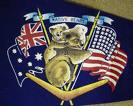
After the Fourth of July weekend and having just passed my American citizenship test, I thought it fitting to address an issue close to my heart and my writing – the concept of cultural identity. As the daughter of a Lancastrian and a Londoner, born in Canada and raised in Australia, I think I am a veritable nomadic ‘mutt’ of no fixed cultural identity.
Growing up in Australia there was little in the way of patriotic feeling. On Australia Day (January 26th) it was rare to see an Australian flag fly and most people treated the day as little more than a public holiday. Few of my friends could even sing the Australian national anthem (Advance Australia Fair) beyond the first few lines. I think that times have changed and now the concept of being an ‘Australian’ has started to take greater shape – moulded by generations of emigrants as well as the plight of the indigenous peoples of Australia but in my mind, however, the concept of cultural ‘Australian-ness’ is still hard to pin down. A sharp contrast (to me at least) to the concept of being an American.
My first Fourth of July party I was literally stunned when friends toasted the Constitution and declared they were proud to be Americans. As an outsider it was fascinating to watch – for everyone had such a strong sense of what being an American meant. Australians would have laughed that kind of patriotism off. When I was growing up if you asked what it meant to be an ‘Australian’ people would have looked at you funny – here in America people can answer this without equivocation. Enshrined within the Constitution and the Declaration of Independence Americans know what it means to be an ‘American’. Australians can’t even pass a referendum to become a republic so we still have (nominally) the Queen of England as head of state…kind of shows you our own cultural indecision!
I have just passed the final hurdle to becoming an American citizen and I was amazed that I was expected to pass a civics test to show that I understood what it meant to ‘be American’. Being a natural worrier I studied hard for the test, fearful lest I be asked about the 13 original colonies or the founding fathers. It was pretty pathetic really as I have studied US law, first for my LLM and second for the New York Bar (which I passed – horrific though it was). I confess to having retained no knowledge of US law whatsoever – so it was a good thing I studied for the citizenship test! As it turned out the questions I was asked were very straightforward, but the questions and material they expected you to cover was illuminating in and of itself. For example, one of the question I was asked was ‘what was the US concerned about during the cold war’- (answer the spread of communism)…
I like creating characters who are, as my family were in Australia, outsiders. My parents are still ‘British’ through and through – no matter the years spent in Australia or in America. Their cultural identity is set in stone. It’s through them that I have an affinity for all the quaintness of Britain – the BBC period piece version of history and identity. People often ask me if I will ever write about Australia and I answer that I’m still not sure I can do that -I’m worried I’m not able to capture the culture properly yet. If I did set a novel there I think my character would have to be an outsider. I would face a similar dilemma writing about America – for though I have a strong affinity with the culture I still remain (despite my civics prowess) a cultural ‘mutt’.
So how does your background and sense of cultural identity shape what you write? How do you think a writer’s sense of citizenship – be it inclusion or exclusion – affects their work?
As writers are we, perhaps, always ‘outsiders’ and ‘cultural mutts’?