About Joe Moore

#1 Amazon and international bestselling author. Co-president emeritus, International Thriller Writers.

Silencing your inner critic

These days I’m interested in all things related to brain function, so a bit of news caught my eye about the brain and creativity. Researchers have discovered that for artists to become creative, they must muzzle their inner critic. 

In an experiment, scientists measured the brain activity of jazz musicians as they performed a memorized piece of music, and then measured it again when the musicians did an improvised piece. Different brain regions lit up, according to the type of performance being given. During the improvisation, the medial prefrontal cortex–the part of the brain that allows self-expression–was more active. During the memorized piece, the dorsolateral prefrontal and lateral orbital regions–the brain areas that monitor and correct performance–were more active.

In other words, in order to be creative, we’ve got to silence our brain’s inner critic.

For a writer, it’s not always easy to silence an internal critic. Take me, for example. I’m perfectly capable of stalling for days over a single paragraph, even a particular sentence. I’ll rewrite and rethink, tweak and prune, until I’m practically clawing at the walls of our house. 

Recently I’ve developed a coping strategy for my internal critic, which I’ve named Harpy Harriet. When Harpy starts whispering in my ear, telling me things like, “Man, your writing sucks. You suck. Whatever made you think you were a decent writer?”,  I merely type a little placeholder, and move on. Inevitably, when I return to that spot after having forged ahead in the manuscript, it’s much easier to write the revision.

But Harpy is a sly, cunning opponent, always scheming to get the better of me. She keeps changing tactics. Recently she’s tried to convince me that my medical issues have done a Flowers For Algernon number on the creative parts of my brain, rendering it incapable of producing decent prose. The only way I’ve been able to reassure myself is by going to my critique group. My group members don’t know anything about Harpy–they just tell it like it is about my prose. And so far, everything seems normal.   I’m not like Charlie, regressing to a creative IQ of 68. I’m okay (at least as far as the writing is concerned). I can tell Harpy to take a hike.


What about you? Do you ever have to wrangle with a harsh internal critic? How have you put a muzzle on it?

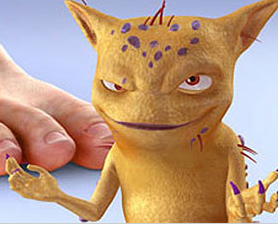
UPDATE: In honor of some of the suggestions in our comments today, I am adding a picture of the Lamisil Monster as a candidate for the Inner Critic…lol.

Of Droughts and Flooding Rains

by Clare Langley-Hawthorne

It’s raining again – and for those of you who have been following the news you know that isn’t a good thing.

After the terrible floods in Queensland that consumed an area the size of Germany and France combined (yes, you read that right), my home state of Victoria continues to face its own flood crisis. Over the last week more than 70 towns across the state and around 4,300 people and 1,700 properties have been affected. As I write this blog, residents are being evacuated as floodwaters advance in the northern part of the state along the Murray River. Although no one I know has been directly affected, all that has happened over the last few weeks has been a sobering reminder of just how much Australia remains at the mercy of the weather.

Jim’s blog post (and comments) yesterday stressed the pitfalls of describing the weather in a novel, but anyone writing a book about Australia would have to acknowledge the weather, just like the landscape, is an integral character.
Even though I have an indifferent relationship to my ‘re-adopted’ home, I cannot help but admire the tenacity of the people who try and tame its wild shores. Just a year or so ago Australians were facing one of the worst droughts in history and now they are facing once-in-a-century floods. If you were to describe the Australian weather as a character, you might think in terms of a Greek goddess wreaking vengeance.

But the weather has also brought out some of the best Australian characteristics – the ‘mateship’ and determination to go on, sacrifices made for others (including, sadly a 13 year old who gave his own life to save his 10 year old brother) and the sense of community that I know so many Australians cherish. For my own part, recent events have made me realize that, although the weather can be both boring and cliched in fiction, sometimes it must take center stage.
BTW: Many people may recognize the title of this blog post from a famous poem about Australia by Dorothea Mackellar but few are probably familiar with the poem in its entirety. I thought, in the circumstances, it was appropriate to share it:

My Country

by Dorothea Mackellar

The love of field and coppice,

Of green and shaded lanes.

Of ordered woods and gardens

Is running in your veins,

Strong love of grey-blue distance

Brown streams and soft dim skies

I know but cannot share it,

My love is otherwise.

I love a sunburnt country,

A land of sweeping plains,

Of ragged mountain ranges,

Of droughts and flooding rains.

I love her far horizons,

I love her jewel-sea,

Her beauty and her terror –

The wide brown land for me!

A stark white ring-barked forest

All tragic to the moon,

The sapphire-misted mountains,

The hot gold hush of noon.

Green tangle of the brushes,

Where lithe lianas coil,

And orchids deck the tree-tops

And ferns the warm dark soil.

Core of my heart, my country!

Her pitiless blue sky,

When sick at heart, around us,

We see the cattle die –

But then the grey clouds gather,

And we can bless again

The drumming of an army,

The steady, soaking rain.

Core of my heart, my country!

Land of the Rainbow Gold,

For flood and fire and famine,

She pays us back threefold –

Over the thirsty paddocks,

Watch, after many days,

The filmy veil of greenness

That thickens as we gaze.

An opal-hearted country,

A wilful, lavish land –

All you who have not loved her,

You will not understand –

Though earth holds many splendours,

Wherever I may die,

I know to what brown country

My homing thoughts will fly.

Opening No Nos

Writer’s Digest has come out with a special issue called “Write Your Novel in 30 Days.” It’s not their monthly magazine, but a stand alone. And it’s terrific. I say this not because I have a few articles in it (he notes with sly self-promo) but because it’s really got great substance cover to cover.
One section has a collection of things not to do in your opening chapter, based on statements by literary agents. Here are some clips (I highly recommend you read the whole issue).
Excessive Description
“Slow writing with a lot of description will put me off very quickly,” says Andrea Hurst. And this is something you’ll hear all the time.
So how do you set an opening scene? Do it with an interplay of action and description. Get the action started first, then fill in just enough information to tell us where we are.
But you’re a literary writer, you say? You love style? Well, if you’re really good, like Ken Kesey’s opening pages in Sometimes a Great Notion, go for it. But you can still start with action and drop in wonderful, styling description later.
Voice and Point of View Fuzziness
“A pet peeve of mine is ragged, fuzzy point-of-view,” writes Cricket Freeman.
This is especially important when writing in First Person POV. We need voice, we need attitude. Like Holden Caulfield in The Catcher in the Rye or Philip Marlowe in any of Chandler’s books. Don’t be bland.
Clichés
My friend, agent Chip MacGregor, lists several, including:
1. Squinting into the sunlight with a hangover in a crime novel. Done to death.
2. A trite statement (“Get with the program” or “Houston, we have a problem.”)

3. Years later, Monica would look back and laugh . . .
4. The [adjective] sun rose in the [adjective] [adjective] sky, shedding its [adjective] light across the [adjective] [adjective] land.
Other Pet Peeves
1. Descriptions making the characters seem too perfect.

2. Too much backstory.

3. Information dumps.

4. A grisly murder scene from the murder scene from the killer’s POV.

5. Dreams.

6. Too much exposition in dialogue.

7. Whiny characters.

8. Characters who address the reader directly.
So there you have it, a handy list of no nos in your opening. Does that mean these are “rules”? I know how you rebellious and creative writers hate rules, so no, they aren’t. But they will increase your odds of turning off an agent or editor.
So resist the temptation. When you get a deal, then you can fight to begin your novel another way if you see fit.
But first you have to sell, and these bumps will keep you from that goal.

Okay, let’s talk. What do you think of these no nos? Do you have others?

What do you like to see in an opening? What hooks you?

Each One, Read One

I happened across a quotation while surfing the net this afternoon. It was headlined across the top of the website for Joseph Beth booksellers, a small independent chain in the Midwest which regrettably has gotten smaller over the past several months but continues to do yeoman’s work at their flagship store in Cincinnati. The quotation, from Emilie Buchwald, is: “Children are made readers on the laps of their parents.” Just so.

The earliest book that I can remember my mother reading to me is Rudy Kazootie, Detective. The title is all that I can recall about the book; googling images for that title brings up an unfamiliar cover, pictures of Rudy Giuliani and Prince, and, uh, some other reproductions of a more mature and scatological nature. It struck a chord in me somewhere, however, opening up some channels in the brain that never closed. I subsequently learned to read on my own at the tender age of four by reading the Harvey run of Dick Tracy comics, purchased from the Tremont Pharmacy in Upper Arlington, Ohio, which always seemed to have a new issue of the book each time I went there. When I reached grade school, my dad, probably alarmed to some extent by my taste in literature, came home with some hardbound books in what were known as the “All About” series, featuring such titles as All About Archaeology by Roy Chapman Andrews, among others. He would sit between my bed and my brothers and read to us for fifteen minutes or so; after the lights went out, the flashlights went on and the reading continued. All About Archeology eventually gave way to Sax Rohmer and Fu Manchu; Dick Tracy never gave way to anything — I still read those strips, to this day — but shared space and time with the Hardy Boys, when I discovered that the serial off something called The Tower Treasure on The Mickey Mouse Club was part of a long-running series that had some thirty-odd volumes at that point in time (1960 or so). I read every one I could get my hands on before I happened to take a good look at the paperbacks displayed on the revolving wire racks at the drug stores and made the acquaintance of a gentleman named Shell Scott, whose knowing leer promised a peek into territories which I had yet to chart and am, alas, still exploring.

It is a somewhat tenuous and tortured trail, indeed from Rudy Kazootie on my mother’s lap and to Shell Scott and…well, never mind. But Buchwald’s premise holds true. I read every Golden Book I could get my hands on to my sons, both of whom somehow went from Bert and Ernie to Elmore (Leonard) and Vince (Flynn). And my younger daughter, to whom my wife read for hours each night, has been reading Vonnegut and Bradbury since she was eleven. And the pattern continues. My older son, who never wanted children but who has become the best father I know, reads to his daughter on a nightly basis. Maybe some day, one day, you will read something by her to your children.

Domestic Television Wars

By John Gilstrap
I’m embarrassed to admit that we are a ten-television family. It’s even more embarrassing that we are a household of two—just my wife and I, effective tomorrow when my baby boy moves into his own apartment. (Technically, since he’s still in the house today, we are an eleven-television family.)

The MOAT (Mother Of All Televisions) is in our movie room. It’s a 106-inch hi-def front projection wonder with a sound system that could do structural damage to the house if I cranked it up loudly enough. It’s the ultimate man-cave that all too often is pressed into service for the screening of chick flicks. Hey, a deal’s a deal. When I consider what I no longer pay to go to a theater, I figure the movie room might just pay for itself one day.

While there’s a certain utility to the MOAT, the pure luxury of a television is the little flat screen we have mounted in the master bathroom. Make fun if you’d like, but it’s nice to do the morning chores with the morning news in the background.

Ours is a three-bedroom house, and we enjoy entertaining guests, so it only makes sense that each bedroom would have its own television. Then there’s one in my office and the one in my wife’s office. It’s nice to watch TV while cooking and cleaning, so there’s a tiny TV in the kitchen, as well.

When we built the house, our son was still in high school, so we wanted to have a place for him and his friends to hang out, so there’s a television in the downstairs family room. When all is said and done, though, the upstairs family room television gets the most use for routine weeknight viewings of network shows.

See how quickly it adds up? You’d think that that Mars/Venus tug of war on program selection would be a snap. Lord knows we have a lot of options. So, when I want to watch Military Channel and Joy wants to watch HGTV, there should be no controversy. She should watch her programs on one TV and I should watch mine on another.

That logic ignores the complication that after 26 years of marriage, we still like each other and prefer to be together instead of being in different parts of the house. Given our day jobs and my night job of writing books, we spend enough time apart, thank you very much. It’s nice to snuggle up on the couch to watch TV together.

Unless . . .

Well, there’s the rub. The unlesses, I mean. At the deepest levels of my soul, I give not a flying fig what Kate is doing with her Eight, and I’d rather put a fork in my eye than watch another episode of any hospital drama ever to be produced between now and the end of the millennium. Ditto Joy’s feelings toward R. Lee Ermy (one of my top five picks of people I’d like to have dinner with), the latest design of weaponry or colorized footage of World War Two battles.

The good news is that the dark days of choices are behind us now that it’s January and some of our shared favorites have returned. Here are our shared favorites, in no particular order:
American Idol
The Middle
Modern Family
The Big Bang Theory
Two and a Half Men (though this one is kind of on probation; it might have outlived its storyline)
Blue Bloods
Pawn Stars
American Pickers (I’m less an enthusiast than she)
Castle (also on probation, though getting better)
So You Think You Can Dance (okay, technically this is not on yet, but it’s essentially a continuum with American Idol)
I’m sure there are more, but those are the biggies.

How about you, Killzoners? What programs do you and your significant other share as favorites to be watched together?

Stuck in the Middle

by Michelle Gagnon

So I’ve once again hit my least favorite part of the manuscript: approximately 50,000 words down, 50,000 to go.

This is always the point where sitting down at the keyboard seems to thrust me into another dimension, one where time eases to a standstill and no matter how many hours I log, the word count fights me, barely inching upward. Oh, the saggy middle. How I loathe it. My writing pace slows. Plot points that seemed brilliant 20,000 words ago are now, clearly, just dead wrong. It sometimes feels like I’ll never pull all the disparate elements together into something coherent that readers will actually pay for. These are the days when I dread opening that .doc file, when I’m tempted to do almost anything else (including laundry and cleaning my oven).

So in lieu of more whining, I’ve come up with some tips for surviving the midpoint (or, really, any writing lows):

1. Walk away
This can be accomplished literally: by turning off the computer, heading out the door and walking around the block a few times. Sometimes engaging in real-life activities, like dinner with friends or a movie, actually provides a new perspective on a particularly tricky plot point.
Or figuratively: closing the manuscript file and starting a new document. Writing a short story, or starting the first chapter of a different book. Sometimes to jar things loose, I’ll embark on a completely different project. Lately during breaks from the manuscript I’ve been working on a screenplay. In some ways that flexes a different part of my brain. Then when I return to the manuscript, the well has been replenished.

2. Engage in some positive reinforcement
If I’m really starting to feel as though my writing has taken a nosedive, I dig up some of my earlier work and re-read the stronger passages. Reminding myself that once upon a time I managed to write intelligible sentences is always heartening. It also helps me remember that I’ve been in this position before, and in the end I managed to finish the book, more or less on time.

3. Spend some time with a master
If re-reading my own work isn’t motivating enough, I turn to authors whose writing always blows me away. For instance, I was struggling with a love scene. The prose was painfully purple, the dialogue cliched, I was beyond frustrated with it. So I went back to a bookmarked passage in Tana French’s last book FAITHFUL PLACE, where a love scene was rendered so painfully well, reading it almost felt intrusive and voyeuristic. Seeing how she accomplished that was inspirational.

There’s simply no getting around it: this part of the writing process is always a monotonous, painful slog. It’s like a train inching up a mountain, the going always gets toughest right before hitting the peak, then it’s a race down the other side.

If you have any tips/coping mechanisms for getting through these next 25,000 words, I’d love to hear them.

The Golden Ticket

We attended the American Idol Experience at Disney’s Hollywood Studios for the first time last weekend. I’d only tuned in once or twice to the show so I wasn’t overly familiar with the format. However, I do appreciate talent shows for finding the stars of tomorrow, and I understand how wildly popular this program is to its fans. Contestants at Disney have auditions during the morning, and then there are five shows during the rest of the day, with three competitors each. The audience votes on the winners, so in the Final Show, all those with top scores from earlier performances compete against each other.

Whoever wins this final daily competition gets a “golden ticket”, a chance to audition at the front of the line, so to speak, for the real American Idol. At least this is how I understood the process; I won’t vouch for it 100%. Anyway, three judges participate in the show, and each contestant sings a song of their choice from a given list. You can see their hopes and dreams in their faces. The experience was fun, and I’d go again.

Then I came home and checked my email and found a message from my agent. We’d gotten a rejection for one of my submissions. My hopes for that project plummeted. I felt like the losers in American Idol, with disappointment washing away my dreams. It was a close call, too, because the editor liked my work very much but they were publishing something similar.

We go through this all the time as writers, and yet those who stick to their guns are the ones who succeed in this biz. Look, it took me six practice books before I sold my first novel. Now fifteen published books later, I am still getting rejections. The publishing market has always been tough, and these days it’s even tighter. But we have to go on stage just like the singers in American Idol, throw ourselves into the performance body and soul, and wait with bated breath for the audience results. Do we move on to the next stage, i.e. a contract and copy edits, or do we step back and regroup before trying a different tack?

Truly I sympathized with those contestants during their vocal performances and the subsequent judging. Maybe editors can’t see our faces or hear us sing when they read our work, but our words sing for us. And if we don’t make the cut, well, there’s always the next show.

Tapping personal creativity: How to make a vision board

Today, our guest is Kathleen Pickering, an award-winning author of romance and women’s fiction. Kathleen’s latest novel is FLIRTING WITH ROMANCE.

The next time you’re feeling a need to ramp up those creative juices, or simply feel the need to create clarity in your world, try building a Vision Board. Vision Boards are a great way to revisit your inspiration and purpose as a creative being.

Vision Boards offer an opportunity to step out of time for a while–to ruminate, dream, create, and to spend time re-discovering you. I originally adopted this process to enhance the writing process, but no matter what your personal calling, Vision Boards help you to cement your goals. You can do this activity alone, or with friends. (It’s great fun with others.)  The goal is to create a Vision Board specifically describing you—your world as an author, parent, career person, planet dweller. The mantra in the movie, Field of Dreams, promised, “If you build it, they will come.” I say, “Build your Vision Board.  Success will come.”  

Building a Vision Board is simple and requires easy supplies: 

1.  A board. Construction paper or poster board works. I use Vellum Bristol art paper. (Great for framing.) Or a cork board if you’re going to use pins and change out visions/goals as they are achieved. If really ambitious, use the back of a door!


2.  Scissors and glue sticks. 


3.  A pile of your favorite magazines and/or personal photos. 


4.  Book flats, if you’re published, and if you choose to add them.

Peruse the magazines, cut out phrases and pictures that trigger an immediate reaction of your self-image, your dreams and aspirations. Be outrageous in your choices to show the mega-person you are! Then, paste/pin them on your board. Not only is the process fun, you’ll be surprised at how the activity focuses your intentions and creates a powerful, visual image of yourself. Best of all, feedback from vision board creators confirms that the goals and visions posted on their boards actually come to pass. 

If you’d enjoy sharing your Vision Board, take a photo and send it to me at kathleenpickering @ymail.com. I’ve created a vision board page on my website. It’s brand new. I’ll post your board in the Mega-Author’s Visionary Club. You don’t have to be a writer to be a part of the club– just the author of your own destiny.

Has anyone created a vision board already?  How did it work for you?

Moasting Fun

by Clare Langley-Hawthorne

After all the doom of bookstore closings and Australian and Brazilian floods, I was relieved to read an article that introduced a new word into my lexicon of ‘authorisms’. It was in a NYT article about two French intellectuals, Bernard-Henri Levy and Michel Houellebecq, and the word is a delightful mingling of moaning and boasting – ‘moasting’. One example would be: “I cannot believe the state of security at LAX. I mean I had to stand on line for an hour and nearly missed my flight back from taping my interview with Oprah. You’d really think in First Class the lines wouldn’t be so bad!”

As you can imagine, the host of social networking sites – from Facebook status updates to Twitters – allow for a plethora of ‘moasts’ to occur – and let’s face it almost all of us have been guilt of a wee bit of moasting now and again. But reading the article made me think of all the fun moasts I could inflict on my next author panel as well as some of the best ‘moasts’ I have heard in my time. Is there anything more despair inducing to an unpublished writer than to hear famous authors lamenting about their publicity schedules or deadlines? You know the kind of thing – “I didn’t even have time for lunch between taping the Today show, being interviewed for The New Yorker and my photoshoot with Vanity Fair.”

So I thought we could have a bit of fun (after all the horrors of the last week or so, I could do with some) with all this…Tell me what are some of the best/worst moasts you have heard or read? What sort of moast would you like to inflict on a particularly annoying friend or rival?

The New Reality Claims an Old Friend


On January 31, one of the great independent bookstores in the country, Mystery Bookstore of L.A., will close its doors, yet another victim of the new economic and publishing realities.
It’s almost inconceivable that the greatest noir city in the world is losing such a good friend to the mystery and suspense community. 
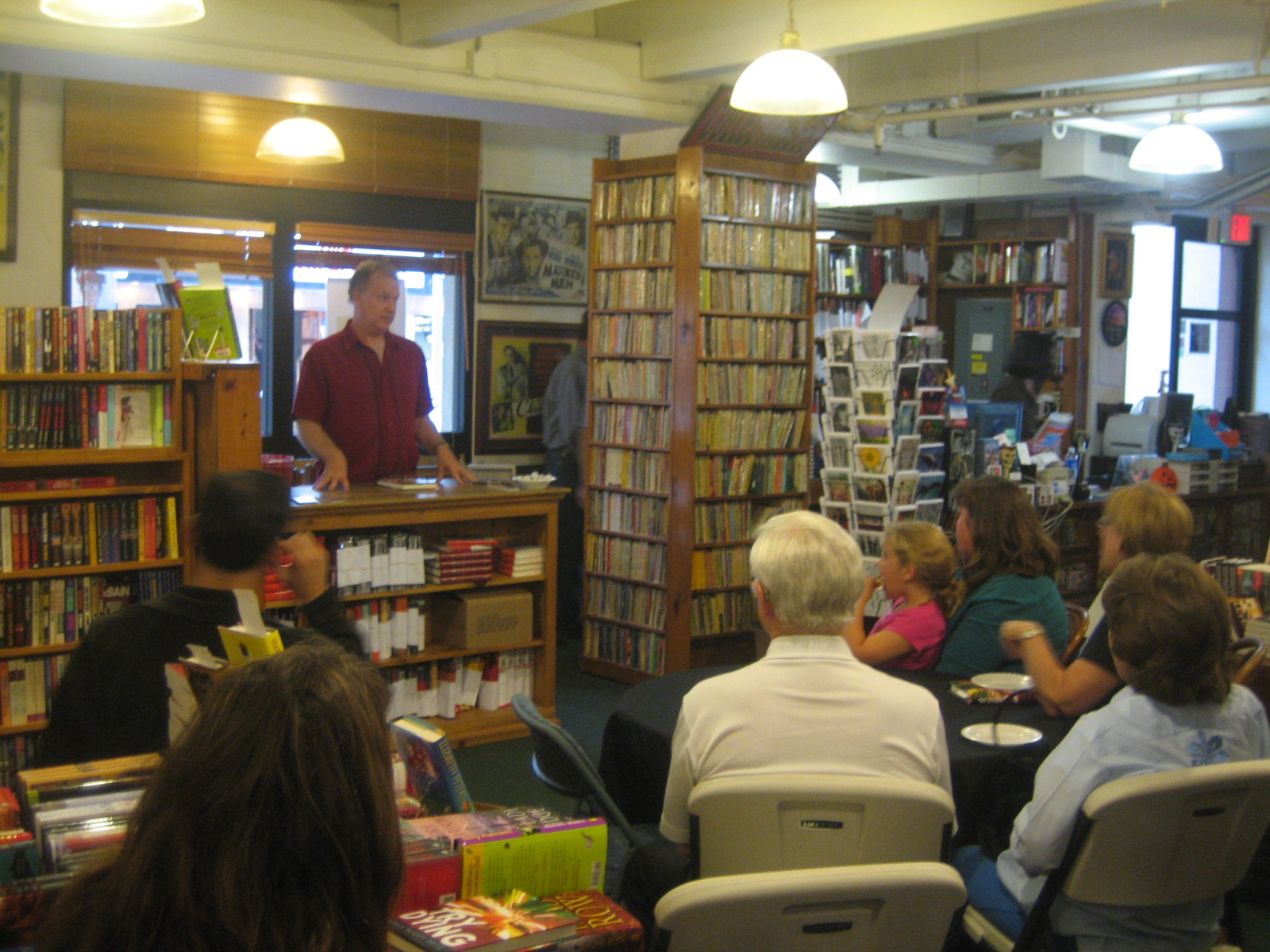
I had the privilege of launching the first book of my Ty Buchanan series, Try Dying, at Mystery Bookstore. And was further honored to be on their list of authors signing books at the L.A. Times Festival each year (though if you want a lesson in humility, try signing at the same time as Mary Higgins Clark or Robert Crais).


Scores of authors owe a great debt to the longtime managers of the store, Bobby McCue and Linda Brown, and the fine staff who love books and hand-selling to customers. Top names made the store a must for their signings. I caught up with our own Michelle Gagnon there last year, and I’ve seen Deaver and Crais and Connelly and Jeff Parker and John Lescroart and a bunch of others at the store. The pre-Festival party for the Times event was always a highlight, the store stuffed with writers and readers and good cheer.
Virtually every reader of this blog, I’ll wager, knows of a fine local bookstore that’s closed. My son’s favorite bookstore, The Little Old Bookshop in Whittier, announced its closing a couple of weeks ago.
It’s the reality of hard economic times and the huge change in the publishing industry vis-à-vis e-books. There is no changing the facts. Like the era of the passenger train and the 10¢ donut, there may be small remnants and reminders of the past. But the day of the thriving independents is coming to a close.
The Mystery Bookstore will have a presence online, and that is where most used books will be sold now. What we’ll miss is the ability to physically browse, hear from the staff what books they like, and that feeling of community good books can create.
So it’s a melancholy time here in L.A. among writers. I got together with some friends in the local MWA chapter the other day, when the news hit. We were all cut to the heart.
I don’t know what else to say. This is kind of a downer blog post, I guess. But I just had to mention the passing of an old friend.
Maybe tonight raise a glass to independent bookstores and the people who love them.