
Can You Automate Grammar?
Terry Odell
I’ve spent the last several weeks editing Beyond the Frame, first making changes and adjustments based on my editor’s feedback, then printing the manuscript and reading it from start to finish, making more notes, and “finally” (because it’s never really over), letting Word read it to me, which led to finding more glitches.
One of the checks Word offers is its “Editor” function, where it will check for spelling, grammar, inclusiveness—is it so bad to use the term ‘doorman’ when there’s a guy holding the hotel door open for you?—and conciseness.
Let’s talk about grammar today.
I’ve always considered myself pretty good at grammar, but of course, I wanted to see what Word’s Editor function had to say. These are some of the things it flagged across several of my books. What I’ve written first, then the Editor’s suggestion/correction below. Changes in bold.
She put the camera to her eye
She put the camera into her eye
She stared past him
She stared at him
Graham finished filing his reports, surprised to see it was four-thirty.
Graham finished filing his reports, surprised to see they were four-thirty.
He recalled the conversation with his father when Gordon brought up working in the same department.
He recalled the conversation with his father when Gordon was brought up working in the same department.
In return for you doing exactly as he says as soon as he says it, he assures me you will not be the victim of hazing.
In return for you to do exactly as he says as soon as he says it, he assures me you will not be the victim of hazing.
He scooped the dirty clothes into the plastic bag, knotted it,
He scooped the dirty clothes into the plastic bag, knotted them
If Black expected him to wash them, he’d pushed the joke too far.
If Black expected him to wash them, he’d push the joke too far.
Mrs. Vernon saw them to the door,
Mrs. Vernon saw them at the door,
He grabbed the guy by the collar,
He grabbed the guy with the collar
You can’t back out now.
You can’t go back out now.
Three days later, dragging her carry-on through the Denver airport
Three days later, dragging her carry-on through the Denver airport
Her hair, cut in the same short, low maintenance do she’d had since college,
Her hair, cut in the same short, low maintenance do she’d have since college
He called Heather’s company
He is called Heather’s company
He scanned the drivers displaying tablets and spotted a tall brunette woman wearing black slacks, a white shirt, and black blazer, holding one with his name.
He scanned the driver’s (or drivers’) displaying tablets and spotted a tall brunette woman wearing black slacks, a white shirt, and black blazer, holding one with his name.
First, he sent an email to Pam, letting her know he would bcc her on all correspondence
First, he sent an email to Pam, letting her know he would be back her on all correspondence
No matter what lies Gerry spread, he couldn’t destroy Heather’s career.
No matter what lies Gerry spread, he couldn’t destroy Heather’s career.
The bottle Ian opened gave a satisfying pop
The bottle Ian opened gave a satisfying pop
She surveyed the offerings, willing to try a little of almost everything.
She surveyed the offerings, trying a little of almost everything.
Needless to say, I didn’t approve any of these suggestions—and to be fair, Word said to ‘consider’ its changes. But give me a human who knows how to read in context any day.
My all time favorite. I’d written, “Joe. What the f**k are you doing here at two in the morning?” I think I was using Grammarly at that time (which has been updated and improved), and it told me that since f**k is singular, it should be, “Joe. What the f**k IS you doing here at two in the morning.”
What about you, TKZers? Do you have a grammar checker that is more accurate? Do you trust it, or do you still have to stop and consider each suggested change? Or do you prefer a human?
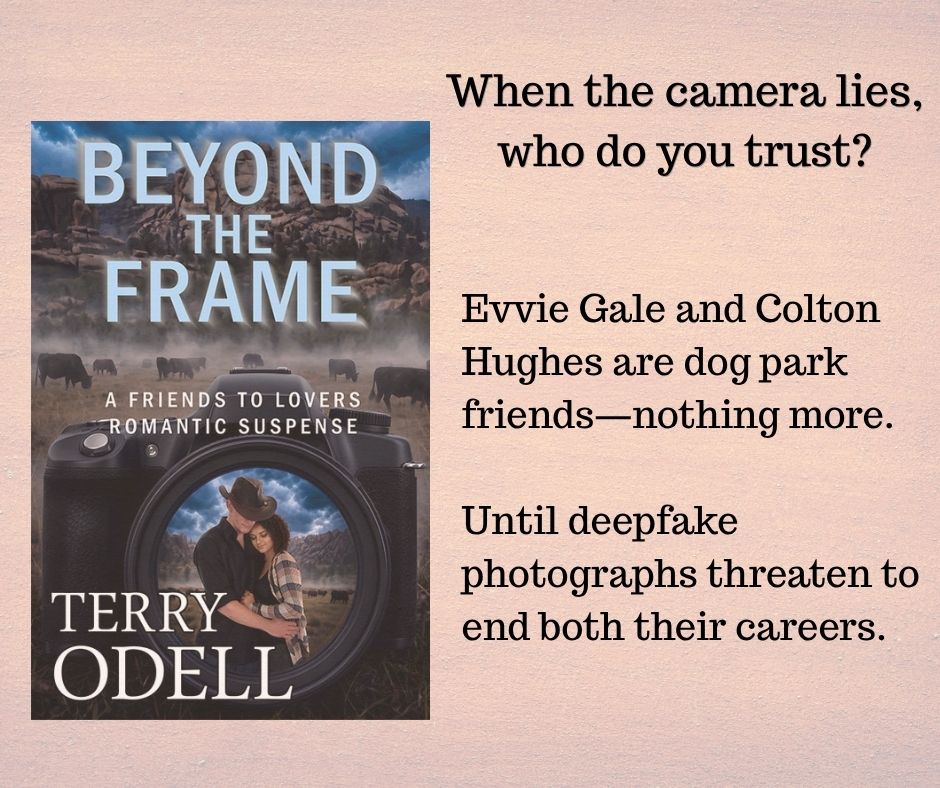
(Oh, and if you’ll permit a little BSP, Beyond the Frame releases October 1st, but you can preorder it today.)
Find me at Substack with Writings and Wanderings
When deepfake photos threaten their careers, dog-park friends Evvie and Colton become each other’s only allies. Evvie, who vanished behind her camera years ago to escape a painful past, uncovers humiliating fake images of herself. Colton, an insurance adjuster with ranch roots, trusts her eye on a suspicious claim. A family emergency pulls them to Wyoming—where Evvie’s own dangerous secret waits.
 Terry Odell is an award-winning author of Mystery and Romantic Suspense, although she prefers to think of them all as “Mysteries with Relationships.”
The exact same thing every friggin’ day.
The exact same thing every frogging day.
Yeah, like that’s a thing.
I guess it’s a way to check your writing to make sure your departure from strict grammar rules is what you meant? Or to imagine what a frogging day would look like …
I’m sure there are people who go froggin’ but I’m content to listen rather than pursue.
Same experience here!
When the help is worse than what you have in the first place, it’s not helping.
Grammar checkers have been an “issue” for word processing for a very long time. Word has been trying for 20+ years to check grammar. Microsoft published an alternative book to Strunk and White so Word’s corrections would be right. It still doesn’t help that much.
Don’t trust the machine!
Trust me, Alan. I don’t!
When I have doubts about grammar, give me my good ole raggedy, dog-earred copy of Strunk and White Elements of Style..
Thanks for the laugh/groan this morning, Terry.
I also have a terrific little book my kids used in grade school. “Scholastic’s A+ Guide to Grammar, by Vicki Tyler. Explanations at that level are easy to understand.
I’ll trust my own grammar judgement and Elements of Style before I ever let Microsoft Word tell me how to say something.
It’s not only Word, Michelle. I’ve seen similar “creativity” from other programs as well.
I too collect grammar suggestion stupidity! Here are a couple of recent suggestions:
He had leaned his head back against the couch. –> wants “learned,” not making that up.
Slowing him down a bit –> wants “downs,” not kidding.
It seems to me that grammar suggestions from Word are substantially worse now than they were 15 years ago — but I do routinely hit “don’t check for this” to shut up the grammar checker, so I don’t get as many suggestions as I used to.
I don’t know what trained Word (or any program) in these grammar “rules” but my solution is to turn off grammar checking in the ms as I write–the red squiggles are helpful; the green, not so much. And I went through a couple of manuscripts using the Editor function for this post. Not for my writing.
There’s not one thing I like about Word, but I especially don’t like the grammar checker. Although it does help me catch when I have the the in a sentence.
I think SpellCheck flags repeated words. At least, I recall they get red squiggly lines, since I tell Word not to check for grammar as I go.
I don’t trust grammar checkers and always double check. Better still, I prefer a copy editor.
Human eyes, when trained, are much better than algorithms.
Do you have a grammar checker that is more accurate? Do you trust it, or do you still have to stop and consider each suggested change? Or do you prefer a human?
Still laughing at “Joe. What the f**k IS you doing here at two in the morning.”
I use ONLY AutoCrit’s counting functions: adjectives, repeated words and phrases, cliches… AND I evaluate every single thing I check personally.
I have a lifetime subscription, and they keep trying to get me to upgrade to the AI version, which I will NEVER do.
I use AC to do the boring bits of identifying and listing and locating and counting – myself to do any adjustments to what I’ve written.
And every time I find a new flaw in myself (usually a tendency to repeat a new word), I add it to the AC list of Personal Words so the algorithms check me for frequency on my own errors.
That’s all I need. I know what I want to write. My beta reader catches things such as a missing closing double quote symbol – if I didn’t catch it and fix it myself already.
My grammar database in my head consists of all the books I’ve ever read since I started over 70 years ago – since I grew up in Spanish in Mexico City, and had no formal grammar lessons ever. And the beautifully written and illustrated articles in the National Geographics at my grandparents’ house.
I picked up rules along the way, piecemeal and accidentally. I have Self-Editing for Fiction Writers. I learned anything I missed when I homeschooled our three kids – it has been enough.
But the AI is definitely good for a laugh, if you can stand to deal with it.
Self Editing for Fiction writers was my bible when I started writing. It was on the top of every workshop presenter’s list of references.
I use SmartEdit to catch most of my mistakes, although I’ve never tried it for grammar–if it even does grammar. I don’t trust any of these “handy helpers” to be of any help at all.
Strunk & White, 2d Ed. My high school English teacher gave a copy to everyone in my graduating class (It was a small class.)
Until I lost it in a move, my other resource was an early edition of Tongue and Quill, the Air Force writing manual. which offered offered such advice as, (operating from memory here.) “Use personal pronouns. When we see, ‘It’s the belief of this office that…,’ we wonder if perhaps the desk chair, the credenza, and your telephone caucused and.came up with this idea. If this is your belief, write I believe.” Unfortunately, the advice was watered down over the years.
Love that personal pronoun advice. Who can trust a desk?
I’m more trusting of PWA, than MS Word, when it comes to grammar but even it comes up with some groaners from time to time.
I think they all have serious flaws. Better to learn the rules than rely on a machine. Or hire out.
For the same reasons, I upload the final manuscript to ProWriting Aid, but only to check for typos and such. My grammar-checker is my human (and fabulous!) editor.
As a test, I uploaded a few pages to both Grammarly and ProWriting Aid — they “corrected” each other’s corrections! That told me all I needed.
“As a test, I uploaded a few pages to both Grammarly and ProWriting Aid — they “corrected” each other’s corrections! That told me all I needed.”
LOL!