
When A Panster Has to Plot
Terry Odell
 Many authors talk about hitting a wall at about the 30K mark, and I’m no exception. At that point, I usually wonder if I’m going to have enough story for a whole book. Since I’ve finished over 30 of them, the answer seems to be yes, but that doesn’t stop the doubts from creeping in.
 I hit another wall somewhere in the 60K neighborhood, which is where I am now in the current WIP. “Wall” is probably the wrong term. Raging river is probably a better term, because now, the nagging question becomes whether the book is ever going to end. This is where I need to get into my version of plotting.
Since I didn’t follow an outline, or much of a roadmap beyond, “They’re going from A to Z and know a few stops along the way, but they haven’t decided exactly which route to follow.” I’ve tried the plotting thing, and 3 chapters is as far into the future as I can go. Maybe if I’d taken writing courses instead of just seeing if I could write a book, I’d be more into plotting and hitting all the plot points at the right spot in the book, but I didn’t.
I’m not recommending my writing process, but it works for me. I have no problems with going back and adding things in earlier chapters because I discovered the one I’m working on needs a piece of information. Or foreshadowing. Or, the opposite. Sometimes I find that I’ve included something that is better cut. Too much mundane conversation. Or just plain too much mundane.
Doesn’t that make for a lot of extra work? I say no. Work yes, extra, no. My first draft can be compared to someone else writing a detailed outline, or a list of scenes, or whatever they need so they can write the book. Jeffrey Deaver spends 8 months doing this. I’ve finished my draft in less time than that.
One thing I strive for is making my chapters end so the reader wants to turn the page. Often, end up sticking something in from out of the blue. A phone call. A character showing who creates a problem for the protagonist. A question. I confess that sometimes these are questions I don’t know the answer to, or a character who shows up out of nowhere. Sometimes my subconscious is laying groundwork. Other times, nothing comes of it and I have to decide whether it’s worth keeping.
Then, because the current WIP is a romantic suspense, I have certain conventions—reader expectations, if you will—that need to be followed. In this case, it’s alternating POV characters. Heroine in one chapter, hero in the next. If both characters are in the scene, then one chapter will flow into the next, and whatever that page-turning (I hope) ending was, will lead to answering the question, or dealing with the problem.
Sometimes, as seems to be happening a lot with this book, my characters aren’t both in the chapter. In that case, that page-turning question won’t be addressed until the characters get together again, or until the reader gets through the alternate POV chapter.
Here, the author hopes that both characters are dealing with whatever I’ve thrown at them and that the reader is sticking with both hero and heroine. Not always easy, but nobody said this gig was a walk in the park. Fun, yes. Easy, not always.
So, here I am, at about 65K, thinking about getting to “the end.” The journey has to be satisfying, which means I can’t rush things, although there are days where it’s tempting. “The bad guy was caught and they decided to try the relationship thing.” Nope, that’s not fair to the reader.
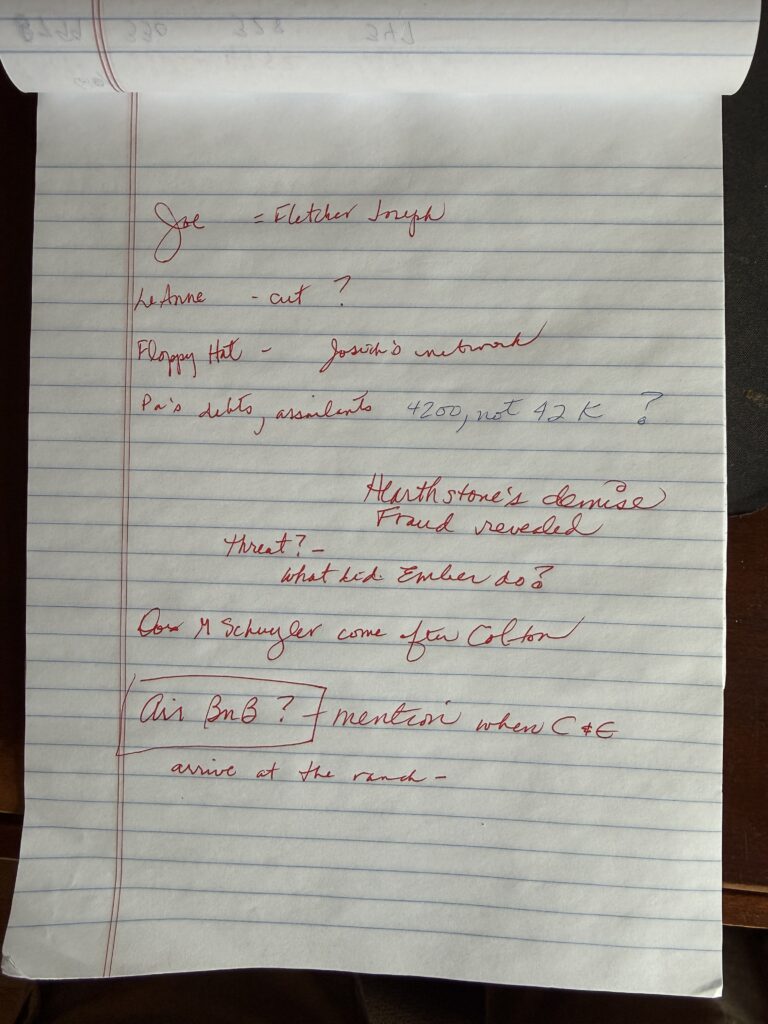 At this stage of the process, I look at my “notes” file to see if I had any ideas that need adding, fleshing out, or cutting. I also get out my handy legal tablet and make handwritten, almost legible notes of threads that I have to deal with. That means for the last 10-20 thousand words of the book, I’m plotting.
Going back and laying groundwork for things that show up later is relatively easy, operative word being relatively. I write tight, so fitting in the new bits means finding the right place, and then getting out the Spackle so the transitions are smooth. What’s harder is discovering that the character you introduced in Chapter 15 to add conflict to the heroine’s arc, ends up being a good guy and where’s the conflict in that? Cutting that thread means making sure any references to that character are gone. Completely gone. Which can end up messing with chapter lengths, which can end up in a lot of rewriting so there aren’t gaping holes. A lot more Spackle is needed for these types of edits.
And then, because my characters don’t have any official authority, how far do I let them go before they do the sensible thing and let the experts take over? Will it make my “ordinary people” heroes less heroic if they give the cops the evidence they’ve found? There’s a limit as to how much disbelief I think my readers are willing to suspend.
 Eventually, everything gets addressed. At that point, I’m ready to print the whole thing using my “fool the eye” technique, and see how it holds together.
All right, TKZers. I’m now officially on deadline, so this is all for today. Anyone want to offer their process, suggestions, or general comments? The floor is yours.
Terry, your process sounds remarkably close to mine. The subconscious is also my guide. It knows better than I do what needs to happen to make the story compelling. When I get stuck, I go back and read from the beginning. Many times, I discover a breadcrumb the subconscious dropped that I don’t even remember writing. That often solves the problem.
But I also depend heavily on brainstorming with critique buddies I trust. They’ve gotten me out of many corners I painted myself into.
So the suggestion I’d add is to cultivate smart critique buddies. That’s not easy and it takes time to build good relationships but well worth it.
Thanks, Debbie. I’ve been with my 2 crit partners for somewhere in the neighborhood of 20 years now. They’re invaluable.
Terry, I enjoyed reading about your writing process and how you plot the last part of your novel, as well as backfilling early to better support the narrative.
While I started out a pure pantser many years ago, I’m a confirmed plotter now. I need a framework, knowing my major signposts–the pre-story, opening, midpoint mirror moment, climax and ending before I start drafting. That said, my outline often gets rearranged in draft. I do let myself discover, sometimes a lot, while drafting, and if I uncover a better path, I’ll take it.
That said, I think I’ve internalized so much now about plotting and story structure that I’ll might be able to do more “plantsing” than plotting. We’ll see 🙂
I like the term authors on a panel at a Left Coast Crime Conference used–“Organic” rather than pantser. I’d fit in there, or as a planster. I think after writing so many books, things just feel right, and when they don’t, I can usually see how to fix them. If my ‘mirror moment’ comes in Chapter 46, but works for the story, I’ll leave it where it is.
I like organic better, too, as well as the term discovery writer.
I’ve learned, too that my process is at least slightly different with each book.
Most of the pantsters I’ve known have become plotters because of the evil that is hard deadlines. Putting that muse in a harness and using a whip doesn’t make them happy, but it works. I’ve taught my method of having plotted important points laid out before writing and allowing a certain amount of freedom between the points helps pantsters. I compare it to laying out gems in a certain order then adding the filigree freehand to create a bracelet.
I have the luxury of setting my own deadlines. 🙂
When I was writing more romance, there were “expectations” that had to be fulfilled, but I never worried about precise placement. Although in reading historical time-travel fiction, if there was going to be sex, it came on page 191, give or take 5 pages.
I plot my milestones, then pants in between. Most of my original plan is a living document that could change if a better idea comes along. It’s helpful to have a roadmap in case I zig instead of zag and get stuck. Even that doesn’t prevent the 30K word brick wall. Not sure there’s a solution other than blood, sweat, and tears. Good luck with your draft, Terry.
I have milestones in mind when I start, generally expectations of the genre, but not very many, and I find when I know too much, I tend to hurry to get to the next, or bored, because now it’s just about finding the right words.
I loosely plot my turning points and lay down the suspense line, which comes in at about 80% of the book. Then I go back and fill in the romance and fix things that have changed because of a twist I wasn’t expecting near the end. Not sure that makes sense…
Makes perfect sense to me, Pat
Terry that is exactly how I write. More fun discovering where the story goes when it gets there. One suggestion… After each drafted chapter I write a brief outline of it in a notebook. Later, when I must go back somewhere to add a foreshadow or otherwise change anything my post-draft outline tells me which chapter to go back to.
Matthew, I do the same chapter summaries, but I use an Excel spreadsheet. Makes it easier for me to search for things. I track the story day/time, the characters, the POV character, the setting, and then the summary.