
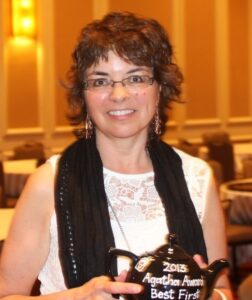
Leslie Budewitz wins 2013 Agatha for Best First Novel
It’s always a pleasure when my good friend and Agatha-winning author Leslie Budewitz visits TKZ for a guest post. Today, let’s welcome Leslie with her “rant” about “The Power of a Rant.”
The Power of a Rant, or How Letting My Main Character Cut Loose Powered a Winning First Novel
I love me a good rant. In April 2012, I attended Don Maass’s Breakout Novel Workshop in Hood River, OR, a week that changed my writing life. I had a three book contract with Berkley for the Food Lovers’ Village series. The first manuscript was due August 1. I went to the workshop with more than half a first draft, and felt pretty good.
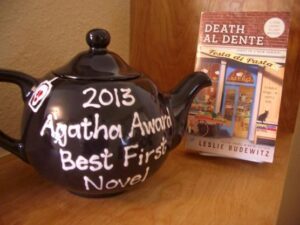 I came home and started over. Death al Dente won the 2013 Agatha Award for Best First Novel.
What changed? I didn’t change the plot. I do outline, and I had created character sheets where I focused on learning what my characters most wanted and what they would do to get it. I knew where the story was going.
But my writing was too passive. Not bold enough. Not enough tension. My main character didn’t drive the story. Don suggested I let Erin go on a rant. Now, he meant that as a character discovery exercise, not as a way to open the story, but that’s what I did with it.
I told this story a few weeks ago at the Writers’ Rodeo in Helena, Montana, and a writer in attendance asked if I could read the original opening—good enough to sell the proposal—and the version I submitted. We didn’t have time then, so I promised to write a blog post comparing the openings. Debbie Burke was presenting at the same conference—here’s her roundup—and kindly offered me a guest spot.
In Death al Dente, a classic cozy mystery, Erin Murphy’s mother, Francesca, has asked her to come home and take over the Merc, the shop she’s been running in the family’s century-old grocery in the heart of the village of Jewel Bay, Montana. Erin, now 32, left home for college months after her father was killed a hit-and-run that has never been solved. She’s had a successful career as a buyer for SavCo, my fictional warehouse grocery chain headquartered in Seattle. Coming home wasn’t in her plans, but when your mother asks, what can you do?
The difference between the two drafts is mainly in attitude and micro-tension. Our main character has a problem, and you know she’s going to find a way to solve it. You know we are going to have a good, old-fashioned mother-daughter tussle in the form of conflict over a family business—two classic situations—and it’s going to matter to solving the murder, which hasn’t occurred yet. All that from the rant on the first two pages.
In the first draft, Francesca—aka Fresca—is more interesting than Erin, the main character. Fresca drives the scene. As revised, Erin takes center stage, and we know we’ll be following a strong, capable woman as she reshapes a struggling business, and solves a crime.
Rants are also a good way to give dialogue subtext, that is, to get at what the characters are saying underneath the words they’re using. In this scene between Erin and her mother, you’ll detect issues of trust, fear of change, and control over family business.
Rants can also be a great way to explore what’s actually driving a character, whether it’s your protagonist or a secondary character. In my standalone suspense novel, Blind Faith (Crooked Lane, 2022, written as Alicia Beckman), I let my main character, a lawyer facing a crisis of conscience, go on a rant about justice. Little of it made the page, but the process helped me get at the heart of her internal conflict and figure out what she would do in response to injustice.
If you are struggling with your main character, if she’s not quite coming alive for you, give her a rant. It may not make the final edit—but it will help you find out who she is, and find her voice.
Death al Dente, draft one:
CHAPTER ONE
“Oh, smell this Genovese basil, darling.” My mother waved a bouquet of fresh herbs about three inches in front of my nose. “Isn’t it heavenly?” She closed her eyes, breathing deeply, an expression that could only be called rapture on her face. Maybe I’d finally discovered her secret for looking youthful at sixty-one.
“You’re making me hungry, Mom.”
“Then eat.” She waved the basil again and the sweet-green scent nearly made me swoon. “Slice up some of those Early Girls from Rainbow Lake Gardens, with that mozzarella from the new Creamery.”
Caprese salad. My favorite. “Mom, there’s too much to do before the Festa opens tonight. We haven’t even started decorating.” The Merc, formally known as The Glacier Mercantile, shared a courtyard with Red’s Bar, the setting for tonight’s kick-off dinner for the First Annual Jewel Bay Festa di Pasta. But Old Ned Redaway–aka Red–didn’t want us to “doll the place up,” as he put it, until his Friday burgers-and-beer lunch crowd had cleared the door. Which would be soon. Which meant I couldn’t give in to my mother’s tempting suggestions, no matter how much my tummy gurgled at the thought.
“Mangia, mangia. All work and no food makes a girl dull and scrawny.”
“Ha.” I’d inherited my late father’s “black Irish” fair skin and dark hair along with enough of my mother’s good genes to avoid most weight problems. But scrawny I would never be, not as the manager of a market specializing in local artisan foods and the daughter of a woman who sold handmade pasta and sauces for a living.
“I’ll wash these up and find a platter and that herbed olive oil,” she said. “You slice a few for each of us.”
“Ah, the truth comes out,” I said, and stepped outside the front door to the produce cart. A cattail reed basket held the season’s first tomatoes–greenhouse, necessarily, in mid June in northwest Montana, but ripe and juicy nonetheless. I plucked two and headed back in. “You want me to eat so you can eat.”
“No good Italian girl ever eats alone,” she called over her shoulder as she headed for the demonstration kitchen at the back of the shop.
Ouch. Okay, I was only half-Italian, but I’d spent too many nights eating alone for far too long. Still did on occasion, though now by choice.
She stopped and turned, gripping the peppery-sweet basil. “What I should have said, Erin, darling, is that when you eat good food, grown and prepared with love, you’re never alone, even if no one else is at the table with you.”
“Nice recovery, Mom.” I grinned.
In the kitchen, I drew out one of the locally-made hardwood cutting boards we sold, honed a chef’s knife on a steel, and started slicing. Working together, we stacked layers into a caprese antipasto appetizer: a thick slice of firm tomato topped with a slab of fresh mozzarella and a large basil leaf, drizzled with a fruity olive oil. Too impatient to grab a plate and fork, I picked one up and savored the smells before taking the first bite, my other hand cupped to catch any stray juices. “Mmm. The taste of summer.”
My mother was too preoccupied with eating to bother chiding me for talking with my mouth full.
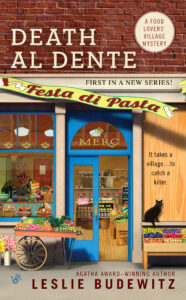 Death al Dente, as published
CHAPTER ONE
“Who put these huckleberry chocolates on the front counter?” I grabbed the stack of purple boxes crammed with gooey huckleberry-filled chocolate wannabes swathed in purple foil and shoved them onto an open shelf on the side wall, next to the herbal snoose.
“I did, honey,” my mother said. “Our customers love them.”
“Our customers,” I said, “buy one for seventy-five cents and walk around the store, so preoccupied with unwrapping it and indulging their sweet tooth that they can’t fathom buying Montana-made goat cheese, or buffalo jerky, or your pastas and sauces. Then they grab a napkin that costs us five cents apiece to wipe the drool off their fingers, and half of them drop it on the floor. There goes our profit.”
My mother scowled. “Erin, what on earth has gotten into you? Why do you hate huckleberry chocolates?”
“I don’t hate huckleberry chocolates. I love huckleberry chocolates. But we can’t rebuild this business on fake food and chemical sugar.”
She picked up the boxes I’d just moved and carried them back to the cash register. “We have always had huckleberry chocolates right here, where the customers can see them.”
“Mom, you hired me to run the place, remember? To shake things up.”
“Some things shouldn’t be changed.”
“Mom, we agreed. The Merc will die if it’s just another knickknacky gift shop. But an artisan market for local and regional foods—”
“Those are local. They’re made five miles from here, by a woman you’ve known half your life.”
“With high-fructose corn syrup and milk chocolate that tastes like rancid Hershey’s. If we find a vendor using fresh berries, real sugar, and high-quality fair trade dark chocolate, sixty percent cocoa solids or better, I will build the Great Pyramid of huckleberry chocolates right here.” I jabbed at a spot on the oak floor, ten feet inside the Merc’s front door, little changed in the hundred years since my grandfather Murphy built the place and opened the town’s first grocery. “I will worship at her kitchen stove. I will put an ad in the paper and a post on Facebook offering a free huckleberry truffle to everyone who walks in that door. And if they aren’t wrapped in purple paper, I will even consider raising the price split.”
My mother stared as though she didn’t recognize me. Not for the first time since I’d returned to Jewel Bay, Montana, the hometown I couldn’t wait to leave after high school, fourteen years ago, to take over her struggling business so she could focus on building her own product line.
And not, I was sure, the last.
(Excerpt from Death al Dente, published by Berkley Prime Crime 2013, copyright Leslie Ann Budewitz)
Does Erin ever find the perfect huckleberry chocolate? I’ll let you read the book to find out. And don’t fret over that luscious business about basil. It finds its rightful place later in the scene. Because a Caprese salad made with sun-ripened tomatoes, creamy mozzarella, and basil so fresh it’s practically still growing is—like an honest rant—too good to waste.
***
Thanks, Leslie, for a terrific before-and-after comparison with excellent lessons from a winning first chapter!
***
Leslie Budewitz tells stories about women’s lives, seasoned with friendship, food, a dash of history, and a heaping spoonful of mystery. She writes the Spice Shop mysteries set in Seattle’s Pike Place Market and the Food Lovers’ Village mysteries set in a fictional version of Bigfork, Montana, where she lives. Her latest books are Lavender Lies Bleeding, the ninth Spice Shop mystery, and All God’s Sparrows and Other Stories: A Stagecoach Mary Fields Collection, historical short fiction set in Montana. As Alicia Beckman, she writes moody suspense set in Montana. She is a former president of Sisters in Crime.
Find her books in print, ebook, and audio across the US and Canada, wherever you shop for books.
What a perfect example of taking something good and making it great.
Thanks, Patricia!
Definitely a more compelling start. Thanks for sharing.
My pleasure, Terry!
Leslie, thanks for demonstrating the “makeover” of a first chapter. Always glad when you visit TKZ!
Always a pleasure, Deb, and great to share some of the conversation from the MT Writers’ Rodeo with the KZ readers!
Great contrast. I’ll keep it in mind. Could be a good way to jumpstart my writing again. It’s been a minute. Nice to “meet” another writer in Montana.
Always happy to boost a writer in the doldrums! Debbie and I are both in the Flathead. And you?
Near Butte. My parents live in the Flathead area. 🙂
Oh, cool! You might consider our annual writers’ conference, in late Sept this year. https://www.authorsoftheflathead.org/
Debbie has invited me. Not sure when I’ll get up there again.
Having lived here for 14+ years, the huckleberry references were golden.
A Montana classic, for sure! I hear tell they grow in a few other mountain states, but I’m not sure I believe it! 😉
Erin’s rant really energized the opening of Death al Dente, Leslie. Wow. The power of the rant indeed. I can see how just getting the writer better aligned with the POV’s attitude is well worth writing the rant, even if most doesn’t make it onto the page.
This post made me realize I’d opened my first published novel with a rant of sorts as well, thanks to being prodded by my development editor Mary Rosenblum to put more attitude in Mat (Mathilda). That attitude carried a five book series from start to finish.
BTW, I’ve attended two Donald Maas workshops myself—a one day here in Portland in 2013 on 21st century fiction and then a three day in Seattle in 2017 covering his emotional craft of fiction.
Dale, great point that a rant helps a writer get aligned with the character’s POV, even if it never makes it to the final version. It’s part of the discovery process where we learn about our characters’ strongly held beliefs.
Thanks, Dale. And Debbie’s right — your insight about alignment with the POV character is spot-on.
Glad to hear Don’s classes were useful for you too. His book on the emotional craft of fiction is excellent.
Great post, and thanks. This is probably what my editor at Berkley meant in her very nice rejection letter when she wrote, “This is quieter than what we usually publish.” I made my characters too polite!
LOL! And that was a very polite rejection! It can be hard to be mean to our story people, piling on the trouble and tension, but it makes for a stronger story — or should I say a noisier one? 🙂
Late to the party but yes, I, too, have to be careful about having my characters (especially females) be too polite. Maybe what I need to do when writing those types of scenes is think about my grouchy attitude when I’m stuck behind slow drivers on the road. LOL!
Thank you, Leslie for posting your before and after. It’s really cool to see the transformation of the scene with the re-write.
My pleasure, BK — and yes, channeling our own less-than-savory emotions and amping them up is a great way to make our characters edgier and more interesting.
Now I want a huckleberry chocolate, not that I know what they are, but they sound delicious. Thanks, guys. LOL
Excellent example of revising a rant, which I happen to love. Rants add another layer of relatability.
LOL! A huck is a wild blueberry of sorts, growing in the mountains, and much prized by humans and bears alike!
Glad the comparison and the use of rants struck you.
Welcome, Leslie, and thanks for a good blog. That rant led to a productive career. You’re Guest of Honor at the Malice Domestic convention in 2027, the same place where you won your Agatha. Congratulations!
Thanks, Elaine! The Malice Domestic GoH honor came as a real surprise and I’m looking forward to every minute of the convention, one I’ve loved since I first attended in 2012 and to my astonishment, won the Agatha for Best Nonfiction.
The revision is definitely a lot punchier.
Some of that, of course, is the revision process. But using the rant to get closer to Erin and help her drive the story really made the difference.
What a wonderful teaching, Leslie. So clear, so charged with emotion. The feelings are contagious, and, boy, do I want to read on so much more with the new and improved version. Well done and thank you ( ;