
Last Saturday I was a panelist at Symposium, a very small writing-focused science fiction event held in my neck of the proverbial woods.
The guest of honor was a local writer, Steve Perry, who has had seventy plus novels published in science fiction, fantasy, thriller, including a NYT best selling Star Wars novel, Shadows of Empire, and ten books in Tom Clancy’s Net Force series.
He and I were part of the first panel of the day, “Love and Death—the only two things worth writing about.” We five panelists agreed that love and death were indeed fundamental to fiction, as they are in life. As Steve noted, everyone hopes for the former and will, eventually, face the latter.
The rest of that session tackled the questions posed in the panel’s description, such as what makes for a good plot, and what are the elements you are looking for, etc.
But the panel got me thinking further about the role of love and death in fiction, and how both are central to story telling.
Death.
Whether the world is at stake, or just one life, the risk of death can both shape and propel a story forward.
During the panel I brought up character death, citing our own James Scott Bell’s three kinds of death stakes:
“As I’ve written many times, the best fiction is about a battle with death, which comes in three forms: physical, professional/vocational, or psychological/spiritual.”
I added a fourth, societal. The risks of dying in any of these ways creates huge stakes for the character, and can drive the plot. Physical death is obvious. Psychological death is a loss of identity, sanity
Speaking of the plot, there’s the plot’s own “death stakes,” which could be one and the same with your hero’s death stakes, or could be death on a bigger scale, and which could also be potential psychological death of a community, or even the death of an ideal, such as justice or freedom, etc.
Love.
We tend to think of love as romantic love, but of course that’s only one kind. There’s love for family, as well as your community and your country.
Brotherly/sisterly platonic love can be powerful grist for the story mill. A little while back I joined my wife’s CraftLit group for an online watch of one of my all time-favorite movies, The Great Escape, which is filled with death stakes, both for characters and as part of the plot.
The Great Escape also depicts brotherly love, based on friendship and a bond brought about by the shared circumstances of war and imprisonment. We see several examples in the movie. There is the scrounger, Hedley, played to perfection by James Garner, and the forger, Blythe, equally well portrayed by Donald Pleasence who become friends while working together. Then there’s the two tunnel kings, Danny, played by Charles Bronson, and his friend Willie (John Leyton).

Hedley insists on taking a now sight-impaired Blythe out with him during the escape, increasing his own risk of physical death.
Willie stays with Danny to guide him when Danny is overcome by claustrophobia. The two stick together and find a way to freedom.
Being willing to lay your life down for another, is a sacrifice for love. Being willing to move heaven and earth to save someone, say a kidnapped lover, can be the stuff of thrillers and failure could result in not only physical death for the lover, but also psychological death for the hero.
Another classic movie example of love and death:
Alfred Hitchcock’s North By Northwest sees Cary Grant’s advertising executive thrust into a world of deadly espionage, thanks to being in the wrong place at the wrong time and being mistaken for someone else.
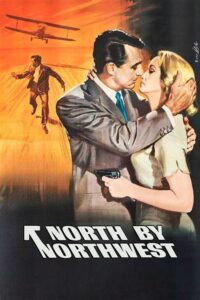
He faces death multiple times in the course of the movie, including memorably at a crossroads when a crop dusting plane turns out to be an assassin’s weapon. He meets and falls for a beautiful young woman, played by Eva Marie Saint, who is not what she seems. In the end, he survives and gets the girl. Love and death drive a suspenseful, relentlessly paced film.
Modern mysteries often have death stakes for the sleuth, who can face not only the prospect of a a physical death, but also psychological and professional, and, especially in a cozy, can deal with societal death.
Moreover, they focus on solving a murder, and these death stakes can be in play for the victim as well as the killer’s motives. The victim may have caused what the villain perceives as death, perhaps the psychological death from the killer’s romantic relationship having been ruptured by jealousy or even betrayal, or professional (vocational) death, again by something the killer perceives as being done to them by the victim. And the killer certainly could be correct.
Modern mysteries can also have a love interest or interests for the sleuth, as in the cases of Stephanie Plum bounty hunter and Hannah Swensen baker and amateur detective. Both deal with long running romantic triangles. Both also regularly deal with potential death stakes for themselves.
So, love and death. Are they indeed the only things worth writing about?
For my part, I’d say they may not be the only things, but they are certainly two of the most important things to write about.
What do you think?
Authoritarian,Totalitarian, Censorship, Societal and Ethical Responses, History etc.
Those are certainly powerful subjects, especially for non-fiction, and have been the basis for compelling tales, such as “Gulag Archipelago.”
Nice analysis, Dale. (And thanks for the mention.)
Perhaps to Love and Death we can add Good and Evil. They are all certainly in The Great Escape!
I’d say we can definitely add good and evil, Jim. Excellent addition.
This is something that’s often missing in modern movies, the friendship and sacrificial aspect.
Having everything be about sex all the time is boring.
In the online discussion following the screening of “The Great Escape,” another viewer, a teacher, pointed out brotherly love was missing from the modern cultural discourse, and lamented it’s absence, especially for young men.
I agree with both your and Cynthia’s comments, and would add the inability for two characters (especially women & men) to have a deeply meaningful, non-sexual relationship.
It seems like they have to be either brother & sister or utterly at odds with one another to not immediately fall into bed together at unrealistic moments.
Dale, your additions of “psychological death of a community, or even the death of an ideal, such as justice or freedom” are esp. timely right now.
AI is leading to the death of individualism and independent thinking. We’re becoming cogs in the giant wheel that crushes nonconformity.
Thanks, Debbie! I agree about A.I. Our freedom, intellectual as well as our autonomy, can perish if we aren’t careful.
Great topic. One thing you said leapt out: “We tend to think of love as romantic love, but of course that’s only one kind. There’s love for family, as well as your community and your country.”
I realize that I represent only one billionth of 1 percent of the reading population and that my position is not a popular one, but it drives me nuts that books (not specifically in the romance genre) are hijacked by romance. That is why, even though writers are told to read a lot of fiction, I read far more non-fiction than fiction. When I started writing, I tried hard to follow this age-old advice of reading tons of fiction, but I got so tired of trying but not finding stories that weren’t hijacked for romance that I just gave up.
Yes, love is more than romantic love but those other versions of love, in my fiction seeking experience, aren’t covered anywhere near as frequently. Growing up, I loved the buddy-type TV shows and for some reason, there’s not much fiction (at least in my experience) that targets this. That’s why Zane Grey’s “Forlorn River” remains my all time favorite novel.
The only rock-solid source of love from a buddy standpoint that I have found is the Star Trek franchise (original series) where the friendship of Kirk, Spock & McCoy is marvelously presented both on screen & in many mass market paperbacks.
As a writer, knowing I’m vastly in the minority in NOT desiring every novel to be turned into a romance, I still have to find a way to incorporate it in my work, but my goal is for it to be a thread, not the dominance of the story – like a background or ‘triangle’ type thread mentioned in this post. Threading that needle is difficult.
I don’t think you are by any means alone in your desire not to have romance in every book you read. I’m a sucker for it, but I also don’t need it in everything. One of the delights of classic mysteries, for instance, is the focus is on the web of human relationships, and unraveling an intricate mystery. There can be couples in love in a Poirot novel, for instance, but they aren’t the focus.
No matter from where it springs, in the end it’s story. Tell it well.
Well said!