
Amazon’s Latest Rollout – And Controversy
Terry Odell
Amazon is rolling out a new feature, “Ask this Book,” a new feature that allows readers (of Kindle books) to interact with the book. It’s currently available for thousands of English-language books on the Kindle iOS app in the U.S. The feature will be enabled on Kindle devices and Android OS next year.
Forget a character’s name? Can’t remember where a scene took place? Instead of searching, which can be a tedious process, you can now ask the AI genie inside the book and it will answer you, also inside the book. No scrolling, no losing your place.
That seems harmless enough. Helpful, even. But you can also ask more general questions, and AI will answer in a paragraph, and that’s where the controversy begins.
This example is from a Kindlepreneur article written by Kevin J. Duncan, Head of Content. Using the book “Alice in Wonderland,” he asked what was the role of the Cheshire Cat.
The response:
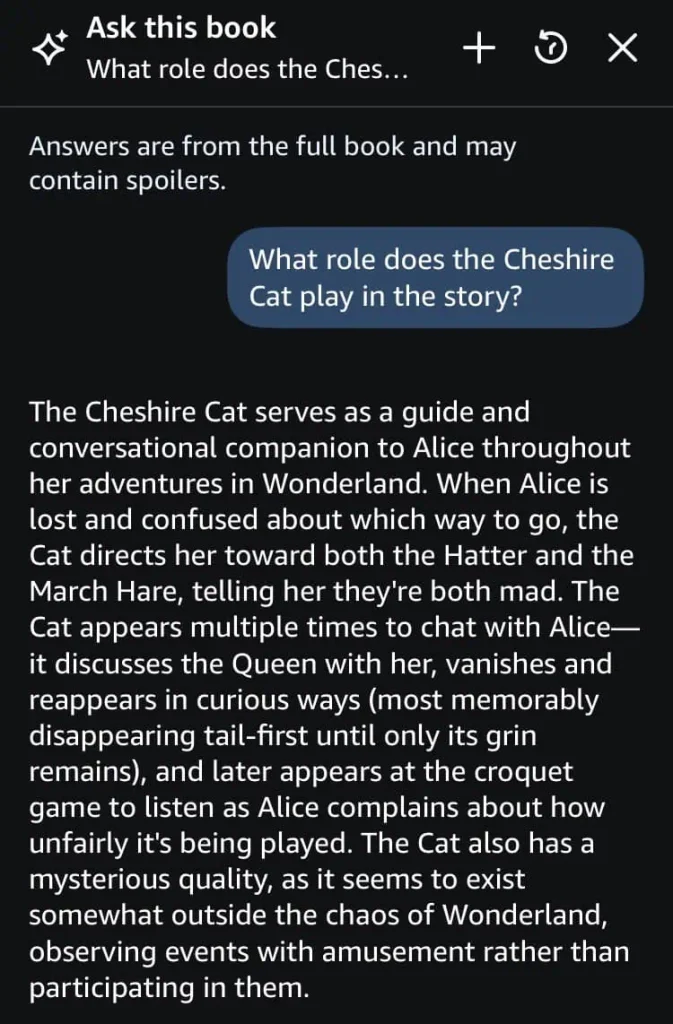
The argument continues that these sorts of answers are the “opinions” of AI. To quote Duncan, “the system is giving you its version of what that thing means. It decides what matters, what doesn’t, what’s central, and what can be glossed over.”
My own test. I don’t own a Kindle, and I buy almost all my books from Barnes & Noble, but I do have a few books from Amazon, admittedly. Most of them are the freebies that come with my Prime membership, with occasional purchases from authors I’m familiar with. I didn’t have access to the Ask This Book feature when I opened a book from my Kindle library to read on my PC, but I did get the feature on my phone.
(Personal note. Reading on my phone is a last resort. I have a Nook tablet and an iPad mini, both of which are much more eye-friendly, but sometimes I’m stuck waiting unexpectedly and don’t have one of those devices with me.)
The Ask This Book feature is activated by tapping the page and getting a menu of icons at top of the screen. Ask This Book is the diamond shape with the little +.
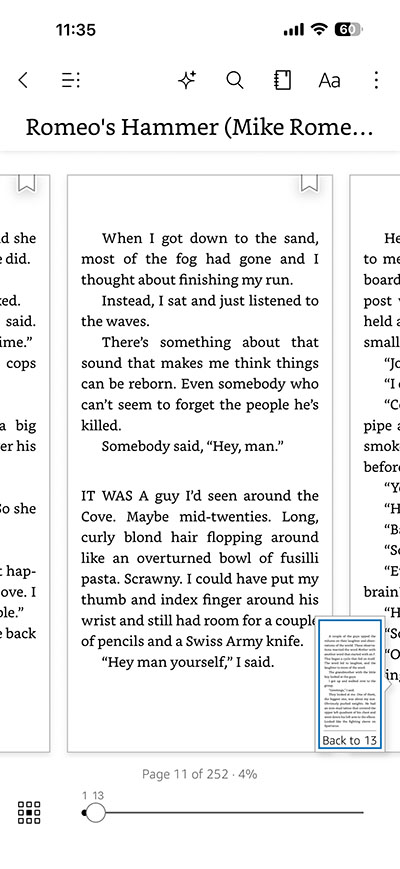
Or, you can highlight a word or portion of text, which should give you the option to ask your question.
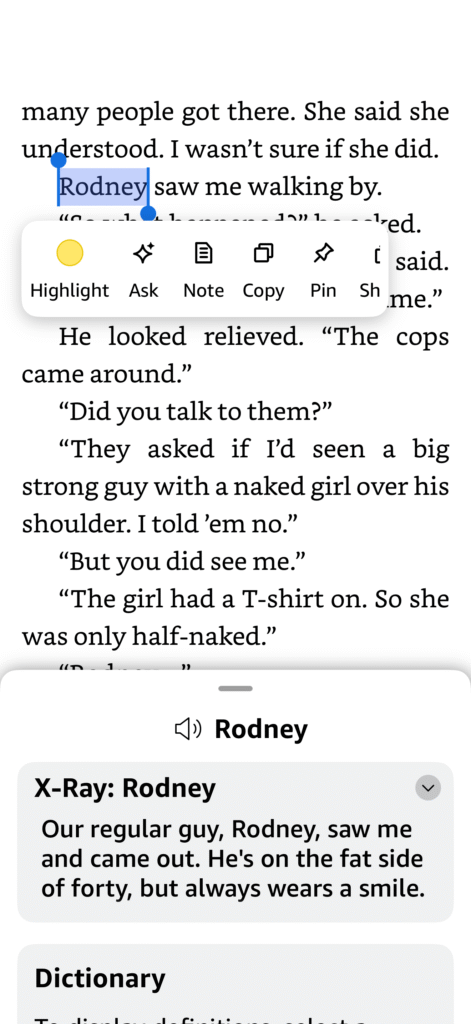
You can also choose between having AI look at the whole book, or only up to as far as you’ve read, which is supposed to avoid spoilers. I used the whole book option and asked the question, “What kind of person is Mike Romeo.”
This is the response I got. (Sorry, but my phone wouldn’t let me shrink the text to get the entire answer on the screen, but you can probably figure out the first sentence.)
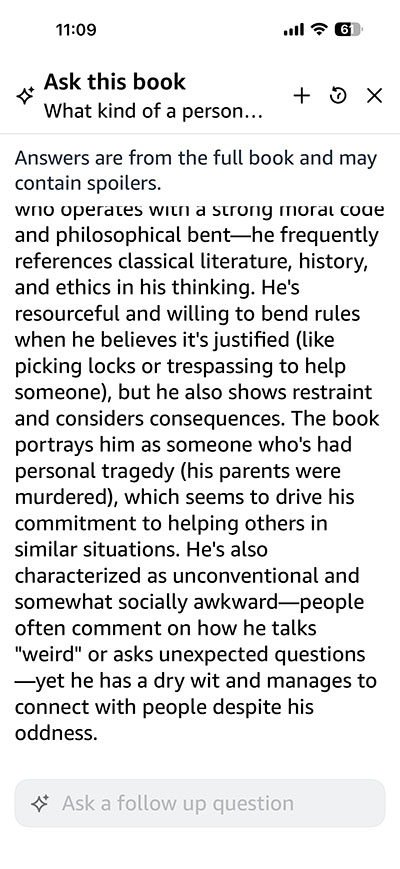
**If you’re reading this, JSB, what do you think about this characterization summary?
The Author’s Guild is pushing back. This is what they had to say:
“The Guild is looking into whether the feature, which was added without permission from publishers or authors, might infringe authors’ and publishers’ rights.
“Ask this Book, which is slated for a wider rollout in 2026, allows readers to query an AI chatbot about books they have purchased or borrowed. So far there is no way for publishers or authors to opt their books out of the feature, though as of this writing the feature is not available for all ebooks. It allows a reader to highlight text and click on an “Ask” icon to ask the AI to “explain” the selected text or enter their own question in the chatbot. All responses are generated from the book itself.
“The Guild is concerned that Ask this Book turns books into searchable, interactive products akin to enhanced ebooks or annotated editions—a new format for which rights should be specifically negotiated—and, given Amazon’s stronghold on ebook retail, it could usurp the burgeoning licensing market for interactive AI-enabled ebooks and audiobooks.”
Writer Beware isn’t too happy about the feature, either. They say, “Agents and publishers broadly regard anything to do with generative AI as a separate right reserved solely to the author, and publishing contracts are increasingly addressing this issue. The primary focus has been on preventing unpermissioned AI training, but with the technology embedding itself at warp speed in all aspects of the book business, the rights implications are expanding just as fast…especially where, as here, they sneak in under the radar.”
Should this be considered yet another format of a book? If so, what are the author’s rights?
As of now, there is no opt-out choice. Ask This Book is included automatically. It operates independently of the author, so they don’t get to review answers, suggest changes, or flag problems.
Your thoughts, TKZers? Are authors and publishers getting shortchanged?
**Note: if you’re upset with Amazon, my books are available wide.
New! Find me at Substack with Writings and Wanderings
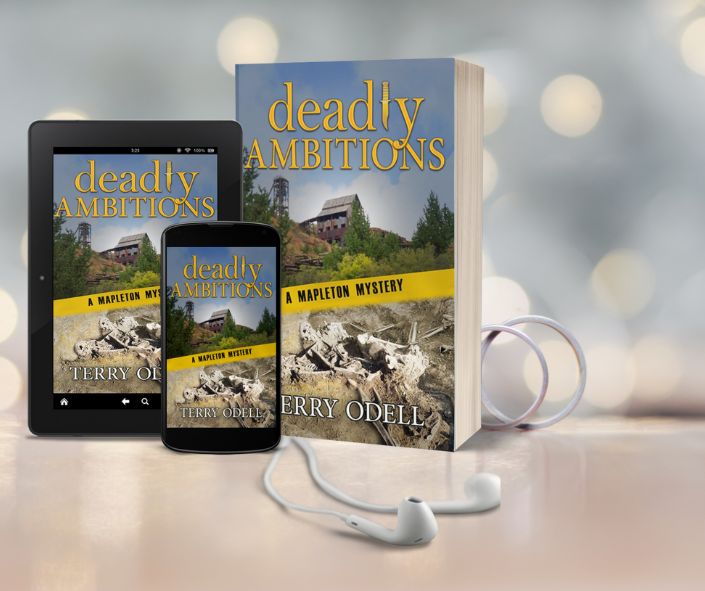
Deadly Ambitions
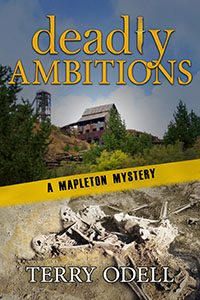 Peace in Mapleton doesn’t last. Police Chief Gordon Hepler is already juggling a bitter ex-mayoral candidate who refuses to accept election results and a new council member determined to cut police department’s funding.
Meanwhile, Angie’s long-delayed diner remodel uncovers an old journal, sparking her curiosity about the girl who wrote it. But as she digs for answers, is she uncovering more than she bargained for?
Now, Gordon must untangle political maneuvering, personal grudges, and hidden agendas before danger closes in on the people he loves most.
Deadly Ambitions delivers small-town intrigue, political tension, and page-turning suspense rooted in both history and today’s ambitions.
 Terry Odell is an award-winning author of Mystery and Romantic Suspense, although she prefers to think of them all as “Mysteries with Relationships.”
I don’t need AI to tell readers what it thinks something means. Sometimes I’m not even sure what something means, and I wrote it. Or sometimes something I wrote doesn’t necessarily mean anything of import, so AI doesn’t need to find some hidden wisdom in a random passage. The only ones who should concern themselves with interpreting my theme(s) are readers.
I’m with you on this one, April. I’m often surprised when a reader sees things I never had in mind as I wrote the book.
Another reason in support of my preference for “old school” analog books when it comes to reading…
I find e-reading uncomfortable due to the “scrolling” format, and the faux page “turning” just feels awkward and unsatisfactory (and the sound effects of pages “swooshing” somewhat annoying…)
There is a physical satisfaction of the weight shifting from the right hand to left as the pages turn and story (hopefully), progresses, which also makes finding where I left off – should I lose my place – relatively easy.
And given this week’s poor – okay, horrible – weather here, I don’t have to worry about keeping a real paper and ink book charged… as long as I can get enough light by which to read, it “works…”
Sure, it’s not as “convenient” as my phone – but I’m not usually reading that deeply or for that long when I’m out-n-about, standing in line (including the TSA and DMV) – I tend to use those kinds of waits to scribble on my omnipresent note pad (or, okay, phone-notes app), or just people watch, and screen time, when I’m abed, is not good for restful, healthy sleep…
So call me a Luddite if you will… or just a grumpy old boomer, but I AM responding online, so… 😁
How you read doesn’t matter. It’s the reading that counts. Thanks for chiming in.
Thanks, Terry, for emphasizing this important issue. Quite a coincidence my post on this AI problem came out this morning too, and my wife calls them “Grant’s rants.” AI steals copyrighted material, kills writers’ creativity, and destroys professional reputations. As one commenter said, “Enough is enough!” My rant today doesn’t address my feelings about the way AI is deceiving and deluding people, especially children.
I added a link to your post from my blog. I’m looking forward to Jim’s thoughts on AI’s summary of Romeo’s character.
Thanks, Grant. It’s a shame we are now having to decide what’s real, what’s enhanced, and what’s woven from whole cloth.
Terry, I also have been watching this latest development unfold and I don’t like it one bit. No one can afford to fight the eight-billion pound gorilla and they know it.
That eight-billion pound gorilla is biting the many author hands that feed it. Here’s a snippet of what I wrote the Amazon customer service agent. “Please tell the developers to read the room. The polls suggest the general public [is] tired of the AI intrusion, and [the feedback is] worse coming from creatives, such as writers. This could very well be the type of thing that pushes Congress to finally enact legislation that not only affects AI, but also delves into [Amazon’s] monopolistic practices.”
I’m hoping the Author’s Guild’s challenges get noted and “Ask This Book” is considered another format. If Amazon continues to use this feature, at least the creators should get paid.
This makes me incredibly angry because they’re not asking the author’s permission. I have one book on Amazon and feel violated. They’re contributing to people not thinking or comprehending for themselves.
I’m also angry about this and hope more authors, publishers, and writers organizations push back against this new “feature.”
We are being short-changed. I believe Ask this Book violates copyright, allowing AI to generate new text based on ours. But also, it intrudes on the reading experience. At some point, it may activate automatically when you reopen a book you haven’t been reading for a while, to bring “you up to date.”
Full disclosure: I’m against the use of LLMs and “GenAI”, period, in the arts, in research etc.
I’m reaching out to authors and asking them to use the Amazon chat feature, get hold of a human, and make our collective voices heard.
Yes, Amazon accounts for the bulk of digital and print sales, but not all.
Together, we can make a difference!
Thanks, Dale.
I think AI has a place in research. It’s not that much different than using Google, etc., but it’s a lot faster. A recent webinar featuring D.P. Lyle pointed out that if you need to know what the road surface was on highway X between points A and B in 1940, you can get an answer in seconds.
And yes, you need to verify what it gives you. However, this “use” isn’t the same at all. How long before students are using this feature to write their book reports?
As I said in my post, authors don’t have the choice to include it in their books. And if it’s used, authors, publishers, etc., should be paid.
I don’t want a bot telling readers what something means. What if it’s a clue? What if the author subtly foreshadows the theme? AI could easily guess incorrectly and destroy the nuances of the book. Or, as in your example of Jim’s main character, AI could be completely wrong about the main character. I read AI’s interpretation of one of my main characters on the book’s page. Though many traits were spot-on, it did not correctly guess her ethnicity, even though it’s discussed several times in the book.
I hear you on this, Sue
Thanks for posting this, Terry. I also don’t like AI thinking for the reader. Not only can AI undermine what the author’s getting at, I assume the bot can be manipulated to see things from a certain point of view.
Like you, my books are available on all the major retail platforms. I’m not in favor of Amazon’s monopoly.
I’m with you all the way on this. Either let me opt out or pay me.