
Since I moved into my new house the day before Thanksgiving, I’m not at all ready for Christmas, decorating, or holiday shopping. Don’t get me wrong. I love the holidays. But moving twice in the same year isn’t as easy as it was twenty or thirty years ago. In fact, I’m running on empty. We got nailed with the first winter storm last week, and it dropped nine to ten inches of heavy, wet snow six days before my snowblower was scheduled to arrive.
Turned out to be a blessing, because I experienced the kindness of strangers like never before. Four different neighbors saw me struggling outside with a measly shovel and ran to my aid. Within minutes, they snowblowed both of my driveways. The following day, they cleared the snow that had fallen during the night, including all my walkways, while I baked “Thank you!” cookies for everyone.
This time, I’m not killing myself to get everything done and situated. I still have packed totes in every room and am slowly picking away at unpacking, but I couldn’t be happier with my new home. Guardian angels must’ve been looking out for me when they guided me here. What you never know when you buy a property is the character of the neighbors. Somehow, I landed in a spot surrounded by people with old school values, decency, and kindness.
Enough about me. I miss chatting about writing but my well of wisdom has temporarily run dry — I need downtime to replenish it — so instead…
Impress your holiday guests with these fun facts about turkeys and Thanksgiving.
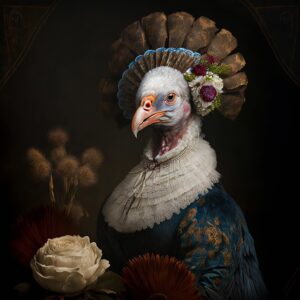 Hope you enjoy them!
15: Only Male Turkeys Gobble
Male turkeys are called “gobblers” because of their famous call — their version of a rooster’s crow — a loud shrill, descending, throaty jumble of sound that lasts about one second. Males often gobble from treetop roosts, where the sound carries better than on the ground. They gobble to attract females and to respond to other males. Sometimes one male’s call can lead to a group joining in, much like wolves howl in unison.
Both male and female turkeys cackle as they fly down from roosts. They give short, soft purrs while traveling on foot and use a long series of yelps to reassemble a flock after turkeys startle and scatter. Young turkeys whistle three or four times to flock-mates when they’re lost. A strutting male uses a chump sound followed by a low hum, neither of which are well understood by the scientific community yet.
14: Wild Turkeys Can Fly
I learned this fascinating fact when I flapped a towel to shoo a large group of turkeys from a previous yard of mine that got bombarded by wild turkeys, sometimes 50 or more at a time. Yes, I love all animals, but 50+ turkeys leave landmines of poo and devour all the food for my crows, chippies, squirrels, woodchucks, jays, and numerous other birds.
The rule in my yard is always: “Everyone must share and get along. If my crows are happy, you can stay. If I hear you’ve stepped out of line, you’re gone.” And everyone understands this, no matter where I live. Except turkeys. And yet, they’re intelligent birds. Years ago, I had a pet turkey named Lou. He would sit next to me and preen my hair for hours, wrap his wings around me (or other family) and give hugs, and coo in our ear when we had a bad day. Loved that bird. Later in life, he went on to win numerous blue ribbons at the Topsfield Fair and became a local celebrity.
However, dozens of wild turkeys in flight can only be described as hilarious. They’re not graceful fliers by any means. Shockingly, they can reach speeds of up to 55 mph in short bursts!
13: Eating Turkey Won’t Make You Sleepy
While everyone blames the amino acid tryptophan for knocking us out after a Thanksgiving feast, the truth is turkey doesn’t contain all that much tryptophan. The sleepy or sluggishness we feel has more to do with piggin’ out on all the appetizers, side dishes, main meal, and desserts.
12: No One Ate Turkey at The First Thanksgiving
 The modern Thanksgiving holiday is based off a three-day festival shared by the Pilgrims and the Wampanoag tribe at Plymouth Colony, Massachusetts, in 1621. The feast celebrated the colonists’ first successful harvest in the New World. While modern Thanksgiving always lands on the fourth Thursday in November, the original feast happened earlier in fall, closer to harvest time in mid-October, when Canadians celebrate. And no one ate turkey.
Two firsthand accounts describe a feast of freshly killed deer, assorted wildfowl, a bounty of cod and bass, and flint, a native corn harvested by the Wampanoag and eaten as corn bread or porridge.
We can only speculate about other foods they feasted on over the course of three days. Wildfowl — most likely duck or geese, pigeons or swans — stuffed with onions and nuts. Lobster, mussels, and eel also make sense for that period in Massachusetts. Native crops such as peas, beans, squash, and flint corn probably also made an appearance on the table, along with vegetables brought over from England, such as cabbage and carrots. Cranberries may have been incorporated into Wampanoag dishes to add tartness, but it’d be another 50 years before someone first wrote about adding sugar to make a “sauce to eat with… meat.” And no gravy (flour wasn’t invented yet) or pie!
11: For The Last 40 Years, We’ve Had a Turkey Hotline
Did you know this?
Professionally trained turkey experts at Butterball field over 100,000 emergency calls during the holiday season. Throughout the years they’ve expanded to meet the modern holiday household. If you can’t get through the old-fashioned way by dialing 1-800-BUTTERBALL, connect through social media, live chat, texting — or even through Amazon’s Alexa.
Have any of you called the hotline?
10: A Raccoon Received a Presidential Pardon for Thanksgiving
In November 1926, a Mississippi man gifted President Calvin Coolidge a raccoon for his Thanksgiving dinner. Since he and the First Lady were animal lovers, he didn’t have the heart to kill the little cutie pie. Instead, he named her Rebecca and added her to the collection of First Family pets, which included a bear, hippo, hordes of dogs, and two lion cubs.
9: The Bird Name “Turkey” Stems from a Case of Mistaken Identity
 During the Ottoman Empire, guinea fowl were exported from East Africa via Turkey to Europe. Europeans called the birds “turkey-cocks” or “turkey-hens” due to the trade route. So, when Europeans first sailed to North America and discovered birds that looked like guinea fowl, they called them turkeys. To be clear, turkeys and guinea fowl are two different animals.
8. The Creation of TV Dinners Stems from a Thanksgiving Mishap
In 1953, a Swanson employee accidentally over-ordered 260 tons of turkey. The frozen turkeys took up space in ten refrigerated train cars, when a company salesman suggested preparing and packaging the turkey with sides in compartmentalized aluminum trays. Swanson sold 5,000 TV dinners that year. That number grew to 10 million the following year.
7: Cranberries Aren’t Just Tasty — They’re Medicine
Readers of Unnatural Mayhem and Restless Mayhem should remember this.  Native Americans have used cranberries to treat wounds and dye arrows. Much like holly, dried cranberries also adorn table centerpieces, wreaths, and garlands.
6: The Term “Black Friday” Backfired
Even though Black Friday now signals the biggest shopping day of the year, in 1966, the Philadelphia Police Department used “Black Friday” in the hopes that it would deter shoppers from leaving the house and adding to the traffic and commotion of the Army-Navy football game.
5: You Can Sex Turkeys by Their Poo
Strangely, a male turkey’s poop is J-shaped, while a female’s looks more like a spiral.
4: Turkeys Can See Better Than You
One of the more surprising facts I found is turkeys have three-times better vision than humans. They can also see color and their eyesight covers 270 degrees.
3: A Native American Interpreted for Pilgrims
 Tisquantum, also known as Squanto, was a Native American from the Patuxet tribe, who was a key figure to the Pilgrims during their first winter in the New World. He acted as both an interpreter and guide as Pilgrims learned to adjust to their new way of life at Plymouth.
Born circa 1580 near Plymouth, Massachusetts, little is known about his early life. As a young man, Tisquantum was kidnapped along the Maine coast in 1605 by Captain George Weymouth, who’d been commissioned by Plymouth Company owner, Sir Ferdinando Gorges, to explore the coast of Maine and Massachusetts and capture Tisquantum and four unnamed Penobscots, because he thought his financial backers in Britain might want to see some [American] Indians.
Weymouth brought Tisquantum and the Penobscots to England, where Tisquantum lived with Ferdinando Gorges, who taught him English.
Side note before I continue: Make no mistake, none of these so-called men gave Tisquantum or the unnamed Penobscots a choice. They were torn away from their land, from their families, and forced to learn English, to assimilate into an unfamiliar culture. Many of these stories make it seem like the Europeans helped Native Americans, rather than the stark reality of kidnapping, rape, slavery, and unmerciful torture that led to genocide.
Now fluent in English, Tisquantum returned to his homeland in 1614, where he was kidnapped again. This time, by an English explorer, Thomas Hunt, who took him to Spain and sold him into slavery. Tisquantum escaped, lived with monks for a few years, and eventually found his way back to North America in 1619, only to find his entire Patuxet tribe dead from smallpox. He went to live with the nearby Wampanoags.
In 1621, Tisquantum met the Pilgrims at Plymouth, where he acted as an interpreter between Pilgrim representatives and Wampanoag Chief Massasoit. Later that fall, they celebrated the first Thanksgiving.
2: The Fourth Day of November is Also The National Day of Mourning.
Before you celebrate the holiday with loved ones in the future, take a moment to remember the events leading up to the first Thanksgiving. Years of conflict took place between the Europeans and Wampanoag People. Millions of Native People died.
The only reason the Pilgrims could even settle in Plymouth was because the Wampanoag population had been devastated by disease, virtually wiped out by a plague Europeans brought with them years before.
Since 1970, many gather on the last Thursday of November at the top of Cole’s Hill, overlooking Plymouth Rock, to commemorate a National Day of Mourning.
1: Turkey Feathers

This is such a fun fact. The American Plume & Fancy Feather Co. dyed 4,000 turkey feathers bright yellow to create the perfect look for Big Bird. No wonder he looks so fluffy. Who knew?
Also, turkey feathers are often used for smudging.
How many of these did you know? Do you have a favorite?
Since this is my last post of 2025, I wish you all a joyous holiday season.
Sue, kind, helpful neighbors are a daily blessing. Glad you found your new home.
A friend had 40 acres where a flock of wild turkeys lived. Whenever he went outdoors, he routinely wore rubber boots. I didn’t know about squiggly vs. J-shaped but I remember doing the turkey trot to avoid it. The birds were tame and would eat dog kibble from my hand. You describe their turkey “talk” so well.
One year, my friends tried wild turkey for dinner but after that his wife said never again. While plucking the bird, she lost her wedding ring amid feathers. Besides she said it was too much work for too little meat.
The rest of the flock lived out their natural lives w/o worry of becoming dinner.
Haha. The turkey trot… I envisioned that land perfectly, Debbie.
Neighbors can be a blessing or a curse. I’ve had both over the years. Thank goodness it’s the former here. 😉
Fun facts, Sue. Love the part about cranberries. Mrs. B makes a killer cranberry sauce. She had a bag of cranberries ready to go, but a medical issue delayed the making. We enjoyed Thanksgiving with our daughter, son, DIL, and three grandboys. My son spatchcocked a bird to perfection. On the way home I lamented the lack of Mrs. B’s cranberry sauce. She said, “Why don’t I make it anyway?” And I said, “Why don’t we cook a turkey breast to go with it?” Which is exactly what we did. Culinary delight ensued.
My sister who is the current family turkey cook brines and spatchcocks the bird. Very moist and tasty. She also uses the technique for the Christmas duck.
We spatchcooked the turkey this year, too. I’ll never cook it any other way. What a time-saver.
Great idea to cook your own turkey and cranberry sauce. Years ago, when I didn’t host Thanksgiving, I did the same. The leftovers are the best part!
All turkeys are safe around me since I don’t enjoy the taste of the Thanksgiving bird. I loved learning these facts since I didn’t know a single one.
So glad you found a great neighborhood— good neighbors are such a blessing.
They really are, Patricia. This neighborhood reminds me of my childhood, where neighbors looked out for one another. I’m truly blessed.
Glad you enjoyed the fun facts! Turkeys are safe around me, too. Wild turkey is tough and sinewy. Yuck.
We have a small flock of turkeys that visit our yard from time to time.
We ate out this year due to widespread family, but we’re going to make up for it and four birthdays and Hanukkah later this month.
Wow, busy month for you, Terry! Sounds like you’ll have plenty of family time.
As you know from the birds in your fields, wild turkeys look nothing like the picture on a Butterball. Wild turkeys are more football shaped. “Thanksgiving turkeys” have been bread to have way more breast meat than nature provided. It is why they can’t fly. With that much breast meat, they can barely walk.
Haha. True, Alan. I love to watch wild turkeys… just not 50+ desecrating my yard. 😉
Wild turkey tracks are spotted around our creek, but I’ve only seen one in the yard. Weird birds. Since my mom’s death, my sister has taken over the Thanksgiving family meal. I do not miss the work or being stuck with the leftovers. I have trauma around leftover turkey.
I love leftovers, but if they dredge up bad memories for you, it’s probably best your sister hosts Thanksgiving. Hope you enjoyed the day, Marilynn!
I’m so glad your new home is working out well, Sue. I can identify with how much more difficult moving becomes as the years go by. We’ll be unpacking for years. 🙂
We saw some wild turkeys wandering around when we were in the mountains of East Tennessee. They didn’t look anything like the big, fluffy birds I associate with Thanksgiving.
I hear that, Kay. I’m in no rush to unpack every tote, just enough so I don’t have to track down certain items I use daily.
You’re right. Wild turkeys look nothing like domestic turkeys. IMO, wild turkeys are much more beautiful. ‘Course, after raising Lou, I have to say that. 😉
Great facts, Sue. I love cranberries and am fascinated to learn they were used by indigenous peoples for healing–makes perfect sense.
I’m so glad you have wonderful neighbors, Sue. We are likewise blessed here.
Hope you have a wonderful holiday season.
So happy to hear you have great neighbors, Dale. It makes a world of difference. I feel like I’ve been transported back to my childhood neighborhood. Oh, and I hear our quiet streets get flooded with trick-or-treaters. Evidently, this neighborhood is known for the best Halloween experience. I better step up my game next year. LOL
Wishing you and yours a blessed holiday season, my friend. Did you see the Cold Moon last week? What a beauty!
Alas I was rained out here. Glad you were able to catch it!
Didn’t know any of this turkey trivia, Sue. I liked the story of Coolidge and the Raccoon the best.
When I was in 1st-3rd grade, I rode a bus to school. The route took us right past a gigantic turkey farm, which was located across the road from the grade school I attended. The driver would always slow down as we passed it & we would lower the windows so we could hear the turkey talk. 🦃
That turkey farm was located about a mile down the road from where we presently live. Now it’s a neighborhood with big homes.
I’d rather have the turkeys…
Have a great week, and I’m glad you’re surrounded by kindness!
Haha, Deb. I’d rather have the turkeys, too!
And thank you. Happy holidays to you and yours.
Fun blog, Sue. One fall, Don and I were vacationing in the Ozarks when we saw a large wild bird in the woods.
“Look, Don,” I said. “A wild turkey.”
“Looks just like the one on the bourbon bottle,” he said.
Hahaha. Perfect response! Don sounds like a character. Happy holidays, my friend.