
When You’re Right, You’re Still Wrong,
Terry Odell

I’ve been dealing with writing stuff I know little about recently, and I’ve turned to reliable sources for research. As so often happens, I end up relying on “It’s FICTION” as I write. My philosophy is it has to be plausible for the situation.
This brought to mind something from years and books ago. I had written the following:
Touching base about the accident. I noticed a couple of units pulling away from the scene not long ago. Wondered if you had anything you could share. The Yardumians are concerned about the missing woman. Told them I’d see where things stand.” Okay, so that was a boldfaced lie. But he figured the Yardumians were concerned, and if they’d asked him to, he’d have called.
When my critique partners got their eyes on it, one suggested either barefaced or bald-faced, which he thought were the “right” usages.
I’d thought I’d used a correct term, so I looked it up. I discovered all 3 usages could be considered correct. (You might like to read the article for yourself.) Curious, I posed the question on my Facebook page, and a short time later, I’d had over 1000 views of that post, and over 40 comments. (To put this in perspective, if I get 150 views of a post, and a dozen comments, that’s a lot.) Granted, Facebook isn’t a scientific sample by any means, but I found the results worth thinking about. It wasn’t the number of hits that was of interest to me, or the number of comments—rather, it was that there was no consensus. Boldfaced and Bald-faced were almost tied with 18 and 16 “votes” respectively, while Barefaced had 7 people saying that’s what they were used to hearing.
What does this mean for a writer? Clearly, no matter which term I used, there would be a whole lot of readers who thought I got it “wrong.” And, as my first critique group used to say, “Just because it’s right doesn’t make it good.”
This can happen a lot, given how many regional differences we have in our language. But it’s not only language; sometimes it can be a ‘fact’ that you get right but readers believe the truth lies elsewhere. Getting police investigation and forensics procedures right when your readers believe what they watch on television is reality can make them think you don’t know your subject.
An author friend who wrote historical novels used the term technology in her book, and her editor called her on it. Although she could document the word’s usage in that time period, she decided to change it simply because readers probably wouldn’t take the time to look up the word’s etymology.
When I was writing Finding Sarah, I wanted to thwart her efforts to get away, so I made the only car she had access to one with a manual transmission. People who drove stick shifts years and years ago (myself included) know that you can start the car by “popping the clutch.” I made sure the car was parked facing a tree so Sarah would have to use reverse, which complicated that solution. However, in reality, in modern cars with manual transmissions, you can’t even start the car unless you’ve got the clutch depressed. Sarah didn’t know that, but critique partners who’d driven stick shifts back in the day thought I was “wrong” when the car didn’t start.
What are the solutions? For Sarah, I had Randy explain it to her later. Readers might have thought I was ‘wrong’ at the beginning, but I hope they understood when it was explained. For cop procedures, it’s nice if you can have either another character or some internal monologue to explain that “life doesn’t work like television.”
As for my bold, bald, bare dilemma? Rather than have over half my readers think I’ve got it wrong no matter which word I chose, I did a write around and said ‘blatant lie’ instead.
How do you deal with people thinking you’re wrong when you’re right?
Find me at Substack with Writings and Wanderings
Deadly Ambitions
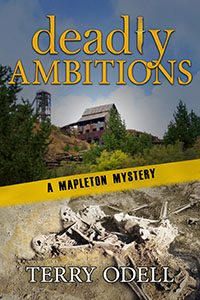 Peace in Mapleton doesn’t last. Police Chief Gordon Hepler is already juggling a bitter ex-mayoral candidate who refuses to accept election results and a new council member determined to cut police department’s funding.
Meanwhile, Angie’s long-delayed diner remodel uncovers an old journal, sparking her curiosity about the girl who wrote it. But as she digs for answers, is she uncovering more than she bargained for?
Now, Gordon must untangle political maneuvering, personal grudges, and hidden agendas before danger closes in on the people he loves most.
Deadly Ambitions delivers small-town intrigue, political tension, and page-turning suspense rooted in both history and today’s ambitions.
 Terry Odell is an award-winning author of Mystery and Romantic Suspense, although she prefers to think of them all as “Mysteries with Relationships.”