
When You’re Right, You’re Still Wrong,
Terry Odell
I’ve been dealing with writing stuff I know little about recently, and I’ve turned to reliable sources for research. As so often happens, I end up relying on “It’s FICTION” as I write. My philosophy is it has to be plausible for the situation.
This brought to mind something from years and books ago. I had written the following:
Touching base about the accident. I noticed a couple of units pulling away from the scene not long ago. Wondered if you had anything you could share. The Yardumians are concerned about the missing woman. Told them I’d see where things stand.” Okay, so that was a boldfaced lie. But he figured the Yardumians were concerned, and if they’d asked him to, he’d have called.
When my critique partners got their eyes on it, one suggested either barefaced or bald-faced, which he thought were the “right” usages.
I’d thought I’d used a correct term, so I looked it up. I discovered all 3 usages could be considered correct. (You might like to read the article for yourself.) Curious, I posed the question on my Facebook page, and a short time later, I’d had over 1000 views of that post, and over 40 comments. (To put this in perspective, if I get 150 views of a post, and a dozen comments, that’s a lot.) Granted, Facebook isn’t a scientific sample by any means, but I found the results worth thinking about. It wasn’t the number of hits that was of interest to me, or the number of comments—rather, it was that there was no consensus. Boldfaced and Bald-faced were almost tied with 18 and 16 “votes” respectively, while Barefaced had 7 people saying that’s what they were used to hearing.
What does this mean for a writer? Clearly, no matter which term I used, there would be a whole lot of readers who thought I got it “wrong.” And, as my first critique group used to say, “Just because it’s right doesn’t make it good.”
This can happen a lot, given how many regional differences we have in our language. But it’s not only language; sometimes it can be a ‘fact’ that you get right but readers believe the truth lies elsewhere. Getting police investigation and forensics procedures right when your readers believe what they watch on television is reality can make them think you don’t know your subject.
An author friend who wrote historical novels used the term technology in her book, and her editor called her on it. Although she could document the word’s usage in that time period, she decided to change it simply because readers probably wouldn’t take the time to look up the word’s etymology.
When I was writing Finding Sarah, I wanted to thwart her efforts to get away, so I made the only car she had access to one with a manual transmission. People who drove stick shifts years and years ago (myself included) know that you can start the car by “popping the clutch.” I made sure the car was parked facing a tree so Sarah would have to use reverse, which complicated that solution. However, in reality, in modern cars with manual transmissions, you can’t even start the car unless you’ve got the clutch depressed. Sarah didn’t know that, but critique partners who’d driven stick shifts back in the day thought I was “wrong” when the car didn’t start.
What are the solutions? For Sarah, I had Randy explain it to her later. Readers might have thought I was ‘wrong’ at the beginning, but I hope they understood when it was explained. For cop procedures, it’s nice if you can have either another character or some internal monologue to explain that “life doesn’t work like television.”
As for my bold, bald, bare dilemma? Rather than have over half my readers think I’ve got it wrong no matter which word I chose, I did a write around and said ‘blatant lie’ instead.
How do you deal with people thinking you’re wrong when you’re right?
Find me at Substack with Writings and Wanderings
Deadly Ambitions
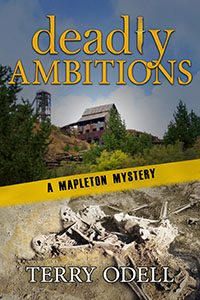 Peace in Mapleton doesn’t last. Police Chief Gordon Hepler is already juggling a bitter ex-mayoral candidate who refuses to accept election results and a new council member determined to cut police department’s funding.
Meanwhile, Angie’s long-delayed diner remodel uncovers an old journal, sparking her curiosity about the girl who wrote it. But as she digs for answers, is she uncovering more than she bargained for?
Now, Gordon must untangle political maneuvering, personal grudges, and hidden agendas before danger closes in on the people he loves most.
Deadly Ambitions delivers small-town intrigue, political tension, and page-turning suspense rooted in both history and today’s ambitions.
 Terry Odell is an award-winning author of Mystery and Romantic Suspense, although she prefers to think of them all as “Mysteries with Relationships.”
My editor usually catches things like that, and if she calls me on something, I usually change it, because if she questions it, other readers will do the same, taking them out of the story.
I once had a heroine who didn’t have a doctorate teach a class at a university. I knew several professors who taught without a PhD, but I also knew that even though I was right, it wasn’t worth arguing about. So, I just gave her the PhD. 🙂
“wasn’t worth arguing about.” Wise words, Patricia.
That’s an interesting one that I didn’t even think about as potentially throwing people off. The types of degrees a college instructor might posess are all over the place & isn’t limited to doctorate level degrees.
I knew that, Brenda, but maybe it was what she was teaching? Victimology?
Choose your battles.
Terry, you bring up an interesting and sometimes annoying thing about writing. While I consider myself a detail oriented person, the over fixation on use of certain words drives me nuts. But the situation varies.
In your example with “boldfaced” — I would just read that in a paragraph and my mind might instantaneously re-translate as “baldfaced” and I’d move on. No biggie. boldfaced, baldfaced, etc. Whatever.
But I also concur with the other example you shared—the use of “technology” in a historical fiction piece is probably worth finding a work around because it might cause more than a split second pause in the reader’s mind if the context doesn’t read right to them–even if the etymology is accurate. Better to change it then throw the reader out of the story unnecessarily.
And commonly accepted definititions for words change over time. In old westerns, it was common to see something like “Last I saw he was headin’ for the bank,” Ross ejaculated.” You throw that last word into a current story people are going to have an entirely different definition for it.
I read a historical where they were evaluating cattle. Mind goes to cows, but they were referring to horses, which threw me. Authors can be right, but if it isn’t common usage, it’s ultimately wrong.
In Israel I worked on a Kibbutz for a week. They had steers. Being an American city boy, I said “Cows.” No no! Cows are on dairy farms. Steers are on steak farms.
Kibbutz Nir Oz
Population 10/7/2023 450
Population 10/8/2023 190
That brings to mind a story I heard at a conference. Book was about driving the steers to market. When they got to the destination, they were having calves.
Cattle comes to mind as a gender-neutral term for steaks. Steers were male, I’m told.
Steers are castrated males. Hence the supremely poor research on the part of the author of that book.
Good points. Our goal is to keep people reading, not send them to a dictionary, Google, or anywhere that’s not the book.
On the flip side, they might learn something new, but I’d rather they learn it after they finish the book.
And yes, writing styles change, and so do word usages.
I have been in “the computer biz” for 30 years now. You can trust me or not. It is up to you.
“Any sufficiently advanced technology is indistinguishable from magic.”
Arthur C. Clarke
That’s a familiar quote, Alan. Thanks for sharing.
Terry, the various faces of bald, bold, and bare hadn’t occurred to me before your post. Thanks for the interesting etymology link.
Words also change definition from generation to generation. Common usage from the Roaring 20s makes no sense to millennials whose slang makes no sense to Gen Z and Gen Alpha, and so on.
I like your workaround of having another character explain.
Thanks, Debbie. Trying to keep up with slang, especially for someone who doesn’t mingle with “youngsters” is a challenge. I’m stuck in the days of ‘groovy.’
Slay? Fire?
Yeah, modern slang is a minefield. I was talking to a much younger critique partner recently. He asked how the scene I was fighting was going. I said, “Not well. I gooned it completely.” He told me that goon isn’t used that way on the internet. “It’s quite rude. Avoid it.”
My editor flagged a few correct usages in her markup. Most of the time, I changed the word. If she didn’t know the usage, it meant there would be readers who didn’t know it either.
My WIP starts in 1973 and jumps to 2000. I was born in 1939 and live in 2025. My world is an exercise in language confusion.
Hi Terry, I’m currently writing MG mystery and admittedly this has been a challenge to get the lingo right for kids who would be quick to point out I got it wrong, then I’ll be found out not as an MG author but an MA author! (Middle-Aged) 😅
At the same time, I’m trying to avoid too much middle-school slang used today since it’ll be dated tomorrow. Coming up with new word combinations has been a fun way for me to handle this (on occasion), and so far I think the readers are letting me get away with it. For example, I used the word “goonsloth” in a scene to describe the main character’s childhood arch-nemesis. It’s a throwback to Goonies and the Sloth character for my adult readers (“easter eggs” are part of this series for my adult choose-your-own-path fans), and hopefully it’s something fresh and funny for the younger readers. I suppose since it’s a made-up word, I can’t be blamed for getting it wrong! =)
So true about slang being a ‘here today, gone tomorrow’ thing. I love that you’re making up words. If readers can figure out the gist, you’ve nailed it.
I think you were wise to use “blatant lie” rather than one of the other options. Pointing out the confusion is one of the great ways critique groups are valuable.
The problem with the stick shift is trickier. That goes beyond language.
I use the word “kinestatic” in all of my novels. Since the word isn’t in the dictionary, it would be confusing to readers, so I have one character use it and another character ask what it means. Then the first character explains something like “We’re doing a lot of work, but we’re not getting anywhere.” (For those who are familiar with software programming, this would be analogous to an Easter Egg.)
Easter eggs are fun as long as they don’t create a feeling of being left out for readers. Explaining them is one way of dealing with it.
I’ve mentioned bits or characters from other of my books, but there’s no context needed. Reader who’ve read the others will know, and those who haven’t won’t realize there’s a connection. What I don’t want to create are spoilers.
“How do you deal with people thinking you’re wrong when you’re right?”
In all things life and art, it isn’t worth an argument, as Patricia noted. If I’m right about something, and I know I’m right, that’s enough. I figure the person who is wrong about that something will someday discover their error, but it doesn’t have to be me who does the convincing.
I’ve got other fish to fry… 🙂
I don’t expect to be arguing with these people, but it’s part of my makeup to want to be accepted, so having them think I’m wrong when I’m right pushes my buttons. If I can take preemptive action, I feel better.
Yeah, I guess I have one of those buttons, too. 🙁
I make these kinds of linguistic “mistakes” all the time in my books and my copy editor is always calling me out. Sometimes I win. Sometimes, he does. 🙂
At some point, it’s a matter of weighing the options more than ‘winning’ or ‘losing.’ Because no matter what you choose, you’ll be right for some readers and wrong for others.
Honestly, I don’t deal with it. After I’ve labored over every word, every sentence and paragraph, I let go. If my editor brings up something, then I’ll agonize over it again. By the time a reader buys the book, I’m done and on to the next. So, if you want my advice, do what you think is right. Most readers will skip right past it anyway.
For the record, I agree with you on boldface lie.
Thanks, Sue. And yes, once the book is out there, I’ve moved on. It’s making it the best I can before it goes out there that creates all those challenges. I want those words I’ve labored over to be the “right” ones.