
by James Scott Bell
@jamesscottbell
 Every now and again I hear some author putting down how-to-write books. “You can only learn to write by writing,” they’ll say. “Don’t waste your time studying writing. Write!”
Which strikes me as making as much sense as saying, “You can only learn to do brain surgery by doing brain surgery. Don’t waste your time studying brain surgery. Just cut open some heads!”
Excuse me if I show a preference for a sawbones who has studied under the tutelage of experienced surgeons.
The writer I know best—me—absolutely learned to write by reading how-to books. I had been fed the bunk that “writers are born, not made” while in college, and I bought it, in part because I got in a workshop with Raymond Carver and couldn’t do what he did. (I didn’t know at the time that there was more than one way to “do” fiction. Carver was a literary guy, and I wanted to write thrillers.)
Years went by with me believing that I didn’t have what it takes to be a successful writer. I added to society’s woes by becoming a lawyer.
When I finally decided I had to write, even if I never got published, I went after it the way Jack London went after inspiration—“with a club.” I started gobbling up books on writing. I joined the Writer’s Digest Book Club and read Writer’s Digest religiously (especially Lawrence Block’s fiction column). I also wrote every day. Living in L.A. it was required that I try screenwriting first, so I wrote four complete screenplays in one year, giving them to a film school friend, who patiently read them and told me they weren’t working. But he couldn’t tell me why.
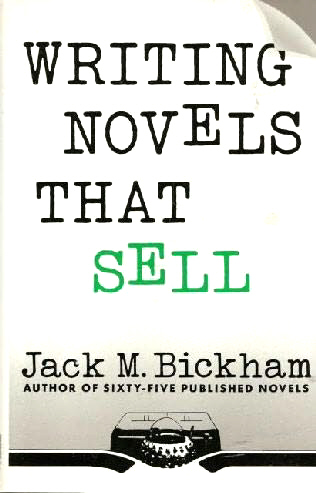 Then one day I read a chapter in a book by the great writing teacher Jack Bickham. And I had an epiphany. Literally. Light bulbs and fireworks went off inside my head, and I finally got it. Or at least a big part of it.
So I wrote another screenplay, and that was the one that my friend liked. The next one I wrote got optioned, and the one after that got me into one of the top agencies in Hollywood.
Now, Hollywood is the only town where you can die of encouragement. My million-dollar payday did not come through, so I decided to try my hand at writing a novel. Amazingly, it sold. Then I got a five book contract, and I was on my way as a working novelist.
In great part because of something crucial I got from a how-to book.
And that’s the reason I’ve written how-to books of my own, and posts here at TKZ. I want to give new writers nuts-and-bolts that will help them construct saleable fiction. I am gratified when I hear from people who have sold books and given me partial credit. One of them is the wonderful Sarah Pekkanen, who gave me props (along with Stephen King and Donald Maass) a year before her debut novel came out. Today she’s the #1 New York Times bestselling author of fifteen solo and co-authored novels. (No, I’m not saying I’m responsible for her massive success, only that I and two others were there for her at the right time; her work ethic and talent did the rest.)
How did the writers of the past learn? Many of them had a great editor, like Max Perkins. Some had an older writer who read their stuff and suggested ways to make it better. Some, like the great writer-director Preston Sturges, learned from the how-to books available in his day. (In Sturges’s case, it was the books of Brander Matthews.)
So a good how-to book is like an editor or teacher. Is there not some value in that?
Now, it is quite true you can’t just read how-tos and get better. You have to have a certain felicity with sentences and the sound of fiction. That’s why the best writers were readers from a young age, piling up the sounds of great sentences in their heads. But they also had help learning the tools to make things better. And of course they had to write, and apply what they learned.
If you do that, the things that work become part of your writing “muscle memory.” Like a grooved golf swing. Then you can go out there and play to win. As Tom Sawyer says in Fiction Writing Demystified:
Writing fiction takes knowledge about basic storytelling. Again, some of us have an instinct for it. A feeling for it. But if you sense that you do not, don’t give up. Much of that part is craft, and it is learnable.
Behind me in my office is my shelf of writing books. I review them from time to time, reading the parts I highlighted. My philosophy has always been that if I can find even one thing in a how-to that helps me, that elevates my writing and makes it stronger, it’s worth the effort to find it.
Do you agree?