The Fifty Page Mark

by Michelle Gagnon

Recently a friend asked for writing advice on behalf of her husband, who started writing a book a few yeaYou Are Here.JPGrs ago but hasn’t made much progress.

“Let me guess,” I asked. “He’s right around the fifty page mark.” She double-checked with him, and he’d stopped at sixty pages even.

I’m willing to bet that most of the people who never finish writing a book stall out right around that point, somewhere between 40-60 pages. And here’s my theory as to why.

After months or years of talking about writing a book (because at least as far as my experience at cocktail parties dictates, almost everyone believes they have a book in them), they’ve finally sat down and hammered some of those words on to the page! Initially, that’s excitement enough.

Because the outset is always thrilling. And things usually go swimmingly for ten to twenty pages. Then, something gets in the way–maybe they can’t figure out what to tackle next in terms of the storyline, or their day to day life intrudes. So they leave for a bit, and come back to it. Or they manage to overcome whatever hurdle they encountered, plot-wise or life-wise, and forge ahead. Another twenty pages in, they’re feeling a genuine sense of accomplishment. They’re doing what so many people talk about but never achieve–and they’ve already written around fifty pages! The rest should be a breeze, right?

So what do they do at this point?

Most people sit back and say, “Better take a minute to look back over what I wrote, see how it is.”

And that’s their downfall. Because invariably as they go back over their work, they start editing. And editing is generally a slow, time-consuming process. Upon review a significant chunk of what they wrote won’t be as good as they thought it was–which is disheartening. Other sections might be better than remembered, but still a little rough.

So after a few weeks or months of editing, they find themselves back where they ended: at the fifty page mark. And suddenly, having written fifty pages doesn’t feel like such an accomplishment.

Here’s my analogy. Awhile back I read Bill Bryson’s A WALK IN THE WOODS, an extremely funny account of his attempt to hike the Appalachian Trail in its entirety.

After a rough start, the hike was going well. Bryson and his buddy were starting to feel seasoned, like they finally knew what they were doing and had gotten into the rhythm of the trail, so to speak. They stopped at an outfitters in Tennessee. Mounted on the wall was a map of the trail. For fun, they checked out how much ground they’d coveredBill_Bryson_A_Walk_In_The_Woods.jpg– and realized that they’d only made it through a tiny portion of the entire trail. At that point they flew home, took a break, and met up again later in Virginia, skipping a huge chunk of the hike.

And that’s exactly how it feels to be a writer at the fifty page mark looking up at the mountain of work looming above you. But unlike Bryson, you can’t just jump ahead to page 300. You’ll have to slog through every page.

For many people, that’s just too overwhelming. So they put the book away, resolving to come back to it when they have more time. And more often than not, that time never materializes.

Awhile back I wrote a post about never looking back. Especially for writers setting out to finish their first book, I think that is absolutely critical. If you’ve been through the process before, you know where you’re going to start experiencing that dread, and how to overcome it. You’ve hiked this particular trail. so although you know that at times it will prove relentless, you’ll get through it, the same way you have in the past.

New writers don’t have that experience to fall back on, so they tend to get discouraged. Here’s my advice on conquering the fifty page mark:

  • Don’t look back until you have at least the bones of the book laid out in its entirety.
  • Accept that your first draft is going to be just that- a draft. Editing can come later, but allow yourself to be just plain bad at times. You can go back and craft every turn of phrase later.

  • Even if you only manage to write a page a day, at the end of a year you’ll have a book, more or less. Set small, achievable goals, and feel proud for meeting each of them.

Remember that every writer has been at that exact same spot and felt just as daunted. What separates those who end up finishing with those who don’t has nothing to do with character or skill–it comes down to sheer force of will. As my mom always said, anything worth doing is a challenge. Rise to meet it and you won’t regret it. If nothing else, you’ll have accomplished what you set out to do: you’ve written your book. And no matter where it goes from there, that alone is a victory.


How can I learn to write like . . .

Recently on one of the online writer’s forums, a new author asked the question: How can I learn to write like . . . ? And they named a few of their favorite authors.

Of course, the standard answer came back right away: Read, write, repeat. Someone else suggested that the author reread their favorite author’s book but concentrate on “seeing” the text rather than just reading it. There was the suggestion of creating an outline of their favorite book after they finished it. Still another said to listen to the audio book version while reading along on the hard copy. Note: buy the unabridged audio CD. Although, come to think of it, there is an advantage to listening to the abridged version while you read along; you’ll see how much can be removed and still make the story work. I often wonder that if they are able to create an abridged version of a book, why didn’t the author take all that stuff out to begin with? Was it really needed? But that’s a topic for another post.

Anyway, there were the expected comments that said, you’re you, not those other authors. Write your own story, not one that sounds like theirs. Just put your butt in the chair and start writing. Many suggested reading books on the art of writing such as On Writing by Stephen King and The Elements of Style by William Strunk. I would of course suggest Plot & Structure or any of my friend Jim Bell’s excellent instructional books on writing.

These are all great pieces of advice. But the original question was how someone learns to write like someone else. I believe you can teach skill and mechanics but not creativity. Even though everyone is creative to a certain extent, a true artist must be able to combine life experience and acquired skills with natural born talent. The talent is either there inside or not. And the ones that can nurture that natural talent and combine it with the lessons of life along with the mechanics of the trade have a chance at becoming artists, or at least artistic.

But to help beginning writers try to answer that often-repeated question, I propose a simple but useful exercise anyone can do. For instance, if you are an aspiring fantasy writer who wants to learn how to write like JK Rowling, I suggest you retype one of her books. Open to page one and start typing the words into your computer exactly as they are composed on the page. What this will do is force you to "see" and “feel” the sentence and paragraph construction. It will make you aware of proper punctuation and grammar from a professionally edited book. And you will begin to feel the rhythm and pacing of the story more from the viewpoint of the writer than the reader. The physical act of recreating the text becomes an extension and enhancement of merely reading the work. Look at it as an exercise to build your writing muscles just as you would perform a workout at the gym to increase body tone and strength.

If nothing else, it will help you as a new writer to acquire proper writing skills directly from the voice and style of your favorite author. But what I predict will happen is that eventually you will break away from typing the book and begin to “see” your own story forming. It might take 20 pages or 200 pages. But if the creative gene is really there, the juices will start flowing, and your story will take flight.

Download FRESH KILLS, Tales from the Kill Zone to your Kindle or PC today.

A case of “writer’s ear”

Many years ago I was taking a walk along the shore with a friend, and our girl talk went to DEFCON 1. (This is the most intense level of sharing between two women, where we swap secrets and confess anxieties. Any more intense, and we’d have to call in the Emo SWAT).   

My friend confessed an affinity for a particular nightly cosmetic ritual–let’s call it extreme  pore cleansing. She went into rich detail about her technique, which she’d raised to the level of art. After about ten minutes, it was clear that her skin-cleansing habit had become an obsession.  

I was a bit aghast at her description, but fascinated. Then I took a step back from the conversation and began to listen as a writer. This is what neurosis is, I thought. Later that day I jotted some notes into my character notebook, a journal I keep specifically for writing. The conversation with my friend (disguised, of course) became background for character description. I’d consult those notes if I ever wanted to describe someone whose face is shiny, red and taut around the edges, like someone who compulsively cleans their pores every night. 


I’m always looking for these moments, the ones when my writer’s ear starts to listen. They’re ephemeral: if I don’t write them down immediately in my journal or on an index card I’ll forget them, like a dream you recall immediately after waking up, but which quickly fades from memory.

Do you keep a character notebook, or something similar? Do you have any moments of “writer’s ear” that you can share?  

p.s. I updated my web site a bit — check it out.

A Rose by Any Other Name…

by Clare Langley-Hawthorne

A recent thread on Dorothy L regarding pen names has got me interested – I write under my own name (I mean, you couldn’t make it up!) but have often wondered about the pros and cons of adopting a pen name. It would certainly make some things easier – as it is when someone Googles my name they are likely to get a plethora of information about me, the author, as well as me, the former lawyer, (including my one published law article on tradeable gas emission permits for climate change!) and me, the former health economist, (including my MA on the costs of schizophrenia!). All up I must look pretty loony, so in some ways I wish I had written under a pseudonym. At the same time, though, I like the fact that I do write under my own name – it means people who knew me from school and college can easily find me and my books and, in many ways, it is just easier to be who I am:)

I have been told, however, that if I write a non-mystery novel I will probably have to adopt an alternative pen name so as not to ‘confuse’ anyone…this makes a sense if, for instance, I suddenly start writing erotica, but other than that it seems an enormous pain. With a pen-name I’d have to set up an ‘alternate’ me including a separate website as well as a ‘new’ social networking and marketing identity….and I have enough trouble keeping on top of all of this as it is! I do understand when authors feel that adopting a pseudonym will make it easier to gain acceptance for their work or to appear ‘gender neutral’ – some female authors, for instance, use initials when writing gritty thrillers so the fact that they are female isn’t immediate apparent (sadly this can still be an issue). I can’t say I intend to do this but I do want to write across a number of genres, including YA, and am grappling with the question of whether to use a pen name or not.

So, how many of you use a pen name or have considered adopting one when branching out into a new genre? How do authors with multiple ‘names’ deal with the marketing/web presence issue? Do they established clearly defined and distinct personas on the web or do they roll them all under one ‘umbrella’ site? What do you think are the pros and cons of using a pen name…and importantly, how do you come up with a really cool one?!

Energy to Write

James Scott Bell


First, a reminder that for the month of March my publisher is making my first Buchanan thriller, Try Dying, available for e-readers for just $1.99. With additional content, too, including various location photos I took when doing the research.

Here’s the Kindle link.

It’s also for Sony Readers, B & N and Kobo.

We now return you to your regularly scheduled blog, which answers this question: How do you increase your energy to write?

We are biological machines, and need energy input lest the law of entropy reduce us to non-functioning blobs of carbon and water.

This is especially true for writers, who not only have to produce but have to have minds that provide fresh ideas and wonderful characters and sharp dialogue.

So here are some of the things I do to get going. I’d like to hear your ideas in the comments section.

Like millions of writers before me, I start the day with freshly brewed coffee. I make it at home or sometimes go off to Starbucks with my laptop and imbibe there. There is as much to the comfort factor as there is to the buzz, I think. I just like having something warm to drink as I write.

I’ve been gratified by all the recent science showing the health benefits of a few cups of coffee. A few. I don’t overdo it. I remember that Balzac thought of thick, black coffee as something of a magic drug. The guy was a speed freak without knowing it. He drank up to 50 cups of the stuff a day. And died from it, at age 51.

What would he have done with Red Bull? I shudder to think.

Exercise. I shoot baskets and run around at a local park, talk long walks, treadmill, ride my bike. Keeping the body honed – which is, thankfully, a relative term (you hear me, David Beckham?) – is essential for the right working of the mind.

An added benefit of the workouts is that the “boys in the basement” ramp up their efforts, especially if I’ve spent previous hours investing heavily in a project. The BITB is Stephen King’s great metaphor for the writer’s subconscious. It pays to keep them happy so they don’t go on strike.

I’m a morning person, so like to get as much writing done early as I can. I try to do a “furious 500” words as soon as possible. Some of that will be sort of “improvising” within my scene. The faster the better here. Oh, and if you need some prodding in that regard, you can visit the ever effective Dr. Wicked.

At about 1 p.m. I tend to power down for a couple of hours—meaning I’m not at my creative best. Around 1:30 or 2 I usually take a power nap. I can put my feet up on my desk and nod off for 15 – 20 minutes, wake up refreshed.

I’ve recently tried something that has supercharged these mini-slumbers. Just before I close my eyes, I take a swig of a 5 Hour Energy drink. Not the whole thing. About a third. Then I sleep, and when I wake up I’ve got this jolt of creative energy that seems to continue without a “crash.”

I’ve learned there is something medically valid to this. It takes 15-20 minutes for caffeine to kick in, so the timing is right for this type of power nap. You get both the benefit of sleep and energy infusion.

I don’t do this every day. I don’t want to get dependent. But if I need to be working heavy on a project in the afternoon, I’ll give it a go.

Sometimes I write standing up, as I’m doing now on my AlphaSmart Neo, on a counter in my house. There’s some added energy when you write standing up. I don’t know why that is, but I don’t need to know, do I?

One last thing. I try to leave off my previous day’s writing at a mid-point of some kind, so I’m ready to fly right back into it. Hemingway used to write half a sentence before knocking off. I first read what I wrote yesterday, clean it up, then I’m ready to dive into the day’s work.

So what about you? What do you do to keep up your energy to write? (Please confine yourself to legal substances)

You Have To Be One To Write One?

By John Ramsey Miller

A female editor once told me that I wrote female characters better than most women authors she had worked with. My agent said the same thing, and I was flattered by it. Great compliments, coming from two knowledgeable women. I don’t know how well I actually write female characters, but I’ve known a lot of women, and hope I understand a little something about the opposite sex. Most of what I know I learned the hard way, which is how I learn most things, and I keep on learning as much as I can about my craft. Knowing people and human behavior is the part you never stop learning, and you have to understand individuals to understand relationships, which are always complex and interesting. I have been blessed to have known a lot of strong women and so most of the women I write are reflections of them. But in the course of publishing seven novels I’ve yet to have any woman ask me why I am qualified to write female characters. I have also written a lot of black characters and I am “porcelain” white and have never to my knowledge been anything else.

I recently heard a segment on NPR centered around a book a female author had written that was set in the deep South during desegregation. Just so happens I was right there at the exact time. This particular panel was discussing the fact that it was amazing that the author was white but had dared write from a black female character’s point of view. (I’m paraphrasing here from memory). A black man (I only assume he was black but it was radio) on the program said that in this particular case it didn’t bother him much as he was able to set aside the fact that the author was white and get into the story. The author obviously got it. Well, of all the audacity. It seems it was forgivable in this case because she did such a good job telling the story from that perspective and she got the dialog right enough to squeak by. Hell, I don’t see why a black author couldn’t write from a Klansman’s point of view if they wanted to, although I can’t imagine why he or she would. A writer writes from his or her experience and imagination based on his observations, and imagining the perspective of someone other than yourself is the stock and trade of a good author. James Patterson, a white man, writes Alex Cross, who isn’t, with perfect pitch. Why does an author have to be something to write it? Or why does he or she have to be specifically something to understand the character’s perspective? You don’t have to be a homosexual to write a homosexual character any more than you have to be a woman to write from the viewpoint of one. I get tired of hearing “You can’t write that!” “The Hell, I can’t! You just don’t want to read it.”

Censorship comes in many forms, and I hate it in any form it takes. I don’t write to hurt feelings, but characters are characters and I write what I see and hear. If I want to write a gay detective, which I don’t at the moment, I’ll write one without having to sleep with other men to qualify. If I want to write a lesbian cop, I can do it and I imagine I can do it convincingly. If I’m not comfortable doing so it will show in the work. Most of us are expected to write with kid gloves on and steer clear of certain subjects, and we all hate it as creative people have to. The market decides what it will or won’t accept and those rules change so frequently that we can’t keep up with them. Political correctness has less than nothing to do with a good story or the characters that we choose to depict.

Do you have to be a black person in Mississippi not write about what it is like being black in Mississippi in the 60s? If you saw it from a white boy’s perspective, you should still know what the black person was seeing and thinking. You don’t have to have been shot to know what being shot feels like, or give birth to imagine that mixture of pain and joy. You don’t have to have sipped from a “Colored Only” water fountain to know what that degrading experience felt like. If you watched “Miss Jane Pittman,” you felt her bravery, her pain, and the sheer determination it took to go to one marked “White Only” and how delicious the water tasted and how huge a step that was for her. I can write that, and so can you.

Let’s get real people. No area of writing should be off limits to anyone and it shouldn’t be. As artists, we owe our readers as good or great a book as we can produce, and that is the only limit we should be expected to place on our work. How many of you have had an editor or agent turn you away from what you wanted to write with a simple, “You can’t write that.”

A Great Time to be A Writer

by John Gilstrap
www.johngilstrap.com

Ever noticed that naysayers are a dime a dozen? Everywhere you go, there seems to be an unending supply of pessimists, doubting Thomases, bear-marketers and curmudgeons who seem to shine brightest when they can wallow in predictions for bad times. It’s been that way for as long as I can remember, but in recent years, the publishing world seems to have been inundated with pessimists, one half-empty glass at a time. “The book is dead,” we hear. “No one cares about the written word anymore.”

I’ve recently come to view these laments as the panicked cries of old-schoolers who see change on the horizon. I’ve known a lot of editors in my time, but I can’t think of a single one who was technologically on the edge. For them, the definition of a book begins and ends with the notion of ink on paper, classically bound in either paper or cloth. Looking out ten years, I’d say those folks have good reason to be fearful.

Or, God forbid, they could adapt.

According to an article in this week’s Publisher’s Weekly, ebook sales at B&N accounted for 3% of total book sales last year, up from less than 1% the year before. The absolute numbers might not be staggering, then the trend certainly is. Run the figures in your head, and you quickly see that the old-fashioned brick-and-mortar bookstore represents a pretty regressive business model. (As I blogged last week, even I, one of the Luddite hold-outs, got a Kindle; and if I can be converted, anyone can.)

For the sake of argument, let’s proclaim the book as we currently know it to be on a terminal course. (I personally believe that there will always be a vibrant market for bound books, but that $25 cover price for what will essentially be a reproduction antique will be a hard sell.) On the day the last printing press were to stop, the market for stories would still be thriving. People would still be reading.

How do I know? Watch how the members of the younger generation entertain themselves. They’ve got their iPhones and their social networking, but what are those, essentially, but words? When I was a kid, we rotted our minds by watching endless hours of bad television (“My Mother the Car,” anyone?). These days, television viewership is plummeting like a comet as kids turn to other forms of storytelling. Even gaming is storytelling. That’s what we do, folks. And with each new Internet fad comes new opportunities for people with imaginations to shine.

If J.K. Rowling and Stephanie Meyers have proven nothing else, it’s that the new generation craves entertainment on the page. And if the scourge of vanity presses has proven nothing else, it’s that quality still matters.

While the $25 hardcover is great for the publisher, I don’t see how it can sustain itself against the lower-priced competition. As the hardcover goes away, so does the stigma of the paperback original, and the hugely different distribution systems for the two formats. My crystal ball shows this being a heavy blow to authors who’ve grown used to 7-figure advances, but a tremendous opportunity for the vast sea of writers formerly known as midlist.

I think the publishing business is today where the transportation business was in the 1920s. The fact that automobiles rendered horse-drawn carriages irrelevant didn’t mean that people stopped traveling; it just meant that modern convenience trumped tradition. I assume that buggy wheel manufacturers who adapted to making automotive wheels did pretty well, even as the whip manufacturers found themselves with way fewer options. Carrying the analogy even further, remember that Henry Ford made a bloody fortune by producing a product that was specifically priced to be affordable.

What do you think? Do you see the publishing world imploding on itself, or do you agree with me that this is a great time to be a writer?

My Hurt Locker Experience

by Michelle GagnonIMG_0646.JPG

Sometimes I can’t believe how lucky I am to have this job.

This past Monday I was given a one-on-one tour of the SFPD Bomb Squad. I realize that might not be everyone’s idea of a good time, but geek that I am, I was positively giddy.

For over two hours I got to see the inner workings of the bomb squad, from the various trucks and equipment in their warehouse to the robots they use to check out suspicious packages. A few things I learned:

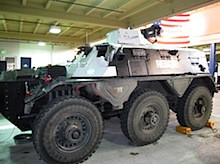
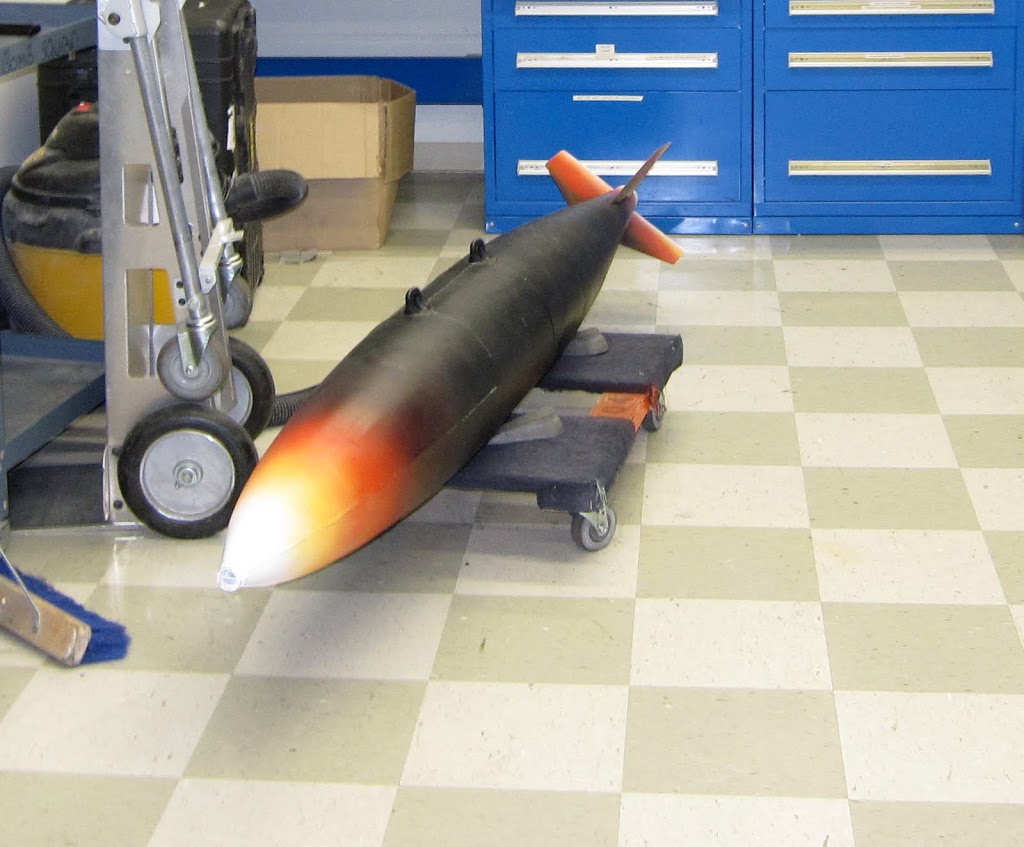
  • Many of the most dangerous calls that they get start out this way: Grandpa passes on. Turns out he was a WWII vet in the Pacific Theater. While cleaning out his apartment, relatives stumble across the live ordnance he took home as a souvenir. The officer who IMG_0673.JPGgave me the tour said that his first call out involved a mortar made out of a highly dangerous and unstable primary explosive, picric acid. They’d all handled the darn thing before one member of the squad turned it around, saw the Japanese characters, and realized that one wrong move could blow the whole place. Fortunately, they made it to their containment unit outside safely (check out the photo of their containment unit. It strongly resembles one of those underwater mines. Any time they pick up explosive material, it gets put in here for the trek back across the city).
  • Anyone else see THE HURT LOCKER? I was a little disheartened to learn that bomb techs consider it to be roughly equivalent to TOP GUN in terms of accuracy. However, he said they did get the suits right. Eighty pounds of suit, although thanks to the even weight distribution, the cop said that if you needed to run in one, you could (I’m guessing that under those circumstances, adrenaline helps tremendously). Even in our famously temperate sixty degree weather, the suits become extraordinarily hot and uncomfoIMG_0669.JPGrtable after a few minutes. I asked how they decided which unlucky squad member is sent out in it, and he told me that they usually Rochambeau for it–however, the winner GETS to wear the suit. Apparently being the guy tucked safely in the command vehicle watching everything unfold onscreen is viewed as the unlucky one. Go figure.
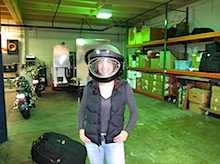
  • The suit is topped by what they call the “Helm of Ignorance,” which he was kind enough to let me try on. Unlike the military ones depicted in HURT LOCKER, theirs do not have the capability for radio communication–which he thought was a good thing, since it would mainly serve as a distraction. And distractions are not good when working with explosives.
  • Here in San Francisco, all ten members of the bomb squad are SCUBA certified, since they also respond to any threats at the port. They’re also all trained in tactical response, since they share the warehouse with SWAT. That way if anything major goes down, they’re able to serve as a backup unit.
  • I asked the nice young man who gave me the tour why he decided to join this particular unit, and how his mother felt about it. He explained that he’d initially been working out of the Bayview/Hunters Point Station (one of the worst neighborhoods here in SF). But after he got married and had kids, he figured it would be a good idea to transfer to a safer unit. So he joined the bomb squad. That’s right, the bomb squad. I couldn’t help but wonder if the mounted division was full.
  • Every bomb tech in the US spends six weeks training in-house, then goes to a school in Huntsville Alabama that’s run jointly by the FBI and the military for an additional six weeks of training. My tour was interrupting a day spent on maintenance, making sure that the robots and trucks were all in working order, the SCBA tanks full- you name it.

IMG_0660.JPG


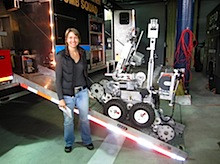
  • Oh, and here I am with their “Big Robot,” who I strongly feel needs a better nickname. Although possibly they just don’t want to get too attached. Remember the movie SHORT CIRCUIT? Couldn’t get it out of my head the whole time I was watching this guy maneuver. The photo above this one is of a napalm bomb, which he assured me had been rendered safe. Or at least, he was pretty sure it had. It was in the workshop, so…I took that as my hint to leave.

Setting the pace

By Joe Moore

The story in most novels takes place over a period of time. Some are condensed to a few hours while many epic tales span generations and perhaps hundreds of years. But no matter what the timeframe is in your story, you control the pacing. You can construct a scene that contains a great amount of detail with time broken down into each minute or even second. The next scene might be used to move the story forward days, weeks or months in a single pass. If you choose to change-up your pacing for a particular scene, make sure you’re doing it for a solid reason such as to slow the story down or speed it up. Remember that as the author, you’re in charge of the pacing. And the way to do it is in a transparent fashion that maintains the reader’s interest. Here are a couple of methods and reasons for changing the pace of your story.

Slow things down when you want to place emphasis on a particular event. In doing so, the reader naturally senses that the slower pace means there’s a great deal of importance in the information being imparted. And in many respects, the character(s) should sense it, too.

Another reason to slow the pacing is to give your readers a chance to catch their breath after an action or dramatic chapter or scene. Even on a real coaster1 rollercoaster ride, there are moments when the car must climb to a higher level in order to take the thrill seeker back down the next exciting portion of the attraction. You may want to slow the pacing after a dramatic event so the reader has a break and the plot can start the process of building to the next peak of excitement or emotion. After all, an amusement ride that only goes up or down, or worse, stays level, would be at best, boring. The same goes for your story.

Another reason to slow the pace is to deal with emotions. Perhaps it’s a romantic love scene or one of deep internal reflection. Neither one would be appropriate if written with the same rapid-fire pacing of a car chase or shootout.

You might also want to slow the pacing during scenes of extreme drama. In real life, we often hear of a witness or victim of an accident describing it as if time slowed to a crawl and everything seemed to move in slow motion. The same technique can be used to describe a dramatic event in your book. Slow down and concentrate on each detail to enhance the drama.

What you want to avoid is to slow the scene beyond reason. One mistake new writers make is to slow the pacing of a dramatic scene, then somewhere in the middle throw in a flashback or a recalling of a previous event in the character’s life. In the middle of a head-on collision, no one stops to ponder a memory from childhood. Slow things down for a reason. The best reason is to enhance the drama.

A big element in controlling pacing is narration. Narrative always slows things down. It can be used quite effectively to do so or it can become boring and cumbersome. The former is always the choice.

When you intentionally slow the pace of your story, it doesn’t mean that you want to stretch out every action in every scene. It means that you want to take the time to embrace each detail and make it move the story forward. This involves skill, instinct and craft. Leave in the important stuff and delete the rest.

There will always be stretches of long, desolate road in every story. By that I figuratively mean mundane stretches of time or distance where nothing really happens. Control your pacing by transitioning past these quickly. If there’s nothing there to build character or forward the plot, get past it with some sort of transition. Never bore the reader or cause them to skip over portions of the story. Remember that every word must mean something to the tale. The reader assumes that every word in your book must be important.

We’ve talked about slowing the pacing. How about when to speed it up?

Unlike narration, dialog can be used to speed things up. It gives the feeling that the pace is moving quickly. And the leaner the dialog is written, the quicker the pacing will appear.

Action scenes usually call for a quicker pace. Short sentences and paragraphs with crisp clean prose will make the reader’s eyes fly across the page. That equates to fast pacing in the reader’s mind. Action verbs that have a hard edge help move the pace along. Also using sentence fragments will accelerate pacing.

Short chapters give the feeling of fast pacing whereas chapters filled with lengthy blocks of prose will slow the eye and the pace.

pacecare1 Just like the pace car at the Indianapolis 500 sets the pace for the start of the race and dramatic changes during the event such as yellow and red flags, you control the pace of your story. Tools such as dialog versus narration, short staccato sentences versus thick, wordy paragraphs, and the treatment of action versus emotion puts you in control of how fast or slow the reader moves through your story. And just like the colors on a painter’s pallet, you should make use of all your pacing pallet tools to transparently control how fast or slow the reader moves through your story.

What additional techniques do you use to control pacing?

Download FRESH KILLS, Tales from the Kill Zone to your Kindle or PC today.

Strategies for surviving the epublishing revolution

One of the perks of being Program Chair of MWA, SoCal  is that I get to do outreach to interesting, dynamic people. On Saturday we had a very cool panel at our chapter meeting, including Marci Baun, publisher of Wild Child Publishing, and our own Jim Bell. Author Gary Phillips moderated the program, which was called, “Epublishing: Will it help your career, or kill it?”

Gary opened the discussion by citing some statistics: Today, epublishing is still a relatively small slice of the publishing world, but it’s growing exponentially. Baun, whose company is an innovator in the epublishing market, started off by setting aside the “myth” that publishers see huge savings by publishing e-books instead of paper.  (Gary has since alerted us to a NYT article on the same topic, Math of Publishing Meets the E-book.) Jim also fielded some questions about TKZ’s new e-book anthology, Fresh Kills.

The panelists stressed that to be successful in any kind of publishing, especially epublishing, it’s important to do social networking. Blogging, Facebook, Twitter: You have to get your name out there and work your networks. At one point they asked for a show of hands from the people who are active social networkers; many hands went up, but not a majority. I was surprised by that–I would have assumed that almost everyone in that group would be active online.  Around the lunch table, I heard some people say that they find social networking to be confusing and intimidating.


A small but consistent networking effort can be very effective  according to Baun, who said she requires an author to make a successful online marketing effort before she’ll launch a print run for their book.

The panel discussed the do’s and don’ts of social networking, including the importance of adding value to the discussion, and avoiding endless BSP. Among the strategies discussed were What to Tweet, and using ebooks as a loss leader. After the meeting I followed Jim’s suggestion to use Tweetdeck, and to get more actively involved in forum discussions.


Other than doing my weekly blog posts, I’ve been hit or miss in my social networking efforts up until now. As a result of Saturday’s meeting  I’ve resolved to spend at least 15 minutes a day making the networking rounds.


What about you? How much time do you spend social networking every day, and are you consistent?