Refilling the Well

One of the authors at the recent Ninc conference said, “Don’t think of writing as draining your mental energy so you need to refill the creative well. Think of writing as recharging your batteries so that the more you write, the more you’ll want to write.”

In a way, this is true. Once you’re on a roll, it’s a glorious feeling. The story flows and you don’t want to stop or interrupt your train of thought.

But how about when you’re in between books? I’ve heard other writers say they write every day, or they take a week off and then start the next story.

Me, I’d rather take off a few weeks or more to catch up in all the things I put off when I’m on a project. I can keep going with one book after another for only so long. Eventually, I reach a saturation point where I feel as though I can’t write another word. I don’t want to sit at the computer in my writer’s cave every day while life passes me by. I’m not getting any younger.

Currently, I’m revising my WIP. It’s intense work because I don’t set a daily page quota. I start when I wake up and I quit when my brain feels fried. I need a break. A month or two looks good right about now. I’ll clean the office, sort files, catch up on emails, write blogs, go out to lunch, and go shopping. And I might even start plotting the next story. Once I do the character development and write the synopsis, I’ll be ready to roll again. In my view, this is part of the creative process.

It’s okay to keep the engine running but sometimes you need to shut it down for maintenance. It might turn on smoother from a fresh start. I know that I need a break after I’ve completed a few books. How about you?

When there’s nothing left to fear, you’re a writer

Clare’s post yesterday about writer indignities left me thinking about indignities in general, on both a macro and micro level.

First, a bit of background: I used to hold what John G. would call a Big Girl job. For years I worked at various multinational firms as a Senior Editor and Senior Writer. The jobs were non-creative, high pressure, and frankly, I would have loved to cast off the yoke of the workaday world. But with a high salary, two daughters in private schools, and a fickle stock market, I never felt brave enough to to sail through the front door one night announcing, “Honey, I quit my job!”  

For years I rode the IT roller coaster. At the height of the tech bubble, I gave myself a $15,000 raise in a single day by switching jobs. Then, globalization began to take hold. The employer that had given me the new job offshored our office to Canada, closing the U.S. facility. Take that, America!

While I was unemployed, I wrote the manuscript that became the first novel published under my own name (I’d previously written Nancy Drews under contract, but those didn’t pay that much. And of course, your name’s not on the cover.) I got a contract for a series from a Big House publisher.

Then one day I got an email from a former colleague asking if I was “available.” After considering quietly saying no without telling my husband, I gritted my teeth, responded “yes,” and soon began a new job at another firm, a huge software security firm.

Fast forward a few more years, and my new employer suddenly began making noises about how they poorly they viewed their American employees.  We cost more than our Indian and Chinese counterparts and we were less innovative, they told us in subtle and not-so-subtle ways. I watched people grow more and more frightened with each round of job cuts. The layoffs would inevitably take place just before the quarterly earnings came out. One day, the entire group that I worked with was laid off. (I was spared the ax that time by the random mercy of a dotted line on an org chart).

Speaking of indignities, my colleagues were forced to train their replacements from India. The Indian workers–who were lovely, incredibly polite and competent people, by the way–arrived in the office for their first day of training looking a little afraid of us, and who can blame them? Everyone handled the situation professionally, though, and the survivors carried on. We learned that the American office was now to be regarded as a small, centralized control center over a global workforce of lovely, incredibly polite and competent people in India and China. And wherever else labor could be had on the cheap.

But finally my day came. I got my severance, and I got to sail through the front door and announce, “Honey, I got laid off from my job!” I was gloriously happy–my husband perhaps a tad less so. So now I’m able to write full time without feeling guilty.

I’m relaying this story to illustrate something my dad always says: “In every crisis, there is a hidden opportunity.” (It’s the same concept as “Every cloud has a silver lining”, I guess, but because it avoids metaphor and my dad is an astrophysicist, his version always seemed more profound to me).

Years ago when I was a student at Wellesley College, I recall reading about some old economic theory. (I’m talking really old, as in hundreds of years). A famous person of that era, the Warren Buffet of his day perhaps, suggested that the only reason one worked hard to become a successful merchant, lawyer, or other professional was so that one’s children could afford to grow up and become artists.  Becoming an artist was the greatest aspiration and the most esteemed vocation possible, by implication.

So I think we may have come full circle.  Now that the multinational class rules the globe, and the “good” jobs with benefits are disappearing, the rest of us are being emancipated from our former wage-mongering selves. We are freer to become artists. In my case, that means I can finally claim my identity as a writer. Sans guilt.

Oh, and so far they haven’t figured out how to offshore artists. See? Told you there was a rainbow.


Writer Indignities

by Clare Langley-Hawthorne

I know writers across the centuries have suffered many indignities – denigrated, banned, ignored, committed to asylums and marginalized – but thus far I have survived on the belief that times have changed (well, no one has committed me yet!). This weekend, however, I suffered my first real indignity. While I am sure for many people it would be a minor issue, for me it opened up a whole host of outrages. My husband went to our new Australian bank to open a term deposit and when he returned, bearing the completed paperwork, I saw listed under my occupation two words that chilled me to the bone. Those two words? Home Duties.

So I asked my husband, with just a hint of sarcasm, wasn’t there another occupation that could possible reflect what I do…I don’t know, ‘writer’, perhaps?…He turned his startled, deer-in-the headlight eyes to mine and tried to explain how he had told the bank that I was a full-time writer, but apparently being listed as ‘self-employed (which I guess was the only category they had) opened up a whole can of worms regarding verifying income etc. So for the sake of ease, they opted to use the term ‘home duties’…because of course, in Australia, what else would any self-respecting married female writer wish to do?!
I suspect you may be able to detect my feelings on this matter – not that I have anything against those who wish to list ‘home duties’ as their occupation – it’s just that that isn’t how I define myself.
Now maybe I wouldn’t be so sensitive about the issue had I not once been a lawyer who earned more than her husband (funny, I was never listed as ‘breadwinner’ on any bank forms then) or had I not recently moved to a country which seems to be imbued with a Mad Men view of women (I will blog/rant about that another time), but as it stands, I feel pretty indignant. I know the view of a bank is hardly indicative of the real value of anyone’s occupation, but still it made me feel as though my writing was little more than a hobby. I was waiting for the bank manager to phone me up and suggest I take up knitting and macrame in my spare time.

So what about you? Have you suffered any similar indignities as you try to convince the world that writer is actually an occupation and (dare I say it) a pretty valuable one, regardless of its income potential (or lack thereof!)?

The First Line Game

James Scott Bell

A number of my novelist friends share an e-mail loop, and from time to time we put up the first lines of our WIPs. It’s always fun to strut our stuff and see what others are doing.
First lines can also be an idea generator. Dean Koontz, in his book How to Write Best Selling Fiction (1981), told how he used to do this all the time, in order to find material. One day he wrote this:
“You ever killed anything?” Roy asked.
He stared at it awhile, then decided Roy was fourteen and talking to a younger boy. And from that one line he developed what became The Voice of the Night.
Joseph Heller wrote this line, without knowing anything else: In the office in which I work there are five people of whom I am afraid. This became the genesis of his massive satirical novel, Something Happened. (The line was moved further in by Heller once the book was finished, but it was the line itself that suggested the larger work).
I was at Bouchercon last week, in a good place because I had just submitted my manuscript to my editor. I am about to begin another novel, so sitting in the hotel lobby one afternoon, I was “in between.” I took out my notebook and wrote this line:
He had loved her since she was six years old.
Now, that is not my usual style, and it has the word had in it, which I would normally try to eschew. But that’s what I wrote. Then I kept on writing, to find out what the scene was about. When I got to the end of the page I had made two startling discoveries, both of which I’ll keep to myself as I may actually want to write this thing!
It is very cool to find ideas this way. Do you ever do that?
Okay, if you’re a writer, do you want to share the first line of your WIP?
If not, what is a favorite first line from a recent book you read? 

A Little of This, a Little of That

I visited one of our local Barnes & Noble superstores — one of those two story freestanding buildings that one can get lost in for hours — and was on the receiving end of a mental gut punch. A good portion of the second floor which had formerly been set aside for fiction has been given over to the expanded children’s section. I don’t have anything against children’s books, mind you; if young ones don’t love reading early it’s doubtful they’ll develop even a deep fond for it later — but a lot of what I saw consisted of book-related merchandise (stuffed animals and the like) as opposed to books. What caused the sinking feeling in the pit of my stomach (and yes, there’s quite a distance to be traversed before one reaches my pit) was that I recalled a very similar occurrence several years before. There was a popular chain store named Media Play that I used to frequent. I walked into one about a year after digital downloading of music became popular, and found that their music CD section was reduced by forty percent. Media Play, by the way, is no longer in business.

What you will find at Barnes & Noble: signs everywhere you look for the Nook (you might say they‘re in every cranny). And the Nook will be available at your local Wal-Mart beginning Monday October 25. You’ll be able to find the Kobo there as well, along with the Sony e-book Reader and something called the iPad. The battle has been joined.

***
Here’s an idea for you: renting e-books. If you can’t afford Ken Follett’s latest book, even as an e-book, rent it for two bucks for two weeks. Pay two bucks, download a DRM-protected file to your Kindle (or Sony Reader, or Nook, or iPad) and read it. It disappears after two weeks. The provider gets a cut and — yes! — the author and the publisher (if there is one) get royalties as well every time a book is downloaded. Under the traditional library model, nobody gets anything when a book is borrowed from the library. I remember a few years ago when I went to borrow a book about a Da Vinci code or something or other and was on a waiting list behind 288 people. If you don’t want to wait to read it, then for a couple of bucks you won’t have to. Reader’s groups would love this. You wouldn’t need a public, tax-supported entity to sustain it, either. I don’t see libraries loving this idea (or jumping on it (some libraries offer audio book and e-book downloads, but the selection is paltry) but its meant as an alternative, not a substitute, to libraries. And suppose you really like the book, and want to keep it? Your rental fee could count, in full or in part, toward the purchase price.
***

A new site to bookmark and check daily: Len Wanner’s The Crime Of It All The Crime Of It All
The Crime Of It All

. It’s devoted to mystery and crime fiction. Worth a look and a read. Repeatedly.

***

And speaking of reading: I’m juggling two books. One is NASHVILLE CHROME by Rick Bass, a fictional treatment of the history of country music’s Brown Family. It’s a wonderfully told cautionary tale about the downside of getting what you wish for. The other is BOOK OF SHADOWS by Alexandra Sokoloff, a beautifully dark tale by one of my favorite authors and people.

Stupid People Bug Me

By John Gilstrap
I don’t often mix the duties of my Big Boy job as the director of safety for a trade association in Washington with the writing side of my life, but every now and then, the two converge.  More often than not, when they do, it has something to do with some stupid thing I’ve heard on television.

Every morning as I shower and brush my teeth, I watch/listen to the cheerful, well-coiffed network newscasters as they present what passes for news these days. A few weeks ago, wedged between reports of the latest celebrity marriage and the reasons why diets fail, my network of choice presented an in depth interview with a “courageous” young man—a “hero” no less—who had to cut off his own arm because he reached into his furnace to retrieve a tool, and he couldn’t pull the arm out again through the louvers.

Actually, he only partially cut it off. After three days of sawing and gnawing, a coworker came by to check up on him and called the fire department. The guy survived, the arm did not.

Not once during this gushing report (pardon the pun) did anyone state the obvious: That you’ve got to be a special breed of idiot to stick your arm through louvers and get it stuck. I don’t mean to pile on here, but are you kidding me?

During his interview, the victim confided to the news guy that he realized that he needed to take the drastic step of self-amputation when he thought about his family. His mother and father were coming to visit him, and he didn’t want them to find him that way. The news played it as altruism; I think it was humiliation. Who would want their parents to think they were that stupid?

I’m being harsh here because there’s a point to be made. We need to start calling stupid stupid, and we need to stop making excuses for people who make ridiculous choices in their lives.

Take, for example, a safety guy I know who brags to anyone who will listen that he gets his prized exotic sports car up to 150 miles an hour as often as he can on under-populated “back roads.” That’s 220 feet per second. Assuming perfect reflexes, he will travel 330 feet—more than the length of a football field—in the time it takes him to recognize a hazard (say, a deer in the road, or a child) and move his foot from the gas to the brake. No one would survive that accident. Or if they did, they’d likely wish they hadn’t.

What level of hubris—what kind of total disregard for others—would make someone think he has the right to put the rest of the community in danger so that he can play with his mega-horsepower toy? I don’t get it.

Coincidentally, this safety guy has problems getting management and employees to buy into the safety program. Gee, I wonder if there’s a correlation.

While we’re on the topic of stupidity, let’s talk about motorcycle helmets. (Actually, we could discuss motorcycles themselves, but I fear I’m alienating enough people as it is.) A friend of mine opposes laws requiring motorcycle helmets because he thinks they dilute the gene pool by giving people who are otherwise too stupid to live an artificial extension on life.

Come on, think about it. A moving vehicle, a shock-sensitive brain, and a world populated almost exclusively with stuff that is harder than your skull. Can you think of anything that might go wrong?

Look, I’m as moved by human tragedy as the next guy, but outside a victim’s circle of family and friends, doesn’t there come a point when self-inflicted tragedy is just plain sinful? Doesn’t there come a point where it’s okay to show anger when people show such disregard to those who love them and depend upon them for companionship and support and income?

I always feel sorry for people who get into accidents because someone else who was too reckless to go the correct speed goes crashing into them. Thee people should definitely get help from an auto accident attorney to get compensation for what happened. But I find it hard to find sympathy for people who crash while going 40mph over the speed limit when they are driving.

I’m there. In the fantasy world where I’m elected king, we’re going to create a colony for the chronically stupid.  Hey, we all make mistakes, but it seems to me that the village idiots should be so labeled, and we should hold them accountable for the havoc they wreak.

Or, I could be wrong.  Am I?

What’s the Weirdest Thing You Ever Did… For Research, That Is?

When people ask me about the research involved in my thrillers, I usually focus on the really cool things I’ve done. My first experience was signing up for a Citizens Police Academy in my town where I participated in over 45 hours of presentations from key departmental supervisors, field trips to various law enforcement offices, a late night ride along with an on-duty officer, and I even had an amazing day at the firing range where we blew up stuff with the bomb squad, shot all sorts of weapons, and watched the K-9 unit go through its paces. I also met my first police technical advisor who helped me with police procedure and crime scene analysis for my first suspense book. And since he knew I wanted to use a flashbang grenade in my book, he set one off near me so I could “feel” it. (Only an author would think this is a good thing. And no, getting my hair blown back by a grenade is NOT the strangest thing I’ve ever done.)

Still solidly on the side of good things, I also have taken a tour of a state of the art crime lab. And last year, I visited Washington DC and toured the FBI at Quantico (where I shot weapons at the FBI firing range and heard a presentation by the only FBI Special Agent who interrogated Saddam Hussein before he was executed), the CIA at Langley, the US State Department and the US Postal Inspectors. Some very cool adventures.

But I’ve also done some peculiar things that I rarely talk about—until now.

My husband once found me stumbling around in a dark room—with the lights completely turned out—because I wanted to know what it would be like to move around with a hood over my head. One of my characters had a childhood tragedy that left him afraid of the dark. And his way of overcoming his weakness was to immerse himself in his fear and fight “sighted” attackers without the use of his eyes. He developed a 6th sense in the dark and I wanted to know if I could “feel” a wall before I ran into it. Most times, I could. Most times…

And one time, when I was stymied by my plot, I walked away from my computer to clear my head and found myself watching an old movie, Gleaming the Cube, a 1989 skateboarding flick with Christian Slater in it, when he was really, really young.


When my husband came home, he saw me sitting on the sofa in the middle of the day when I normally would be writing. He asked what I was doing—after seeing Christian Slater on the small screen—and I told him I was working. Yeah, right.


After he laughed–like he seriously didn’t believe me–I walked calmly into my office and outlined the rest of my novel. That book became my debut novel – NO ONE HEARD HER SCREAM – and it sold in auction. I saw something in that silly movie that triggered the solution my brain had been searching for. The whole plot fell into place after that. Cool, huh?

The way I figure it, I owe everything to Christian Slater. I’m even considering putting together a research workshop on the Six Degrees of Christian Slater. I may have OTHER things that I’ve done that are so out there they may never see the light of day, but that’s for me to know, and you to find out.


So how far have you gone for research? Come on, it’s just the two of us. Tell me everything…


So you wanna write a book

By Joe Moore

It seems like every time I meet someone and they learn that I’m a writer, they always comment that they had often thought of writing a book, too. Sometimes I think the prospect of being a published author may be the number one goal or dream of everyone who has ever been excited by a good novel. It’s natural to think, “I could do that.” And in reality, they can. But most don’t or won’t. Why? Because the dream far exceeds the labor. Like most specialized occupations, the average would-be author will remain in the dreaming stage. Few proceed to the next step: actually sitting down and writing a publishable, contemporary work of fiction.

But for those that really want to take the next step, here are a few tips on getting that novel “inside us all” onto the page.

First, become an avid reader with the eyes of a writer. Read as many novels as you can get your hands on. But try to read from a writer’s viewpoint. Read for technique and style and voice. Keep asking questions like: Why did the author use that particular verb? Why is the writer using short, choppy sentences or long, thick description. Cross genre lines. The genre you wind up writing might not be the one you first imagined. Reading other’s work also can be inspiring. It is a source of ideas and helps to get the creative juices flowing.

Next, know the marketplace and write for it. The end product must be sellable. This goes back to being familiar with your chosen genre. You may love westerns, for instance, but they can be way down the sells chart and not a good choice for a debut author. Having said that, any story in any genre can be a hit if it’s built on strong characters. Always remember that your characters make your story, not the plot.

A third tip is to be true to yourself. Don’t try to push against what you feel in your heart and soul when it comes to your story. This may sound like the opposite of the previous tip, but that one deals with the business side of writing, this one the emotion. Beyond understanding the market, realize that if your heart is not in the words, the reader will know it. You can’t hide your lack of love for your writing.

Another tip is to have proper training. Being a devoted reader is only a portion of the task. I’ve had the opportunity (or drudgery) of reading many first-time writer’s work. It’s astounding how many people simply don’t know how to write. I’m not talking about style or content. Forget coming up with a cool plot or unique cast of characters. I’m talking about constructing a sentence with proper use of grammar and punctuation.

If you’re still in school, make sure you give your writing classes as much attention as possible. After all, they teach you the tools of your trade. If you’re out of school or later in life, consider taking some adult courses in basic English and perhaps in creative writing. They won’t teach you how to write a bestseller but can help you get your thoughts down on paper properly. Consider it a refresher course. Some colleges and universities offer degrees in writing. This is by no means a requirement to writing a novel, but it’s always a direction to go if you feel the need. And don’t forget attending writer’s workshops, conferences and joining a local critique group. Workshops are usually taught by pros; conferences have lectures and topic panels dedicated to strengthening your skills; and critique groups offer a new, fresh set of eyes to help improve your work.

Finally, once you’ve finished the first pass through your manuscript, the real work begins: rewriting, editing, polishing, and finishing. There’s nothing that will turn off an agent or editor quicker than an unpolished manuscript. There are tons of books available out there on how to self-edit your work. And getting others to take a look at it will help to reveal possible problems you missed. Edit, revise, edit, revise, repeat.

There’s a saying that everyone has at least one book inside them. But writing a book is hard. It takes firm commitment and dedication. Let your story out, but do it by following these logical steps. Skipping one of them usually results in frustration, disappointment and a half-finished manuscript collecting dust in the bottom of a drawer.

So what about you guys? Is this how you managed to finish your first book? Were you able to skip a step and jump right to a publishing contract and advance check? Any other tips to pass along to first-time authors?

————————————
THE PHOENIX APOSTLES, coming June 2011
"Bold, taut, and masterfully told." — James Rollins

That damned daily writing quota

I hate thinking about my daily writing quota.

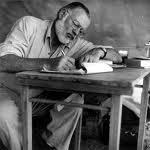
Most writers live and publish by a quota, a magical number of words or pages of work they produce each day. Supposedly, Stephen King writes ten pages a day, every day, no matter what. Hemingway was a little more reasonable, at 500 words per day. 

The truth is, I don’t actually have a quota, not if one insists on the notion of measuring effort in terms of something solid and concrete, like numbers of words. My quota is more elastic, more ephemeral if you will: it’s time spent writing. I write for two hours each day in the late morning, no matter what. (Okay, sometimes I’ll write for 45 minutes a day, or 20, but those days are rare.)

The problem with my type of quota is that I’m a word worrier. I can spend the entire two hours nibbling around the edges of a single paragraph. The next day, I might strike that paragraph and start over. With this method, productivity, as you might imagine, is quite the wild card.

I do have occasional spells when the writing flows–I bound through the pages effortlessly, like Emily Dickinson’s frigate on a following sea. But those happy periods of clear sailing are inevitably followed by a dead calm, and I get bogged down on a single page for days. Or a single sentence,


“Just keep going!” When we’re stalled, this is the sage advice we get from most writing teachers, critique groups, and professional writers, But so far I’ve been incapable of doing that.  Sometimes I do leave a placeholder, something like, “Brilliant description of character goes here, but don’t do a generic description dump. Must be something fresh that will make the reader’s eyes widen in recognition.” One can take that kind of thing too far, however. You can wind up with an entire novel of placeholders, and then where would you be? Exactly where you started.

Well, now I’ve depressed myself simply by writing about my quota. What about you? What is your daily writing quota, when and where do you write, and how religious are you about keeping to it?

And if you write ten pages a day no matter what, don’t hold back. Don’t worry about the fact that I’ll be cranky at you for the rest of the day.


Literary Tattoos

by Clare Langley-Hawthorne


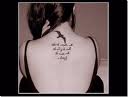
I was listening to a podcast on my way back from dropping the boys at school on a new book detailing the cultural phenomenon of ‘literary tattoos’ – people who feel the need to have inked on some part of their body the name, picture, or quote from their favorite author or poet. While no one, to my knowledge, has the name Ursula emblazoned on their buttocks, the idea of a literary tattoo intrigues me – and since listening to the podcast, I find myself asking people whether they would consider getting such a thing, and if so, who would they chose?…

In the book, The Word Made Flesh by Eva Talmadge and Justin Taylor (the book which was discussed in the podcast) there are pictures of people with quotes (and illustrations) from work by Herman Melville, Franz Kafka, William Blake and Samuel Beckett (just to name a few). Each of the tattoos represent a whole story in and of themselves about how and why a person felt compelled to engrave the words on their flesh. Pretty cool really.

For my part, I am way too squeamish to get any kind of tattoo (and let’s face it, too worried about what it would look like on my saggy eighty year old body in years to come) but if I was to consider a literary tattoo, and if I restricted it to books and authors I love (look, if I got on to poetry this blog post would never end!), there are three most likely contenders:

They are (in no particular order):

Joseph Conrad’s Heart of Darkness
One of my favorite books, I would nonetheless have difficulty putting “Mistah Kurtz – he dead” or “The horror! The horror!” anywhere on my body. Even some of his more cheery quotes are still major downers so I doubt I will ever have a tattoo with such gems as “the wilderness found him out early, and had taken vengeance for the fantastic invasion. I think it had whispered to him things about himself which he did not know, things of which he had no conception till he took counsel with this great solitude–and the whisper had proved irresistibly fascinating. It echoed loudly within him because he was hollow at the core.”
Besides where would such a quote go? Back? shoulder? stomach?!

Emily Bronte’s Wuthering Heights
Now a quote from this book would be pretty amazing- though perhaps not original enough to enter the ranks of cool-dom. I could see myself with a discrete Catherine or Heathcliff quote, perhaps on an ankle…What do you think – “That is not my Heathcliff. I shall love mine yet; and take him with me: he’s in my soul” or perhaps, “I can not live without my life! I can not live without my soul!” But then again, I’m not sure what my husband would say to either of those…

David Malouf’s An Imaginary Life
Now this book is my all time favorite book and perhaps it is the one I would be most likely to use for a literary tattoo. One quote which would be wonderful, is this:
“What else should our lives be but a continual series of beginnings, of painful settings out into the unknown, pushing off from the edges of consciousness into the mystery of what we have not yet become, except in dreams that blow in from out there bearing the fragrance of islands we have not yet sighted in our waking hours”. Not bad, eh?

Well, I can’t say I am rushing out to a tattoo parlor to have anything inked on any region of my body, but still the concept is an interesting one. So tell me, have any of you got a literary tattoo? If so, who, what, why and where? If not, would you ever consider having one and if so, which quote or author would you chose?