James Scott Bell
@jamesscottbell
Don’t Follow Me. I’m Lost Too.
I would like to follow up, if I might, from James Scott Bell’s excellent contribution of Sunday last titled “What Will Book Publishing Look Like In Six Months?” I started to write a comment to that essay but it soon became long enough for a post of my own, so here it is, for what it is worth. I will tell you ahead of time that I have NO idea what book publishing will be like in six months, other than it’s going to be more chaotic than it is now. Herewith, however, are a couple of factors that are influencing things now that no one seems to want to talk about.
I read an article recently in the Wall Street Journal concerning the fact that publishers are noticing that self-published e-books offered at a two to three dollar price point are getting an increasing share of the market. Now, traditional publishers will tell you that they simply cannot offer e-books in that price range. For one thing (they say) it only costs three to four dollars per unit to physically publish a book. That may well be. There is an additional problem that traditional publishers face, however, an expense which is also factored into that publisher‘s list price. That problem is the very expensive cost of the Manhattan real estate upon which those who toil on the publishers’ behalf hang their hats each morning. The Konraths and the Crouchs and the Lockes and the Wynnes and yes, the Eislers who are doing quite well on their own are already paying for their own office space. It’s called home. The publishers, on the other hand, have to pick up their fixed cost (those expenses that remain the same whether they sell a million books or don’t sell any) somewhere, and they do it somewhere in the remaining twenty-two bucks of that hardcover you used to buy at Borders. Not all of that remaining money goes to the landlord for the lights and carpet and walls, but some of it does. And authors such James Patterson sell enough books to keep the candles burning. Those e-book prices accordingly aren’t going to be coming down any time soon (but read on).
Trad publishers also have another problem. They have to keep the gnomes of Zurich happy. The gnomes in this case are the parent companies like NewsCorp, Sony, Bertelsmann and the like who are looking at the balance sheets and figuring out how they are going to explain to their stockholders that the reason that the dividend checks aren’t as big this year because this or that publishing company did not perform to expectation. The money for those declared dividends comes out of that unit price as well. With the gents I mentioned earlier, their stockholders are their families. If an independent e-book authors take their families out for an extra nice meal, and the bills all get paid on time, they’re happy. That’s their stockholder report. But the traditional publishers have a constituency that is not so easily satisfied.
One might think, after considering the above, that the traditional publishers are accordingly stuck at a twelve dollar price point for an e-book. I mean, they have fixed costs, stockholders, and, of course, the author needs to be paid too. Actually, however, they are not stuck. At least theoretically. There is a school of thought — one that I happen to subscribe to — that says that at a (much) lower price point the traditional publishers could sell enough e-books to make up the difference in what they lose in selling at a higher price. It is my humble opinion that at some point, sooner rather than later, one of the traditional publishers is going to bite the bullet and price a book by one of their A list authors at three to five dollars, and then sit back with a bottle of Maalox in one hand and a .38 Special in the other, waiting to see if the sales numbers jump high enough to make up for the decrease in sales price per unit. In other words, if I’m selling one thousand books at ten dollars apiece, and I drop the price to five dollars, I have to sell two thousand books to make the same money. I think they can do it. If they do, they’ll put the Maalox to their head. If not…It will be interesting to see which publishing house will walk that plank first, and which author will be holding hands with it. And those offices in mid-town? They are the real estate equivalent of a dead man walking. I know of one gentleman who is running a very successful independent music label imprint out of a hotel lobby. He has a smartphone, a laptop, a pair of ear buds, and access to a nearby Kinkos. He farms out his publicity, promotion, booking, and marketing and he stores his artists’ music on an external hard drive that’s the size of a spiral notebook. He’s making good money. And no one even knows he’s running a business. He is the future.
As we look at the landscape, what I just described could be called the hills. What about the trees? To get a description of that we have to ask a tough question which is also being asked, and answered, by CPA bean counters in boardrooms, even as I write and you read: at what point does the percentage of e-book sales in relation to physical book sales reach the point where the manufacture and sale of physical books — either by genre, or for the industry as a whole — becomes a losing proposition? I have seen opinions that set that point as the moment when e-book sales constitute twenty percent of total books sales. Some genres have reached, and exceeded, that point already. My understanding is that, for the industry as a whole, e-book sales constitute thirteen percent of sales. It may well be somewhat more than that; I doubt that it is less. Whether the point has already been reached, however, or is reached six months or six years from now, it raises some tough questions. Will publishers gradually phase out physical books for all but their perennial best sellers? Will physical books be published in sharply limited qualities, marketed for collectors? There are some genre publishers that have survived quite nicely for years publishing limited editions (Subterranean Press and Cemetery Dance come to mind). But those limited editions come with expensive price tags.
I hate the thought of a world where a physical book is a luxury which can ill be afforded. But we have to consider that scenario as possible, too. The market, and the unseen hand that guides it, does not always come to rest upon a happy medium. At least for some.
Good Guy PDC
By John Gilstrap
Good morning, everyone. Now that you’ve had a chance to mingle and meet, let’s take our seats and get started. Welcome to the first annual Good Guy Professional Development conference. Mr. Grave, Mr. Rapp and Mr. Harvath, I need you to leave your weapons at the check station. You, too, Mr. Massey. Yes, all of them. Mr. al-Jawadi will take good care of them.
Mr. Rapp, I don’t appreciate that kind of talk here. Not all . . . Okay, apology accepted.
I’d like to offer a special welcome to President Ryan. It’s a real honor, sir. And congratulations on your son’s success as well. I think we all can agree that the world is a much safer—
Excuse me. Yes, Mr. Pitt? Because they’re Secret Service agents, that’s why. They are the single exception to the no weapons rule. Surely this makes sense to you. I thought it would. Thank you.
Moving along, this morning’s agenda includes—
Oh, good God. Who’s pounding on the door? Oh. Just ignore her, and maybe she’ll go away. What? No, I’m not being sexist. Jessica Fletcher is not welcome in any gathering that I run. Certainly not where food or tea is being served. It’s just not worth the risk.
Who locked the doors, anyway? Ah. And why did you do that, Inspector Poirot? Uh huh. I see. Well, technically, Inspector, there’s more than one killer in this room. Quite a lot more than one, actually. We don’t need a locked room, thanks. It’s a fire code violation.
Mr. Lockwood and Mr. Pike, please sit down. I don’t need your help. And Inspector Poirot does not “talk funny,” as you say. He’s Belgian. And meaning no offense, why are you two here in the first place? This conference is for lead characters. A sidekick conference is in the planning stages . . . My apologies, Mr. Pike, you’re absolutely right. I’d forgotten. You’re welcome to stay. But Mr. Lockwood—may I call you Win? All right, then, Mr. Lockwood, I need to ask you to leave.
Getting back to the agenda, we’ve got a lot of ground to cover, beginning with a panel presented by Clark Kent and Bruce Wayne discussing the difficulties of living a dual life. That will be moderated by Peter Parker.
I see you, Mr. Bolitar. Please put the laser pointer down. The red dot on my chest is certainly a riot, but it’s distracting. Thank you.
The dual life panel will be followed by a technical workshop called “How to Get 500 Rounds Out Of A 30-Round Magazine Without Reloading.” That will be jointly taught by two of my favorite Johns: John “Hannibal” Smith, and John Rambo.
Our luncheon speaker is the ever-entertaining Captain Ahab, whose keynote is titled, “Manic Monomania.” I don’t know about you, but I’ve been thinking about little else for days.
In the afternoon, we have . . .
***
The afternoon sessions are up to you, dear Killzoners. Let’s have some fun. Trying to stick to the voice of the speaker, post your suggested courses and presenters. Or interact some more with the attendees.
This could be a hoot.
(FYI, I’ll be away from the keyboard all day today, so I’ll be kinda quiet.)
It’s 10pm, does Steve Jobs know where you are?
A bit of a brouhaha erupted this week over the discovery that Apple might be collecting data on iPhone users’ locations. Apple immediately released a response firmly denying any malfeasance. However, they did acknowledge that their software contains “flaws” that affect the collection of data required for location-based services.
Don’t worry, I’m not about to wander off into the conspiracy theory woods. Well, not too far at least. I’d actually be impressed if Apple managed to track my iPhone, considering the fact that I can barely get it to function properly to make calls.
And the truth is that these days, by and large people don’t mind making their every move public. They’re freely offering up data on nearly every aspect of their lives. Via Facebook and Twitter, I receive a slew of daily posts along the lines of: “John Doe just checked into Four Barrel,” and, “Jane Doe is at SFO.” (Side note: what a gift FourSquare and programs like it are for thieves and stalkers!) Some restaurants and bars encourage “checking in” like this, offering a discount or bonus for people who do it. You can apparently even become “mayor” of the place you check into most frequently.
We’ve become a nation of oversharing, from tweeting about the bagel we just ate to discussing how much sleep we got last night and what the doctor said about our blood pressure. And it doesn’t stop there. All those little tools designed to make our lives easier also quietly file away information about us and our habits. Grocery savings cards record what you’re eating and using to clean your house. Fastrak passes record your car every time it crosses a bridge (and allegedly, according to internet posts that boldly march much deeper into the conspiracy forest, they might also be tracking your movements around major cities). In many urban areas, CCTV cameras are set up to discourage criminal activity.
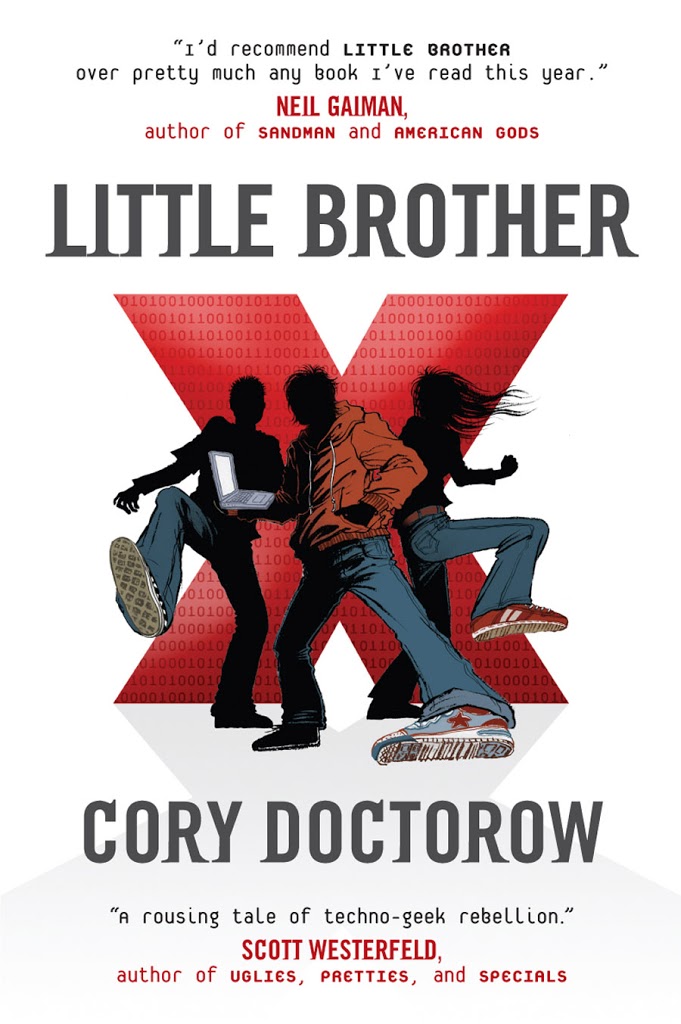
I recently read Cory Doctorow’s excellent novel LITTLE BROTHER. The story is set in a near future, so many of the tracking tools that play into the plot already exist and are deeply rooted in our day to day lives. And as Doctorow points out, it wouldn’t take much for these seemingly helpful tools to be turned against us. In his book, police are able to collate data from electronic public transportation cards (like the Clipper pass we have he
re in SF) to track “irregular” movement patterns. In addition to metal detectors, schools are equipped with cameras that analyze students’ walking patterns, and every laptop comes with a chip that monitors key strokes.
Of course, none of this is new, as any Philip K. Dick fan knows. But we’re certainly a lot closer to that potential future than we used to be. In London, the average resident is filmed 300 times a day; Britain has 4.2 million closed-circuit surveillance cameras, one for every 15 people in the country. Did you know that your computer webcam can be turned on remotely? It can. In fact, the Lower Merion School District near Philadelphia admitted to activating Webcams 42 times during a 14-month period, claiming that it did so only to track lost or stolen laptops.
But as I said, no one seems to mind. People already film the most intimate aspects of their lives for public consumption on YouTube. How do you value privacy in a culture where the prevailing dream is to become famous, even if that fame is tied to a videotaped pratfall off a ladder?
All right, I’m stepping back out of the woods. And of course, all of this provides rich material for crime fiction writers like me to mine, so I’m hardly one to complain.
By the way, I had oatmeal for breakfast, and the doctor said I’m doing just fine. Go ahead and turn on my webcam if you want to see for yourself.
Visual Tools for Writers
Get The Juices Flowing . . .
By: Kathleen Pickering
Twice now I’ve enjoyed writing workshops presented by my friend, Heather Graham, where she uses an effective, interactive writing technique employing random words to build story ideas. My first effort resulted in the horror lampoon, “A Zombie Love Story,” which became a short story included with Heather’s and other FRW authors in the Florida Romance Writers e-book anthology, Vampires, Werewolves and Zombies, Oh, My! ![]()
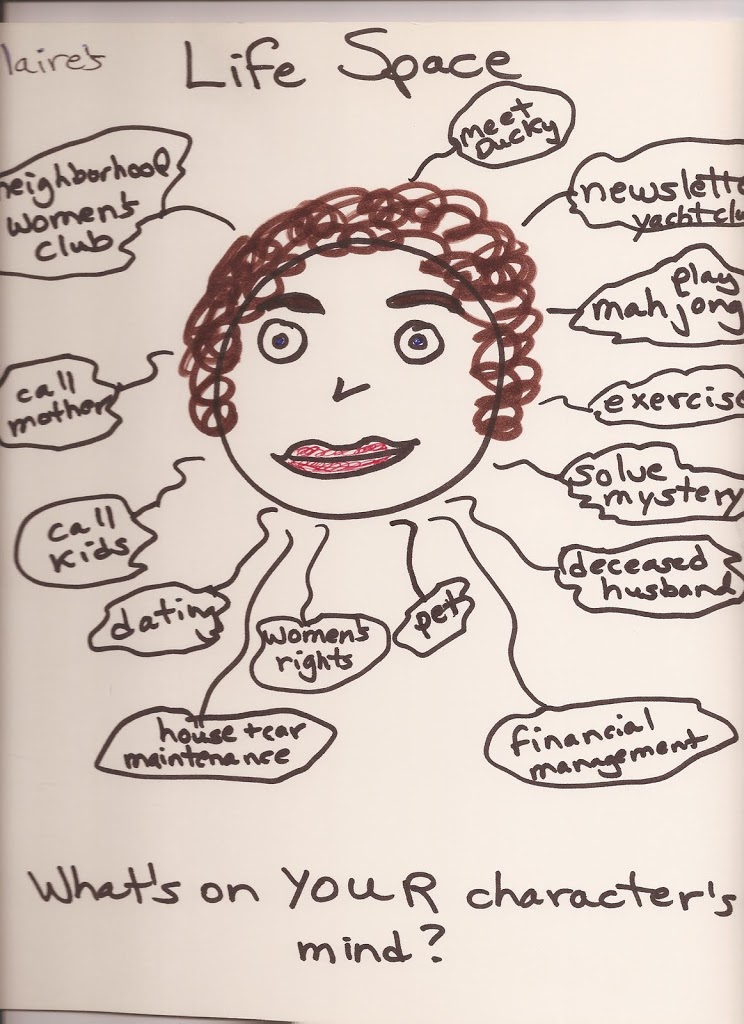
Heather’s great method either helps bring new story ideas to life, or move an already stalled story forward. When creating a new story, random nouns describing three people, one place and three adjectives become the cornerstone for a full page of narrative. While we haven’t experimented with moving a current story forward with this technique, I’d suggest choosing three characters from a current story, a site they’d go to, and adjectives best used in the story’s particular theme. Using the first words that come to mind for each category works best.
Let’s test the creative juices. My latest words drawn from Heather’s pool were:
People 1. Alligator Wrestler. 2. Ventriloquist 3. Girl Scout.
Place: an RV.
Adjectives: Crass, Distant, Startled
In the workshop, Heather supplied the lead sentence:
“Blood dripped from the wall . . .”
Just for kicks, take five minutes or less to try your hand at creating the first paragraph (or two) of a story using the above words and Heather’s sentence. I’d be curious to see what you build. I’ll post the paragraphs I crafted from these leads later on in the day. (Fair warning: my son’s birthday is today. I’ll most probably be distracted until evening.)
Best of all, would your results entertain you enough to consider growing them into a story? Enjoy!
ANZAC day
After a marathon effort of close to 30 hours traveling to get back to Melbourne from Tucson (delays included) I awoke to ANZAC day here in Australia. At dawn this morning in almost every country town and city across the country people gathered to remember Australia’s war dead.
Given today’s date, I thought I would dedicate today’s blog to the ANZACs and pose a few questions for American readers of TKZ on the meaning and significance of the day. Here goes…
- What does ANZAC stand for?
- Which famous battle are the ANZACs known for?
- What did the wives and daughters of the ANZACs send them (hint here, I can provide a recipe for them!)
Good luck and feel free to test my own knowledge of ANZAC day in your comments too…
What Will Book Publishing Look Like in 6 Months?
How Do You Deal With Writer’s Block?
Shameless Self-Promotion Alert
by John Gilstrap
A few times a year (but only a few times) I devote my slice of intellectual real estate here on The Killzone to shameless self-promotion. Today is one of those days.
This will be a three-book summer for me. Threat Warning, the third installment of the Jonathan Grave thriller series, will hit the stands on July 1; but before that, in hopes of whetting readers’ appetities, Kensington will rerelease my 1998 novel, At All Costs, on May 1 (next week!). The pBook rerelease will follow in 2012.
We chose At All Costs for the first rerelease (Nathan’s Run will come out again in eBook form in August) because it actually shares literary DNA with the Grave series. That’s the book where Irene Rivers–now the director of the FBI, codenamed Wolverine in the Grave books–was first introduced. In At All Costs, she’s my protagonists’ worst nightmare as she continues to pursue them for crimes that only they know they never committed.
The rerelease strategy was my editor’s suggestion–well, sort of. During a meeting at last year’s Bouchercon in San Francisco, she mentioned that she’d like to see a story about Irene’s past. When I told her that I’d already written it, but it was now out of print, Kensington re-bought the rights, and here we are.
I’ve blogged before that it’s a daunting task to edit page proofs of a previously-published book. In the end, I didn’t change much beyond a significant reduction (but not elimination) of the F-bomb. I tried hard to keep my substantive changes to a minimum, but a few were irresistable. Take the throw-away reference to the “US Air Arena,” which, at the time I wrote the original story, was the hope of the Washington Capitals hockey team and the Washington Bullets basketball team. Since then, US Air became US Airways, the Bullets ceased to exist. The facility itself was abandoned and ultimately torn down. Last time I drove through there, it was an empty lot. I changed the throw-away reference to “a stadium.” That should stay relevant for a while.
The most interesting part of the editing process was the realization that the story would have been largely different if I had written it today. A huge section takes place at a hazardous waste site. In 1996, when I was committing the story to paper, that hazmat stuff was very much a part of my life. As I was reading through the vernacular and the images, I realized that there’s a verisimilitude there that I don’t think I could have created from my now-stale memories of my moon-suit days. Forgive the immodesty, but there are passages in the book that cause me to pause and think, “Wow, that’s really good.”
Then there was the emotion of revisiting that creative space in my mind. My son–now 25–was ten years old when I wrote At All Costs, and it’s impossible to read some passages without being taken back to where I was in my life when I penned them. Those were heady days, when the publishing industry was all hope an opportunity and unbridled success for me–the days when I was first meeting so many of the then-up-and-coming writers who would soon become fast friends, and staples of your local bookstore. I’m not one to long for turning the clock back, but I’m not above bouts of nostalgia. The act of revisiting At All Costs felt like a bit like piloting a time machine on occasion.
As I write this, I fear that I’m not explaining it well, but it’s the best I can do.
I hope you have a chance to read the book. More than that, I hope you enjoy it if you do.