
By John Gilstrap
Before getting to the meat of this week’s blog entry, I wanted to share a bit of very cool news. As every TKZ regular knows, Basil Sands is a frequent and entertaining participant here. A year or so ago, when my fellow Killzoners and I published Fresh Kills: Tales From The Killzone, Basil volunteered to produce audio versions of the book and podcast them. If you’ve listened to his narration, you know that he’s very good at that sort of thing.
A few weeks ago, during a routine email exchange with the folks from Audible.com, the people who publish the audio versions of the Jonathan Grave series, I mentioned to them that they might consider adding Basil to their stable of narrators. I’m not sure of the details that transpired between Basil and Audible.com at that point, but I am thrilled to announce that Basil Sands will be the narrator for my next Jonathan Grave novel, Threat Warning, which will be released on July 1.
Having heard the great job he did with Fresh Kills, I can’t wait to hear his take on Threat Warning. For the second week in a row, then, here’s to serendipity! Way to go, Basil!
We now return to our original Blog programming:
*
New York publishing went Hollywood back in the mid nineties, throwing high six-figure and even seven-figure advances at first time authors. It’s a shame that so many of the authors who received such largesse didn’t know that the big money would ruin their writing careers.
A million dollar advance puts a writer in the position of having to sell something like 300,000 copies in hardcover for the publisher just to break even, and 350,000 for the writer to start earning a royalty check. Those are hard numbers to achieve even for established authors; for an unknown rookie, the odds are one in thousands. Whereas in a normal world, rookie sales of 75,000 or 80,000 copies would be the stuff of cork-popping and the terrific launch of a career, those same sales for the anointed and overpaid were a source of embarrassment for the team that forked over the cash.
But the big advance was only part of the problem. In order to have a chance at recovering their investment, publishers had to throw another couple hundred thousand bucks at marketing and promotion. Back then, when a “big book” failed, it failed big. If the disappointment was public enough, no other publisher would touch the author, who would forever join the ranks of one-hit wonders.
First lesson of New York publishing: The bad stuff is always the author’s fault.
Meanwhile, because all the marketing dollars were going to the big books, the midlist authors who were lucky to be pulling in $30,000 advances got squat in promotion. Their success (or failure) was driven largely by efforts of independent booksellers to hand-sell. Back then, even if a midlist title didn’t earn out, the independents would still order the next title of an author whose work they liked. There was a tacit agreement between publishers and booksellers to “grow” and author over time. That was before computers started running the business.
Now the indies are virtually all gone, and the hundred-year-old publishing business model is in turmoil. Virtually all of the legacy houses are stuck with bazillion-dollar contracts that have virtually no chance of earning out, and to cover their downside (backside?), many are establishing eBook lines that will provide a steady stream of revenue against greatly diminished costs. Among the diminished expenses are the size of authors’ advances.
This is a game-changer for writers who make their living exclusively through writing. A reasonable advance (pick your own number to define reasonable) keeps the lights on and the kids in shoes during the period after a book is bought and before it is published. The advance is what writers use to pay bills while writing the next book. If advances implode, I’m not sure how full-time writers will make ends meet.
Self publishing will become the solution for some, I suppose, but I continue to believe that the only writers who have even a remote chance for success via self publishing are those who have already established their names via traditional means. There’s just too much noise out there for newbies to have a real shot.
While my crystal ball is notoriously cloudy on all things, I’m confident that there’ll be a solution to all of this that will keep publishers in business, and will continue to make mega-selling authors mega-wealthy. But if publishers have a brain in their collective head, they’ll have to find a way to pay less up front in advances, and more in royalties that are distributed more frequently. That would be the everybody-wins solution, I think.
What about you, dear Killzoners? For those of you who dream of canning the day job and writing full time, do you see yourself rolling the dice on self-published sales, or on royalties alone, or is an advance a critical component of your plan?
I Spent the Day with John Cusack

“Wasn’t that the worst apocalypse…EVER?” I texted to my older brother the day after, who quickly replied, “I’ve seen better.”
All day long on Rapture day my siblings exchanged text messages. My other brother wrote, “No sense buying green bananas” and “I’m not flossing today.” And when my sister did her grocery shopping, she texted, “Everything I bought today is a lifetime supply.” I also called my mom to borrow money, telling her I’d pay her back on Monday. She totally fell for it. After the clock ticked down to THE END, I had an automatic message go out to anyone who texted me – “The person you tried to reach has ascended. Try again later.”
My husband and I celebrated our last day by watching the movie “2012” with John Cusack—no less—and ordered our first pizza in months. We ate dessert first and ran with scissors to work up an appetite, capping off our excitement with an exploding world tsunami flick. I thought the movie would blow, but the special effects kept us overlooking the fact that it was a John Cusack movie. After the film ended, I texted my family, saying, “We’re celebrating Christmas. Happy New Year!”
In hindsight, if I had actually believed the end of the world would come on a damned weekend—Why not on Monday, for crying out loud?—I might have spent the time better. I blame John Cusack for this. I’m jaded. Cynical. Maybe I should have taken it more seriously and taken stock in all the things I have to be thankful for, but I didn’t want to crowd Thanksgiving. That day, turkey rules.
So tell us. How did you spend Rapture Day? What cracked you up? What made you think? What did you actually do as the clock ticked down? Or did you even KNOW about it? (Yeah, some of my friends didn’t buy a vowel or get a clue. [Insert eye roll here.])
The Void Between Books
I’m in between books, and normally, this makes me anxious. I feel lost, adrift without a goal. But this time I am enjoying the freedom. Maybe it’s because I’ve set other goals. I am revising my last backlist book so I can get it into e-book format. Now that I’m off my regular writing schedule, I can devote myself full-time to finishing the revision. It’s a long story, over 500 manuscript pages, so it’s been tedious. I have to compare the printed book to my Word file, which does not include the edited version. Besides making these editorial changes, I’m also tightening up the work. It’s amazing the difference a few years of experience makes. I’ll feel a sense of relief when I’m done, but then begins the confusing array of choices re book cover design, formatting, etc. One step at a time.
Meanwhile, I’ve done a list of suspects for my next mystery. I have already turned in the first completed book in this series. I’m only dabbling at the synopsis for book two because the next couple of weeks will be a washout for creativity. Window installers are here this morning and they’ll be making noise and havoc for two days straight. Plus, we have other events going on that might prove to be too distracting. So it’s a good time for a break. Eventually I’ll just sit down and write the whole synopsis.
And then what? I’ll probably write the first three chapters of this next mystery and then move on to book three in my proposed paranormal romance trilogy. Or I could tackle Smashwords for the backlist book. Or…you see, there’s always something to do.
How do you feel about the void between books? Are you relieved to have reached the finish line and to be mentally free of your project, or does the freedom cause you anxiety until you plunge into the next story?
The “Rapture” and Book Reviews
By: Kathleen Pickering
![IMG00024_w[1]](https://killzoneblog.com/wp-content/uploads/2011/05/IMG00024_w-5B1-5D_thumb-5B1-5D.jpg "IMG00024_w[1]")
I had a book deadline for yesterday, and given most of the hype leading up to Saturday’s expected “Rapture”, I kept looking out the window and wondering . . . so, if I’m gonna disintegrate at 6 p.m., do I really need to finish this final edit for Monday?
Now, stay with me here, you’ll see my point.
Since I knew the “Rapture” prediction was hype, and that the hype was unreal (Why would I have a deadline for Monday if it was real? My editor surely would have known!), it started me thinking about the power of opinions.
Which led me to the power of book reviews. (My point, entirely, which Clare Langley-Hawthorne tapped into with her blog from yesterday. I wonder if she was thinking Rapture, as well?) So, to continue Clare’s conversation, I ask: Will Internet reviews be as powerful as the tried and true print and media reviews?
I say, hell yes.
From all the Internet marketing classes and webinars I’ve attended, the magic words are “buzz’” and “viral”. While TV interviews are the ultimate for books sales, I believe (hallelujah!) that Internet book reviews are another rapid means to get word out about a hot, new novel. Believe me, brothers and sisters. I am taking full advantage of online reviews. (Feeding the bees to make a buzz, you might say.)
I just received a 5-Star review on my self-pubbed, urban fantasy, MYTHOLOGICAL SAM, and enjoyed a surge in my Amazon sales from this post. (Thank you, Melissa Cabrera!) So, I am taking Internet book reviews very seriously. Here’s the book. Feel free to check out the gratifying book review:

http://werevampsromance.blogspot.com/2011/05/kathleen-pickering-book-review-author.html?m=0#more
Now, granted, this is only one review, but I have posted this opinion on Facebook, Twitter, my email signature, other writer’s groups, and now here on this fabulous blog page. FOR FREE. That suddenly gives this review multiple opportunities for exposure.
Do I care if my reviewer is educated? Respected? Influential? Hell, no. Although I’m sure she is, what truly matters, is that she liked the book enough to give it 5-Stars and rave about it to everyone she knows. She’s starting a buzz for me, and that’s priceless. Word of mouth on the Internet is how ‘viral’ gets born.
So, while still courting radio, TV and print media for reviews, I’m putting my money (which isn’t requiring much, I might add) on Internet marketing, which includes free book review blog sites and interviews. Internet marketing is something I can actively target and control (until it happily and wishfully goes viral, of course). I will do the same with my book being released next year through my publisher, as well. I’ll keep you posted on whether or not my efforts prove profitable. It’ll make an interesting study.
Has anyone else seen a rise in sales from Internet book reviews? And if you are a reader, do you buy from the Internet reviews you read?
The Future of Book Reviews
We’ve had a number of blog posts about the future of publishing and the rise of the e-book, the impact of social networking, blogs and the plethora of book and author related websites filling our digital world…but one thing that struck me this weekend (as I perused the New York Time’s book review online) was the future and influence of the mainstream book reviewer. Now I can’t say I have any quantifiable data on the sales impact of a favourable book review in the NYT but I would hazard a guess that 10-15 years ago a good review in a venerable newspaper like the NYT or a great review in Publisher’s Weekly (or, heaven help us, Kirkus) would have had a sizable impact on book sales. Today, I’m not so sure…
I do think good newspaper reviews and starred PW reviews encourage publishers to spend additional advertising and marketing money on an author’s book – which would certainly help rather than hinder sales – but just how influential are they now? Would a critical mass of favourable Amazon reviews generate greater sales? Would a rave review from a popular online blogger garner more readers? It would be interesting to try and survey authors to see what they thought had the greatest impact on sales. No doubt a bestseller occurs due to the cumulative effect word of mouth and media exposure – but I wonder what role traditional reviewers play in influencing this?
I’m an old fashioned girl so a great NYT book review will get me out there searching for the title (either online or in a brick and mortar store). I will, however, also check out the Amazon reviews and Google the author/title to see what kind of buzz (or not) there is in the blogosphere. If a trusted friend raves about a book then I will also check it out but more often than not, I will hear about a new book from my mother (sadly, I sometimes think only her generation that still reads – my friends usually say they have no time…) who has read the review in The Times, the Financial Times or The Guardian (can you tell my mother is English?). Rarely will a blogger’s recommendation be enough, simply because I find it hard to assess the reviewer’s credentials and impartiality – of course, we could have another entire blog post in this regard (having heard some professional reviewers question ‘amateur’ reviewers’ ability to meaningfully review!)
What do our TKZ authors think? How do the traditional forms of newspaper or PW reviews impact sales do you think, when compared to say Amazon, Goodreads or online blogs? In a post-Oprah world who do you think is going to become the most influential word on books? How is the whole review thing going to pan out with the dramatic rise in e-book sales (many of which are self-published titles) – and, for all our TKZ readers out there – whose opinion or review matters to you as a reader?
Publishers Trying Stuff
We’ve been all over the e-book revolution here at TKZ. Last month I asked what the publishing industry would look like in six months. We’re starting to see some things taking shape.
E-book sales are up 159.8%. Adult hardcover and mass market paperback sales are down 23.4%.
If you were an American car manufacturer and you saw that sales of Japanese made cars were up 158.8% and sales of American cars were down 23.4% in the first quarter, what would you do? I’ll tell you what you would do. You would run to the federal government and ask it to bail you out.
Traditional book publishers can’t do that. (Well, I guess they could try, but it would be a tougher sell than a Charlie Sheen self-help book.)
So what should they do? Try stuff. Innovate. Move fast.
There’s a problem, though. It’s not easy for major industries to change. Publishers have been operating under a model that is a hundred years old. But the market does not care. It is merciless. So adapt or be left in the dust.
This week one of the major Christian book publishers, Tyndale, announced a “digital first” imprint. They are going to bring out four fiction titles in July that are e-book only, by new authors. Then they’ll add non-fiction titles. If a title performs well, they will consider giving the author a print run.
Lisa Jackson, Associate Publisher explains, “The world of publishing is shifting rapidly, and it’s important that we as publishers deliver content in as many ways as possible. The Digital First project allows us to get fresh, new voices into the marketplace more quickly and efficiently than ever before.”
“I am very excited about this new initiative,” says Ron Beers, Senior Vice President and Publisher. “Tyndale has always been known for its innovation. Now we are working hard to be at the leading edge of the digital publishing revolution and to use that creativity and expertise to most effectively launch new voices into the marketplace. We are one of the few houses that has invested heavily in in-house digital expertise and this has allowed us to be more nimble yet strategic in bringing digital content to market.”
***
Looking at this from a business angle, this seems like a solid move. Whether this will be a net positive for the bottom line cannot be predicted. There are too many variables and the landscape changes almost daily. But it’s proactive and “outside the box,” and that’s what it’s going to take to survive. Plus, it lowers the risk of finding new authors the old way, via advance and print runs and hoping to sell through. It’s like a farm system.
Now, what about the writers? How is this deal for them? I have not seen an actual contract, but I have heard informally that we’re talking very low advances with a higher percentage on the back end, between 30 – 50% royalty. IOW, shared risk and reward.
Seems like a win-win.
Yet the stats above indicate that print is in a downward trajectory. So will being “in print” mean the same thing a year from now? Will there be enough shelves for the new writers to occupy?
Yet the stats above indicate that print is in a downward trajectory. So will being “in print” mean the same thing a year from now? Will there be enough shelves for the new writers to occupy?
What do you think?
My Muse
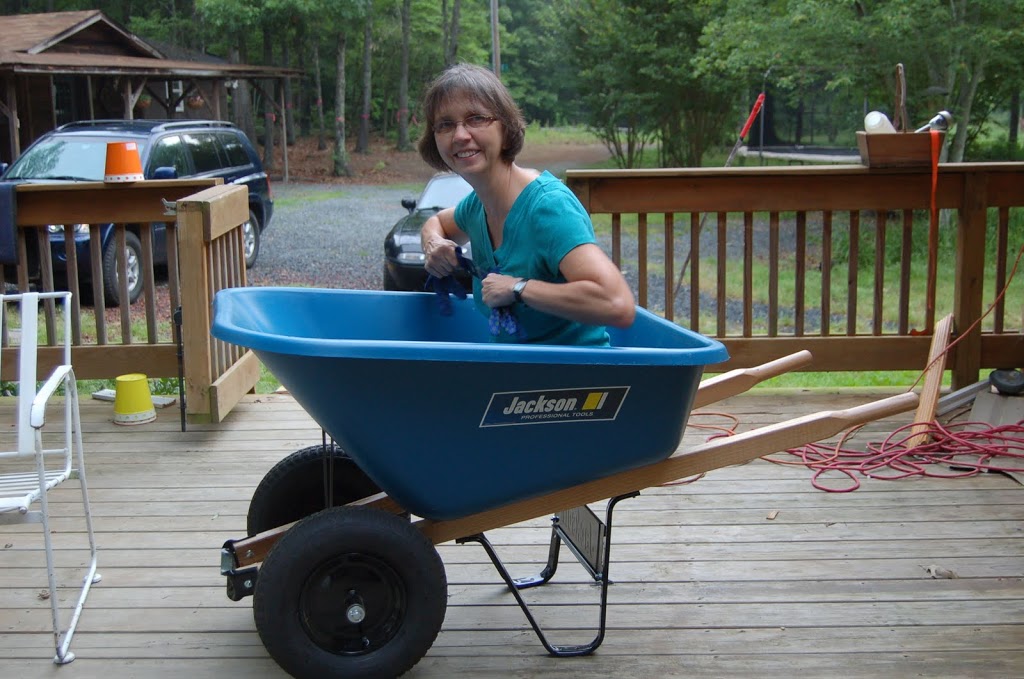
I truly believe that I would not have achieved anything I consider worthwhile in this life without my wife, Susan. I have never loved anyone or anything with the sincerity and intensity that I feel for her. She had a birthday on the 20th of May. I bought her this set of very expensive wheels, which she looks great in. She looks great in anything.
I know it’s like giving pots and pans for Mother’s Day, but wait… Here was my thinking. We have a large place. A small house, but a large garden, which is hers entirely, and she likes to move things like wood, stones, dirt, mulch, and other heavy things around on the property. We have a regular wheelbarrow with one wheel, which is hard to hold straight when its loaded. I have a five-horsepower motorized wheelbarrow that carts 1,000 lbs and dumps its load, but Susan has a hard time cranking it. I have to start it. This is a wheelbarrow that will allow her the independence to do more of what she enjoys without needing anyone’s help.
Susan is the most unselfish person I have ever known. She wants everything for others and only what she needs for herself. She has never once expressed any doubts that I would succeed at whatever I attempted. And she worked a job, made the meals, and raised my children while I sat in our bedroom day after day for several years typing. She never got discouraged as the 161 rejections stacked up, because she liked my manuscripts and honestly believed I would sell a book and then several more, which I did. My biggest regret is that she is still working while I sit and type day after day. I always wanted to give her the best the world has to offer, but she has always been satisfied with simple things. I have heard her say more than a few times, that our life together has been a lot of things, but never dull.
I know that if it were not for her I never would have found the author in me. And I would never have been happy, which I truly am. Every good female character I write is mostly made up of Susan, so strong, independent women are easy for me to write. Knowing how hard she works is what drives me to work as hard as I can. The world disappoints, but she never does.
My youngest son is getting married on June 4th and I have not been writing at all for the past few weeks. I’ve got too much on my plate to think about any story but our own. I hope each of you has a muse, an inspiration, and a reason to sit day after day and pound out your soul and take the blows we all have to take.
John Ramsey Miller
Serendipity

Fourteen months ago, I posted a blog entry here on The Killzone, in which I described a day of, shall we say, intestinal distress while in Islip, NY. In that post, I wrote something kind of snarky about the Hilton Garden Inn where I was staying. Specifically, I talked about my dismay that after hours of overnight dehydration, I couldn’t order room service to have that bland meal one needs after such an illness.
Among the comments generated by that post was this one: “My name is Adrian Kurre and I am the head of the Hilton Garden Inn brand. I read your post on your stay at the HGI Islip. I’m disappointed on a couple of levels. First that you became ill and could not make your presentation and second that we could not get a meal to you at lunch time when you were still feeling less than perfect. I know that you are not blaming the HGI for your illnes, but I sure wish we could have helped you feel better. If you’d like to email me at adrian.kurre at hilton dot com I’d love to hear more about your stay and what we could have done to make it better.”
I thought (and still think) that that was the coolest thing in the world. I wrote to Adrian to tell him so. Here’s a guy who no doubt has a bazillion things on his plate, and he took the time not only to stand up for his brand, but to reach out to a customer to show that he cares. In an era when true customer service is hard to find, I really was very impressed. So impressed, in fact, that wherever possible, I’ve become something of a Hilton purist in my travels.
It turns out that my effusive email arrived in Adrian’s box on a day when he needed to hear good things, and thus began a year-long correspondence through which I learned, among other things, that he’d become a fan of my work (how can you not love a man with such fine taste?). As a gesture of thanks I asked and received permission to set a pivotal scene in Threat Warning at the Hilton Garden Inn in Arlington, Virginia. (I promised Adrian that Jonathan and his team wouldn’t make a mess while they were there.) I think stuff like this is very, very cool. Fiction is rife with random events connecting to cause an unexpected outcome, and I’m always thrilled when happy randomness affects me.
There’s actually a coda to this story that I’ll share when the time is appropriate, but for now, I just want to praise kindness, caring and serendipity. You never know when the smallest gesture can make a big difference.
By the way, here it is for the record: Even though the restaurant was closed at lunchtime at the HGI in Islip, someone from the staff would have gone out and picked up food for me if I’d asked. It’s that kind of place. I like those kinds of places.
9-Act Screenplay Structure – Novel Plotting Resource
The first step toward recovery is to admit I have a problem. So here it is. I’m NOT a plotter. I’m a complete “pantser.” There, I said it, but…
When I looked into plot structure for fiction—while I was still delusional about having the capability to actually plot—I found references to the Nine-Act Screenplay Structure. This is the basic framework of today’s blockbuster movies. You’ll see 3-Acts and 12-Acts, but I played with this version below as a format and had some success in conceptually plotting one or two of my earlier stories. Ah, the ambiguity…
It’s my belief that once your brain grasps the concept of this structure, you may automatically follow the idea whether you’re aware of it or not. As a visual learner, it helped me to draft this and embed it in my brain, like a time bomb triggered to go off when I sat in front of my computer.
The 9-Act structure is similar to the classic Hero’s Journey that you may have seen, but I thought this would be interesting to talk about. See what you think. Would something like this work for writing a novel?
Word of Caution – Once you see this framework, you may not enjoy movies the same way again. Just sayin’…
Nine-Act Screenplay Structure
Act 0—During Opening Credits First 5 Minutes (film time)
What strikes the conflict—sets it up—event years earlier may plant the seed of conflict
Act 1—Opening Image—The Panoramic Crane Shot Next 5 Minutes
Act 2—Something Bad Happens 5 Minutes
In a crime story, it’s usually the murder—Reveal the bad front man, but hold off on the introduction of the bad head honcho until later
Act 3—Meet Hero/Protagonist 15 minutes
Meet hero—give him 3 plot nudges to push him to commit
Act 4—Commitment 5-10 Minutes
The push—Usually one scene that’s a door to Act 5—1-way door, no turning back
Act 5—Go for wrong goal – approx. 30 minutes est.
A series of 8-12 min. cycles called whammos or complications followed by a rest period of 5 minutes or so to uncover some of the backstory. End this act with the lowest point for the protagonist. The dark moment.
Act 6—Reversal 5-10 Minutes—Usually 70 Minutes into the Film
The last clue discovered—Now Act 2 makes sense—It is the low point, a history lesson usually revealed by the bad guy/honcho—but reveals the Achilles heel of the nemesis too.
Act 7—Go for New Goal 15-20 Minutes
The clock is ticking—Hero has a new plan. The action seesaws back and forth with nemesis and hero gaining & losing ground between each other—usually takes place in 24 hours within the context of the movie. Favors are repaid, magic, good luck happens. The new plan is kept secret. New goal is achieved.
Act 8—Wrap it Up 5 minutes
Back to where it all began—a feeling of accomplishment & rebirth—the world restored. Ahh!
Now having outlined this plotting structure, I’m not sure if following something like this (without deviation) would hamper creativity by providing too much framework. This would be like “the rules” of writing. Maybe rules are there to be understood, but we shouldn’t be afraid to break them either.
I tend to “think” about my book ahead of time and let my brain ponder what I call my “big ticket” plot movements—like what my black moment will be for my main character(s). I also develop my ideas on who the main cast of characters will be and maybe where I might set the story location(s).
Basically I’m impatient about writing. Plotting and outlining ahead of time would be like the San Antonio Spurs, Manu Ginobili, sitting injured on the sidelines of the NBA finals. The guy just wants to play, man. Let the dude play. (Of course by the time this post happens, the Memphis Grizzlies could put Ginobili on the bench until next season.)
What tips can you share on plotting…for those of us who are challenged by a heavy dose of impatience?
Rock What You’ve Got
My good friend and fellow thriller author Mark Terry is conducting a virtual book tour to launch his latest page-turner, THE VALLEY OF SHADOWS. Mark and I become friends 5 years ago when we shared a publisher. Over the years we’ve supported each other with advice and the exchange of ideas. We’ve also served as each other’s sounding boards and beta readers. Mark is a frequent visitor and friend of TKZ. Welcome, Mark.
By Mark Terry
Do you wish you could write like Lee Child? Or Stephen King? Or Nora Robert?
 Not: Do you wish you had a writing career like them? Ha! Sure, we all do, I suppose, at least at some level.
But, do you wish you could write like them?
For a second, take your favorite writers and think about what makes them, well, them.
My favorite writers, if that’s possible to break down, are probably the late Robert B. Parker, John Sandford, Dick Francis, hmmm, probably Jonathan Kellerman. I could go on (and on, and on…), but let’s stop there for a moment.
I just listed, more or less off the top of my head, four very successful novelists (two dead) who have a lot in common and a lot different. Parker and Dick Francis, for the most part, wrote in the first person. Parker was all about sparkling dialogue, stripped down description and efficiency (in my opinion). Dick Francis, uh, horse racing, but aside from that, I think of the decency of his characters, his research, a kind of efficiency of prose. Sandford? Pace, man! A stripped-down prose that’s like a lightning rod to his characters’ hearts, and for me, I love the way he structures his third-person narratives. Kellerman? I think characterization, texture and description.
I ain’t any of them.
That isn’t to say that my own books might overlap somehow – I hope they do. Perhaps analyzing my own strengths is a fool’s game, but I would say pace for certain, efficient prose, dialogue, writing action.
It probably would not be a good idea if I decided to try and write like Jonathan Kellerman. My strengths are not his strengths. That isn’t to say that I don’t try to give the reader a sense of place, or that I don’t focus on characterization. I do. Hopefully all writers do. But the sort of stories I write and want to write – and have had some success with – focus on pace and action.
Where am I going with this?
Years ago, when I was sending novel after novel manuscript to a former agent, I sent him a manuscript for a novel about a consulting forensic toxicologist. He called me up almost immediately upon reading it, gushing, saying he loved it, it was original, it took the things that I was good at and used them. Then he went through some of my previous manuscripts and said something along the lines of, “With this manuscript you were doing Carl Hiaasen, and with this one you were doing Robert B. Parker, and with this one you were doing…”
 The point being, that perhaps for the first time I was being just Mark Terry. (Which all makes for an interesting story, except he couldn’t sell it).
But I think there’s something vital to writers in this. It’s a little bit of: What do you bring to the table? What is uniquely you? JUST YOU. Then exploit it. Rock what you got.
How about you? As a writer, what makes your books unique? Are you content with your own voice and style? Or would you like to write like someone else?
Mark Terry is the author of 13 books. The fourth Derek Stillwater thriller, THE VALLEY OF SHADOWS, will be released in hardcover and as an e-book on June 7, 2011. His previous Stillwater novels – as well as other standalones – are available as e-books and other formats. Visit his website at www.markterrybooks.com.