I’m in between books, and normally, this makes me anxious. I feel lost, adrift without a goal. But this time I am enjoying the freedom. Maybe it’s because I’ve set other goals. I am revising my last backlist book so I can get it into e-book format. Now that I’m off my regular writing schedule, I can devote myself full-time to finishing the revision. It’s a long story, over 500 manuscript pages, so it’s been tedious. I have to compare the printed book to my Word file, which does not include the edited version. Besides making these editorial changes, I’m also tightening up the work. It’s amazing the difference a few years of experience makes. I’ll feel a sense of relief when I’m done, but then begins the confusing array of choices re book cover design, formatting, etc. One step at a time.
The “Rapture” and Book Reviews
By: Kathleen Pickering
I had a book deadline for yesterday, and given most of the hype leading up to Saturday’s expected “Rapture”, I kept looking out the window and wondering . . . so, if I’m gonna disintegrate at 6 p.m., do I really need to finish this final edit for Monday?
Now, stay with me here, you’ll see my point.
Since I knew the “Rapture” prediction was hype, and that the hype was unreal (Why would I have a deadline for Monday if it was real? My editor surely would have known!), it started me thinking about the power of opinions.
Which led me to the power of book reviews. (My point, entirely, which Clare Langley-Hawthorne tapped into with her blog from yesterday. I wonder if she was thinking Rapture, as well?) So, to continue Clare’s conversation, I ask: Will Internet reviews be as powerful as the tried and true print and media reviews?
I say, hell yes.
From all the Internet marketing classes and webinars I’ve attended, the magic words are “buzz’” and “viral”. While TV interviews are the ultimate for books sales, I believe (hallelujah!) that Internet book reviews are another rapid means to get word out about a hot, new novel. Believe me, brothers and sisters. I am taking full advantage of online reviews. (Feeding the bees to make a buzz, you might say.)
I just received a 5-Star review on my self-pubbed, urban fantasy, MYTHOLOGICAL SAM, and enjoyed a surge in my Amazon sales from this post. (Thank you, Melissa Cabrera!) So, I am taking Internet book reviews very seriously. Here’s the book. Feel free to check out the gratifying book review:
http://werevampsromance.blogspot.com/2011/05/kathleen-pickering-book-review-author.html?m=0#more
Now, granted, this is only one review, but I have posted this opinion on Facebook, Twitter, my email signature, other writer’s groups, and now here on this fabulous blog page. FOR FREE. That suddenly gives this review multiple opportunities for exposure.
Do I care if my reviewer is educated? Respected? Influential? Hell, no. Although I’m sure she is, what truly matters, is that she liked the book enough to give it 5-Stars and rave about it to everyone she knows. She’s starting a buzz for me, and that’s priceless. Word of mouth on the Internet is how ‘viral’ gets born.
So, while still courting radio, TV and print media for reviews, I’m putting my money (which isn’t requiring much, I might add) on Internet marketing, which includes free book review blog sites and interviews. Internet marketing is something I can actively target and control (until it happily and wishfully goes viral, of course). I will do the same with my book being released next year through my publisher, as well. I’ll keep you posted on whether or not my efforts prove profitable. It’ll make an interesting study.
Has anyone else seen a rise in sales from Internet book reviews? And if you are a reader, do you buy from the Internet reviews you read?
The Future of Book Reviews
Publishers Trying Stuff
Yet the stats above indicate that print is in a downward trajectory. So will being “in print” mean the same thing a year from now? Will there be enough shelves for the new writers to occupy?
My Muse

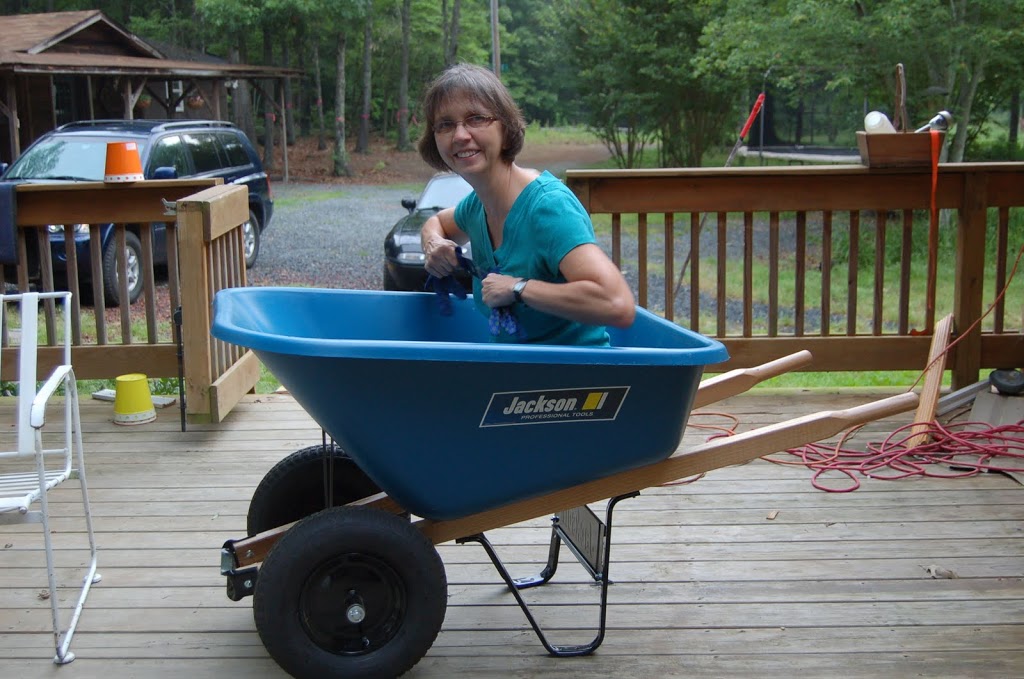
I truly believe that I would not have achieved anything I consider worthwhile in this life without my wife, Susan. I have never loved anyone or anything with the sincerity and intensity that I feel for her. She had a birthday on the 20th of May. I bought her this set of very expensive wheels, which she looks great in. She looks great in anything.
I know it’s like giving pots and pans for Mother’s Day, but wait… Here was my thinking. We have a large place. A small house, but a large garden, which is hers entirely, and she likes to move things like wood, stones, dirt, mulch, and other heavy things around on the property. We have a regular wheelbarrow with one wheel, which is hard to hold straight when its loaded. I have a five-horsepower motorized wheelbarrow that carts 1,000 lbs and dumps its load, but Susan has a hard time cranking it. I have to start it. This is a wheelbarrow that will allow her the independence to do more of what she enjoys without needing anyone’s help.
Susan is the most unselfish person I have ever known. She wants everything for others and only what she needs for herself. She has never once expressed any doubts that I would succeed at whatever I attempted. And she worked a job, made the meals, and raised my children while I sat in our bedroom day after day for several years typing. She never got discouraged as the 161 rejections stacked up, because she liked my manuscripts and honestly believed I would sell a book and then several more, which I did. My biggest regret is that she is still working while I sit and type day after day. I always wanted to give her the best the world has to offer, but she has always been satisfied with simple things. I have heard her say more than a few times, that our life together has been a lot of things, but never dull.
I know that if it were not for her I never would have found the author in me. And I would never have been happy, which I truly am. Every good female character I write is mostly made up of Susan, so strong, independent women are easy for me to write. Knowing how hard she works is what drives me to work as hard as I can. The world disappoints, but she never does.
My youngest son is getting married on June 4th and I have not been writing at all for the past few weeks. I’ve got too much on my plate to think about any story but our own. I hope each of you has a muse, an inspiration, and a reason to sit day after day and pound out your soul and take the blows we all have to take.
John Ramsey Miller
Serendipity
9-Act Screenplay Structure – Novel Plotting Resource
The first step toward recovery is to admit I have a problem. So here it is. I’m NOT a plotter. I’m a complete “pantser.” There, I said it, but…
When I looked into plot structure for fiction—while I was still delusional about having the capability to actually plot—I found references to the Nine-Act Screenplay Structure. This is the basic framework of today’s blockbuster movies. You’ll see 3-Acts and 12-Acts, but I played with this version below as a format and had some success in conceptually plotting one or two of my earlier stories. Ah, the ambiguity…
It’s my belief that once your brain grasps the concept of this structure, you may automatically follow the idea whether you’re aware of it or not. As a visual learner, it helped me to draft this and embed it in my brain, like a time bomb triggered to go off when I sat in front of my computer.
The 9-Act structure is similar to the classic Hero’s Journey that you may have seen, but I thought this would be interesting to talk about. See what you think. Would something like this work for writing a novel?
Word of Caution – Once you see this framework, you may not enjoy movies the same way again. Just sayin’…
Nine-Act Screenplay Structure
Act 0—During Opening Credits First 5 Minutes (film time)
What strikes the conflict—sets it up—event years earlier may plant the seed of conflict
Act 1—Opening Image—The Panoramic Crane Shot Next 5 Minutes
Act 2—Something Bad Happens 5 Minutes
In a crime story, it’s usually the murder—Reveal the bad front man, but hold off on the introduction of the bad head honcho until later
Act 3—Meet Hero/Protagonist 15 minutes
Meet hero—give him 3 plot nudges to push him to commit
Act 4—Commitment 5-10 Minutes
The push—Usually one scene that’s a door to Act 5—1-way door, no turning back
Act 5—Go for wrong goal – approx. 30 minutes est.
A series of 8-12 min. cycles called whammos or complications followed by a rest period of 5 minutes or so to uncover some of the backstory. End this act with the lowest point for the protagonist. The dark moment.
Act 6—Reversal 5-10 Minutes—Usually 70 Minutes into the Film
The last clue discovered—Now Act 2 makes sense—It is the low point, a history lesson usually revealed by the bad guy/honcho—but reveals the Achilles heel of the nemesis too.
Act 7—Go for New Goal 15-20 Minutes
The clock is ticking—Hero has a new plan. The action seesaws back and forth with nemesis and hero gaining & losing ground between each other—usually takes place in 24 hours within the context of the movie. Favors are repaid, magic, good luck happens. The new plan is kept secret. New goal is achieved.
Act 8—Wrap it Up 5 minutes
Back to where it all began—a feeling of accomplishment & rebirth—the world restored. Ahh!
Now having outlined this plotting structure, I’m not sure if following something like this (without deviation) would hamper creativity by providing too much framework. This would be like “the rules” of writing. Maybe rules are there to be understood, but we shouldn’t be afraid to break them either.
I tend to “think” about my book ahead of time and let my brain ponder what I call my “big ticket” plot movements—like what my black moment will be for my main character(s). I also develop my ideas on who the main cast of characters will be and maybe where I might set the story location(s).
Basically I’m impatient about writing. Plotting and outlining ahead of time would be like the San Antonio Spurs, Manu Ginobili, sitting injured on the sidelines of the NBA finals. The guy just wants to play, man. Let the dude play. (Of course by the time this post happens, the Memphis Grizzlies could put Ginobili on the bench until next season.)
What tips can you share on plotting…for those of us who are challenged by a heavy dose of impatience?
Rock What You’ve Got
My good friend and fellow thriller author Mark Terry is conducting a virtual book tour to launch his latest page-turner, THE VALLEY OF SHADOWS. Mark and I become friends 5 years ago when we shared a publisher. Over the years we’ve supported each other with advice and the exchange of ideas. We’ve also served as each other’s sounding boards and beta readers. Mark is a frequent visitor and friend of TKZ. Welcome, Mark.
By Mark Terry
Do you wish you could write like Lee Child? Or Stephen King? Or Nora Robert?
Not: Do you wish you had a writing career like them? Ha! Sure, we all do, I suppose, at least at some level.
But, do you wish you could write like them?
For a second, take your favorite writers and think about what makes them, well, them.
My favorite writers, if that’s possible to break down, are probably the late Robert B. Parker, John Sandford, Dick Francis, hmmm, probably Jonathan Kellerman. I could go on (and on, and on…), but let’s stop there for a moment.
I just listed, more or less off the top of my head, four very successful novelists (two dead) who have a lot in common and a lot different. Parker and Dick Francis, for the most part, wrote in the first person. Parker was all about sparkling dialogue, stripped down description and efficiency (in my opinion). Dick Francis, uh, horse racing, but aside from that, I think of the decency of his characters, his research, a kind of efficiency of prose. Sandford? Pace, man! A stripped-down prose that’s like a lightning rod to his characters’ hearts, and for me, I love the way he structures his third-person narratives. Kellerman? I think characterization, texture and description.
I ain’t any of them.
That isn’t to say that my own books might overlap somehow – I hope they do. Perhaps analyzing my own strengths is a fool’s game, but I would say pace for certain, efficient prose, dialogue, writing action.
It probably would not be a good idea if I decided to try and write like Jonathan Kellerman. My strengths are not his strengths. That isn’t to say that I don’t try to give the reader a sense of place, or that I don’t focus on characterization. I do. Hopefully all writers do. But the sort of stories I write and want to write – and have had some success with – focus on pace and action.
Where am I going with this?
Years ago, when I was sending novel after novel manuscript to a former agent, I sent him a manuscript for a novel about a consulting forensic toxicologist. He called me up almost immediately upon reading it, gushing, saying he loved it, it was original, it took the things that I was good at and used them. Then he went through some of my previous manuscripts and said something along the lines of, “With this manuscript you were doing Carl Hiaasen, and with this one you were doing Robert B. Parker, and with this one you were doing…”
The point being, that perhaps for the first time I was being just Mark Terry. (Which all makes for an interesting story, except he couldn’t sell it).
But I think there’s something vital to writers in this. It’s a little bit of: What do you bring to the table? What is uniquely you? JUST YOU. Then exploit it. Rock what you got.
How about you? As a writer, what makes your books unique? Are you content with your own voice and style? Or would you like to write like someone else?
Mark Terry is the author of 13 books. The fourth Derek Stillwater thriller, THE VALLEY OF SHADOWS, will be released in hardcover and as an e-book on June 7, 2011. His previous Stillwater novels – as well as other standalones – are available as e-books and other formats. Visit his website at www.markterrybooks.com.
Finding (and keeping) a writing group
For the past decade or so, I’ve been on a constant hunt for the perfect writing group. For those of you who haven’t tried a writing group (aka critique group), it’s a group of writers who get together regularly to submit pages and give feedback.
My first group was a spin-off from a fiction-writing class at UCLA Extension. When that group fell apart, I started looking for another one. My search eventually became a sort of Holy Grail.
Sometimes I attended more than one writing group at a time. Each one had its strengths and weaknesses: One group gave better feedback, while the other seemed more stable. At one point I blended the two groups into one; like a merger acquisition specialist, I was hoping that the combined enterprise would become the Perfect Writing Group.
And for the most part, it has. We’ve watched each other grow as writers, sharing triumphs and rejections. Along the way we’ve shared personal highs and lows, as well. There have been illnesses and work crises. One of our members, a lovely older man who was writing a Civil War yarn, recently passed away. (Rest in peace, Harvey.)
When it comes to keeping a good writing group, structure counts. In most of the groups that have lasted for me, the writers read their work out loud. The group then goes around the table, providing feedback and making notes on copies. Writers are not allowed to “talk back” or defend their work. We have to sit silently and take it.
Personalities count when it comes to keeping a group together. I’ve seen good groups fall apart when a spoiler comes in–these are usually people who can’t tolerate constructive criticism, or who clash with other members.
I couldn’t live without my current writing group. We meet every other week, and the group has been meeting now for 15 years, long before I joined it.
How about you? Do you attend a writing group, and has it helped your writing? What format do you use?
Resolution, justice and happy endings
This got me thinking about the need for a satisfying ending and how, in many books, I have been more disappointed by a trite or glib happy ending than I ever have by books in which evil doers get away (at least in part) with their misdeeds.
Nevertheless, I do think resolution is critical in any kind of novel, and by that I mean that all the critical plot elements have been explained and resolved. I wonder though if I don’t secretly yearn for justice at the end of a mystery or thriller. Would I be satisfied with a conclusion that allowed the crime to go totally unpunished? Would I feel let down if the protagonist failed to succeed in bringing the perpetrator to justice? To be honest I’m not sure.
What about you? What kind of resolution are you looking for in a crime novel? Do you need to see justice done?