Advertising in e- books. Are you ready for it? Do you want it? Granted, advertising in a book is not a new idea. There are paperback imprints that in the front or back of one book will place ads for other books which they publish which may be of similar interest to the reader. There was a somewhat short-lived experiment in the early 1970s to place four-color ads for cigarettes in the middle of paperbacks as well. But…advertising in an e-book?
That is the idea currently being floated by Harper UK. As it is currently conceived, such commercial interruptions would be limited to works of non-fiction (apparently because we readers of fiction have such easily derailed attention spans). The example which was presented was that an e-book concerning bird-watching could contain an advertisement for binoculars. You can see where this could go. Imagine the irregularly scheduled commercial in the e-book version of a sex manual. Or an ad for ginsu knives in a true crime book. Given the ever-growing popularity of the iPad (not to mention the Kindle Fire) such a commercial or advertisement could manifest itself in multiple media forms. Would it be a page that you could skip by, or perhaps one of those annoying popups for a movie or commercial product? And make no mistake: such a plan may be limited to non-fiction books at the moment, but if the trial with non-fiction e-books is at all successful, works of fiction will be next.
With that in mind, here is a bit of free advice: if you are fortunate enough to have a major entity, be it a publisher or Amazon or whoever, interested in publishing your work, make it your business to determine how and if your agreement addresses this issue. The argument from the other side may be that such an addition to your work in e-form is part of the content, or form, or your work, and thus falls under the purview and authority of the publisher. If you are in a position to negotiate this point (in other words, you haven’t signed anything yet) there are a number of points to consider. Two of the bigger ones would substance and form. You might object to ads for certain products (alcohol, condoms, and firearms, to name but three examples) or products manufactured or sold by a certain companies (The GAP, Wal-Mart, Progressive Insurance, and McDonalds, to name but a few). You might also have some concerns with regard to how the commercial is presented, or the product portrayed, in Your Book. An even bigger issue, however, concerns who will get the cheddar from the sale of such ad placement. When an ad is placed in your e-book, will your cash register go Ka-ching? Or will the proceeds of such go into the publisher’s coffers to offset the costs of publishing your e-book?
Is this an issue yet? No; but I believe it will be soon. Authors, published and prospective: what do you think about advertising in an e-book? Do you like the idea, or not? Why? And readers. Would you mind an occasional advertisement? Or are you happy to have a place to go that is ad-free?
A debt we cannot repay.
It’s Veteran’s Day here in America. To all who have served, thank you. For everything.
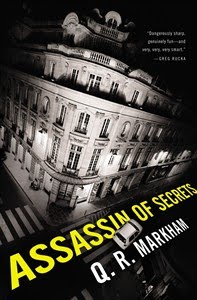
So news broke this week that Q.R. Markham’s debut novel, ASSASSIN OF SECRETS, was being pulled from shelves after the publisher (Mulholland Books) discovered that numerous passage had
allegedly been taken from other sources.
To get a sense of what they mean by “numerous,” follow this handy link. Apparently the only part of the book that Q. R. Markham didn’t plagiarize was the overly generic title and his bio.
My question is, why would a new author do such a thing? And more importantly, after all the plagiarizing scandals of the past decade (see: Stephen Ambrose, Kaavya Viswanathan, et al), how could he blithely expect not to get caught? In the digital era, all you have to do is type in a key phrase, and Google can usually instantly match it to a source. So why take the risk?
I have to wonder what the months leading up to his novel’s release have been like for Q. R. Markham. Was he basking in the thrill of having gotten away with something? Was he w
aking up nightly in a cold sweat, shaken by nightmares of being discovered? (Something about his pose in the photo to the left leads me to suspect probably not.) Or had he actually managed to convince himself that the work was his own?
And how did Mulholland Books (an imprint of Little, Brown) get so far along in the process without discovering the malfeasance? The book was released a week ago, which means that ARCs of it made the rounds months earlier. In fact, Publisher’s Weekly gave ASSASSIN OF SECRETS a glowing review, praising it as “quirky” and “entertaining.” My favorite part: “the obvious Ian Fleming influence just adds to the appeal.” Yes, of course, the Ian Fleming “influence.” As in, passages were extracted directly from his James Bond series and dumped into Markham’s narrative.
But he didn’t limit himself to stealing from merely one giant of the spy genre: Robert Ludlum’s books were also liberally borrowed from. Other excerpts have been attributed to John Gardner, Charles McCarry, Geoffrey O’Brien, and James Bamford. I have to admit to being a bit tickled by the inclusion of my pal Raymond Benson’s HIGH TIME TO KILL. If you want a great espionage read, go to the source on that one.
Here’s the thing. I’ve been forced to jump through numerous legal hurdles with each book, ranging from acquiring permissions for song excerpts and poems, altering university and town names, and changing one benign reference to Star Wars for fear of igniting a legal response from mighty Lucasfilm. So who feel asleep on the job here?
I have a frie
nd who recently discovered that his novel ULTIMATE RUSH was being made into a film by Sony Pictures- yay, right? Except here’s the rub: they never optioned it. They changed the title to PREMIUM RUSH, altered a few character names, but adhered to the overall plot about a bike messenger on the run. Joe has been fighting them in court, so
far to no avail. Theft, pure and simple. Apparently in Hollywood, it’s easier to get away with that sort of thing.
This has to be hugely embarrassing for Mulholland, especially since it’s a newer imprint that just started releasing books this past April. The question now is what happens to Markham? His second book has been canceled (obviously, although I’d love to see who he robbed to write that one), and I’m guessing he’ll be asked to return the advance. But will he also be sued by Mulholland? How about the people whose work he co-opted? (Here’s your shot at the big bucks, Ray).
Anyway, here’s the takeaway. You never rip off another writer’s clever turn of phrase–ever. It’s cheap and wrong and basically illustrates that you’re incapable of an original thought. Shame on Q. R. Markham for thinking he could get away with it.
Have you ever written yourself into a corner? Have you progressed at least midway through your story and then realized your hero is going down a black hole and you don’t know how to get him out?Recently, I found myself in this situation. In my synopsis, which acts as my writing guideline, I was up to the part where the hero, Lord Magnor, goes to the underworld to obtain a sacred book stolen by Hel, Queen of the Shades. To get there, he has to die. Circumstances with the heroine make him despair of their future together, and so he takes a poison pill that another character has given him.
Here is what my synopsis said:
He awakens underground in front of an iron gate. This leads to a gold-paved bridge that crosses the river Gjoll. Beyond is Helheim, where Hel resides. A giantess guards the gate and asks him for the password. If he fails to give the right answer, she’ll toss him in the river and it will carry him to the land of fire and eternal torment.
Magnor figures out a way past and meets Hel. She isn’t willing to give up the Book of Odin, not even for the mead he’s brought. So he creates a diversion and steals the sacred book.
Now this presented several problems. How does he get past the giantess when he fails to give the right password? How does he get into Hel’s palace? What kind of diversion does he create, and how does he steal the ancient relic?
I printed out these questions and sat on my “thinking couch” until the answers came to me. First of all, if he fails to give the right password, the giantess won’t throw him in the river. Instead, she’ll doom him to spend eternity in the company of other lost souls.
At that point, he has to find another way past the gate. He doesn’t have any cutting tools or acid to break in at some point farther down the line. And even if he could do so, how would he cross the raging river? What he does have are his wits, so he eases into the shadows and cheats by climbing up the rocky wall lining the chamber and gaining access to the opposite bank that way. In other words, he goes up and over instead of across. It’s the Kobayashi Maru solution from Star Trek. If you’re in a no win situation, change the rules.
So what about confronting Hel? He decides upon a frontal approach, stating his business to the palace guards in such a confident manner that he convinces them to allow him an audience with the queen. I’m glossing over the details but suffice it to say he states his case to her and she refuses to comply. Now we need a distraction so he can steal the book that rests in a glass case.
In the story, I’ve already planted the seeds for this solution. He’s been given a magic horn that is supposed to sound a warning when the demon, Loki, is near. But what will happen if Magnor blows the horn within Hel’s palace? He does so, and glass shatters throughout the hall, including the case protecting the sacred book. He snatches the artifact as Hel’s minions surround him.
Now what? The heroine has been told she must obtain a golden apple from the Fae to revive him. But fairies aren’t part of Norse mythology, which my story is based on. Here is what my synopsis says:
Erika must return him to the land of the living. She realizes how much he means to her and won’t risk losing him. However, reviving him isn’t easy. Aware that she only has a certain window in which to resuscitate the warrior, she saves him just in time.
Okay, how does she save him? Anytime you leave things vague like this in your synopsis or writing outline, eventually you have to come up with the details. Again, I’d already sowed the seeds within the story. Erika, a descendant of Odin, has inherited some of his shapeshifter powers. She cannot change her own form, but she possesses the power to manipulate the earth.
Odin also had the “breath of inspiration”, and this reminded me of the breath of life possessed by the Mord Sith in Terry Goodkind’s Sword of Truth series. What if, instead of going to the Fae, Erika is inspired by the figurines of fairies she’s designed in her pottery studio? Fairies might not be real, but what about fairy dust? And so she uses her innate power to revitalize the hero with the magical dust she breathes into his mouth.
As you can see, whatever corner you back your hero into, if you’ve laid the proper groundwork for your story, the solution will arise from material you’ve already planted. So go ahead and gloss over these details in your selling synopsis, but be assured when you come to them in the story, the muse will help you fill in those plot holes. You can rewrite your synopsis accordingly.
So who else has backed a character into a corner, and how did you get him out?
By Kathleen Pickering http://www.kathleenpickering.com
One of the beauties of being an author is that you find stories everywhere. Since this is a mystery writers’ bog where I am so kindly welcomed as a multi-genre author, I want to try my hand at a mystery. Wanna play?
So, it’s a beautiful Sunday morning along the New River in downtown Fort Lauderdale. You are heading for a Jazz Festival where folks may not actually be as they seem.
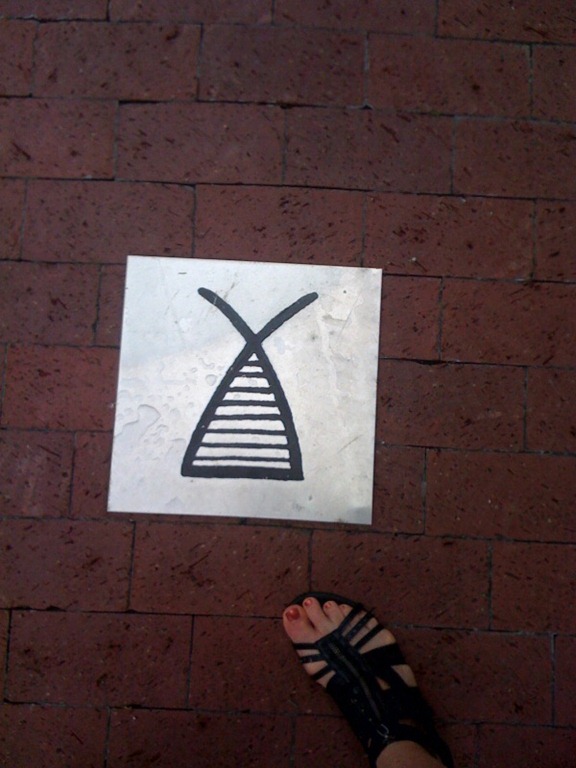
To reach the river, you enter an open park with a large pavilion just before the river walk. On the paved sidewalk you find this symbol:
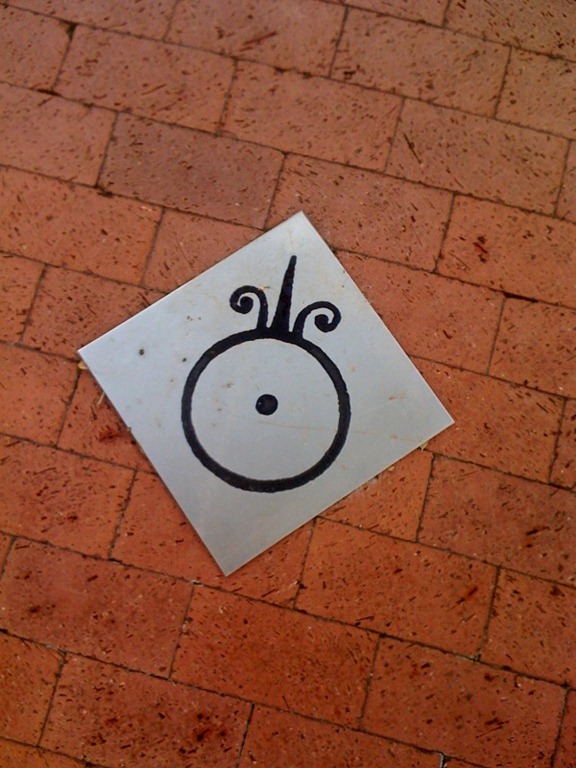
You think, that’s cool. Is it a fish? A dwelling? It’s just a novelty until you reach the other side of the park. There where the path ends you see this symbol:
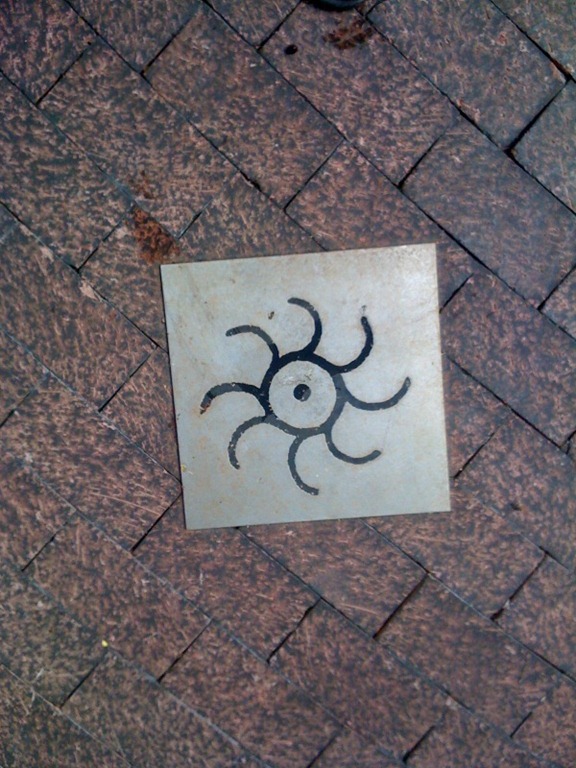
Now, you can’t help it. You follow the orange-brick road circling the other side of the park and discover this:
Now, you’re wondering, is this a secret code? Directions for aliens landing on the green? These symbols are not located at the four compass points, but simply dotting the path at four points where you would enter or exit the park. So, now, your curiosity is peaked. Is there another symbol in the other section you haven’t checked? Sure enough. At the path by the fountain at the city side of the park, you find this:
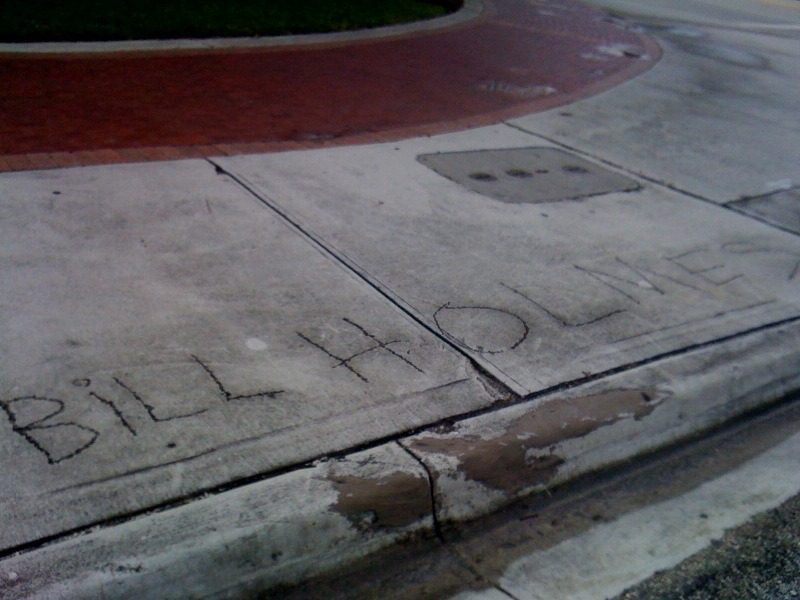
Then someone’s name is carved into the cement at the foot of the park:
If you tell me what kind of mystery this creates for you, I’ll tell you mine. I’m sure someone smarter than I will be able to tell me what these symbols represent. In the meantime, let’s make our own meaning and build a mystery. It doesn’t have to be long. A paragraph or two, like a cover blurb, will do just fine.
Now, as a throw in . . . across from the park is an open pit where they’re starting construction. The pit is lined with fencing decorate with images such as these:
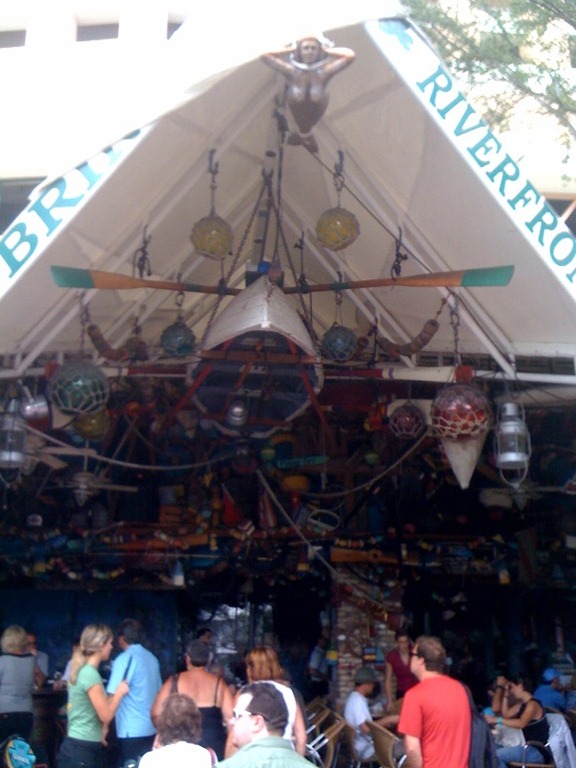
On the other side of the park is an odd tavern filled with flotsam and jetsam. It’s masthead is a flying mermaid. Do either of these locations have anything to do with the symbols?
Let ‘er rip, mystery writers! The winner gets a free, autographed copy of Mythological Sam – The Call. Let’s see what you can do!

By John Ramsey Miller
A few weeks ago, my wife and I were among the hundreds in attendance when Stephen King addressed an audience at George mason University as part of Fairfax, Virginia’s Fall for the Book Festival.
By way of full disclosure, seeing Stephen King live is to me analogous to what I imagine it would be for a classical actor to see Kenneth Branaugh. Or Laurence Olivier. While many of King’s stories don’s appeal to me anymore (I read Pet Sematary when Joy was pregnant–‘Nuff said?), he works the English language exactly the way I wish that I could.
He also worked the audience with supreme grace and skill. The fact that he was entirely at ease on the stage confirmed for me that his spontaneity was well-rehearsed. If that read as snarky, please re-read. I meant it as a statement of supreme admiration. As one whose Big Boy Job requires dozens of speeches a year–a few to standing O’s, I hasten to add–I can attest to the importance of hard work to making things easy.
Sooner or later, we all find ourselves alone on stage–or something like a stage–and I thought I’d share some of the tricks of the trade when it comes time to entertain an audience.
First, notice the E-word. Embrace the fact that successful speakers are first and foremost entertainers. I don’t care if you’re delivering a eulogy or a paper on astrophysics. People will remember you if you’re entertaining. And they will forget you if you are not.
We all work too hard to be forgotten. So, how can we be memorable?
Step One: If you truly hate public speaking and are not willing to work for it, turn down the public speaking gigs. Your audience and your replacements will both be grateful.
Step Two: Remember that ain’t none of this about you–iy’s about the audience. Give thme a good ride, and they’ll love you forever. Turn to navel-gazing bullshit about your muse and your struggles, and you’ll turn everybody off.
Step Three: Have something to say. This is where preparation and rehearsal pay dividends. And remember that making feel good is better than making them feel bad. Know where your laugh lines are and wait for them. If you don’t know how to do this part, sign up with your local chapter of Toast Masters and learn how to structure and deliver a decent speech. (See Step Two above.) Every person in your audience gave up the sure thing entertainment option of watching a Seinfeld rerun for the ninth time. You owe them at least as good a ride as that.
Step Four: Talk to your audience, not at them. Make eye contact. Smile. Invite input. The fact that this is the 4,784th time you’ve delivered this speech doesnt change the reality that it’s the first time for each of your audience members.
Step Five (and this one’s a personal bugaboo): Yes, you need a microphone. I don’t care if you’re James Earl Jones on crack; you’re easier to hear in the back of the room if you’re amplified. (See Step Two–again.)
Step Six (actually, it’s 5-A): The microphone is a voice amplification device. It is not a pointer, a magic wand, or an extension of your Italian gesticulation hand. To work, it needs to be pointed at your mouth. We’re talking straight-on. Ninety degrees. If you’re speaking from a podium, think in arcs as you look from one side of the audience to the other. As your head moves, the mouth-to-mike distance should remain constant.
When using a lavalier microphone (always my preference), take time to hide the cord and the transmitter. Having that black cord swinging around gets in the way and looks ugly. Neatness matters to the audience. If you have an audio technician working with you, trust his advice. If you don’t, put the microphone a fist’s width from the underside of your jaw. For guys, that will be between the second and third buttons on your shirt. For ladies, that means that you have to dress in anticipation of a microphone.
There’s more, of course, but I think these are the basics. What do y’all think? What are your tricks or cardinal rules for presentations?