Author Affirmations with Stuart Smalley

by Jordan Dane

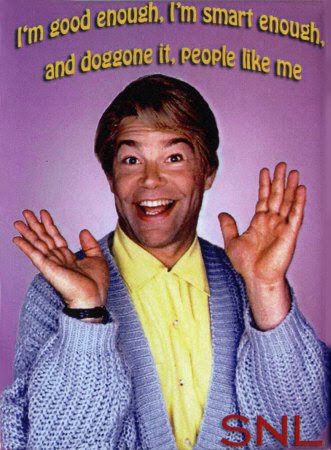
“Because I’m good enough, I’m smart enough, and doggoneit, people like me.”
Stuart Smalley, Saturday Night Live (Al Franken)


I’ll be on a panel at the Romance Writers of America annual conference in Anaheim in July – “The Care and Feeding of the Writer’s Soul.” Ever since I committed to doing it, I’ve been pondering my contribution and examining my own practices when it comes to nurturing my writer’s spirit.

But I wanted to open the topic up for discussion here to get your input. If you could create a box of affirmations for the writer, what would be your personal contribution?

On my computer I have been collecting sayings that have meant something to me over the years. These have come from author speaking engagements, emails, or things I’ve found online that inspired me enough to post it where I could see them every day. Affirmations can be reminders of author craft you want to repeat or they can be a way to keep a positive attitude or make progress in your career.

Here are a few sayings on my computer that mostly deal with author craft:

“Stick with the action.” Romance author Dana Taylor
When I muddled an intro action scene with back story, Dana wrote these words in an email after she critiqued the scene.

“Be there.” James Patterson
Patterson was a speaker at am RWA conference in 2004. He filled a ballroom, standing room only. By these two words he meant to put your reader into the scene using all their senses. He also said that he puts as much care into the first sentence of each chapter as he does the first line in any book. (I wonder if all the James Patterson(s) do this?)

“Trust the talent.” Robert Crais
I heard Crais present this on a video he sent via email in one of his newsletters. He talked at length about how he writes in constant fear, but that he trusts the talent that has brought him his success. It reminded me that all people have doubts. That’s human nature, but when you have a natural storyteller inside you, you should trust it.

“Get in, make your point, then get the hell out.” Robert Gregory Browne
Rob spelled this out when he explained ELLE on a blog post. Enter Late, Leave Early. The method is best explained by the TV show “Law & Order” where the scenes are sharp, concise, and don’t over-explain to slow pacing. The barest essentials of the scenes are captured to move the story along and a viewer’s mind fills in the gaps in action. The same works for books.

Here are a few that would be my contribution to keep a positive mental attitude:

“The next pair of eyeballs to see this proposal will be the ones to say, Yes!”

“I strive to be better with every book. My best story is always my next one.”

“I touch new readers with every story.”

“My books are unique because they are filtered through me and my personal experiences. I’m not in competition with anyone, except me, to be the best author I can be.”

Here are a few silly ones:

“I never get my page numbers wrong. I must be good at math.”

“When I kill people on paper, they stay dead. Booya!

As for practices to keep me positive, I have a shredding ritual for any rejection to expel the negativity from my house. Try it. It’s liberating. When I complete any project, I also treat myself with something that isn’t food—time off, vacation, fun evening with friends or family, attend a book signing, buy a new outfit. I used to think that each positive step in my quest to become a published author was only a small part of a longer future—that celebrating too much is a distraction that can swell your head. But now I celebrate everything. Life’s too short not to cherish even the smallest of pleasures.

Please share your thoughts. What would you write and contribute to an author’s affirmation box? What practices do you have to keep your mind positive and your writer’s soul nourished?

First-page critique: Untitled

By Joe Moore

Our annual first-page critique marathon continues with an anonymous submission that came in untitled. Take a look at it. My comments follow the text.

He stepped out from behind shadows cast by large oak trees, “Good evening.” Not a second passed before her smile faded. She obviously didn’t recognize him. A scream seemed to be stuck in her throat while she pulled her Publix grocery bag close to her body. She stepped away from him and when her elbow hit the wall of the house, two eggs fell out of a pink Styrofoam carton and onto the cement porch, orange yolk spraying against his polished shoes.

He felt his jaw tighten. “Open the door and don’t make a sound.” He kept both hands inside his coat pockets but gripped harder around the mallet in the palm of his right, in case she tried to run. First thing he should do is make her clean his god damned shoes.

She fumbled with the keys. She couldn’t be more than forty, but her hands shook like she was ninety years old. “I’m losing my patience with you,” he said. “Open the fucking door.” His voice sounded calmer than he felt. He wanted to crack her head open right there. Her skull would explode and her brains would splatter just like the egg yolk now drying on the tips of his loafers.

“Please. I have a brand new granddaughter I haven’t seen yet—” he shoved her inside when the key finally turned. She tripped on the corner of an area rug and the contents of her grocery bag spilled out across the hardwood floor. She crawled across the room and huddled against a wall. He shut the door and pulled down the shades.

The house brightened when he flipped on the light. It was tidy. Looked like something on the cover of Better Homes and Garden. In the center of the room, a rust colored sofa rested with a quilted afghan draped over the back. It was surrounded by dark cherry wood tables and a large grandfather clock encased in a solid oak frame.

Overall, this is not too bad, but it could be greatly improved. The setup has the same weakness as Monday’s submission—I felt like I’d seen the generic scene many times before, especially as an opening to so many TV dramas. The key to catching an agent or editor’s eye is originality—a new twist on a well-established theme. This is a basic setup but I don’t see anything new here. Not knowing anything else about the story, here are my line-by-line comments.

He stepped out from behind shadows cast by large oak trees, “Good evening.”

Ditch the comma and replace with a period after trees. Consider having him step out of or from the shadows rather than from behind them.

Not a second passed before her smile faded.

I would start a new paragraph with that line. And it reads a bit awkward to me. Under the circumstances, I’m not sure it’s even needed.

She obviously didn’t recognize him.

Does this signal to the reader that she should have recognized him? Perhaps she once knew him but he’s older or his appearance has been changed? Is he wearing a disguise? Or is his face otherwise well known or has it been on the news? Remember that the writer is laying the first groundwork here that has lasting impressions on the reader.

A scream seemed to be stuck in her throat while she pulled her Publix grocery bag close to her body. She stepped away from him and when her elbow hit the wall of the house, two eggs fell out of a pink Styrofoam carton and onto the cement porch, orange yolk spraying against his polished shoes.

I suppose that a Styrofoam container with a dozen eggs could be jarred open and have only two eggs fall out. Just being picky here, but I had to pause to picture if it were possible. Also, I assumed this is a big clue here: “polished shoes”. Does this signal that the aggressor is a well-dress villain or perhaps a neat freak?

jscHe felt his jaw tighten. “Open the door and don’t make a sound.” He kept both hands inside his coat pockets but gripped harder around the mallet in the palm of his right, in case she tried to run. First thing he should do is make her clean his god damned shoes.

Here we go with the shoes again. And his weapon of choice is not a knife or gun but a mallet? That’s certainly different. Perhaps he just came from eating stone crabs.

She fumbled with the keys. She couldn’t be more than forty, but her hands shook like she was ninety years old.

I liked this imagery with the hands although saying he wasn’t sure of her age gives me the impression that she may have been picked at random.

“I’m losing my patience with you,” he said. “Open the fucking door.”

OK, it’s time for my speech. You can’t even begin to imagine how many potential readers you will turn off by using the f-bomb on the first page of your book. Using it proves nothing. My advice: just don’t do it. Oh, and you don’t need the “he said” here. It definitely wasn’t the victim speaking.

His voice sounded calmer than he felt. He wanted to crack her head open right there. Her skull would explode and her brains would splatter just like the egg yolk now drying on the tips of his loafers.

Boy, this guy is (1) ultra violent (2) really into his shoes.

“Please. I have a brand new granddaughter I haven’t seen yet—”

I felt like this was a strange way of saying this. It’s almost like saying, “I’ve got a brand new plasma TV I haven’t seen yet.” Rather than “brand new”, how about, “Please, I’ve got a family, a granddaughter . . .”

he shoved her inside when the key finally turned.

You mean when the key turned and the door opened. Also, it should be a capital H on he since it’s a new sentence.

She tripped on the corner of an area rug and the contents of her grocery bag spilled out across the hardwood floor. She crawled across the room and huddled against a wall. He shut the door and pulled down the shades.

The house brightened when he flipped on the light.

“Brightened” may not be the best word choice since it connotes cheerfulness.

It was tidy.

The house or the light?

Looked like something on the cover of Better Homes and Garden.

This is an incomplete sentence lacking a subject. But that’s OK if it’s a style thing the writer intends to continue throughout the story. Warning: incomplete sentences get old fast.

In the center of the room, a rust colored sofa rested with a quilted afghan draped over the back. It was surrounded by dark cherry wood tables and a large grandfather clock encased in a solid oak frame.

Very observant villain. Is this to help build his character?

———-

So here’s what I take away from this first page. We have a shoe-fetish, stone crab-eating assailant who is a possible interior decorator and who picks random, forty-something victims who buy physics-defying cartons of eggs. What a hoot it would be if I were right.

These are my personal first impressions of this sample. Other’s may disagree with me or have different reactions. I’ve been hard on this writer, more so than normal even though this is a somewhat awkward but decent first draft. All first drafts need work. And I would keep reading at least for a few more pages to see what happens.

But my comments were also meant to emphasize that EVERY WORD COUNTS. Each word is like a brick laid in place to form the strong walls of the story. Choose them wisely.

If my facetious interpretation of this first page is correct, then it’s excellent storytelling. If not, I suggest the writer go back and rework it until every word builds on top of the previous one to form a solid image in the mind of the reader. Thanks for submitting it and good luck.

How about the rest of you innocent bystanders? Would you keep reading or go out for stone crabs?

THE HOLY WILD–A YA First Page Critique

By: Kathleen Pickering  http://www.kathleenpickering.com

Yukon

I had the privilege to read this anonymous first page of a Young Adult novel. It’s intriguing, but IMHO left me a little cold on the emotional side.

I made comments after the work. This writer has talent. Viewing a dead loved one on the first page definitely is riveting. With just a little more emotional punch, this piece will rock! Read on. I’d like to hear your thoughts, as well.

THE HOLY WILD

My father is frozen solid. He lies face-up on the Ski-Doo trailer in my front yard, bound in place by a length of yellow rope around his torso. His legs jut out over the back, and from where I stand in the open doorway of our house, I can see the lower half of his face – blue-white skin and a moustache encrusted with ice. I stare at him and forget to breathe. I want to run to him, to grab his shoulders and shake him from sleep, but I can’t. It’s as if the cold has claimed me as well, slowing my mind and stiffening my limbs.

January air claws its way into my lungs. Beside me, my mother sways. I expect her to crumple, to break as I’m about to break, but her hand darts out and latches onto my forearm, steadying us both.

That really is him.

At the bottom of the steps, Chase Taylor and his father stand on the tramped-down snow. They whisper, but I hear. They’re debating whether it’s better to take my father inside to thaw or leave him outside in the cold. My head shakes no – no, they can’t be having this discussion. No, he’s not gone. No, he never wandered off into the Yukon wilderness in the first place.

When they decide to wrap him in the old orange tarpaulin that covers our woodpile and deposit him in the snowdrift against the south side of the house, a scream rises up and lodges in my throat.

“At least we found him,” Mr. Taylor says to my mom.

At least we found him? What kind of stupid comment is that? The concept better late than never doesn’t exactly apply in this case. I fight to keep myself from pummeling him with my fists, reminding myself that it’s not his fault. In the dying light, I ease out a long, slow breath and work to convince myself that being found is decidedly better than being lost, even if you’re dead.

***

This is a compelling beginning, but I must say, for a first page, I don’t have enough information (who, what, where, when, why and/or . . . why not?) to be emotionally invested in such a difficult moment. So, I was left shrugging my shoulders and saying, “So what?”

Now, as someone who witnessed her father’s death over 20 years ago and misses him every day, I understand the trauma behind viewing the frozen, lifeless body of one’s hero and wanting to puke at the logical, but morbid and heart-wrenching debate over whether the body should be kept frozen outside or brought inside to thaw. But, some of the important facts have not been delivered to gain my full empathy. What I want to know is:

– Who is the narrator here? Gender? (From the voice, I’d say female.) Age?

– Why did the father wander into the Yukon, and why was that bad? (Other than his death, of course.)

-Are they in the Yukon now? (From the title, HOLY WILD – which is a GREAT title, I’d say, yes.)

– What is going to happen now that he is dead?

– Most important of all, tell me how this character’s world just crumbled and what he or she is going to do about it.

Oh, and the last paragraph on this submission made an excellent hook. It could also be a great first paragraph.

Now let me add that all of this info could not be delivered in the first page, but I do need to know one or two more facts to hook my emotional investment in this character and the story.

For example, the sentence, ‘The concept better late than never doesn’t exactly apply in this case,’ does little to move the story forward. That sentence could be omitted and one with more pertinent info be added. (i.e., My father found dead won’t protect us from his brother’s claim on our land. Or whatever the threat is. You get my drift. More info to invest the reader in the story.)

That’s the nit-pick of my evaluation.

Now, what is wonderful about this first page is that the writing is crisp, the scene visuals are crystal clear and my imagination is triggered to the tragedy. I can see the build up into a potentially threatening situation. The Yukon is an interesting setting about which I know nothing. So I find that particular piece of geography interesting. I like that.

All I need is the emotional punch behind this awful death and I’ll be hooked. Believe me. So much can be delivered in one sentence. This first page has five to six paragraphs. Some of the exposition could be cut to answer one or two of the questions which would move the story forward while enlightening—and hooking the reader.

This was an exciting beginning. On a scale of 1-10 with 10 being the highest, I’d give this work a 7. I would read more.

And again, this is my opinion. . . and you know the drill . . . everybody has one!

Thanks for submitting your page and letting your work air for all to see, oh Brave Author!

Write on!

xox, Piks

Inside the Mind of Evil


Today’s first page critique raises the tricky area of starting a novel from the antagonist’s perspective or getting ‘inside the mind of evil’. As this page reveals it can be a very effective technique – but (and this is a big but) you have to be careful. It can very easily fall into cliche. As this first page reveals, however, it can also be a great way to suck your reader in quickly to the story – raising the stakes as well as the tension.

So here is the first page of the submission entitled SINS OF THE FATHER.
My comments follow at the end.

Sunday, August 12

Erin looks like his first. The resemblance was clear from the moment he saw her: the red hair; the delicate nose and freckled skin; the way one corner of her mouth quirks up with dry humor in response to a comment from her companion. Now, watching her unobserved from the safety of fifty yards’ distance and a thicket of brush as concealment, he can see the resemblance to her namesake even more clearly. It’s as though he’s traveled back in time… As though forty years have vanished in an instant and he is a boy once more, flushed with the promise of that first kill.

Fear radiates from both she and her companion. Through night-vision goggles special ordered for just such an occasion, the Hunter can almost see Erin’s dilated pupils, the way her chest heaves as she half-drags her friend to some imagined safe port in the storm. Her friend – blonde, blue-eyed, with a close-trimmed beard and a penchant for watching her when she is unaware – is bleeding. Badly. Between his blood and the haphazard way they forge through the underbrush, tracking them is a simple matter.

The clouds are thick in the night sky, and there are thunderstorms in the forecast. The highway is at least a mile from here. Since he began tracking them, Erin has made some surprisingly foolhardy decisions – frankly, he’d expected more of her, but she’s been running in exactly the wrong direction for the past six hours. She and her friend both have cell phones, he is certain, but there’s no reception in this area – they’d have better luck using tin cans tied together with string out here. It’s only a matter of time.

He prefers hunting in the spring or fall – while the ground is still soft enough to ensure easy burial after the kill, but before the summer’s rampant overgrowth makes progress through the woods slow going. Erin forced his hand this time, but he’s not bitter about that. On the contrary, he’s looking forward to the game. He’s always loved a challenge.

My comments:

I think this first page is very effective in drawing the reader in – it establishes the scene well, raises the stakes and leaves the reader eager to learn more. There are a few minor points however that I think might make this first page even more compelling:

1. The descriptions in the first two paragraphs make it sound like we are in daylight and so when the night vision goggles are mentioned I was taken out of the story as I wondered how does he know the girl’s hair is red or the man’s eyes are blue if it’s at night? By the third paragraph it’s clear the hunter has been stalking them for hours but, still, the issue took me out of the story. 

2. The use of the name ‘the Hunter’  took me out of the scene as well. Although this first page is written in third person, the thoughts are those of the antagonist and I wondered whether he called himself ‘the Hunter’ or whether it sounded too distant – pulling us away from the very close perspective we have. I would also delete ‘almost’ from this sentence – he can either see her dilated pupils or he can’t – there is no almost – unless he is imagining it.  If he feels like a hunter I would also like the author to be more specific – what kind of hunter does he see himself as (what kind of predator?) The greater the specificity there is the less likely it is to feel cliched.

3. Though this first page didn’t feel too cliched to me, I do think the author needs to tread carefully, especially as the image of the perpetrator as a hunter who views his prey as sport has been done before – you need to keep it as fresh as possible.

4. I thought the last paragraph was very effective. It provided a good segway into the next paragraph/viewpoint. As a reader I wanted to know more about how Erin and her companion got into this situation and what they could possibly do to avoid being the next ‘kill’. The author balanced the need for information with the need for action really well, and I for one would read on.

So what did you all think? What is your views on successfully portraying the inner mind of the antagonist? Does this first page succeed? Would you keep reading?

Limit the Exposition in Your Opening Pages

James Scott Bell
Twitter.com/jamesscottbell


Since I am the resident zombie fiction guy, the first page I’ve been given for critique is, not surprisingly:
Z.O.M.B.I.E. Squad:  Hot ZOMBIE Nights
Jaz surveyed the semi-dark alley after escaping from her BMW. Drat. ZOMBIES. Not what she needed at the moment. How would she explain this to her new boyfriend?  Not the ZOMBIES per se, but the fact that this would be the third time this week that she’d bailed on dinner with him. Well, if he was a quality catch, he’d let her make it up to him, if not, there were other non-ZOMBIES out there in the world. Right?
There was a screech of metal on metal, as one of the ZOMBIEs dragged something along the side of her M3, and it would definitely leave a mark.  Ok, “drat” just officially became “double-damn” the minute both her love life and her car became casualties. Being undercover with ZOMBIE International Technologies was never easy. Often it downright stunk, just like this alley. It always seemed to be us or them and just a street away from normal. Whoever thought that all aliens were smarter and more techno-savvy, never met a pod-ZOMBIE.
The pod-Zs looked almost as unearthly as they were. Jaz could see their sallow, waxy faces as they stepped out of the shadows and into the moonlight. Light-colored images of the humans they might have been. Ok, maybe she could see why someone who didn’t know better might think they were just the walking. Jaz’s chest heaved a bit as she took in one, deep, cleansing breath. It was warm, wet, and tasted a bit like the Cuban carne asada she’d planned on having for dinner. She sighed as she pulled the transonic pen-dart from her bra: her $100 Dior Du jour, lace alternative, super-sexy, continental blue bra, with matching underwear. Yes, they did match her Beemer perfectly. That should say something about the level of clothing perfection and date desirability she had worked so hard for as she prepared to meet up with 3DP-vid god, Wylie Taylor.
It pained her to risk her Dior bra by using it as a weapon holder, but without stockings, there were few choices to secure a pen-sized super weapon and keep it accessible.
****
Paranormal fiction. Zombies. You have to build a world, and that’s what the writer is attempting to do here, plus give us exposition to boot. And the instincts are good: weave the exposition within the action.
However, this opening is weighted too heavily on the informational (notice how “blocky” the text is on the page). It’s a common mistake made because the writer feels the reader has to be clued in to a lot of background before he can understand what’s going on.
Almost always a wrong choice. Because readers will wait a long timefor explanations so long as something is happening that is disturbing.
This first page delivers a great opening disturbance. To make it even more effective, let the action be primary and drop exposition in later, a bit at a time.
To show you what I mean, here is the opening rendered with just the action sentences:
Jaz surveyed the semi-dark alley after escaping from her BMW. There was a screech of metal on metal, as one of the ZOMBIEs dragged something along the side of the M3.
She could see their sallow, waxy faces as they stepped out of the shadows and into the moonlight. Light-colored images of the humans they might have been. 
She sighed as she pulled the transonic pen-dart from her bra.
***
I am much more in this scene now. I want to keep reading. I want to know what that thing in her bra does.
The author has me hooked, and can begin to drop in exposition as needed. But keep it brief. The next lines might be:
Being undercover with ZOMBIE International Technologies was never easy. Often it downright stunk, just like this alley.  
Then get back to the action. Then later the stuff about the boyfriend. More action. And so on.
Also, I’d cut: The pod-Zs looked almost as unearthly as they were. This is a “tell” just before the “show” of the next sentence. The latter creates a picture for the reader, who can then draw his own conclusion.
I like the voice that is “lurking” here. But it sounds “once removed,” e.g. in this line: That should say something about the level of clothing perfection and date desirability she had worked so hard for as she prepared to meet up with 3DP-vid god, Wylie Taylor.
This is the author commenting on Jaz, not something from Jaz herself. I wonder if the author might consider turning this into a First Person narration. Then the fun aspects of the voice could come out more naturally, e.g.:
I pulled the transonic pen-dart from my $100 Dior Du jour, lace alternative, super-sexy, continental blue bra, with matching underwear. Matched my Beemer, too. But this was about date desirability. Hard work, but then again it was 3DP-vid god Wylie Taylor I was going to meet up with.
If I ever got away from these Zs.
That’s just a suggestion, something to consider. You can achieve pretty much the same effect in Third Person, but you should make sure the narration sounds like thoughts your character would actually think, and keep author commentary out of it.
I like this concept. Hey, fun zombie thrillers are my bag. So hook me with action in this first chapter and drop in only the exposition that is absolutely, positively necessary for the understanding of the scene.
It is much less than you think. And a much better start without it.

Dang Excellent Submission

John Ramsey Miller is very much impressed with this submission. What can I say? It starts with the end, or does it? The bubbles tickling as they exit. Vibro dance. It’s all here. Just read it and agree. 
Nerve Damage
 
Beads of sweat glowed on sun-drenched, silken skin. She lay on the diving board, positioned on her stomach, face resting on folded arms. The wickedly delicious events of the morning left her physically sated.  Her other appetites blazed. The cell phone rested within easy reach. Any moment the call that would make it happen. From captive princess to ultimate victor; she’d outsmarted them all. She basked in the sun and the brilliance of her imminent triumph. 
Jester, her King Charles spaniel and favorite creature on earth, sat atop the poolside settee. He startled as the ring-tone trilled and the phone vibro-danced on the board’s grainy surface. She picked it up and noted the incoming number. She closed her eyes, savoring the moment. She raised the phone.
Before the device reached her ear, it dropped from her hand, bouncing off the board and splashing into the water below. 
The muscles of her forearms quivered as a freakish spasm passed through her body.* Jester jumped off the settee with a yelp. He crouched, whining, paws extended and belly pressed tight to the ground. 
Weakness cloaked her. She struggled to her elbows. Her limbs failed and her shoulders twisted as her now unresponsive arm acted as a lever that rolled her, as if in slow motion. Her muscles would not respond. She summoned one weak cry as her body hit the water.   
Her face plunged under the surface. Internal commands to swim and thrash yielded nothing. The fresco on the bottom of the pool rotated before her fixed and unblinking eyes as she spun and sank. Can’t move shrieked through her consciousness. Her heart pounded in her chest and ears. Water passed through her nose and mouth. Tiny bubbles rushed for the surface, tickling in their exit. Fluid advanced down her throat and balloons of air escaped, belching out and up. The reflex imperative to cough and gag was insistent but her body did not respond.
 
Water flowed down her windpipe, the dense and cool sensation terrifyingly foreign but unmistakable. It invaded her lungs. Like a continuous first breath on an icy winter’s morning, but it was not air. And it did not stop.
 

First Page Critique: DON’T SAY A WORD

by Michelle Gagnon

Today’s first page critique submission is entitled, DON’T SAY A WORD. As Joe said yesterday, we’re accepting 350 words max of works in progress. We aim to provide an overall assessment of the work based on what we’ve learned through our own publishing experiences. We hope it will be helpful not just to the author of each work, but to all of our readers.

DON’T SAY A WORD

“All right, Marconni, see Valentino. There. Mickey’s the one in the red silk,” I said, pointing to the three gang members of the Valentino family gathered in the New York City Italian restaurant.

Assistant FBI Director John Marconni drew in a deep breath as we watched the surveillance feed. The lights inside glowed dim, and the closed sign appeared in the window with the red checkered curtains two hours ago. The last public patrons were long gone.

“They won’t be there long. Valentino doesn’t socialize well,” I said, running a hand over my neck, massaging the tight muscles.

Marconni nodded. “He’s not slipping out this time, Aiello.”

“You won’t take him alive,” I said, shaking my head, “he’ll never testify.”

I grimaced and felt adrenaline pumping into my system. At least at this hour, whatever went down, no more civilians would die at Valentino’s hands.

Marconni raised his hand and spoke into the mike. “Hold, Team one. Eyes open, Team two!”

I saw it.

Movement on the street caused Marconni’s hesitation.
A figure appeared out of the shadows and walked toward the restaurant. A woman, dressed to the nines, clingy red scrap-of-a-dress, four inch heels, body to die for. Long brown tresses cascaded to her waist. She fished in her purse for something.

“We got her, boss. She’s going in. Team two, hold position. We got a renegade on approach.”

My heart slammed into my chest.

She inserted keys into the lock and for a fraction of a second, as she opened the door to the Valentino hideout, the dim lights inside illuminated her face.

“You seeing this, Tony?” Marconni asked.

“I see it,” I growled, the recognition flooding into me, twisting my gut.

I watched as the woman walked over to Mickey Valentino. He pulled her into his arms and they embraced. Kissed. His hands roamed all over her, and I watched with revulsion as she responded to him.

“We gotta go in, Tony. I’m sorry,” Marconni whispered where only I could hear. Then he spoke into his mike, “Go, Team Two. Take ‘em alive. All of them.”

As an opening page, I really enjoyed this submission. The author does a good job of dropping the reader into the middle of a scene without an inordinate amount of exposition. The stage is set nicely for whatever is about to transpire.

I do wish that I was given a better sense of where the narrator is vis a vis the action; is he in a van? I assumed so, based on the surveillance feed line, but a single sentence of clarification would be helpful. What does it smell like inside the van? Maybe it reeks of take out, since they’ve been there for awhile. Perhaps our narrator is hungry, since he’s been stuck there for hours. Also a few lines about the restaurant, and/or the surrounding area. Is there anyone else outside? Is it summer, spring, fall? This is another opportunity to provide a few key details that really set the stage. I understand that it’s late; can he hear garbage trucks collecting trash from dumpsters? A few cabs sliding past on the nearly empty streets? Are homeless people dozing in nearby doorways?

And what does Marconni look like? Is he in a sharp or rumpled suit? Old, or young? Again, just adding in a sentence here or there to build a sense of what the characters look like and what they’re feeling would be helpful.

There’s a nice noir feel to this piece, and I think it would be great to expand on it a bit. But some of the phrasing is a bit trite: grimacing, heart slamming into my chest, adrenaline pumping into my system. These are all nice and descriptive, but a bit overused. I would aim for more subtlety, and coming up with a way to illustrate these sensations that is more original.

All in all, I would definitely keep reading. I’m curious to find out what the narrator’s relationship is to this woman, and to discover what’s about to happen in the restaurant. Well done.

First-page critique of LISTEN TO ME

By Joe Moore

Today we kick off our annual first-page critiques marathon. This is where we invite you guys to submit the first page (350 words max) of your WIP. We’ll take turns featuring a submission on our blog posting day and offer comments. In general, this is not meant to be a line editing exercise although suggestions on misspelling, improper punctuation, and other obvious errors are sometimes included. Instead, what we try to determine is our personal first impressions on story content, hooking the reader, establishing voice, creating a setting, developing characters, and any other advice that we hope will help the anonymous author move forward toward attracting the attention of an agent or editor.

Today, the first page is from a story called LISTEN TO ME. Join me at the end of the sample for my reaction and notes.

As he sinks slowly into the chair across from me, he looks just like a doctor should — greying hair, a well-trimmed beard with badger stripes framing his lips, and wire-rimmed glasses his wife must have chosen. They’re far too tasteful compared to the terrible shirt he’s wearing. On the plus side, his smile seems genuine.

"How are you feeling about today, Stacy?" His voice is too loud for the muted tones of the room – – all earthy browns and soft corners. It’s his office, but he’s tried to make it look like a living room. There’s a broad coffee table between us, and lamps on the tables at our sides. Too bad the external door has a combination lock. Kind of kills the good-time vibe.

He’s waiting for an answer. I start shrug, then freeze in place until the razors of pain ease. My stitches are all out now, but the hard pink lines spider webbing across most of my upper body are just the flag of truce for healing. Underneath I am still many layers of mangled nerve endings and fractured flesh.

Doctor hears me catch my breath and his eyes snap to mine. All that beguiling distinterest is an act. He is measuring me.

"Pain?" he says, softly this time.

"Yes. But it’s not so bad. I just moved wrong." It burns and crackles under my skin until I want to scream. But I won’t tell him that. He may measure me as wanting.

I will get out of here today.

His lips press together, barely visible under the curtain of heavy mustache. But after a second he smiles again. Planting his hands on his knees, he creaks to his feet, speaking as he turns to reach behind his chair.

Overall, this is pretty good storytelling. There’s a lot of mystery and unanswered questions already forming in my head. I immediately wanted to know more about Stacy, what brought her into what looks like an exit interview with the doctor, what kind of place is she being released from, why is there a combination lock on the door, and most of all, what caused her extensive and dramatic injuries. The setting is developed well as is the uneasy relationship between Stacy and the doctor. Tension is present right from the start.

Now lets take a look at the text again and I’ll include some specific impressions:

As he sinks slowly into the chair across from me, he looks just like a doctor should —

How should a doctor look? Instead, just describe him as having greying hair, a well-trimmed beard with badger stripes framing his lips, and wire-rimmed glasses his wife must have chosen. They’re far too tasteful compared to the terrible shirt he’s wearing.

I’m not sure what a “terrible” shirt is.  Florescent, day-glow, Hawaiian, animal skin, camouflage? Tell us why it’s “terrible”.

On the plus side, his smile seems genuine.

"How are you feeling about today, Stacy?" His voice is too loud for the muted tones of the room – – all earthy browns and soft corners. It’s his office, but he’s tried to make it look like a living room. There’s a broad coffee table between us, and lamps on the tables at our sides. Too bad the external door has a combination lock. Kind of kills the good-time vibe.

You didn’t describe a place that has a “good-time vibe”. Unless you’re being sarcastic, in which case we don’t know yet what Stacy’s personality is, so good-time vibe doesn’t really work here.

He’s waiting for an answer. I start to shrug, then freeze in place until the razors of pain ease. My stitches are all out now, but the hard pink lines spider webbing across most of my upper body are just the flag of truce for healing. Underneath I am still many layers of mangled nerve endings and fractured flesh.

Flesh is soft. I’m not sure if you can fracture soft flesh. Perhaps torn would be better?

The Doctor hears me catch my breath and his eyes snap to mine. All that beguiling distinterest is an act. He is measuring me.

"Pain?" he says, softly this time.

"Yes. But it’s not so bad. I just moved wrong." It burns and crackles under my skin until I want to scream.

Is “crackles” really the best word choice here?

But I won’t tell him that. He may measure me as wanting.

I will get out of here today.

His lips press together, barely visible under the curtain of heavy mustache.

I don’t think “a well-trimmed beard with badger stripes framing his lips” works visually with “barely visible under the curtain of a heavy mustache”.

But after a second he smiles again. Planting his hands on his knees, he creaks to his feet, speaking as he turns to reach behind his chair.

————-

My advice about the typo (distinterest for disinterest) and a missing word (I start to shrug): Rule number one before submitting anything to anyone for review: Proof read it. Then get someone else to proof it. Finally, check and double check it again. A typo on the first page of a manuscript can be deadly.

Like I said, this is pretty good storytelling. A cleanup and edit would solve the minor issues I raised. I like the way the author is building suspense right out of the gate. I would not hesitate to read on and see what happens next. Thanks for submitting this, and good luck.

How about you guys? Do you agree with my critique? Any other comments? Would you keep reading this manuscript based on the first page?

We’re doing first-page critiques again at TKZ

We’re launching another round of first-page critiques  here at TKZ! You can send us the first page of your manuscript (anonymously, of course!), and we’ll critique it. Sound good?

Here’s how it works: Send the first page (350 words max) of your manuscript  as a Word attachment, along with the title, to the email address killzoneblog at gmail dot com. (We’ll take the first 33 submissions we receive over a month’s period, first come first served.) The pages will be divvied up among the Killers. From time to time we’ll post each page, and do a critique. Everyone will be able to comment as well.

Last year we had great fun doing this exercise! We’re looking forward to reading some of your pages!

Disconnection

by Clare Langley-Hawthorne

I had the most frustrating experience this weekend as I returned to Australia only to discover that the painters who had been painting the inside of our house had not only failed to return any of the furniture to its  rightful place but had also managed to disconnect our wifi. After 15 hours flying solo with my twin 7-year olds in tow I can’t say I was  thrilled to face either prospect – but it was the disconnection from the outside world that I found the hardest to bear. 


After trying and failing to reconnect the wifi (picture a heap of tangled wires, various Apple, Sonos and wifi devices on the ground and me, tech-moron extraordinaire, standing over it all in despair) I found myself hunched over my iPhone desperately trying to send email and texts and reading the news in 4pt font. I never thought of myself as addicted to being online but once I was disconnected I realized just how ingrained my need for internet access 24/7 had become. 


It’s amazing how everything I do – from my role as secretary to the local American Women’s Auxiliary to my writing job – depends on email. I couldn’t email the agenda for our board meeting or send my latest proposal to my agent. I was truly (if only temporarily) off the grid…and it kinda freaked me out. 


Of course, my husband has now managed to instruct me long-distance how to restore all necessary connections so I am back online but not before I realized (sadly) just how reliant I had become.


So what about you? How would you cope being ‘disconnected’ – would you revel in the freedom of not being tethered online or would you, like me, stare into the void and blink…