
By John Gilstrap
My next book, Damage Control, hits the stands on June 5. In this edition of the Jonathan Grave thriller series, Jonathan steps into a trap when he and Boxers travel to Mexico to rescue a busload of missionaries from the hands of a drug cartel. Someone in Washington betrays him on what should have been a routine ransom drop-off, and the result is a lot of dead hostages and kidnappers. As Jonathan and Boxers escape with the lone survivor, the cartel and their sponsors in Washington move heaven and earth to stop him. Publishers Weekly gave the book a glowing review, and I’m pleased to report that my publisher, Kensington, is pulling out some new stops in the promotion department.
One of the coolest things I’ve been asked to do is a video blog that brings readers deeper into Jonathan’s world. I’m calling it “Jonathan Grave’s Arsenal.” In two-minute segments, I’ll give overviews and demonstrations of the weapons Jonathan has at his disposal. So far, I’ve completed videos highlighting Heckler and Koch’s 5.56 mm HK416 (designated the M27 by the US Marines), the Colt Model 1911 .45 caliber pistol, and the Mossberg 12 gauge shotgun. By the time I’m done, the series will cover, at a minimum, the 7.62 mm HK 417 and the amazing 4.6 mm HK MP7. I’d like to do some episodes on explosives, too, but I haven’t yet figured out the logistics of that, what with all those pesky ATF rules.
While I’ve written a few movies over the past decade or so, I haven’t actually shot one in a long time. The last time I edited a film, I used a home version of a Moviola, literally cutting the film and splicing it with tape.
When first approached about this video blog thing, I had no idea how I was going to do it. Sure, I have a digital camera that shoots video, but I’d never actually shot video with it. Plus, since talking heads are boring—and, in my case, shiny—I knew I’d want to do cutaways.
Well, lo and behold, my Windows 7 program comes complete with Microsoft Movie Maker, an editing program that is way more powerful than I would have imagined. More than adequate for my needs. You simply drag the segments you want to work with to the work window, and you can make precise cuts.
With the first episode in the can, as it were, my next challenge was figuring out what the hell to do with the 60MB files. They’d choke anybody’s email server. Enter: YouSendIt.com. For $149 a year, you can email an unlimited number of HUGE files to people. The Kensington team is thrilled with the results.
My only frustration—and I’m turning to you dear Killzoners for help—is how to do voiceovers in Movie Maker. From what I can tell, on the digital recording, the audio track and the video track are all together. Is this correct?
“Jonathan Grave’s Arsenal” will be exclusive to Barnes & Noble for the first few weeks of its existence, but then I’ll add it to my website and upload it to YouTube.
I feel a new obsession coming on. I deeply don’t need another obsession.
Critique of VANGUARD RISING
Today I’m offering a critique of an excerpt from VANGUARD RISING. I believe it serves as a great example of unexpected openings. Read on, and you’ll see why…
 The darkness was all encompassing. Dan could turn in any direction and save for the glow from the radio in the dashboard[,] there was only black. It was very fitting, it matched his mood. He had been feeling the black, emptiness since he woke up this morning. It was getting late. He looked at the clock on the radio faceplate. It had just turned ten.
The glowing radio dial meant there was noise coming from the speakers in back. He didn’t hear any of it. He only heard the storm in his mind. You don’t amount to anything. You’re a failure. Nothing you do is right. He pictured every mistake he had ever made. Every embarrassing moment he had ever experienced was brought to the surface, magnified tenfold.
When he was up he didn’t think about those things. But he was down right now. Way down. And he had been this way for days. He couldn’t take it anymore. He wanted it to stop.
Dan knew this personal trial well. He would put himself through it almost routinely. This time was different. The void he felt in his belly would be silenced this time. For good.
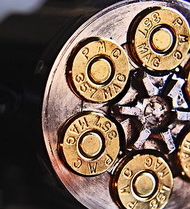
He reached over and opened the glove box, allowing the door [to] drop freely. He sat and stared for a moment at his savior nestled inside. One of the many things he had inherited from his father after his death. The cold blackness of its six inch barrel seemed soothing to him somehow. It was a statement of ultimate control in his world.
He reached in and grabbed the checkered walnut grip. It seemed heavier than [it] was only a few hours earlier. In the dim light of the radio he read the barrel, Colt Python .357 Magnum. For some reason, maybe because she knew it had value, she had kept it instead of selling it to one of his father’s friends.
He had found the last of the ammunition in the house. His mother had thrown out all of it she could find after the funeral. It seemed fitting that he came across it this morning in the garage by accident. Eight rounds in the bottom of a toolbox drawer.
He needed something to give him a feeling of control. Knowing he had it was burning at the back of his mind all day. He had a gun, and now he had bullets to go with it. They were even the right ones, 145 grain Winchester Silver Tip hollow points. More than enough to do job.
He unlocked the cylinder and swung it open. Six rounds. He only needed one. With a quick flick of his wrist the cylinder and its lethal cargo snapped back into place. He pulled the hammer back quickly with his thumb. The trigger moved rearward in its housing. It was in single action mode. Just another four pounds of pressure and it would be over.
He raised the revolver up and placed the barrel under his chin. Four more pounds of pressure. The top of his head would most likely be blown off. The bullet would probably put a hole in the roof of the car. Four more pounds is all it would take. His index finger rested on the trigger hesitantly. Is this what he wanted? Four more pounds. With a squeeze of the trigger he answered.
Then came the blinding white light out of the darkness, and everything was once again black.
All in all, I think this is a very strong beginning. As I said at the outset, losing a character on the first page of a book is unexpected, and can do a lot to draw a reader in. I’m curious to find out why Dan was feeling depressed enough to kill himself, and to know who said those terrible things to him. Clearly he’s lost his father relatively recently–could that alone have been the impetus? I would definitely keep reading to find out more.
A few technical points. I inserted edits in brackets, where a word was needed to clarify what was happening. I also think that since he was given a name, it should be used more frequently: “Dan” in place of “he” in several more spots.
The language could also be trimmed some, which would help with clarity and would additionally serve to drive the reader toward the conclusion more rapidly. For example, “His mother had thrown out all of it she could find after the funeral” is a bit wordy. Better to say, “She’d thrown it all out after the funeral–except for the eight rounds in the bottom of a toolbox drawer. It seemed fitting when he’d come across them in the garage this morning.”
Also, there are a few places where punctuation could be used to strengthen the impact of a sentence. “With a squeeze of the trigger he answered,” might be better served by inserting a comma, “With a squeeze of the trigger, he answered.” I’d advise the writer to go back through this passage and carefully examine all the punctuation choices to make sure that they add to the narrative flow.
The final sentence could be tightened up. Rather than: “Then came the blinding white light out of the darkness, and everything was once again black;” I would say, “A blinding white flash, then darkness fell again.” A small change, but in the end that can be what makes the difference.
What do you all think of today’s submission?
First-page critique of ARTIC FIRE
By Joe Moore
Here’s another submission to our first-page critiquing extravaganza. It’s called ARCTIC FIRE. Have a look. My thoughts follow.
Ben was excited. It would be his first year as a full time counselor at scout camp, a hard to get position he’d dreamed of since first attending as a Tenderfoot four years earlier. His brother Ian, three years younger, was a First Class scout attending his second camp and seemed proud of his brother’s position. Ian would only be at Gorsuch for a week while Ben would be there for two months. Ben hoped to give his brother something to attain to.
Ben was an exemplary scout, a member of the Order of Arrow. At fifteen he was within six months of earning his Eagle Scout rank. Only ten percent of all scouts complete the demanding path to Eagle. It had been hard work and he was going to complete it a full eighteen months ahead of schedule.
After two sessions of the National Youth Leadership Training School at Camp Denali he knew how to lead boys. He was aware of not only how to teach them the skills every scout should know, but knew how to prepare for any emergency he could think of, how to keep them safe on campouts and hikes, how to perform advanced first aid and wilderness survival.
And to top it all off, maybe most important for many of the scouts in his charge, Ben Sanders knew how to tell stories. It was a skill he had learned from his father whose skill at filling the boys imaginations with visions of mountain trolls, sea spirits and brave warriors was amazing. The only props his father used for his tales were a ratty old gray wool blanket and his story stick.
The well-worn birch walking stick had been made about the time Ben was born. Carved images of bears, wolves and eagles decorated the shaft just below the handle, worn smooth and shiny by his father’s own grasp, the oil and sweat of his palm rubbing the white wood to a sheen as if it had been polished and rubbed with varnish. And now, his father was handing the stick to him.
I’m not going to get into any nitpicking here even though there are a couple of punctuation errors. Despite the fact that this is decent writing, the major problem is that nothing happens. It is 100% narrative backstory. After reading it, I have no idea what the story is about, what’s at stake, what the story question is, and why I would want to read page 2.
I’ve spoken many times on this blog about the pitfalls of starting a story in the wrong place. And I along with my blog mates have tried to emphasize that there’s really no need for backstory at the beginning. This first page contains important information, but we don’t need to know any of it yet.
My advice to the writer: find a point in the story where something happens that jolts Ben Sanders out of his “ordinary” life into an extraordinary situation because of physical, mental or emotional stress. Delete everything that’s written up to that point. That’s where the story should start.
Thanks to the author for submitting this first page and good luck.
Setting things up
Today’s critique is for the first page of THE SET UP. My thoughts follow.
THE SET UP
While I wait in line to pass through airport security, I check my pockets. Just my wallet, cell phone, and a ticket stub for the parking garage. And the envelope. No car keys. No knife. No gun.
I left my girlfriend, Carly, in Vlad’s Lexus with her iPad and orders to put the windows down if she smokes. Vlad is real particular about his car.
A ticket to Philly is in my hand, but I’m not going on any airplane ride. I just have it in case the TSA agent asks. I do this kind of thing all the time, but a trickle of sweat runs down under my shirt collar and I flinch.
They send me through the cattle gate, then wand me, and I grab the plastic tub with my stuff. Except the envelope. That’s still in my jacket pocket, damp with sweat. They stop an old lady ahead of me and give her the choice of getting groped or getting radiation sickness. She must be ninety.
It’s almost eleven o’clock, and it’s tough getting around all the moms with baby strollers and the stressed-out business types. I could use my size to push through, but I look at them and see the exhaustion on their faces and forget using my elbows and just walk.
I find Gate D11 and slow down to look for the men’s room. The setup is pretty standard. You pick an airport and name a gate that’s inside security, that way both parties have to go unarmed. Meet in the bathroom, make the exchange. Simple.
It’s a different Mexican every time, but we’ve done three trades with them so far and it’s gone fine. I see a stubby guy with a shaved head pop up from his seat, but then he goes to the window and gets on his phone. Not my guy.
10:59. I pat the envelope for the tenth time and go to the bathroom door. There’s a folding yellow sign in front, with a picture of a guy slipping and falling. I smile and go around it.
The bathroom is big and cold. …
* * *
My comments:
I was drawn in by this first page, after stumbling a bit on the title. (The noun version of “to set up” should be “setup” or “set-up”.) I like the narrator’s straightforward, present-tense voice. Present tense and first-person POV are tricky to handle, but this worked well for me.
I thought the idea of having crooks meet at the TSA-controlled airport was fresh. I did wonder how the narrator had pulled this rendezvous off repeatedly, what with no-fly lists, and the fact that by now he must be on record for buying tickets he didn’t use. If nothing else, I’d think he’d be nervous about that aspect of it. He’s described as being generally nervous, but the more specific his fear, the better.
Overall, the setup of THE SET UP was handled efficiently and well. I did object to the use of generics (“Vlad” and “Mexican”) was too broad-brush for me, leading me to expect that I’m about to get a familiar Russian mafia vs. Mexican drug ring tale. I think it could use some compelling detail here to bring the reader more into the situation.
I got confused by the action flow. On the first read-through, when I read “I see a stubby guy with a shaved head pop up from his seat,” I assumed the narrator was already in the bathroom, and the guy was popping out of a stall. Later I wondered why the author described the bathroom as “big and cold” when he’d already been in there for a while. I had to pause and reorient myself. By preceding action with “Meet in the bathroom, make the exchange,” you’ve already put the reader’s head in the bathroom. Don’t then backtrack to the gate area for the guy popping out of his seat.
I thought the tension fell off a bit in the last paragraph, probably because I was confused during the first read, and thought he was exiting from the bathroom. I had no idea why he would smile, since he hadn’t made the exchange.
It should be an easy fix to focus the action so that readers won’t get confused by the flow. I admit that I’m relatively easily thrown as a reader. Not everyone would trip over the issues that misled me, but you don’t want to lose any reader on the first page.
Was I the only one who got confused? Anyone else have anything to add?
Responding to Feedback/Criticism
We have done a number of first-page critiques in recent weeks and I thought it might be a good time to think about how writers should respond to feedback and/or criticism. I think I speak for many when I say that dealing with criticism is one of the hardest things you have to do as a writer, especially when you get a myriad of comments, some of which are contradictory!
Even some of our recent critiques show that feedback can be a very subjective thing – what might be a really compelling first page for one person may be a complete let down for another…so how should writers handle criticism?
I think first and foremost, you need to take note of consistent feedback about a particular aspect of your writing. With many of our first page critiques there was a commonality of responses – often that the page involved too much ‘telling’ and not enough ‘showing’, or that it failed to have sufficient dramatic weight to tug a reader into the story. This kind of consistent feedback is useful stuff and, though sometimes a writer has to suck it up, it’s worth listening to.
It becomes more problematic when there are contradictory comments, especially if the feedback is ‘this really worked for me’ versus ‘this didn’t work at all for me’. Such contrasting responses are harder to deal with – not merely because you can never satisfy everyone (if you did it would be way too dull a world!).
Here is my rule of thumb: If it speaks to me as a valid criticism (deep inside, once I get past pride and ego…), then I take it on board. If not, I seek additional validation from others that I trust, to see if they agree that the criticism has merit. Many times, especially in a writing class, some criticism is more about the reviewer’s own issues that the work itself.
As a writer you have to get used to all forms of criticism, because you’ll get it from fellow writers, readers, agents, editors and reviewers. How you respond can be indicative of how seriously you take your art. Here at TKZ, I have been very impressed by how the people who have fessed up to their submissions have taken the critiques and comments provided. Everyone has behaved professionally and has been gracious and respectful of the feedback offered. Thankfully, we have seen for the most part only insightful and helpful commentary…but for many of us, there will come a time when it won’t be, and we will have to work out how to respond (or if to respond at all, as sometimes it is better to remain silent!). It could be the crazed one-star Amazon reviewer, or the snarky anonymous commentator…or it could even be a scathing review in a prestigious book review (we can dream, can’t we!)
So, how have you all found the first page critiques so far? Are they helpful in a wider sense or limited to the author who submitted them?
Have you ever had a really wrenching ‘criticism’ moment – and, if so, how did you deal with it? Were you tempted to get into an all out flame war with someone who dissed your work or did you just take a deep breath and hoped to disappear into the floor?
Jump, and Figure Out What to Do When You’re Up There
Got an email some time ago from a guy I played high school basketball with. Nice to hear from him. Those were glory days. We had one of the best teams in the city. I wrote back and finished off my email with this: “We had a great team, didn’t we? A bunch of hard working, normal guys . . . and Jim Caruso.”
Caruso. He was a year ahead of me and clearly not wired the same as I was. I was dedicated to being an athlete. I didn’t smoke, drink, party or stay up late. Caruso was the exact opposite.
To give you a picture, we were once playing in a winter league at another high school. We drove over to Pacific Palisades on Wednesday nights, played, drove home. To get there and back we had to take twisty Sunset Boulevard.
So I was driving back once after a game. It was a cold night in the canyon, and I carefully guided my Ford Maverick along Sunset. Suddenly, a convertible comes tearing by me. I don’t remember who was driving, but I do remember who was in the passenger seat: Caruso, a cigarette in one hand and a beer in the other, his sweaty blond hair blowing in the wind. I remember he was laughing.
The thing was, Caruso had all this natural athletic talent. He was about six feet tall and built like a bull. And that’s how he played basketball. He had one speed, full, and I don’t think he ever took a shot that looked the same as any other. He was at his best when driving the lane and jumping in the air…then figuring out what to do once he was up there. Which was usually something very cool that either ended up with the ball going through the hoop or off the wall.
This drove our coach, John Furlong, absolutely crazy. Furlong was a strict disciplinarian and team-oriented coach. He yelled a lot. He got red faced mad at you if you messed up too badly. None of us wanted to be on the wrong side of Coach Furlong.
Except Caruso. He just didn’t seem to care. No matter how mad Furlong got at him, Caruso would take it silently, then go out on the floor and pretty soon do the same thing again. Which was why Furlong wouldn’t start him. But he couldn’t keep him on the bench for long because, despite everything, Caruso was too good not to be in the game, scoring points and grabbing rebounds.
It was impossible not to like him. He had this infectious smile and he seemed to go through life with a certain damn the torpedoes, full speed ahead kind of joy. In pickup games he’d always be laughing, joking, talking smack and slapping you on the butt when you did something good.
Jim Caruso graduated in my junior year. The next year we had another great team at Taft High, this one disciplined and predictable, much to the relief of Coach Furlong. Still, I couldn’t help feeling our team lacked a certain, what’s the word, exuberance? I missed seeing Caruso cutting through the key, doing his thing, a thing uniquely his own.
Then one Saturday I was in the gym shooting around and a fellow teammate came in.
“Hey,” he said, “did you hear about Caruso?”
I stopped shooting. “No, what?” I figured maybe he’d been picked up on a DUI or something.
“He’s dead,” my friend said.
I just stared at him, stunned.
“Killed in a car accident,” he said.
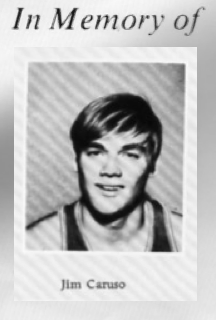
And I immediately remembered that night I saw Caruso in the convertible, and thought maybe this wasn’t such a shock after all. In fact, looking back, it was both sad and oddly predictable. That year, in our high school yearbook, there was one of those “In Memory Of” pages for students who’d died. It was the last any of us would ever see of Caruso, and that was hard to believe.
I don’t know what was going on in Jim Caruso’s life. The only thing we had in common was basketball. It was enough. I didn’t want to emulate his off the court antics. What I did want to do, when the situation was right, was go for the wild shot, the totally improvised move, just to see what happened. I knew you couldn’t play a whole game that way, but you at least needed to have that kind of fearlessness in your arsenal.
I draw an analogy to writing here. Discipline, fundamentals and hard work are still the keys, but you have to be willing to “go for it” sometimes. You have to jump in the air and figure out what to do when you’re up there. Fearless.
I still have this indelible picture of Jim Caruso. It was in a pickup game, the first time I’d ever played with him, just before I started at Taft. His name had been whispered to me. Everybody knew about Caruso. I was a little bit intimidated at the prospect of playing with him. But then we started the game and I remember just watching him, marveling at his raw ability. Crunch time came and the game was tied. Caruso did his thing, driving toward the hoop and jumping up with a taller guy all over him. He seemed to hang in the air for a full minute. His legs were splayed and his left elbow (he was a lefty) stuck out like divining rod. And then somehow, some way, he got off a hook shot (it was the only shot available to him) and it banked off the backboard and through the net.
And he came down laughing and turned around and looked at me as if to say, “See? That’s how it’s done, son.”
And sometimes, it is.
First Page Critique: OF DREAMS AND STARS
This is an excellent example of a first page by an author who does a great job of creating a mood but who needs to pay more attention to basic grammar and punctuation. Reading this first page is similar to being seated in a restaurant and loving the promise of the menu but finding spots on the glasses and — worse — a crusty flake or two of something unidentifiable on the silverware:
Between Dreams and Stars
John knew that if he didn’t find shelter soon, that this would be the end. It would be fitting though, for this icy wasteland was the first place that reflected how he had felt for the past three years, since she disappeared.
The shrieking wind reached another octave. John brought his arms and head towards his chest. Even if he could have lifted his head up, it would have been useless. The wind distorted the snow and ice into a blinding static. Groping along the frozen mountainside, he struggled to bring one foot in front of the other, sinking deeper into the snow.
He felt like he must be getting close now. The Sherpa, who remained thousands of feet and a day and a half behind, claimed that what he was after was within hundreds of yards of the summit. This peak, with rock as dark as the night, was a nameless crag amidst the Himalayas. Anonymous, jagged, and relentless, it challenged John’s resolve. He had to know. John moved his leg forward and suddenly there was nothing. The narrow rock he had been on, slid down the mountain. Losing his balance, he reached out, hoping there would be something. His left hand found a slim crack, it was enough. He swung his right hand around and he fiercely clung to cliff, heart racing with adrenaline, his chest heaving with rapid breaths.
He closed his eyes and focused, slowly bringing his respiration rate down. He began to inch his way backwards until after an excruciating hour he made it back to the last place he had solid footing. He collapsed to the ground. The near fall had sapped a lot of energy out of him. He reached for his pack to grab some food. To his dismay it was gone.
Let’s get the bad and the ugly over with first so that we can focus on the good. The problems begin with the first sentence, and that’s not a good way to begin: two “that(s)” when one would do nicely with a comma the author doesn’t need at all. Try this: “John knew that it would be the end if he didn’t find shelter soon.” You can switch the clauses around if you want. Just use one “that,” however. Additionally, the absence of that pesky comma makes for a smoother sentence and introduction. It’s the first patch of storytelling ice that lets the reader slip right into the narrative and heightens the suspense. Let’s keep going. The second sentence is a bit overlong, and needs more than a comma to break it up. I’d like to know who “her” is as well. It makes the tragedy of “her” disappearance a bit more personal. Maybe: “It would be fitting. The icy wasteland around him was the first place that reflected his mood for the past three years, since (fill in name of ‘her’) disappeared.”
Similar problems surface and resurface throughout this piece. The author uses too many commas, an ongoing problem I have with my own writing as well). “His left hand found a crack, it was enough,” is but one example. It could be separated into two sentences or set off by a semi-colon, if one likes those. There are also some problems with adjectives and metaphors and the like (the wind doesn’t reach a new octave; the shriek of the wind would. Static would not be blinding, but a haze would be). Sometimes the author tells us the same thing one too many times. If John is cold, hungry and on the side of a mountain and he reaches for a pack of food and it’s gone, we don’t need to be told that he’s dismayed. “(D)ismay” doesn’t cover it in any event; I’d feel as if someone had p**sed in my cornflakes if I hadn’t already dropped them down a crevice. Add some good old fashioned typographical errors (“…and he fiercely clung to cliff…”) and it is quickly apparent that this piece needs some hard-nosed red-pencil review.
So. There are spots on the glasses and the silverware isn’t serviceable. The menu, however, is impressive. The author creates a great mood immediately. John is cold and hungry and between a slippery rock and a hard place that is waiting several thousand feet beneath him. There was a discussion here several days ago about opening a story with the weather. That is fitting and proper to do here. The weather is the story — at least for the moment — and it is a dangerous mother indeed. The author sets it up well, demonstrating that John is driven and desperate. He otherwise would be back at the lodge or camp or whatever, riding the storm out in front of a roaring fire while trying to talk the reindeer sweater off of a snow bunny. There is also that high peak where John is perched. You don’t have to be acrophobic when confronted with a stepladder in order to appreciate John’s predicament.
I’d like to see what happens next and find out what happened to the “her” that got him on the mountain and the snow. First, however, the author needs to rev up the snow blower and make the path accessible.
First Page Critique: END POINT
First the submission, and then my input:
END POINT
Mason Boll leaned forward in the driver’s seat of the van, squinting to get a better view of his target. Twenty yards away the focus of his attention—a tall, gangly youth named Brett Feinman—was chatting with a girl at the corner of two residential streets in a tony section of Santa Monica. The girl seemed to be doing all the talking. Feinman was mostly listening. Periodically he cast shy glances down at the sidewalk. The girl wore a smug, flirty smile, as if she relished her power over the kid. She kept leaning in, touching his arm for emphasis.
Mason’s orders were clear: grab Feinman off the street and deliver him as promised. Today’s job would pay handsomely: well into five figures, with a promise of more to come. For that kind of money his employer demanded that everything go without a hitch. Feinman had to be delivered without any injury to the head. Not even a bruise. Mason wasn’t worried on that score. He prided himself on swift, error-free operations using the skills he’d honed as a military contractor in Iraq.
From the van’s cargo bay behind him, Mason heard one of his crew crack his knuckles for the umpteenth time. What the hell were those two kids yakking about for so long? Mason wondered. Stifling a surge of impatience, he checked the van’s long side mirror for any sign of a cop or nosy Neighborhood Watch type. Except for some wild parrots doing acrobatics on an overhead power line, the street appeared deserted. Without taking his eyes off Feinman, Mason extracted a pack of cigarettes from the glove compartment. He lit a smoke. Then he settled in to wait.
There’s stuff to like here, storywise, but the author gets in his own way, stylewise, by reverting to passive voice, and non-specific language. Consider this change to the first paragraph after a little cosmetic adjustment:
Mason Boll leaned forward in the driver’s seat of the van, squinting to get a better view of his target. Twenty yards away, a gangly sixteen-year-old named Brett Feinman chatted with a girl at a residential corner. Actually, Feinman mostly listened, periodically casting shy glances at the sidewalk while the girl flirted, occasionally touching his arm. As in most adolescent conversations, the girl seemed to have all the power.
Okay, I added a detail there at the end, but by doing a little tightening and adding detail where there was only generality (sixteen-year-old instead of “youth,” for example), the piece feels more professional to me.
I would severely trim or even cut the second paragraph. This is page one—the hook, the most important bit of literary real estate. We don’t need to know that Mason had been a contractor in Iraq, and we certainly don’t need to know what his fee is. If that stuff is important to the story, I would find a way to plant it somewhere else. As for the mission to snatch the kid, let the reader piece that together from Mason’s actions.
Moving on, allow me to play with another paragraph:
Behind him, in the cargo bay, Paulie Knuckles earned his handle yet again, popping his finger joints for the umpteenth time. “Must you?” Mason asked.
“They get stiff,” Paulie said. “You don’t want them stiff if I have to hit the kid, do you?”
“I don’t want you hitting him at all. No bruises, remember?”
“No bruises on the head,” Paulie corrected. “Everything else is free game.”
“I want this paycheck,” Mason said. “Don’t screw it up. We only hurt him enough to get him into the van.”
“Whatever.”
Mason let it go. Paulie knew the rules, and he needed the money, too.
“Come on, kids,” Mason grumbled. “Either get a room or break it up. I ain’t got all night.”
Okay, that wasn’t true. He’d stay here for a week if it took that long to get the job done.
I tried to do a couple of things right there. First, I gave a name to “one of his crew” and then gave some life to characters. I have no idea if the changes reflect the specific desires of the author, but that doesn’t really matter in this case. The point is that characters don’t become interesting until you hang a few details on the skeleton.
Note also that I was able to accomplish through dialogue and character interaction all of the important elements of that expository paragraph that I cut. I’m still not convinced that the first page is the best place for that interaction, but this is a pretty clear illustration of how “showing” through interaction is better than “telling” through narration.
First Page Critique: Beware the Wolf
By Jordan Dane
Please enjoy Beware the Wolf, an anonymous submission for critiquing, My thoughts are on the flip side.
***
Hoards of onlookers pushed and shoved to the front as they congregated behind the yellow tape, all hoped to see the mutilated body. Police huddled, compared clues, and discussed the who, the how, and the why of the crime. They may work and eventually answer who and how, but the why will always be a mystery.
Derek Mitchell reached for the tape, ducked below it and entered the crime scene. He waved a moth from his face as he stepped around the temporary lights.
“Hey.” A scowling officer pointed at him.
He held up his ID. “I have authorization to be here,” he said in a low voice. The man retreated.
He turned his head, and studied every detail of the park. Hours before the killing, children played on the slides and swing sets feet from where the body now lay. Oak trees and crepe myrtles surrounded the area, which provided ample cover for the attacker to wait for a victim. The location would indicate a random murder. Only, he knew this victim wasn’t random. The why is what he needed to understand in order to stop future killings.
Uniformed officers searched the flora with flashlights looking for clues, bagging every gum wrapper and lollipop stick, while two detectives stepped back from the corpse and waved the medical examiner forward.
He arrived too late. He needed to examine the body and area before the authorities arrival to detect fragile clues. He approached the examiner. “I need a few minutes to examine the evidence.”
The man nodded and walked back to his van.
He took a deep breath and raised the crimson stained sheet. It appeared to be a wild animal attack. The skull peeked through deep gouges of skin and muscle. The throat open, exposed the larynx, which was the source of blood that now seeped into the ground. Eyes, wide, stared into nothingness.
A shiver ran down his spine. To the human eye, a dog or wild animal killed her. Only he knew the truth. One of his people killed her.
***
Critique
The author sets a dark tone from the start – a crime scene with a dead body—but the punch of the last couple of paragraphs might work better if their essence were moved to the front of this scene to put the reader right into the action as seen through the eyes of a different kind of detective. Derek could be looking right down at the body and gathering “clues” in his own way.
With Derek walking up to the crime scene—and with the scene description so generic without details—these parts could always be described later during the course of the next narratives, if they are still important to the scene. Readers of crime fiction are familiar with aspects of a crime scene. To write it so generally is almost like waving a red flag that the author is glossing over details they may not be as familiar with. This sentence is a good example of too generic with POV problems: Police huddled, compared clues, and discussed the who, the how, and the why of the crime. Derek would not know what’s in the heads of the police or what they’d been discussing, so this reads like a bit of author intrusion.
If the author clues the reader in from the beginning that Derek isn’t quite human, he/she can build in his “abilities” to read a crime scene like a wolf. Derek could sense the fear from the crowd as he searches the bystanders. (Killer sometimes watch the cops work at scenes where they killed.) He could search the faces through the eyes of a predator at night, for example.
Sniffing the air, he could be drawn to the smell of blood and the splatter before he even sees the body. He might overhear snippets of distant conversations between the human detectives mixed with chatter from the crowd, since he has wolf instincts. Don’t go too crazy with this. That could slow the pace. Tease the reader with the set up, but leave more for later. For now, the author should “think” and “react” like a feral wolf. Since dogs/wolves can recognize scents off specific animals, does he have the same ability? Does he “mark his territory”? (Just kidding, but you get the idea.) Use your imagination on what his instincts are and why he’s a cop working “special cases.”
Another point – the author describes the park, right down to the oak trees and crepe myrtles as making “good cover.” Trees and shrubs could be cover, but why mention the variety? This reads like the author is using Derek’s POV to set the scene in a manner that would not be natural for a cop. It’s forced.
I’m also not sure how Derek would know from the start that the victim wasn’t a random kill. He’d have to establish a relationship between the vic and the killer, which is typical cop procedure that is backtracked after more is known about the victim’s life and a timeline of her activities that led up to the killing. But the first step in any investigation is to ID the victim, which isn’t mentioned here either.
If the attacker hid behind cover and waited for any victim to show up, that’s random, yet Derek seems to have an unexplained reason for knowing this wasn’t a random act of violence. Rather than spell all this out in the first 350 words, the author might focus on Derek’s instincts and his ability to read a crime scene in his feral way and leave the details/clues of the case to be discovered later. The intriguing part would be Derek, his instincts and abilities, and the conflict he faces being an outsider to both worlds—as a cop who isn’t human.
The author mentions that Derek “arrived too late,” but I would venture an opinion that he could detect far more than the average human who needs specific evidence to build a case. He wouldn’t need a human ME’s opinion of what happened and fragile clues would be his specialty. Is Derek trying to stay ahead of the cops to wield his kind’s brand of justice? Does he keep secrets to that end? Or does he work with human cops to keep the peace? Derek is the ultimate “lone wolf” cop.
There is definitely enough here to make me turn the pages. There are inherent conflicts in this scenario of an outsider cop working his own cases, sometimes at odds with humans and perceived as betraying his own kind. Plus he’d be tracking a killer with greater abilities to evade pursuit—a classic outsider theme that could be fascinating to explore. Good job of conceiving this plot, character, and conflict!
Kunoichi: Critique
Chapter 1
“Dismantle the bridge after crossing it”
Wednesday, August 26
S.S. Palma Soriano, 120 miles off the coast of Sevastopol, Ukraine
They executed the entire row. Two dozen men on their knees. Hands tied behind their backs. Looking over the side of the freighter at a reflection of the quarter moon on the calm waters of the Black Sea. Just a few seconds of racket. Then the bodies fell forward. Bled out. The men in black military fatigues relaxed. Let the muzzles of their suppressed MP5 submachine guns face the deck. A stocky, Nordic-looking redhead standing at one end of the firing squad whistled. Pointed at them.
“Reload!”
They changed their clips.
The second half of the crew was brought out. Knelt next to the bodies of the first group, in deep, warm puddles of maroon.
“Fire!”
Racket. Fall. Bleeding.
The wheel lock for the bulkhead hatch spun around and the door opened. An Asian woman in her late thirties walked out onto the deck, a twenty-four inch sword strapped to her back, a ninja-to. Two men in Russian military officer uniforms, a general and a colonel, followed her. Behind them, two more men in black fatigues escorted out the white-haired captain of the ship handcuffed. The general said something in Russian to the Asian woman. She turned to the colonel. In heavily accented English, he said, “General Kornilov wants to know if your men have checked the entire ship yet. He also thanks you again for agreeing to meet him here for the exchange, Ms. Mochizuki.”
With an American accent, she said, “Please, Colonel Grieg, call me Chiyome.” The colonel put his hand to his chest, genuflected slightly. Chiyome motioned towards the row of dead men. “We checked every inch, could only find forty-eight. But I’m sure your smuggler friend has a few secret compartments you’re unaware of.”
Grieg translated for Kornilov, briefly discussed something with the general. Then he sauntered over to the ship’s captain, said something in Russian. The white-haired man answered, shook his head at Grieg. Emphatic. The colonel got in the old man’s face. Yelled.
Pointed at the crew’s bodies.
The captain shook his head again, repeated his previous answer.
Grieg stepped away, turned to Chiyome. “That is everyone.”
“Good.” She moved in front of the captain. Smiled. Brushed his shoulders off. Then unsheathed her ninja-to and decapitated him in a single fluid motion.
Kornilov and Grieg froze. Watched the head roll across the deck. Over the side.
“Well,” said Chiyome, taking a breath, “now that that’s out of the way….” The redhead came over to them with a laptop under his arm, opened it so that Kornilov could see the screen. Chiyome flung the captain’s blood off of her sword. “Fifty million American, as promised. All you have to do is press enter.”
Grieg translated.
Snickering, Kornilov moved to press the key.
Chiyome put the tip of her blade against his chest. “Wait.” She pushed her sword into him, forced him to move back. “Colonel Grieg, would you be so kind as to ask General Kornilov if he’s spoken to anyone else about our transaction?”
The colonel did as instructed. Got a response. “He says no, not to anyone.”
“Is that so?”
“He swears it.”
She stared into the general’s eyes. “How honest.”
The two men who’d been holding the white-haired captain drew their pistols on Kornilov and Grieg. Forced them onto their knees.
Kornilov shouted. Grieg translated. “What’s going on? I thought we had a deal.”
Chiyome sheathed her ninja-to. Took the computer from the redhead. Pressed several keys. Held it so that Grieg and Kornilov could see a video feed of the general talking and having coffee with a man in a suit in an office. The symbol of the Russian Federal Security Service, the FSB, was visible on the suited man’s cup. The video cut out. Came back on a close-up of the suited man’s dead body on the floor of the office, Chiyome standing over him. Static. Chiyome closed the laptop, squatted in front of the general. “You could’ve at least switched cars before driving to Lubyanka.”
Kornilov spat in her face.
She wiped it off. Nodded to the man behind him.
Racket. Fall. Bleeding.
Chiyome came over to Grieg.
“No, no,” he said. “Please…I—I don’t even know what this is about. I am just a translator.”
“Unfortunate.”
She nodded again.
Racket. Fall. Bleeding.
My Critique
This action-packed opening grabbed my attention right away. It’s a great opening hook. I could easily envision the scene. And the terse, rapid-fire style lends itself to the thriller genre.
That said, some of the longer paragraphs could be more divided. For example, the one beginning “They executed….” I’d like to see a new paragraph start with, “The men in black military fatigues…” We are switching attention from the executed to the executioners, and this would be a good place for a paragraph break.
I wasn’t sure who was meant by “Pointed at them.” Who? Maybe change to “Pointed at his comrades.”
I started to get confused by the paragraph beginning with, “The wheel lock opened…” Three people are mentioned here and I wasn’t sure who was the translator at first. I think this could be made clearer. I’d start a new paragraph beginning with “The general…” And I might name the characters more quickly. Here’s my rewrite:
General Kornilov spoke in Russian to the translator, Colonel Grieg. The colonel turned to the Asian woman and said in heavily accented English, “General Kornilov wants to know if your men have checked the entire ship yet. He also thanks you again for agreeing to meet him here for the exchange, Ms. Mochizuki.”
You mention that the Asian woman speaks with an American accent. Is this necessary? Is she American? Yet she’s Asian. And the other guys are speaking Russian and accented English. It gets confusing.
Also, the second time you mention “the redhead”, I’d rather you say “the redheaded man or soldier.” I tend to think of redheads as being female.
By the third “Racket. Fall. Bleeding,” I am getting tired of this phrase and I’m ready for the language to have a more natural flow.
More importantly, whose viewpoint are we in? An omniscient presence hovering over this scene? While the action holds my interest and I get the gist of what’s going on, I’m yearning to be in someone’s head and to experience this emotionally from a viewpoint character. In other words, emotional impact is missing.
In the best thrillers where the story starts with a prologue and someone dies, the writer immediately puts you into a character’s viewpoint so that you feel their horror as they face the last minutes of their life. Thus you care as a reader about what happens to them. Action without reaction is merely plot.
What if you have the trio on deck during the initial executions? What if we’re in the general’s head? We’d experience his cold sweat, his twisted gut, his fear of discovery. With this emotional investment, we’d be eager to see who would bring down this Asian woman after she kills him.
It’s a great beginning, but it could be even better if the reader identifies with one of the victims. Or you could even make the viewpoint character one of the soldiers who is sickened by what he has to do and what he sees.
This sounds like an exciting story, and after this engaging opening, I’d certainly be curious to read more.