Dispatch From The Shallow South

by John Ramsey Miller

I live in the “rural” South. She nurtures me in those big warm arms, and she shares her stories with me, and it’s because of her that I speak with that pleasing twang we southerners share like a genetically induced cowlick. I’d rather set a book in a small southern community than in New York City, and I find a character who goes shirtless and eats instant coffee from a jar with a spoon infinitely more page worthy than a slumming detective who’s secretly a multi-millionaire playboy. I am known as much for my oddball characters as for anything else in my novels. My oddballs aren’t a stretch for me. I actually saw a man eat Sanka because there was no hot water. It was not a pretty sight, but one that stuck in my mind in the way piping-hot mozzarella cheese clings to the roof of my mouth. I don’t hang out much with multi-millionaire detectives so I have little idea as to how they behave.

Here in the sticks I see a lot of mullets and other accoutrements of Out-Of-Touch-With-High-Fashion-and-I-Don’t-Give-A-Hoot disease. Last night in a local restaurant I saw a middle age man with a Prince Valiant hairdo, a work shirt, jeans and hunting boots. Here in the outer regions I am often among people in 12 step programs due to a WALMART shopping habit. I have heard music dance mix tapes have both country and hard rock music on them. I spend time with people whose social filters were due for a change 100,000 interactions ago. Out here you can wear a NASCAR t-shirts and jeans and sport coat to church and be overdressed. Women may have a closet full of camouflage fashion accessories, consume their alcoholic beverages from cans, have a distinct fascination with mud and four wheelers, and spit at the ground to accent a point they’ve just made. Their men are a lot rougher around the edges than the gals.

The other afternoon my wife had to stop because a 40 lb alligator snapping turtle was sunning in our driveway and wouldn’t give her right of way. I took the turtle by its tail (at some peril since I have seen these reptiles snap a broomstick in half) put it in the back of my SUV and drove to a large pond between here and the town nearest my house. And the whole time I was lugging this prehistoric monster down the bank, and I was trying to hold it out to keep from losing a chunk of right leg, I was thinking about the turtle soup from Commanders Palace. For a few seconds that shelled critter came close to a cooking pot. I seriously considered looking on the Internet for instructions on dressing out a snapping turtle and searching for a recipe for that soup I do love so. Only a reluctance on my part to do the necessary research saved it. Well, that and my desire to save a creature so stupid he’d wandered from his pond and into the woods. It’s possible that it was on its way somewhere and I interrupted turtley vacation plans. God, I love the sticks.

This weekend I am going to be digging post holes in the earth to sink 4x6s for a new chicken coop that I’m building and for setting fence posts. I have 50 chickens arriving next week and I’ve waited until the last moment to shelter them. So, I’ll be sweating and smiling and thinking about the healing power of hard work. And next week I’ll be writing again, which (as we all know) is far harder than digging holes or building structures for Henny Penny.

To end on a high note, here’s a picture of my youngest grandson sitting in my wife’s lap that I took this afternoon. He is quite a character, and this is what life is all about.

An Open Letter to Booksellers

By John Gilstrap
www.johngilstrap.com

Dear Bookseller,

Thank you for inviting me to your store to sign copies of No Mercy. And thank you for the work you do. You are the lynchpin in the machinery that keeps the book world on its axis despite a culture that seems to value the written word less and less. It’s important that we work together to do whatever we can to pull people into stores to buy books. That’s why you invite me, and that’s why I show up. We’re a team.

It’s a shame we didn’t sell more copies, but it was great getting to know you and your staff. I’ve been thinking about the event since we last saw each other, and I believe I might have found some areas for improvement in the future:

Perhaps you should consider putting me inside your store. Yes, I know that things are a little cramped, but customers aren’t seeing me out there in the mall. They’re just seeing a guy at a table with a bunch of books, and judging from the looks on their faces, I think they’re a little creeped out by it. It’s the way they pull their children a little closer as they pass. Let’s share retail space as well as love.

The signage was a great idea; thanks for that. There’s actually only one L in Gilstrap, but hey, these things happen sometimes. Next time, though, along with the big picture of the book cover on the sign, could you display the picture of me that my publicist sent? If people can match a face to a poster it might take some of the creepiness out of the whole guy-sitting-at-a-table thing.

Please don’t think me ungrateful or overly pushy, but for the brief time I’m taking up space in your store, what say we all sell my book? That’s right, mine—the current Gilstrap; not the next Grisham or Baldacci or Miller. Sure, they’re fine authors, but they’re not here right now. Remember that lady who came to the desk while I was there and asked where she could find the new Jack Reacher book? That would have been the perfect time to say, “Oh, if you like that kind of thriller, you might want to meet John Gilstrap. He happens to be sitting right there.”

Perhaps I’m not the best judge on this particular form of etiquette, but it seems reasonable to inform every customer that there’s an author in the house. Perhaps it seems obvious what with the table and all, but believe me it’s not. People get tunnel vision when they shop. They need a little nudging. Ask around. Many of the independent stores and the more experienced chain stores do it that way. Hand selling really moves books.

While we’re on this topic, let’s talk about all those books you stacked around me at the table. It made for a great display, but I think half of them or even more should displayed inside the store away from me. I think it’s intimidating for people to evaluate the merit of a book while the author is watching. Just ask my wife. (I’m a hoverer as she reads my manuscripts, but that’s not important right now.) I think copies should even be stacked at the register so that the salespeople can hand each customer a book while they inform them that there’s an author in the house.

Thank you for your time and attention. As I close, I’d love to hear how I and my fellow authors can make your bookselling job easier. Should I have made up bookmarks and handed you a stack, or would you just see that as more clutter for your desk? I know I end up doing little but sitting at that table, but would you prefer that I walk around and chat up your customers? Truthfully, because of the aforementioned creepiness factor, I hesitate to approach readers on the prowl.

Finally, please know that I’m grateful for all of this. How else can we make the book signing thing more beneficial to everyone?

Warmest regards,
John Gilstrap

Who knows what evil lurks…

John Ramsey Miller

With this one in the can, I will have written 52 blogs. I think some of them were worth reading. At least, and as of this writing, I have received no death threats over them. I have received death threats, and I suppose I earned them.

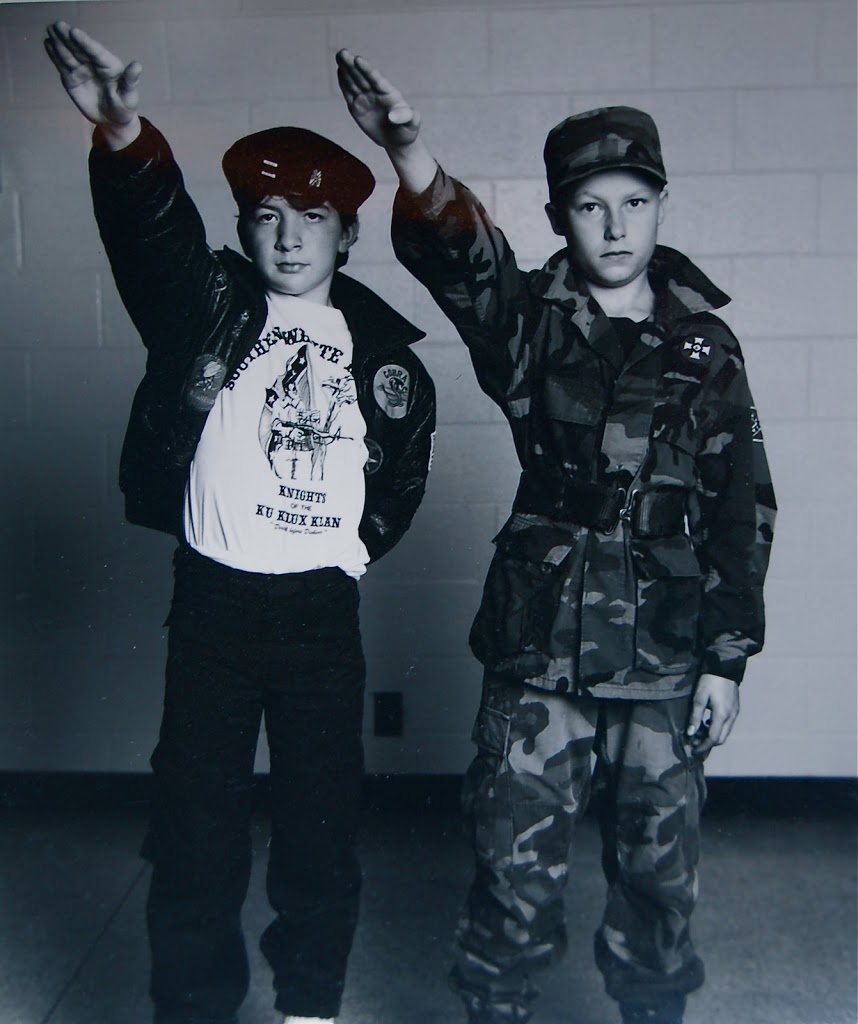
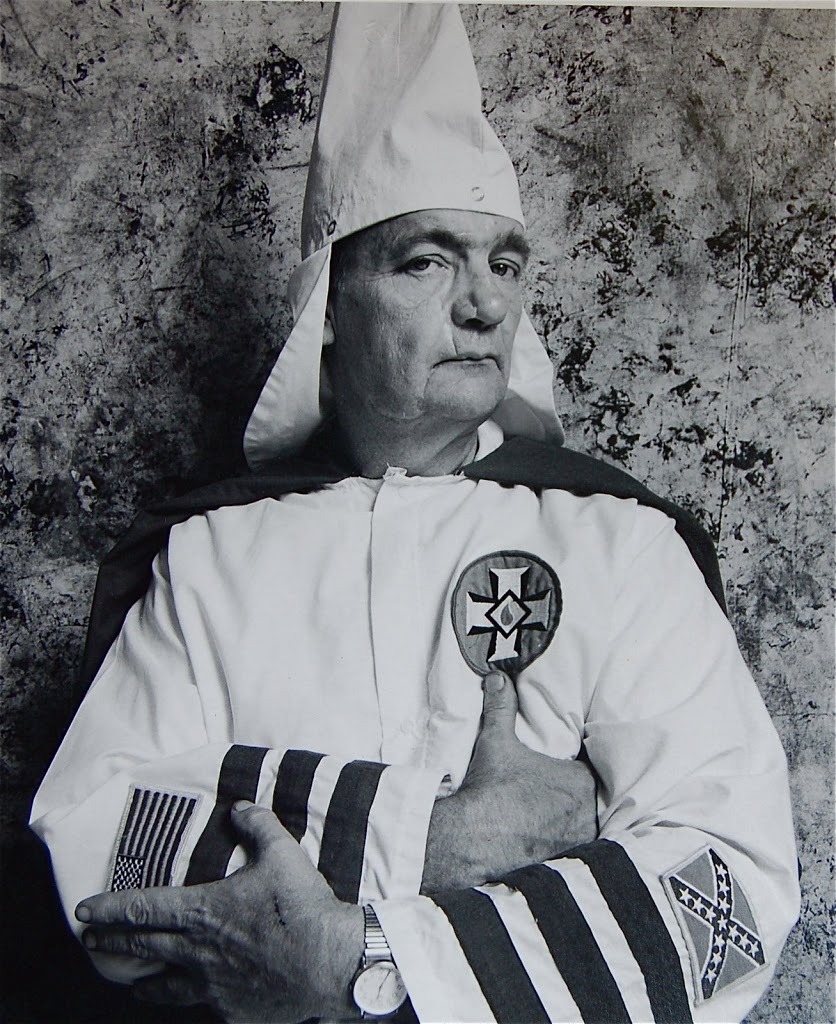
I wanted to clarify the thing in the anniversary blog about me setting up a portrait studio at racist gatherings. I did it to capture images of Klansmen, Skinheads, and Identity Christians, not because I was attracted to their speeches. I was a portrait photographer and I was interested in intense groups of people for series. I started with artists. I did death row inmates. I met the leader of a group of skinhead thugs who had broken Heraldo’s nose on TV and I photographed him and a few of his friends in New Orleans in the late 80s. That led to a letter of an introduction letter (on SS lightning bolt letterhead) to other groups of like-minded racists around the country. I don’t know what I did with the damned thing. I’m sure it used to be in the drawer with the collected letters from death row inmates in Angola.

Children of Hate Pulaski, TN 1989

Here’s how I did it: I used a Polaroid back on a large format (4X5”) camera. I’d ask for the subjects to sign a release and I’d give them the B&W portraits, which I put fixative on. What I didn’t bother to tell them was that after the picture was pulled, there was a high-quality negative left over, which I could print later in a darkroom. I suppose the subjects, most of which were hardly rocket scientists, believed they had the only prints, although I never said as much.

From my childhood these people were my enemies and when I was younger they terrified me because they focused their hatred on my father. I could say that I despised them for their beliefs, which are narrow and frightening. But the truth is, I just felt sorry for them because their philosophy is based on their fear of being further marginalized in society than they already are. They are dangerous on several levels, but are inherently only slightly more suspicious of outsiders than they are each other. According to FBI sources, about one in twenty is an informant. In short they are paranoid and deluded as to their importance and potency. I found their gatherings sad affairs filled with a sort of beer hall bonding over a cold glass of hate and ignorance. I felt sorry for the children of hate, because they never have a chance (until much later) to form their own idea of self and of the value of others who are different than themselves.

Grand Dragon of the Florida KKK 1990

When the story and pictures I’d done hit the presses, the subjects went wild. I had death threats. Several while I was being interviewed on radio in Miami. The Miami Beach police watched over me without my asking. I lived in a predominantly Jewish neighborhood and I had made a number of friends in the ADL (Anti-defamation League) while I was doing the series who made sure I was watched over. I had spent hours of time on the telephone with investigators with The Southern Poverty Law Center trading information as I learned who these people were and their relationships to each other. I guess I had much better pictures of certain subjects of interest than they did, and I had names and addresses. The racists felt betrayed when the not-so-flattering story was published, but I never told them I agreed with anything they said. I just listened and absorbed and ultimately regurgitated my experiences for a piece for Miami Herald’s Tropic Magazine entitled, MY FRIEND THE NAZI.

Grand Secret Cyclops Pulaski, TN 1989

None of the Nazis, Skinheads, Klansmen, or Christian Identity members were ever my friends. Friends don’t make your skin crawl. I wish I had been able to show them how wasteful and self-destructive their philosophies were, but that’s not usually in the realm of being remotely possible. Hate is all they have.

Knowing When To Quit

By John Gilstrap

You’ve been working on the story for the better part of a year. The plot is all you think it should be, and you love the characters you’ve created. Finally, you reach the day when you get to type every author’s favorite phrase: The End. You do your little happy-dance around the office and maybe celebrate with the family.

Then you read what you’ve written. Uh-oh. That big twist in Chapter Seventeen wasn’t as well set-up as you wanted it to be. And jeeze-oh-peeze that dialogue seems flat in Chapter Seven. And the spelling errors! Oh, my God! You hunker down and make those changes, plus dozens more. Woo-hoo! You’re done.

Then you read what you’ve written. Damn. Now that you’ve changed Chapters Four, Eight and Eleven, that Chapter Seventeen twist is so obvious that people will see it coming from ten miles away. And your protagonist’s hair color has somehow miraculously changed in Chapter Twenty-Four. Besides, you know what? This whole story might just suck. Maybe treating the story as a mystery is a mistake from the beginning. Maybe it needs to be romantic suspense. Maybe you need to start over from page one.

Maybe it was better before you started diddling with it. Maybe . . . blah, blah, blah.

A friend of mine who is a landscape painter told me once that good artists and great artists are separated by the ability to know when the trees in the painting have exactly the right number of leaves. You can have too few, and you can have too many, and a great artist knows when to quit. A successful writer knows when his story is finished and it’s time to let it go.

I struggle with this on every book I write. Hell, I struggle with it on every one of these blog posts. I’m an obsessive re-writer, but I can’t stand the notion of something being “out there” that is not exactly the way I want it to be. And more times than not, when I look at it one more time, there’s something else I feel compelled to change.

How do you all determine when it’s time to move on? How do you gather the courage to quit?

Conspiracy Theories Give Great Thriller

John Ramsey Miller

Human beings will do anything to turn a profit, to gain an edge. Conspiracies will exist forever and throughout the universe. Greed rules the world. Always has, always will. We thriller authors know this and have learned that you cannot really write over-the-top bad guys as long as you keep the motivation real and the character true to his or her motives. Wealth, social or political power, elevation of status, feeding a sense of self-importance, protection of the status quo, a desire to stay out of prison, a need for accolades are all motives for forming or joining a conspiracy.

When you watch a James Bond movie, how do you not wonder how the evil geniuses go about recruiting hundreds of people that will kill any and all comers, threaten the world with selective destruction for extortion of money from world powers. You have to wonder where the bad guys got the cash to build a secret base on an island or in a false volcano where the receding lake is made of steel painted to look like water. How much do they pay their evil workers? Short of buying an out-of-work army from a third world country, or recruiting in mental hospitals catering to the criminally insane, how do you find hundreds of psychopaths who will also do exactly what they are told and will live with other criminals in the middle of nowhere?
Back to conspiracies. Not all are believable, but if you remember to keep them in proper sliding scale, you’ll pull it off. The only difference between a street gang leader, a mafia don, the head of a very large business enterprise, and head of a government agency often lies in the trappings and degree reward at stake. There is little difference between the way a small time drug dealer and the head of a large bureaucracy think and plot.

I just read how organic food is no healthier than food grown using insecticides and commercial fertilizers by a conglomerate. So a chicken raised on feed made from other chickens and injected with steroids and antibiotics is no better for you than one raised by a farmer’s wife who feeds them only natural grains, roasted soybeans, corn and kelp, etc… Well that sounds a lot like what the tobacco companies used to say about the safety of cigarettes. I read about bills introduced to heavily regulate produce sold in farmers markets due to fears of salmonella and other contaminates. How many cases of food poisoning comes from local produces grown on farms as opposed to government regulated large commercially outfits? It sounds like something a Con Agra would pull because people are buying that produce from farmers markets and not the local grocery store. There’s a conspiracy to write a thriller around. The possibilities are endless and we’ll never write them all.

There is no doubt that people working for governments commit murder in the name of protecting secrets, or getting rid of obstacles and critics of the regime. It happens every day. King David sent a brave soldier to a certain death in battle so he could have that man’s wife. Joseph Stalin killed 30 million of his own people out of paranoia and in the guise of progress. Our government killed off and enslaved thousands of native Americans in order to utilize the land they inhabited.

The secret of writing conspiracies is to keep it on the page, and to always tell a little story within the bigger story that the reader can identify with, a character they can identify with and root for. Nobody who loves a thriller wants to read about a battle between titans who are equally matched and you’ve got a perfect yawn machine on paper. But you pit a preteen boy armed only with a slingshot against an armored giant with a spear and sword on a battlefield, and you have the boy kill the giant, and you’ve got yourself a story. Why? Because we are all facing giants every day of our lives, and there’s a chance that any one of us could be the boy with a slingshot.

Is There A Thread Here Somewhere?

John Ramsey Miller

I got an email this week from Jennifer Chappelle. She is opening a new bookstore in downtown Locust, NC called Uwharrie Books (U War EE). Her new shop is going to feature books by North Carolina authors and she intends to make Saturdays author event day where authors can come in and sign their books for local book lovers. Locust is a small town, but one with a Walmart for serious competition. If there are enough readers in the area who will shop at an independent, hopefully Uwharrie Books will do well. It’s refreshing to see someone willing to swim upstream against a swift current. We’ve seen the trend of readers to buy cheap at any cost (the small hand sellers who were once the backbone of the industry), an erosion of customer loyalty, and a trend away from reading for the TVs, Gaming devices, and PCs. All of these trends can change when people get fed up with insipid TV content, winning an imaginary war, and shopping at giant box stores that are taking over the world. If and when “they” decide to try thinking and imagining once again, and decide that a few cents more to maintain stores owned by actual members of their community, who reinvest in that community, strikes a chord. Please, don’t the Waltons have enough in the bank yet?

Walter Cronkite was buried Thursday in New York. Uncle Walter was a fixture for my generation, a supreme and trusted journalist who had watched from the sidelines as the news he was devoted to reporting (without injecting his own bias, well, except for declaring the Vietnam War lost, which is still being debated) evolved into a cross between a carnival fright ride and a candy store. The media seems intent on keeping the populace scared to death, depressed about the state of the world, and aware of the importance of keeping up with the latest fads. The Today Show is nothing but one long commercial for products, punctuated by celebrity shenanigans, quick bursts of terrifying news and sound-bites of political propaganda. It bothers me. It bothers me a lot. Newsmen seem to be chosen for their pleasing appearance, rather than their journalistic abilities. Just as people get the Government they deserve, so goes it with the news. We are asking for this and for it to continue. Hard to imagine this superficiality is so widely accepted. It is our job as thriller authors to entertain and scare the crap out of people, and the news outlets are usurping our positions. Why do people need us if they can get the crap scared out of them every time they turn on their TV sets?

And the trend toward reality shows should be helping bookellers. I’d rather read War & Peace in Russian than watch Survivor, Bridezilla, Housewives of Orange County, New York City, or New Jersey, or I’m A Celebrity, Get Me Out of Here! So you’d think people would be reading more as TV hurdles down the slippery slope greased so thoroughly by Jerry and Maury. The sad thing is I see it getting much worse before it gets any better. What does that say about us? You know very well what it says.

WHAT ELSE WOULD I BE DOING?

John Ramsey Miller

Here I am, a once-upon-a-time-NYT-best-selling author, back at the beginning of my career yet again, but with a couple of million books in print. This is the third time I’ve been writing a novel without a publishing contract and I’m not getting any younger and other than writing novels I have few prospects for an alternative career. Writing thrillers is easy for me. Everything else looks really hard.

In my life––if you count the part time gig in high school––I’ve had exactly four jobs as an employee of someone else. I drove a delivery truck for Solomon’s Dry Cleaners in the eleventh grade. I got fired after my fourth accident in two weeks. Mrs. Solomon was nice about it. Her insurance company insisted she replace me. After high school I worked a summer on a tow boat that ran up and down the Mississippi River non-stop at five knots maximum from New Orleans to somewhere up the Ohio River. The engines were so loud you couldn’t have a conversation except out on the barges. The food was excellent. They had to put me off in Greenville, Mississippi after I got sun poisoning after spending a day on the barges outside New Orleans. Fair skin made a day laborer in the sunshine a pipe dream, and truthfully it lacked something crucial. My third actual job was as a graphic artist/photographer for a TV station in the Mississippi Delta. I got fired because I hid Martha Mitchell out from the media and the TV station thought that was some sort of a breech of media ethics. Evidently I was supposed to hold her down while they skewered her. I was glad I got fired. Working at a TV station sucks. My fourth job was in 1978 as the official disseminator or public information for Leflore County Schools, the poorest county school district in Mississippi, which means poorest in the free world. The predominantly black county schools had books from the 1960s that the white school students had dog-eared, scribbled in until they looked like redacted documents from the FBI, and could either burn or hand off to the county. There were actually high-school teachers at the county schools who didn’t have a college degree and were no more than babysitters. In Mississippi the county schools were historically parking places until crop season. The federal government paid my salary. That job I quit. I can’t remember exactly why, but I guess it was being that I figured being depressed was something I could manage on my own without the government’s help.

Before I started writing, I made a living as an artist or a free lance photographer or something else I did to earn money and I never went hungry. I’ve made my living writing since the mid-eighties. First as an ad copy writer, a journalist, a non-fiction author, as a scriptwriter, and a thriller author. I have made a living at it, although not as good a living as some, better, I suppose, than most fiction authors. I do have a book in the can and I’m going to do some painting and sculpting before I start another book. This writing thing keeps me off balance and maybe I’m as insecure as most other authors I know. It’s just a weird business, and its the business side I don’t think I’ll ever understand or master. I’m not much for politics, and self promotion has never been easy for me. I grew up in a “be modest” and “don’t blow your own horn” family. I guess I need a larger ego than I possess, more self assurance or something.

Writing has always been easy for me. I just sit down. I see the scenes and I transcribe them. Maybe it’s too easy. It’s something I know I’m good at. I enjoy doing it. It has been my art form and I have painted my words, told my stories, on an international scale. I have touched people, made their lives better for a moment or two. I am blessed and lucky and fulfilled in the writing thing. As long as I enjoy it, I will keep doing it, but not one moment longer. You have to make a living, but life is too short to do a thing you don’t love doing.

http://www.johnramseymiller.com

WHY DO GOOD AGENTS TURN DOWN GOOD BOOKS?

Anne Hawkins is an agent with John Hawkins & Associates, which was founded as Paul Reynolds Literary Agency in 1893, and makes it the first literary agency founded in America.

Anne is not only a highly respected, and beloved agent with a list of best-selling authors in her stable. She is a consummate professional with impeccable instincts, a devoted advocate for her authors, but she’s also a blind hoot. It is with great pleasure that I welcome Anne here as my guest on The Kill Zone.

John Ramsey Miller

Why do Agents Turn Down Good Books?

By
Anne Hawkins, Literary Agent
John Hawkins & Associates, Inc.

Rejecting authors’ projects is one of the least pleasant aspects of my job. It’s no fun to feel that I’ve ruined someone’s day, even though I always try to be gentle and courteous. How much nicer it is to call or e-mail and say, “I love what I’ve read. Please send more.”

Of course, the most common reason for rejection is a perceived lack of quality, a natural reaction to a misbegotten query letter or sloppy sample pages. Sometimes, however, I have to turn down projects that are actually quite good. Subjective judgment plays a large role in that sort of decision, but so do other business considerations. Let’s take a look at some of the factors that influence an agent’s choice of books for representation.

PERSONAL TASTE: A literary agent sinks or swims professionally because of her taste in books. This taste impacts the kinds of books she represents (her list), her contacts among editors and publishers, and ultimately her success in the business. Good agents learn to trust their taste and only represent projects that inspire them, because those are the books they’re likely to sell.

Most of us concentrate on the areas we enjoy and where we consequently have the greatest knowledge and expertise. If we don’t “get” it, we don’t handle it. You may be the next Dr. Seuss, but if the agent you query doesn’t fancy children’s books, she’ll almost certainly turn you down.

Authors can minimize this kind of turn-down by researching the kinds of books each agent does represent. Jeff Herman’s GUIDE TO EDITORS, PUBLISHERS, AND LITERARY AGENTS (most recent edition) is the premier print resource, since each listed agent states specifically the sorts of books she does and does not handle. Some of the best on-line resources are the searchable databases on Authorlink.com, Publishers Marketplace.com, and the Association of Authors’ Representatives (AAR) website. Sad to say, certain other writer-friendly sites perpetuate information is that is either out of date or downright wrong. (One has me listed as a top agent for horror fiction, even though I have never represented a single book in the genre.) There is good information on the internet, but do yourself a favor and cross-reference. Don’t rely on any single source.

PASSION: For me to take on a new book by a new author, especially a novel, I simply have to love it. It’s not enough to “like” it or “admire” it or consider it “salable”. We’re talking about real passion here. Even at the very beginning of the submission process, editors can sense when the agent is on fire about a book — and the feeling is contagious. Chances are, that’s the book the editor will choose to read first. Later on after the sale, down the long, bumpy road to publication, an agent needs this kind of wild enthusiasm to continue to be a strong and persuasive advocate for the author and his work. “Lukewarm” just won’t go the distance.

KNOWLEDGE OF MARKET: An agent needs to keep track of the markets for the kinds of books she represents. This knowledge may be as general as the track record of an entire genre or as specific as one publisher’s immediate needs. In short, agents need to know what’s hot — what’s not — and who’s looking for what. Market factors are a huge topic, so here are just a few examples:

Publishing is in the business of selling books, lots of books. If an agent wants to place a book with a major publisher, she has to believe that book has the potential to attract a substantial number of readers. If she judges that its market is too small or too specific, she’ll most likely decline.

The existence of a recent, successfully published book (or books) can make a similar project extremely hard to sell. Even if your book is better, somebody has beaten you to the punch. The concept is no longer “new news.” This is particularly true for non- fiction, but it applies to novels as well. If the market appears saturated with a certain kind of book, an agent will be reluctant to take on a new project in that category, knowing that her chances of placing it are slim.

Sometimes, an agent will know that the market for an entire genre is on the decline, so she’ll be hesitant to take on any book of that sort. At other times, a market will be on an upswing, so she’ll be champing at the bit to land an author in that genre. Historical fiction, for example, was a tough sell for many years. Recently, however, its popularity has surged to the point that agents who wouldn’t have touched the genre five years ago are now actively looking for it.

EDITORIAL CONTACTS: To put it bluntly, if an agent doesn’t know the right editors for a book, she has no business representing it. From time to time, every agent reads a wonderful project that she has no clue how to place. Believe me, she’s doing the author a favor by declining.

Here’s why. As a general rule, an agent can submit a project to a particular publishing imprint once — and only once. If the original editor declines, it’s very difficult to get another editor at that house to reconsider the book. Obviously, the key is to get the submission into the hands of the right editor the first time around, since you usually don’t get second chances.

SUITABILITY TO GENRE: Some kinds of books have specific conventions as to format, word count, style, content, etc. If a book strays too far, it may be unsalable – no matter how good it is. Of course, authors can cheat this unhappy fate by doing some homework on the particular requirements of their chosen genres.

Mixed genre books are another dicey situation, since an agent or publisher needs to feel that there is a definable market for a particular book. When an agent reads a book that is “kinda mystery, sorta horror, with strong romance and science fiction elements,” she’s going to wonder just who the audience might be. Projects like this have a history of falling through the cracks in the marketplace, so an agent will have to think long and hard about her chances of placing it.

LENGTH: A related subject is the matter of length, or word count. For adult fiction, most books range from around 70,000 to 130,000 words in length. There are exceptions of course, but very short or very long novels can be problematic to sell because of pricing, production, and distribution issues. In the case of books for children and young adults, the length must be appropriate for the targeted age group. There’s a bit more leeway for certain kinds of non-fiction, but even there inappropriate length can be a deal-breaker.

AUTHOR: Generally speaking, an agent takes on an author and his project because she is interested helping him build a long-term career. This is almost invariably true for fiction, where the name of the game is to increase readership over the course of many books. Agents may shy away from a novelist whom they believe to be a “one book wonder” because of the enormous investment of time and energy for only a single book. (This is not necessarily true in non-fiction, where one-off books, such as celebrity biographies, are more common and can be quite profitable.)

It goes without saying that if an agent has reason to suspect that an author might be the “client from hell,” she’ll have to carefully consider whether representation is worth the hassle. Then again, everybody’s different, and what’s poison to one agent may be ambrosia to another.

CREDENTIALS AND/OR PLATFORM: For certain types of non-fiction, an author needs relevant professional or academic credentials. For example, to write a credible diet book, it’s best that the author (or co-author) be a physician or a nutritionist with demonstrated knowledge and experience in the field. Agents know that publishers aren’t likely to go out on a limb with a book that can’t speak with some kind of authority.

“Platform” is a different animal. It’s usually defined as the existing audience that an author can bring to his book. Authors often develop their platforms through such vehicles as speaking engagements, syndicated columns in magazines or newspapers, media exposure, or a very strong internet presence. Platform is essential to selling some kinds of nonfiction. Without it, an agent will surely turn down the project, no matter how good it may be.

CONFLICT OF INTEREST: Weirdly enough, this situation comes up much more frequently than anyone would suppose. If a new author approaches an agent with a project that is uncannily similar to one she’s currently representing, the agent has to turn it down. There’s simply too great a chance for misunderstanding or possible legal action if one author suspects that his agent has discussed his ideas with a competitor. This is the kind of situation that can ruin an agent’s reputation, and no book is worth that.

SUITABILITY FOR AGENT/AGENCY: This is somewhat of an odd-ball issue, but it does happen. Once in a great while, an agent will have to turn down a project simply because representing it could cause hard feelings among her established clients or publishing contacts. To use an extreme and fictitious example, let’s say that an agent does a lot of business in the Christian publishing market. She’d be hard pressed to take on a book with raunchy or irreverent content that would be deeply offensive to the authors and editors with whom she works every day. Most of the time, agents are pretty eclectic in the projects that they choose — and authors and editors accept that — but there are some lines that just can’t be crossed.

IN CLOSING: Good books draw rejections for a variety of reasons, and many of these reasons have nothing to do with the quality of the work. I know for a fact that I have has turned down books that other agents subsequently took on and sold. Then again, I’ve had some major successes with books that quite a number of my colleagues had previously rejected. If a book is truly outstanding, it’s only a matter of time until the right agent steps up to the plate and offers to represent it. Don’t give up too soon!

HOW CAN ANY AUTHOR EVER RUN DRY OF IDEAS?

By John Ramsey Miller

[Author’s note: John Gilstrap is at Thrillerfest, and I’m not, so I am filling in for him by appearing a day early. I feel like the lone Jewish staff member who is working on Christmas Eve. So, close the bar for me, JG.]

The one question people ask me most, and I’m sure this is universally true, is the origin of my ideas for my books. I usually tell them I get ideas from running reality through my own “what if ?” and “paranoia” filters. When an author needs inspiration for a character, a scene, or a plot, all they have to do is to look to real life.

The inspiration for my first published novel, THE LAST FAMILY, originated from a story I read in the early 90’s about how the DEA confiscated property of a Florida doctor whom some informant––a drug addict––said was dealing drugs. They took everything the doctor had, based on the word of a liar paid for each name he gave the DEA. There was no evidence whatsoever except for the word of a man who was paid to hand drug dealers over to the DEA. He was a relative of, and had a grudge against the physician for throwing him out of his house for abusing drugs. The doctor was never tried for the alleged drug dealing. He lost all of his worldly possessions, his practice, and his wife left him. It was a typical case of government gone wild without any worry of normal consequences. Ah the arrogance of power, and the innocent bones crushed to powder in the exercising of such power. The feds do not usually apologize or acknowledge mistakes because it’s bad for bureaucratic careers.

I thought about the real doctor from my perspective. I went farther wondering how innocent pediatrician who had been in a similar situation––except maybe his wife was upset and was in a car crash that killed her and his kids––would react to such a perfect tragedy. Would he hate so much that he would become unbalanced and homicidal? How would he get back at the DEA? Might he pay them back by murdering their families in retribution. As I constructed the story the doctor became a character played by the man who’d lost his family and blamed a specific DEA team. In fact the team had not been responsible for the man’s loss of family and position, but he blamed them. Over time, the doctor evolved and was replaced by a sadistic, CIA-trained psychopath and master of disguise. More believable adversary, I thought. But I saved the “understandably” demented pediatrician for another story some other time.

Just the past two weeks, we’ve had:

1) a whacked out media circus surrounding the death of a performer, who, as usual is being rehabbed in death. For the past few years, the media had no interest in portraying this performer’s positive side, because, until he was good and dead there were more ratings in keeping his weird and controversial alive. Am odd emotionally immature, wildly extravagant “and flawed was again joined by an amazingly brilliantly talented angel” side. Plus he’s got a new album that will be coming out very soon. NOTE: After he died, James Brown lying in his casket toured several cities (complete with costume changes). If I’m not mistaken, that was the “Say it loud, I’m Dead and I’m Proud” Tour. Last I heard his casket is still in is living room. Use your imagination. Is a comeback tour in the works? Maybe a “This is a Dead Man’s World, but it wouldn’t be nothing…

2) A spree killer here in the Carolinas. A man with hundreds of arrests, out of prison five weeks and killed at least five and maybe as many as seven people in a few days before police shot him after they caught him partying in an abandoned house.

3) A governor (a presidential contender no less) who lied about his whereabouts over a Father’s Day weekend so he could shack up with a mistress in South Carolina. A governor who isn’t resigning, by the way.

4) A man driving while intoxicated and speeding who it turns out has a dead body in the back of his van. The body was that of a woman shot multiple times. The murder weapon was one of four guns found in the van. The killer’s wife was in the passenger seat. I guess he was one of those guys who won’t let a woman drive his vehicle.

5) Famous pitchman Billy Mays died and they are advertising today that he will be in one last ad promoting a new product (purportedly filmed before he died, but who knows). It isn’t merely ghoulish, it’s seemingly greedy of the company to use the ad, much less advertise the fact of the ad is on its way to a tube near you. It’s called creating buzz for a new product. Lots of material there.

6) How about LA doctors who write narcotics prescriptions for any celebrity who asks and is willing to pay. Doctors lead dull lives, so they worship heroes and glamorous people and they love the almighty dollar. It’s a recurring story in the news, and a great plot with hundreds of possible spins.

So that’s just a few off the top of my head, and each of those news stories had hundreds of possible tangents. Those are just news stories. Each of our lives are filled with things we see and hear that we can use later in a story to add texture, accuracy, or personal touches that resonate with readers, or maybe just a reader here and there out of all the readers who pick up our work. Everyday we absorb things we may not even pay attention to. As one who walks in a self-absorbed fog most of the time I can attest to that.

I am known to occasionally throw a weird character or two into my novels. My agent calls those characters “Miller People.” These are people I build from bits and pieces of people my mind collects. I see low cut Ostrich cowboy boots on someone. A year or two later I remember those boots but I put them on a rail thin RV salesman. It says something about the salesman, adds a dimension, puts questions about the salesman in a reader’s mind. The boots are a story the reader doesn’t get to know, but they know there’s something of a complexity of a personality in the boots. Maybe the salesman can’t see how people see him, and he thinks the boots make him a man of style and mystery. I’m off on a tangent here. It’s the bits and pieces that add flavor.

So open your eyes and start running things through your own filters. I’m sure most authors do precisely the same thing in their process.

IN CONGRESS, JULY 4, 1776

The unanimous Declaration of the thirteen united States of America

by guest bloggers: Thomas Jefferson & John Adams

When in the Course of human events it becomes necessary for one people to dissolve the political bands which have connected them with another and to assume among the powers of the earth, the separate and equal station to which the Laws of Nature and of Nature’s God entitle them, a decent respect to the opinions of mankind requires that they should declare the causes which impel them to the separation.

We hold these truths to be self-evident, that all men are created equal, that they are endowed by their Creator with certain unalienable Rights, that among these are Life, Liberty and the pursuit of Happiness. — That to secure these rights, Governments are instituted among Men, deriving their just powers from the consent of the governed, — That whenever any Form of Government becomes destructive of these ends, it is the Right of the People to alter or to abolish it, and to institute new Government, laying its foundation on such principles and organizing its powers in such form, as to them shall seem most likely to effect their Safety and Happiness. Prudence, indeed, will dictate that Governments long established should not be changed for light and transient causes; and accordingly all experience hath shewn that mankind are more disposed to suffer, while evils are sufferable than to right themselves by abolishing the forms to which they are accustomed. But when a long train of abuses and usurpations, pursuing invariably the same Object evinces a design to reduce them under absolute Despotism, it is their right, it is their duty, to throw off such Government, and to provide new Guards for their future security. — Such has been the patient sufferance of these Colonies; and such is now the necessity which constrains them to alter their former Systems of Government. The history of the present King of Great Britain is a history of repeated injuries and usurpations, all having in direct object the establishment of an absolute Tyranny over these States. To prove this, let Facts be submitted to a candid world.

He has refused his Assent to Laws, the most wholesome and necessary for the public good.

He has forbidden his Governors to pass Laws of immediate and pressing importance, unless suspended in their operation till his Assent should be obtained; and when so suspended, he has utterly neglected to attend to them.

He has refused to pass other Laws for the accommodation of large districts of people, unless those people would relinquish the right of Representation in the Legislature, a right inestimable to them and formidable to tyrants only.

He has called together legislative bodies at places unusual, uncomfortable, and distant from the depository of their Public Records, for the sole purpose of fatiguing them into compliance with his measures.

He has dissolved Representative Houses repeatedly, for opposing with manly firmness his invasions on the rights of the people.

He has refused for a long time, after such dissolutions, to cause others to be elected, whereby the Legislative Powers, incapable of Annihilation, have returned to the People at large for their exercise; the State remaining in the mean time exposed to all the dangers of invasion from without, and convulsions within.

He has endeavoured to prevent the population of these States; for that purpose obstructing the Laws for Naturalization of Foreigners; refusing to pass others to encourage their migrations hither, and raising the conditions of new Appropriations of Lands.

He has obstructed the Administration of Justice by refusing his Assent to Laws for establishing Judiciary Powers.

He has made Judges dependent on his Will alone for the tenure of their offices, and the amount and payment of their salaries.

He has erected a multitude of New Offices, and sent hither swarms of Officers to harass our people and eat out their substance.

He has kept among us, in times of peace, Standing Armies without the Consent of our legislatures.

He has affected to render the Military independent of and superior to the Civil Power.

He has combined with others to subject us to a jurisdiction foreign to our constitution, and unacknowledged by our laws; giving his Assent to their Acts of pretended Legislation:

For quartering large bodies of armed troops among us:

For protecting them, by a mock Trial from punishment for any Murders which they should commit on the Inhabitants of these States:

For cutting off our Trade with all parts of the world:

For imposing Taxes on us without our Consent:

For depriving us in many cases, of the benefit of Trial by Jury:

For transporting us beyond Seas to be tried for pretended offences:

For abolishing the free System of English Laws in a neighbouring Province, establishing therein an Arbitrary government, and enlarging its Boundaries so as to render it at once an example and fit instrument for introducing the same absolute rule into these Colonies

For taking away our Charters, abolishing our most valuable Laws and altering fundamentally the Forms of our Governments:

For suspending our own Legislatures, and declaring themselves invested with power to legislate for us in all cases whatsoever.

He has abdicated Government here, by declaring us out of his Protection and waging War against us.

He has plundered our seas, ravaged our coasts, burnt our towns, and destroyed the lives of our people.

He is at this time transporting large Armies of foreign Mercenaries to compleat the works of death, desolation, and tyranny, already begun with circumstances of Cruelty & Perfidy scarcely paralleled in the most barbarous ages, and totally unworthy the Head of a civilized nation.

He has constrained our fellow Citizens taken Captive on the high Seas to bear Arms against their Country, to become the executioners of their friends and Brethren, or to fall themselves by their Hands.

He has excited domestic insurrections amongst us, and has endeavoured to bring on the inhabitants of our frontiers, the merciless Indian Savages whose known rule of warfare, is an undistinguished destruction of all ages, sexes and conditions.

In every stage of these Oppressions We have Petitioned for Redress in the most humble terms: Our repeated Petitions have been answered only by repeated injury. A Prince, whose character is thus marked by every act which may define a Tyrant, is unfit to be the ruler of a free people.

Nor have We been wanting in attentions to our British brethren. We have warned them from time to time of attempts by their legislature to extend an unwarrantable jurisdiction over us. We have reminded them of the circumstances of our emigration and settlement here. We have appealed to their native justice and magnanimity, and we have conjured them by the ties of our common kindred to disavow these usurpations, which would inevitably interrupt our connections and correspondence. They too have been deaf to the voice of justice and of consanguinity. We must, therefore, acquiesce in the necessity, which denounces our Separation, and hold them, as we hold the rest of mankind, Enemies in War, in Peace Friends.

We, therefore, the Representatives of the united States of America, in General Congress, Assembled, appealing to the Supreme Judge of the world for the rectitude of our intentions, do, in the Name, and by Authority of the good People of these Colonies, solemnly publish and declare, That these united Colonies are, and of Right ought to be Free and Independent States, that they are Absolved from all Allegiance to the British Crown, and that all political connection between them and the State of Great Britain, is and ought to be totally dissolved; and that as Free and Independent States, they have full Power to levy War, conclude Peace, contract Alliances, establish Commerce, and to do all other Acts and Things which Independent States may of right do. — And for the support of this Declaration, with a firm reliance on the protection of Divine Providence, we mutually pledge to each other our Lives, our Fortunes, and our sacred Honor.

(Note)
I wrote several blogs for the 4th of July that turned into political diatribes, and, as I read this document for inspiration, I realized that it was more important simply to allow people to read and consider the most important document penned in modern history. Life, liberty, and the right to pursue happiness without undue interference. Heavy stuff, freedom, and it comes at a great cost. Being free is something we all have to work hard to maintain.
Happy 4th & God bless America.
John Ramsey Miller