The ultimate holiday wish list for writers

The holiday shopping season has barely begun, and already I sense desperation in the air. Last week the anchors at CNBC fretted over whether Black Friday and Cyber Monday would lift the fortunes of a sagging stock market (they did, briefly).

Then there’s the quiet desperation of trying to find a perfect gift. If you’re shopping for a writer, it helps to know what type of writer she is. Organized or overwhelmed? Disciplined or a Lazy Mary? The following list of gift ideas is tailored to some universal writer types:

For the writer starting a book tour:  A special signing pen. This should be something fairly showy and substantial, like a Montblanc.  Get both black and blue inks.

For the writer who hates her bug-ridden, balky PC: An Apple MacBook Pro, pre-loaded with the Scrivener writing program. She’ll think she died and went to writer heaven. (This is top of my list this year, just in case Santa is reading this blog).

For the writer who is researching a setting for his book: An all-expenses paid trip to the most exotic locale in his WIP. This gift has the added bonus of being tax deductible for Santa.

For the writer who is desperately in need of inspiration: A weekend event with motivational guru Tony Robbins. Last year we were at the Marriott in Palm Springs during a Tony Robbins event. We rode the trams with gaggles of freshly-inspired seminar attendees. I can’t imagine a more gung-ho group, except for possibly Seal Team 6.

For the writer facing a photo shoot: If your writer is stressing over posing for her author’s photo, a little makeover is in order. This gift can include anything from hair and makeup to a wardrobe re-do. You can easily order makeup online but why not go the extra mile and get organic cosmetics online instead? At the extreme end, consider springing for some plastic surgery (but only if she’s been yearning for something specific along those lines. Don’t suggest it first, or you’ll be sitting at the bottom of the stocking with a lump of coal).

For the disorganized, overwhelmed writer: A year’s underwriting for   housekeeping service. Your writer may still be disorganized at the end of the year, but she’ll have fewer excuses.

So, Dear Reader, what would you add to my wish list of gifts for writers? And what is on your own list this year?
SHARING GOOD NEWS: A Twit speaks on Tweets

By Kathleen Pickering  http://www.kathleenpickering.com

I’m calling myself a Twit because it took me so long to understand the REAL value of Tweeting. If there is a glimmer of a chance that I’m not alone in this, I’d like to share the value I’ve discovered, as well as offer tips I have found to enhance the Twitter experience.

Two very cool events have happened that I want to share. When I “tweeted” the first one, the proverbial light bulb finally illuminated in my marketing head on the enormous benefits of Twitter.

I tweeted this:

Just learned my 1st Super Romance WHERE IT BEGAN earned 4.5 Stars from RT: http://www.amazon.com/Where-Harlequin-Superromance-Kathleen-Pickering/dp/0373717547/ref=sr_1_4?ie=UTF8&qid=1317497566&sr=8-4

Of course, Twitter shortened the link automatically for me. For my mystery writing/reading friends, RT = Romantic Times Magazine.

Well guess what happened? Within an hour, incredible author notables (and I dare say friends or acquaintances) such as, F. Paul Wilson, Christina Dodd, Beth Ciotta, Allison Chase, Cynthia Thomason, and Mary Stella re-tweeted my announcement to their friends.

Let me say this: HOLY QUACAMOLE! Paul has almost 3000 followers, Christina Dodd enjoys the company of over 7000 friends. Talk about spreading the good news!

That means my message was received by an exponentially larger audience than my own. (Which sits at under 1000 friends and will hopefully grow as I become more active.)

So, for those of us who could use a suggestion . . . or seven . . . on how to enhance the Twitter experience, here’s what I’ve learned:

1. Short but Important: the first words you choose to post are critical to catching friends’ attention. I humbly submit, however, that as authors trained to “hook” a reader, that should be a comfortable task.

2. Less is More: If you saturate your channel with uninteresting material, folks will start passing over your Tweets rather than clicking to read more. Be INTERESTING with fewer tweets with links than over-posting babble. The more clicks per tweet you receive, the longer your Tweets stay alive.

3. Timing Counts: That being said, visibility goes a long way to receive attention for your messages. “Packaged” Tweets (bundled together at one time) are not as attractive as well-spaced notices. Folks are saying posting every 30 minutes to every hour, or once every 2-3 hours is optimal for business activity.

4. Keep Your Post Alive: An interesting Tweet with a clickable link to more information that is news worthy can stay alive for over three weeks if done correctly. What is correct you ask? First, it helps if you have a good friend base established (or begin one with an amazing first Tweet); Second, Tweets with links to websites, blogs, freebies and contests do very well.

Now, here are some FREE tools I discovered to enhance your Twitter experience:

A. Tweet Scheduling: There is a free application that helps you set up your Tweeting schedule of–don’t forget– compelling Tweets. Click here: It’s called, TIMELY.

B. Sharing Photos: Check out POSTEROUS as a free and easy means of uploading photos to your Tweets while keeping within the 140 character requirement.

C. Get More Followers: I find this link incredibly clever for earning more followers. Offer something for free (an e-book, a contest on your website, gift certificate, and interview, etc.) by getting Tweeters to repost your Tweet to their friends or on Facebook, etc. It’s a great way to amass an e-mail list as well as gaining Twitter friends. Check out CLOUD:FLOOD for more information.

So, this Twit has finally caught on the the Twitter experience. I’m hooked, now. Better late than never and really looking forward to more Twitter fun. I hope these tips help anyone out there who may have felt as awkward as I over not understanding Twitter.

Does anyone have any other Twitter tips they can share?

Oh, and, as for the second event I’d like to announce? You’ll have to wait for my next blog!

Hope your Tweeting week is grand!


What not to Blog About

by Clare Langley-Hawthorne

I came across a blog post by literary agent Rachelle Gardner on ‘what not to blog about‘ and it prompted me thinking about social media in the new age of publishing and what is and is not ‘off limits’.

Rachelle’s list of what authors should not blog about includes:
  • contract provisions (including advances, royalty rates etc.);
  • status of your manuscript being shopped;
  • unhappiness with your publisher, agent or publicist;
  • extreme social or political opinions; or
  • basically venting or ranting ad infinitum on pretty much anything:)
I think what should or should not be included in your blog depends on your aim and focus for blogging in the first place. At TKZ we pretty much focus on the craft of writing, the writing life, and the publishing industry. As such we tend to steer clear of political/religious or social discussions outside that (admittedly pretty wide) remit. I think one thing we all strive for is to appear professional about our writing and this is where I think Rachelle’s blog post provides a timely reminder to be careful about crossing the line when it comes to social media.

What do I mean by crossing the line? – Saying anything that might negatively impact your writing career. In this era of digital publishing the rules may be changing but the need to appear professional remains the same.

In addition to Rachelle’s list, I would also hesitate to disclose too much about your current WIP (apart from generalities), status of your discussions/contracts with an agent, or anything that your publisher may regard as confidential. In addition, I think authors need to be cautious about what material they self-publish when under contract (witness the controversy when Kiana Davenport lost her traditional deal after refusing to pull a self-published work). While it is fine to blog about the challenges of writing, it is also important not to appear negative or unprofessional or to disclose too much about particular people or publishers involved (after all, you never know who may be reading what you post…)

Now perhaps some of you think I am too cautious, but I worry that there are so many mechanisms for authors and readers to reach a ‘personal connection’ – from blogging to Facebook and Twitter – that sometimes the line between personal and professional gets blurred. Rachelle’s blog post was a great reminder of this for me.

So what do you think? What things do you think authors should not blog about? Have you ever blogged, tweeted or posted on Facebook anything you later regretted?

Tis That Season Again


John Ramsey Miller

Tomorrow (that would be 2 days ago in Blog time) around three AM I am going to drive 11 hours into the much deeper South for a weekend with my old hunting buddies. Opening Day in Mississippi. I’ve worked my enjoyment of hunting into several of my books because it is a part of my life that is just plain getting back to my basic nature. I now the Bambi lovers (I actually am one) are cringing, but only those who have never done it before. I’m not going to say deer are happier dead, but I am happier when I have a freezer full of venison. It’s the other red meat.

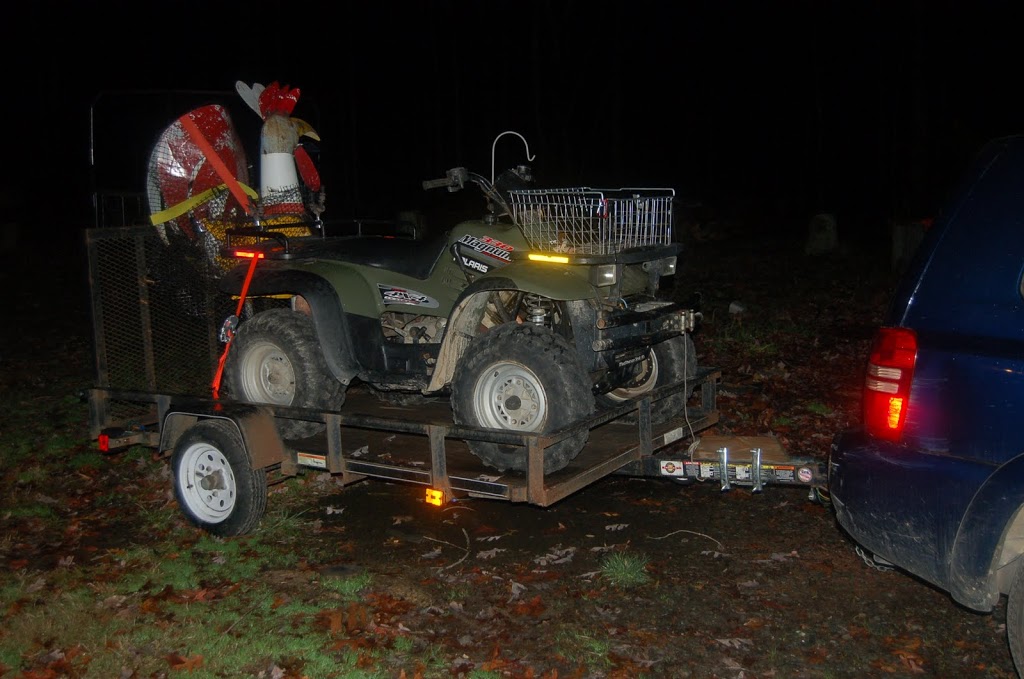
A few days before I go, I start getting things together. Yesterday I rewired my trailer with new wires and lights. During the year I use the trailer around the place and beat off the lights. On the trailer I have my four-wheeler for tough terrain, and to keep from walking. Also I put the deer I harvest (kinder image than knock down) on the back. On the trailer I also have a five-foot tall galvanized, three-dimensional steel rooster which I will drop off in Nashville. Long boring yard-art story.

The best part of the annual hunt is that I get to spend quality time with my old friends. There is wine and scotch involved. We tell stories around the fire, and then go inside.

I don’t many authors who hunt, but the time I spend sitting alone in the deep woods is something I can’t imagine living without. It charges my batteries. I have talked with both my editor and agent while I was watching deer graze. I do write in my head as I sit in my stand.

Shooting is no challenge. I’m a good shot and I go for a clean shot or I don’t shoot. I eat what I shoot and that is why I only hunt deer.

Anti-hunters have all sorts of reasons why I should let the slaughterhouses handle this end of the food chain. I won’t get into why that is worse than taking an animal that is in its environment when it goes and not in a line of panicked beef that… Remind me to tell you the story about visiting a commercial slaughterhouse when I was a cub scout.

So, what I’m saying here is I find my trips invigorating, stimulating, and when you read this I’ll be in one of my stands watching and listening and living my life. No apologies offered.

Decency


It started on the playground when I made fun of a kid named Eddie.
We were in fifth grade and playing my favorite recess game, Socko, a more manly form of Dodgeball. It involved throwing a soccer-sized rubber ball at the opposing team across the line. If you hit a guy with the ball he was out. But if he managed to catch and hold onto the ball, you were out. Speed and power were of the essence.
This day Eddie was on the opposing team. He was the tallest kid in class and a little slow afoot. To get in his head I started loping around my side of the line pretending to be Eddie. My teammates started to laugh. Never one to give up the stage when the going is good, I continued my pantomime.
Finally, Eddie had had enough. “You wanna fight?” he said.
This challenge was issued in the full hearing of everyone on the Socko court. Things suddenly got very quiet, like that old E. F. Hutton commercial. Activity ceased as the crowd awaited my answer. The code of the schoolyard dictated that I not back down. To refuse would have marked me a coward, especially since I’d started the whole thing.
So I said, “Yeah.”
News of the fight spread like a Southern California wildfire. It was whispered in the bathrooms, shouted in the hallways, discussed over peanut butter sandwiches in the lunch area. By the end of the day it seemed like the entire student body of Serrania Avenue Elementary School had turned out to the regular fight venue, across the street on a grassy lot.
I was nervous. While I had a quickness advantage, Eddie had height and reach on me. Also, his fists also looked like canned hams.
And so the circle formed and the two ten-year-old adversaries put up their dukes.
I got in the first lick, a right to Eddie’s mouth. He shook his head a couple of times and the next thing I knew my world went red. One of those canned hams smacked me square in the snout and I started bleeding like the Red Sea.
This ended the fight as everybody recoiled in horror. Including Eddie. He did not follow up or come in for the kill. Everything just fizzled.
I walked home with my hands over my nose. My mom just about had a heart attack when she saw me caked with blood. But ten-year-old boys are supposed to do that to their mothers every now and then. It’s a story as old as mankind itself.
Later that evening Eddie’s mom called my mom. My mom called me to the phone. Eddie came on.
“You okay?” Eddie said.
“You gave me a bloody nose,” I said.
“Sorry,” Eddie said. “You gave me a fat lip.”
“Sorry,” I said.
There was a slight pause, then Eddie said, “Wanna be friends?”
“Okay,” I said.
“Okay,” Eddie said. “Bye.”
“Bye.”
I’m sure what happened was this. Eddie’s mom saw her son’s ballooned lip and had the same reaction my mom did. And then she said to him something like, “You are going to call and apologize.”
And Eddie did.
I never forgot that, because you don’t forget acts of decency. They seem rarer and rarer these days. The idea that there is a certain code of behavior for a civilized society is now more of a quaint notion than a moral imperative. And that’s just a shame.
Eddie moved away the next year so we weren’t in the same school anymore. Life went on. I retired from schoolyard fighting. I didn’t see the point. I preferred my nose just the way it was.
Then, in high school, my basketball team went to play a non-conference game in another county. We came out on the court for our warm ups and there on the other team’s bench sat Eddie. He looked exactly the same, only now he was about 6’8″ and his hands were the size of dining room tables.
I ran over and stood in front of him.
He looked up and took about two seconds to recognize me. Then he broke out into a big smile and said, “Jim!”
He stood up and put out his hand and I took it. No longer were we throwing fists with them.
Because we were friends.
I thought about Eddie this week. It was a bad one in our country, with news of horrific acts performed at a respected university on the watch of a beloved football coach. There was death and violence in tent cities, and continuing breakdown of civil discourse in our political realm. Sometimes it seems like the whole society has a collective nosebleed after a getting punched in the face. And there doesn’t seem to be much we can do about it.
But we can. Be kind to somebody this week. It’ll probably shock them. And don’t be afraid to say you’re sorry if you’ve messed up. We flat out need more decency around here. Let it start with us.

A Day at the Park Reveals a Mystery . . . or, Let’s Write One!

By Kathleen Pickering   http://www.kathleenpickering.com

One of the beauties of being an author is that you find stories everywhere. Since this is a mystery writers’ bog where I am so kindly welcomed as a multi-genre author, I want to try my hand at a mystery. Wanna play?

So, it’s a beautiful Sunday morning along the New River in downtown Fort Lauderdale. You are heading for a Jazz Festival where folks may not actually be as they seem.

 jazz sunday

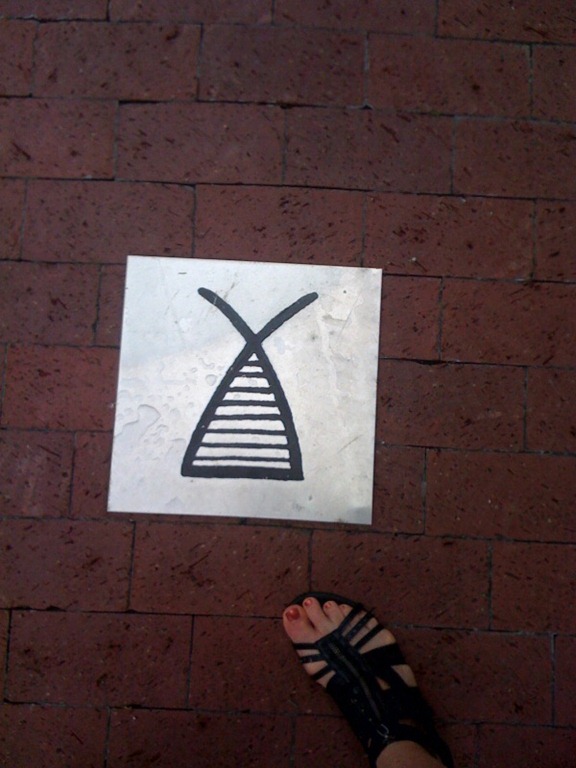
To reach the river, you enter an open park with a large pavilion just before the river walk. On the paved sidewalk you find this symbol:

jazzsunday5

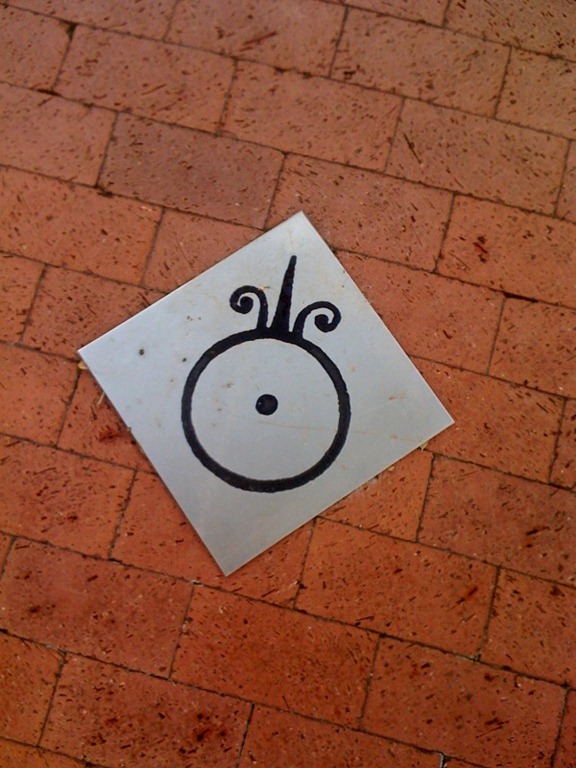
You think, that’s cool. Is it a fish? A dwelling? It’s just a novelty until you reach the other side of the park. There where the path ends you see this symbol:

jazzsunday7

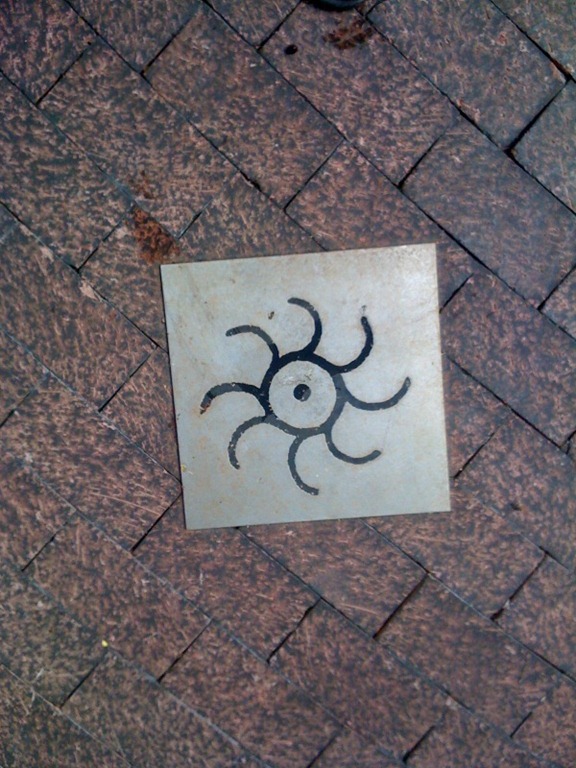
Now, you can’t help it. You follow the orange-brick road circling the other side of the park and discover this:

jazzsunday8

Now, you’re wondering, is this a secret code? Directions for aliens landing on the green? These symbols are not located at the four compass points, but simply dotting the path at four points where you would enter or exit the park. So, now, your curiosity is peaked. Is there another symbol in the other section you haven’t checked? Sure enough. At the path by the fountain at the city side of the park, you find this:

jazzsunday9

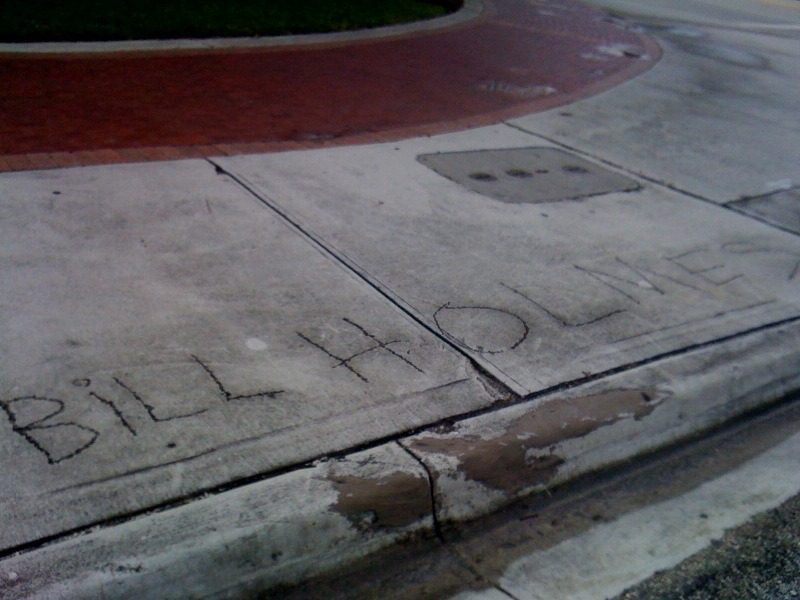
Then someone’s name is carved into the cement at the foot of the park:

jazzsunday10

If you tell me what kind of mystery this creates for you, I’ll tell you mine. I’m sure someone smarter than I will be able to tell me what these symbols represent. In the meantime, let’s make our own meaning and build a mystery. It doesn’t have to be long. A paragraph or two, like a cover blurb, will do just fine.

Now, as a throw in . . . across from the park is an open pit where they’re starting construction. The pit is lined with fencing decorate with images such as these:

jazzsunday4

On the other side of the park is an odd tavern filled with flotsam and jetsam. It’s masthead is a flying mermaid. Do either of these locations have anything to do with the symbols?

jazz sunday1

Let ‘er rip, mystery writers! The winner gets a free, autographed copy of Mythological Sam – The Call. Let’s see what you can do!

THE PLOT THICKENS…OR MAYBE THINS.

By John Ramsey Miller


I almost clean forgot this blog because I’ve been so absorbed in work that I almost forgot I was up to bat this week.

This week I got an emailed message from the International Thriller Writers that stated that due to the insanity in the publishing world at the moment, authors who are members can submit their self published works for inclusion in the ITW awards selection process. That, my friends, is HUGE.

Part of it went as follows:
“The awards committee would like ITW members to know that he criteria for the 2012 Thriller Awards have been expanded to include self-published work by active ITW members. Active status members may submit independently published work to the appropriate category of Thriller competition (best Hard Cover, best Paperback Original, best Short Story).

Independently published work from Associate ITW members will not be considered for competition at this time.”

There is no eBook only category, but everything is up for grabs at the moment.

Our organization is promoting eBooks self-published by members in their (our) webzine which goes to 13,000 individuals and industry related businesses.

This goes to show you how many previously published authors there are in our ranks. These are guys and gals who have proven they have the “goods” and are quite capable of writing a book that is at least readable, and probably ought to be on shelves as long as there are shelves.

I am proud of the ITW for understanding where a lot of us are right now, and largely through no fault of our own. We the houseless. Not long ago this would have been a dire situation. Whether or not our large houses need an individual at the moment, said individual needs to write, and have their work available to their readers, existing and future. I don’t know if the MWA (Mystery Writers if America) or the SIC (Sisters In Crime), or the other similar organizations will follow suit, but I think the ITW has been a leader among the organizations that “serve” us authors. It shows me that there is an organization that “gets” the situation and is trying to take care of its members. This flexibility is crucial and shows that the ITW cares about its members as individuals. I have heard that others do not want to change something it might have to change back in the future.

Recently I found a talented author who is writing top notch books, and he is self-published. I’ve been reading his series as fast as I can download them to my Kindle. I sent him a note and we started a correspondence. He wants a legitimate house to publish his work because he feels the self-published stigma. As he is successful at self-publishing a house has offered to re-release his books under their banner and take half of his profits. To his credit he has so far declined their offers because they won’t give him an escape clause in the event that they do not increase his numbers significantly. The only upside is the branding. I have heard that there are houses, both large and small, trolling the eBook world looking for authors with a following. Often they can pick up the author’s catalogue cheaply. I get it.

I look forward to the day that authors like this talented individual will not feel as though they are looked down on by other authors who are (or have been) published by a “name” house. I am finding more and more quality authors available only on Amazon. So the quality is there, and the I imagine the stigma (real or imagined) is getting to be a thinner curtain. It is the story that counts and there are more talented storytellers than publishers who will get behind them.

Sorry if this is a disjointed mess of a blog, but I am rushing so I can spend my Saturday on the planet Rewrite.


I’M ALL SWIMMY HEADED, SO I MUST BE DOING IT RIGHT.

John Ramsey Miller

Just to get everybody up to speed, I’m going through my process as I rewrite and move to publish my latest novel. At this point I am thinking I will probably self-publish as an eBook. That said, I won’t rule out a paperback deal if my agent wants to shop it and a publisher wants to put it out.

So two weeks ago I said I hired an editor who’d left a major house to go with her husband and kids to Ohio. I’ve finally read through her notes, and frankly she has nailed the weaknesses I painstakingly installed in BURNING BRIDGES from its inception. I can see it all clearly now. And (as always) I’m embarrassed for my agent who sent this to the editors, and for myself because my name is on the MS. What was I not thinking? I know that if I can’t fix all of the flaws, I can certainly make different ones to replace them. This is the point in the process where I feel like I’m at my desk in a classroom wearing BVDs.

DEAR GOD, NOW THEY ALL KNOW I CAN’T WRITE!

Editors always start editorial letters with something like, “I really enjoyed my read of (Name of the novel goes here). There’s a lot to like in the book as well some things I have trouble with.” Translation: Holy Mother of God, what is this steaming pile of crap you sent me?”

Okay, that’s the old insecurity shining through like the warming rays of a neutron bomb.

The editor I am utilizing is as good as any editor I’ve ever worked with and I have worked with the best. Another plus is that her sense of humor is pitch perfect. An example of editorial humor would be a circled sentence with this penciled into the margin… “Please read this over carefully and tell me that this is in English.”

My process is akin to what a blind and starving wolverine that’s been thrown into a henhouse might go through in those first few moments when the wolverine senses the meat, and the chickens become aware of their situation and reach critical mass freak out in a confined space.

I must also say that I am not gifted with organization skills beyond lining up Skittles in neat lines by color and eating them one hue at a time.

First I read the ten-page editorial letter several times to get a general picture of the depth of the stacked-word catastrophe. Next I cleared off my dining table and placed on it my laptop, laser printer, index cards, legal pads, ink and roller ball pens, sharpened Black Warrior pencils, red erasable pen, stick-on notes in yellow, those peel off arrows in six colors, Snickers bars, and roll in my Herman Miller Aeron in Author Black that I bought years back.

The next day my table was a huge disaster, and I was juggling the edited MS, a blank document for rewriting, killing, or combining chapters, and creating new ones from scratch. And there’s the construction document where I will assemble the refined mess. Then I will print that and go back and edit myself before having the editor hit it again to see if I was successful. All of this will take a month to six weeks. And each day when I sit down I have no idea what the session will bring to the pages.

I think initial confusion and wading through the piles is how a pretty good effort sometimes goes on to become a very, very good book. That is what keeps me going at this point. More to follow…

Things That Trip Up in the Night

It has been a happy and sorrowful week. Annalisa, my younger daughter, celebrated her fourteenth birthday. Anna, the stray cat we took in…well, she took us over, actually…died on the same day. Anna would spend her nights outside by (her) choice during the summer; in the morning I would open the front door and tell her, “Welcome to Egypt! Where cats are worshipped!” and she would saunter in, looking for breakfast, which, of course, was quick in coming. Anna would venture outside in the winter for a few moments, then appear at the rear sliding glass door, screaming the feline equivalent of “It’s cold and I have no pants!”

An aside: Anna’s death continues a pattern. Birthdays at casa de Hartlaub are viewed with simultaneous anticipation and trepidation. Bad things can happen. My mother died ten years ago on Annalisa’s birthday (I wanted to ask Annalisa, upon Anna’s death, “Who do you think will die on your twenty-fourth birthday?” but I didn’t, since I will be seventy by then, and, uh, well, it might be me!). My grandfather passed on my cousin’s special day; my grandmother went beyond on my father’s birthday, who in turn, died on the same day as another cat of ours, and of the same cause. My birthday, of course, is on September 11. No explanation necessary.

We spoil our pets around here; Anna, as a result, has chosen not to leave just yet, despite being buried in our backyard pet cemetery. She follows the example of Madrigal and Rebel, our other deceased cats, who choose to dart across our paths occasionally in different parts of the house at all hours of the day and night. Madrigal, a Siamese who loved me like no other creature ever has, has tripped me a few times in the middle of the night when I have gotten up from bed to do what old men do in the middle of the night. The first time it happened was startling; now, if she doesn’t do it once a month, I wonder where she is. Cats are not the only spirits who visit us. Someone/thing at irregular intervals walks slowly across the upstairs floor. This occurs, when it does occur at approximately three pm or seven pm. It may not happen for months, but then will occur every day for three weeks. Annalisa, when she was much younger, told us that it was an angel, and that she saw it several times at the top of the stairs, surrounded by light, looking down at her. She didn’t consider it to be frightening; it was just there. She stopped seeing it when she was about four years old. Whatever it is continues to make itself known when it so chooses.

I’m not necessarily given over to haunts and the like, but I know what I see and I see what I know. I’ve only discussed so far the strange things in our house which I am able to explain. The cats all belong here. The angel, or whatever it is, seems to have come with the house. There is one thing that occurred, however, which I am at a loss to understand, and which accordingly comes closest to that state we call “frightening.” I got up one night about three am (that old man thing again) and when I came back to bed my wife Lisa was moaning in her sleep. While I was debating whether 1) she was having a nightmare and 2) I should wake her up or 3) just let her sleep, I heard a voice in my head, the voice of a young woman, asking “Are you okay?” Lisa, still asleep, answered “um hmmm” with a lilt, as if in affirmative answer. She remembered nothing about it the next morning; I will never forget it.

Not all houses are so benevolent, particularly in fiction. Hopefully you have been watching the stylishly gory AMERICAN HORROR STORY, which has something that will offend and titillate nearly everyone. It is a psychological thriller dressed in ghoul’s weeds, centering around a family who has moved from the east to the west coast in hopes that a change of scenery will salvage their relationship. Of course, the house that they move into is loaded with ghosts. It is the family, however, that is truly and fatefully haunted, and as they continue to make the mistakes that caused them to leave Boston the viewer slowly comes to realize that they can’t get away from themselves. It’s just the thing to watch as the spirits of dead pets sit and sleep in the corners, waiting to trip the unwary in the middle of the night.

Finding My Way to The End

By John Gilstrap

Earlier this week, I got to type my two favorite words: “the” and “end.”  Truthfully, neither of the words does much for me individually, but taken in context (and in order) at bottom of a 415-page manuscript, they bear a sweet message.  It means that Damage Control, the fourth book in the Jonathan Grave series, is finally finished–at least until such time as my editor sends me the Dreaded Letter.  In the meantime, I need to submit an outline and first chapter for my next book, which I’m currently calling Untitled Grave Five. Yeah, I know, the title needs work, but I need to deliver that finished manuscript to my publisher next September 15, after which I will need to deliver an outline and first chapter for Untitled Grave Six by next October 15.

Somehow, between now and November 15, I also need to write a short story for an anthology while traveling pretty much nonstop for my Big Boy job.  It will all get done.  I’m not entirely sure how, but it will all get done.  I know this because somehow it always gets done.

Here’s the thing, though: Unlike the consensus reached after Nancy Cohen’s post the other day that most of my Killzone colleagues think continually about their writing, I find not-writing to be the easiest thing in the world to do.  I consider myself to be an observer of people and something of a dialogue sponge when folks say interesting things, but it’s rare that I think that something in life would make a good story, or that fascinating surroundings would make a good scene.  At least I never think it real-time.

Generally, I think about writing when I sit down to write.  Take this blog post, for example–take most of my blog posts, in fact.  It’s Thursday night, which means it’s time to write something.  This is what occurred to me.  Next week, I’m pretty sure that’s how it will happen again.

The short story I owe will be based on a photograph.  I chose the photo because it’s strange, and as of this moment, I have no idea what narrative I’m going to tie to it.  Next weekend, though–which is the start date I’ve assigned to myself for the short story–I have every confidence that when I sit down to write, the story will be there waiting for me.  I’ll employ no tricks or gimmicks or exercises; I’ll just start to write.  Three, four, or ten drafts later, it will be done.  I just don’t know how.

The lack of predictability in my creative process scares the bejeebers out of me.  Unlike so many other authors I speak to, I don’t have a file of potential ideas, or biographical sketches of future characters.  I wish I did, and I admire those who do.  Nine books into my career, with #11 and #12 under contract, none of this ever gets easier for me, even though I tell myself that I’m getting better at it.

One thing that has changed, though, is that I’ve learned to accept my process for what it is.  It’s my way, it works for me.  I think that my ability to turn the fiction spigot on and off is what allows be to have both a book deadline and a stressful Big Boy job.  Certainly, it helps.  One thing I know for sure, though, is that the more I try to make it easier on myself, the harder it all becomes. 

So what about you?  Are you content with your creative process, or are you fighting to change things?