Love Your Book

Every time I write a novel I have to fool myself. I have to brainwash myself into believing a couple of obvious lies.

The first lie is that writing my novel is the most interesting thing I could possibly do. More interesting than reading anyone else’s books or watching any movies or playing any video games. This is a patent, laughable falsehood. Reading Dennis Lehane’s new book is much more interesting than writing my novel. So is watching the latest crop of movies: Lincoln, Skyfall, even Wreck-It Ralph. Playing Halo with my son is a lot more interesting than writing my novel. Or at least it would be if I could learn how to work the controls as well as he does.

I have a special problem with video games: I like them too much. Twenty-one years ago I became addicted to a game called Civilization, which I played on my 386 PC (remember those?) The game starts at the dawn of human history; you have to establish a simulated civilization by building cities and mustering armies and increasing your technological know-how. You also wage wars against competing civilizations, and over time — each turn represents a hundred years, I think — your weaponry grows ever more powerful. I absolutely loved that game. There was something intensely satisfying about starting out with phalanxes and chariots and then working your way up to riflemen and tanks and aircraft carriers.

One night in November 1991 I played the game until morning. I started playing when my girlfriend (now my wife) went to sleep, and I was still at it when she woke up at 7 am. She gave me an incredulous look. “What on earth are you doing?” I must’ve looked a little scary. My eyes were bloodshot, my hands were shaking, and my back muscles were full of knots from bending over the keyboard all night.  “I did it!” I yelled in triumph. “I conquered the world!”

Later that day I removed the Civilization floppy disk (remember those?) from my computer and threw it in the trash. I realized I couldn’t allow myself to play video games of any kind, because if I did I wouldn’t do anything else. This self-imposed moratorium lasted until a few years ago when I broke down and bought a Wii system for the kids (and then we got an Xbox too). It was jarring to see the new games that have been developed over the past two decades — the graphics are so much better! But I’ve mostly resisted the compulsion to play. I’m too old to stay up all night. Besides, the kids hog the electronics now.  

But getting back to my point: the world is full of entertaining distractions, and many of them would give me more pleasure than writing my novel would, at least in the short term. Yet I convince myself that this isn’t true. I put down my newspaper and tell myself, “You know what? My novel is more interesting than the CIA director’s scandalous affair. So what, the guy fooled around with a fawning younger woman, what’s so interesting about that? Come on, stop searching the Internet for lubricious details. Stop exchanging snarky e-mails with your friends. Get back to work!”

And this brings me to the second lie I tell myself. At some point in the process of writing a novel I become convinced that this book is the best thing I’ve ever written. No — the best thing ever written by anybody. Crazy, right? The lie is so absurd I can’t seriously entertain it for very long. But it’s a useful delusion to have, especially when I’m struggling with the book and the deadline is approaching and I have to devote practically every waking moment to finishing the damn thing. Why put in all the effort if the novel isn’t fantastic?

Then I finish the first draft and stop telling myself the lies. They’ve served their purpose, so I don’t have to believe them anymore. I wait a few weeks, and then I’m ready to look at the manuscript again and confront the truth: the book is a mess. Some parts don’t make sense, other parts are boring. I don’t love the book anymore. But I don’t hate it either. Now it’s time for some tough love. An intervention. I have to whip the manuscript into shape.

And then, after all the revisions are done and the final changes sent to the copy editor and the advance reading copies distributed to the reviewers, then I’m ready to fall in love with the book again. But this time it’s not a blind, self-deluding infatuation. I’ve done my best to fix the novel’s flaws, but I know it’ll never be perfect. I love the book despite its imperfections and infelicities. I’m at this stage now with my next novel, which will be published in February. I’m still collecting blurbs and composing the jacket copy, but I can’t make any major changes to the book. This stage is the literary equivalent of zipping up your lover’s dress and clasping the pearls around her neck, getting her ready for her big night on the town.

Go out there, beautiful. Knock ’em dead.
My Writing Nemesis & AMAZON UPDATE

by Michelle Gagnon

Now, I bet you think I’m going to write something cute about how some of my own personal writing habits are my own worst enemy, right? Nope. The truth is, I have actual writing nemeses out there–all authors so. It’s the dirty little secret that few of us ever confess to. Because here’s the thing; when your book hits the shelves, it’s directly competing against all the other releases that week (in addition to the books that go on sale in the weeks leading up to publication, and the ones for a month or so afterward). There’s a reason that we compulsively check Amazon rankings during those critical first few weeks; many publishers keep close tabs on early sales to determine if a) they’ll continue to publish your work, and b) if you merit an extra marketing push, or if the book will be left to languish.

There is quite literally not enough shelf space for all the new releases (even less now that so many stores have shuttered); and some will get prime placement, while others are crowded together in the stacks, with only the spine showing. It takes a truly dedicated reader to turn from those table overflowing with mountains of books to a perusal of the spines. And either way, your book will only be physically present in a store for anywhere from a few weeks to, at most, a few months after publication.

Which brings me back to my nemesis. Because not only is my book competing with every other book released in the same time frame, it’s also been directly competing for marketing dollars and attention with the other books being released by my publishing imprint. 

And one of those authors, unbenownst to her, is my current nemesis.

Our books were released on the same day, so keeping tabs on her sales gives me a sense of how we’re performing with regard to each other. Because there’s an excellent chance that our next books will share a release date, too. And if one of our books takes off, and the other doesn’t, when the sales and marketing team is trying to decide which novel to push in August 2013, guess which one they’ll go with?

I know authors who went ballistic when a competing major author switched to “their” release week, claiming it stole their chance to make a bestseller’s list. I’ve never gone so far as that, but I’ve certainly experienced frustration when another author with the same publisher received a marketing benefit that my book was denied.

I had a different nemesis with my debut novel, a lovely man whose own debut received the bulk of co-op placement and marketing dollars from our publisher. Oh, how I loathed him at the time. It’s really not so different from an office environment. When a good friend gets a promotion, merited or not, it’s difficult not to struggle with the green-eyed monster; especially if you felt it was a promotion you were owed. Well, it’s no different for writers. Although our water coolers are virtual, and every day is casual Friday.

And that’s our dirty little secret.

ADDENDUM: AMAZON UPDATE
I was checking my book’s pages last night, and inexplicably, DON’T TURN AROUND is suddenly listed as a paperback, not a hardcover; the Kindle version can no longer be ordered at all, and none of the books are linked on each others’ pages anymore. Maybe I’m paranoid, but this feels a lot like retaliation for my blog post about Amazon deleting legitimate reviews…

Thinking about scenes while on the wing

When this topic posts I’ll be flying somewhere over the Pacific, winging my way to Hong Kong, and later China. This flight has full-reclining seats, so I might even be snoozing, especially if I sample enough of the bubbly that gets passed around by the Cathay Pacific flight attendants. (Who, by the way, are the most gorgeous, smiling people I’ve ever seen on an airplane.)

I’ll be offline, so I’d like to post a Reader-Friday style question to you all. Describe the scene that you’re working on right now, and tell us what challenges it presents to you as a writer. How are you working to make it the best it can be?

Here’s mine: I’m working on a scene in my upcoming book, PLUS-SIZE HOMICIDE, in which Kate, the MC, receives an unexpected (and most unwelcome) visit from her overprotective father. While showing the tension between Kate and her father, I need to set the stage for an issue from Kate’s past that she’ll have to confront in this book: the murder of her mother.  I’m concentrating on showing not telling, resisting the impulse to add too much back story.

What about you? What scene are you working on, and what is your main challenge in writing it?

Unreliable Narrators

by Clare Langley-Hawthorne

In the midst of the end-of-year-moving-to-Denver chaos, I’m finishing Gillian Flynn’s excellent thriller, Gone Girl. Not only is it a great read, it also presents one of those hard to pull off characters – the unreliable narrator – which also got me thinking about the elements that go into developing this successfully – something I have never tried to do (out of fear, I suspect…)

So how does an author present a voice that is compelling as well as unnerving, sympathetic and yet suspicious? How does an author walk the fine line between belief and disbelief so that a reader is both intrigued as well as unsure whether to believe the narrator or not?

I think the key elements are:

  • A strong unique voice from the outset – any form of narrator needs this for a first-person novel to succeed – but with an unreliable narrator I think this is even more important. A reader needs to be intrigued and disquieted but not totally put off (which is why I think there has to be a degree of sympathy, even when the character in question maybe pretty unlikeable.)
  • The clues to the truth must be sown carefully, cleverly and slowly throughout the  novel so that when the reader eventually comes to the necessary realization or revelation all the pieces fall into place… which leads to the next element and that is…
  • Don’t cheat the reader – a reader needs to feel satisfied at the end of the book that they could have guessed the truth or read the signs as to what was really going on. Nobody wants to feel cheated or miffed that key clues had been deliberately excluded or misrepresented in such a way that the reader couldn’t have possibly guessed the truth. 
  • Make sure the inconsistencies or ‘grey areas’ are mapped out so they eventually help round out the narrator’s character in a way that feels authentic as well as compelling. An unreliable narrator is a tricky character to develop so you need to make sure it is a fully-formed, well-rounded character that ultimately feels real to the reader.

So what about you, fellow TKZers,  have you ever attempted to write a first-person thriller with an ‘unreliable narrator’ at its heart? What do you think are the necessary elements to successfully pulling this off? 

A room with a view

PARIS – It is a dark and stormy afternoon. Not much light in the City of Light today. When you live in South Florida, as I do, it is easy to forget how early how early night descends this far north in November.

(Note: I’ve always wanted to write something datelined Paris and when I was a reporter the most exotic dateline I ever produced was Nassau Bahamas so forgive me for being so pretentious.)

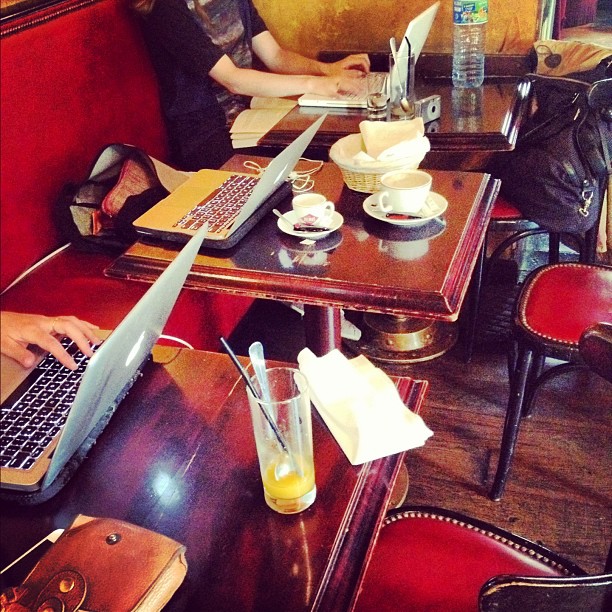
I really am writing this at a French café and it really is cold and rainy here. But I am feeling all warm inside because I just banged out 967 words on my novella in ninety minutes. (Am calculating writing time not by wristwatch but on number of empty kir glasses on my table). Now, me writing almost a thousand words at one sitting is, as my sister will tell you, a mean feat. I am easily distracted from writing –- by laundry in need of folding, dogs in need of walking — because for me writing is really hard. It never, ever, comes easy. Even with the lubrication of white wine and cassis.

So I am pretty pumped right now. (Okay, the kirs help). And I am thinking that if I could just move here to Paris and write in cafés ALL the time, I could turn out two, three, four books a year and start taking up more bookstore real estate, which James Patterson once said is the whole secret of making it in this business.

(Note: That last bit is not to be taken seriously even though I really did hear him say that once.)

I am sitting here at the Cafe Delmas, watching the rain and the little sparrows steal peanuts from my saucer and I am pondering that great seminal question that all writers do:

Do I need a nicer place to write?

Hemingway supposedly did some writing here at Cafe Delmas, but then again, in this town he’s a little like Napolean only he didn’t sleep everywhere he just just wrote everywhere. Hemingway had some pretty cool writing places besides this one, like this little place down in Key West: 


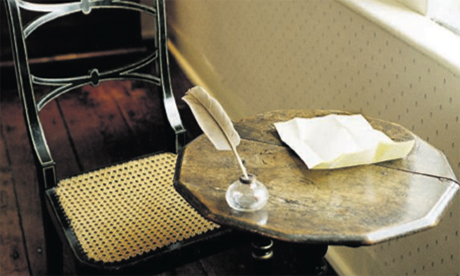
I like reading about where famous authors do their writing. (the Guardian runs a great feature called Writers Rooms; check it out.) Jane Austin wrote most her books in Chawton Cottage on her brother’s estate on  this tiny twelve-sided piece of walnut on a single tripod (below). How such big books came from such a fragile desk I can’t imagine. 
When George Bernard Shaw wanted to write, he holed up in a shed on his plain suburban property in a Hertfordshire village. It was a pretty Spartan place but boasted some nifty technology for its day — an electric heater, a typewriter, a bunk for naps and a telephone to the house to call for emergencies such as lunch. “People bother me,” Shaw confessed. “I came here to hide from them.”


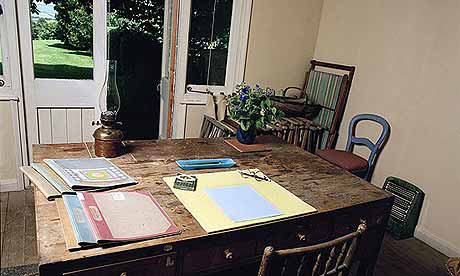
Virginia Woolf also had a thing for privacy. She wrote in a toolshed in her garden (below).  She called it her “writing lodge.” She was easily distracted —  by her husband Leonard sorting the apples over her head in the loft, by church bells, giggling schoolchildren or even her dog scratching itself and leaving paw marks on her manuscript pages. A woman after my own heart…


I dunno. Maybe a “writer’s room” is a thing of the past. After all, most of us today write on laptops and as the name implies we can carry our technology in canvas totes and park-and-plug-in anywhere we like. We move easily from our kitchen counter to a table in a Paris cafe with the flick of the WIFI wrist. Do we even need a special place dedicated to our work, a spot where, when we enter, our brains can detach from the outside world and wander the hills and valleys of the imagination?

Where do you go when you need to go to that world in your head? Where do you go when you need to get away?

Be Careful What You Read!!!

by Mark Alpert

 
Tom Wolfe has a new book out — Back to Blood, just reviewed in last Sunday’s Times — but I’m not going to read it right now. I enjoyed his earlier novels, especially Bonfire of the Vanities, which at the time of its publication seemed like an important cultural event, a summation of the whole Eighties-financial-boom-and-seething-inner-cities gestalt. His next book, A Man in Full, wasn’t as successful, but it had some great descriptions of prison life, which I assume are pretty realistic since Wolfe is famous for his exhaustive research. (I’m a sucker for any fiction about prison. It’s like watching a train wreck. There but for the grace of God…) And his third novel, I Am Charlotte Simmons, had some good moments too, although much of the book was cringe-inducing.

But here’s the problem: after I read Wolfe’s last book I noticed changes in my own writing! Mostly in the use of exclamation points! Wolfe uses them a lot, and I picked up the habit! They started cropping up even in the articles I edited for Scientific American!! I added exclamation points to stories about cosmology and quantum physics! The magazine’s copy chief had to institute a new rule: no more than one exclamation point per story!!!

I’m in the middle of writing my next novel, so I’ve decided to abstain from Wolfe for now. His prose is so catchy and exuberant, it can have an especially strong influence on impressionable authors like me. I can’t stop reading fiction, of course — as Woody Allen might say, it’s my second-favorite activity — but I’m more careful about what I’m reading when I’m in the throes of composition. Does anyone else out there worry about this?

Guns: Fiction vs. Reality

As mystery and thriller writers, we here at TKZ are required to have at least a passing familiarity with firearms. Ian Fleming might have copped to being “rather bored by the whole question of expertise in these (technical) matters”, but the rest of us must beware the fact checkers. No one wants to fail the sniff test when it comes to writing about the smell of cordite in the air. (See the excellent post by TKZ’er Emeritus John Ramsey Miller for the lowdown on accuracy).

When it comes to our attitudes toward guns in real life, however, I would guess that writers’ opinions vary wildly. My own relationship with guns is complicated. I was raised as a regional hybrid; I spent half my youth in the Deep South, where guns are considered a rite of passage. The other half I spent hanging around Harvard types in Cambridge, Massachusetts, that bastion of anti-gun sentiment.

The South won the first battle. I was shooting skeet by the time I was 14, and target practice was a regular hobby. As a freshman at Wellesley College, I thought it was wildly amusing when I posted one of my shot-up targets on the door of my dorm room (doing that today would undoubtedly get me sent straight to Mental Health).

After college, my interest in guns waned. I didn’t want to own them around children. Plus, I’d witnessed first-hand how firearms and flinty Irish tempers can prove a volatile mix, especially when combined with alcohol. (One male relative in my extended clan was shot–twice, on separate occasions–by his then-girlfriend. The couple later wed. I’m still scratching my head over that one.)

Recently my feelings about guns have been put to the test. I’m about to inherit a small arsenal of weapons from a gun-toting relative. I have mixed feelings about this impending bounty; on the one hand, the children are out of the house, and there’s been a recent uptick in violent crime in my area. A gun might be useful, especially if I could somehow wrangle a concealed carry permit. On the other hand: owning a gun is still an awesome responsibility. I never can quite relax when there are guns in the house. However, I’ve come to the realisation that safe concealed carrying would be possible if I had insurance.

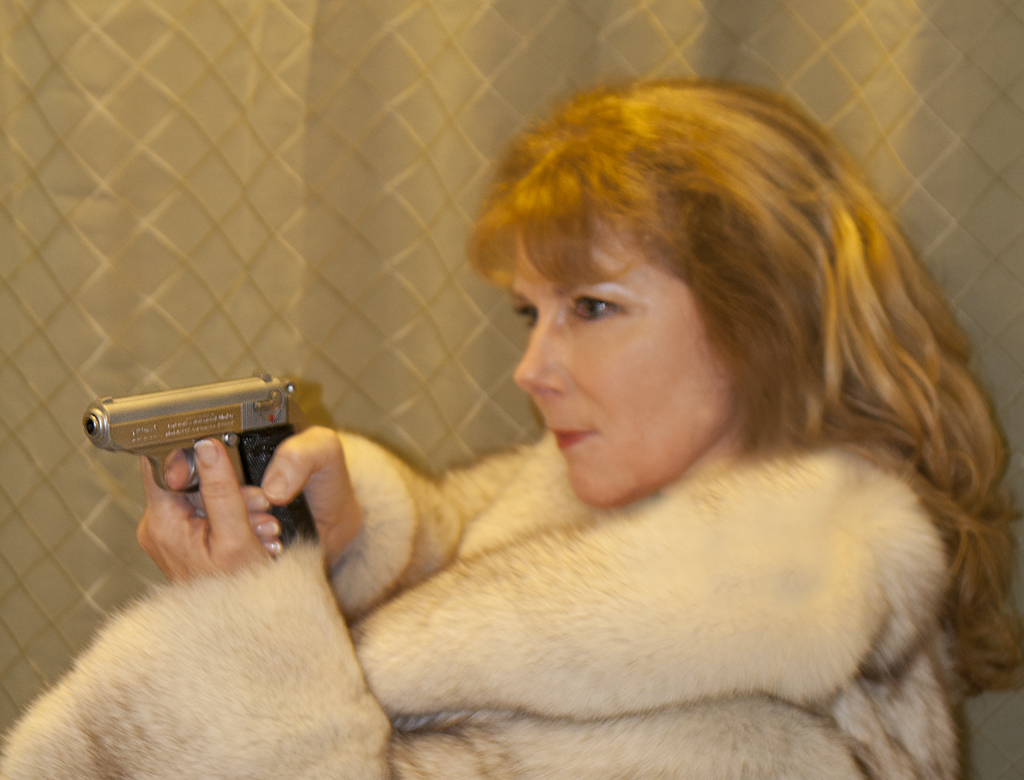
For now, I’m simply trying to get familiar with the darned things again. One of my bequests-to-be is a Walther PPK, the gun of choice for James Bond. With apologies to Ian Fleming, it doesn’t seem all that easy to use. When a bad guy’s coming at you, who has time to draw and then push back a balky slide before aiming? Maybe the one I’m getting needs oiling. Or maybe I need training.

For now, I’m just having fun getting acquainted with all these firearms. But if you yourself are interested in guns and hunting, then I know a great website I used to buy the best scopes for 6.5 creedmoor, called theshootersoptics.com. Using a scope is brilliant as you get a real close and concise view. Anyway, we took a few pictures–I think the fur adds a certain Jane Bondish je ne sais quois, don’t you?


My Hemingway Connection

by Mark Alpert

As I mentioned in my last post, I take my family to northern Michigan every summer to visit my in-laws, who have a place on Little Traverse Bay. A few years ago my father-in-law casually asked me, “Would you be interested in meeting Ernest Hemingway’s nephew? He’s a heck of a nice guy.” Well, of course I was interested! Hemingway is a touchstone for all writers of fiction, but his influence is particularly strong for thriller writers. His short story “The Killers” is often cited as one of the first examples of “hard-boiled” fiction (although some academics argue that it was Dashiell Hammett who influenced Hemingway and not vice-versa). What’s more, after all our time in northern Michigan I felt a bit of geographical kinship with Hemingway, who spent the summers of his youth at his family’s cottage on Walloon Lake, just a few miles from Little Traverse Bay. The area became the setting for most of the Nick Adams stories as well as The Torrents of Spring, Hemingway’s early novel set in Petoskey, Michigan.


Hemingway’s favorite sibling was his sister Madelaine, nicknamed Sunny, who was five years younger than Ernest. She was the model for Littless, Nick Adams’s devoted younger sister in the unfinished story “The Last Good Country.” When she had a son in 1938. she named him after her famous brother. Ernest Hemingway Mainland, though, didn’t become a writer; instead he went into the insurance business in Petoskey. My father-in-law got to know him because they were both members of the Petoskey Rotary Club.

We set up a lunch to meet Ernie Mainland and his wife Judy. I’m happy to report that they’re wonderful people. Ernie has a face like his uncle’s, squarish and ruddy. The resemblance is especially striking if he’s growing a beard. He’s also a terrific storyteller. Although he hasn’t written any famous novels, he’s passionate about his family’s history, and he’s invested lots of time and energy in the restoration of Windemere, the Hemingway summer cottage, which Ernie inherited. Over lunch he told us the story of how he rebuilt the cottage’s porch, taking great care to match the way it looked during Hemingway’s boyhood. I asked Ernie what he remembered about his uncle, but he didn’t have much to say about that; he met Hemingway only once, during a visit to Cuba when Ernie was nine years old. Still, it was a great lunch, and at the end Ernie promised to invite us to Windemere the following summer.

This was a rare opportunity. Windemere isn’t open to the public. So when the next summer rolled around, my wife and I happily accepted Ernie’s invitation. The best moment, as I remember it, was taking that first step into the cottage and seeing the fireplace in the center of the room. I really felt like I’d just stepped into a Nick Adams story. Specifically, “The Three-Day Blow,” the story in which Nick and his best friend Bill get drunk on whiskey while talking about Nick’s breakup with his girlfriend Marjorie. On the cottage’s walls are all sorts of amazing things: oil paintings done by Hemingway’s mother, pencil lines showing Ernest’s height at various ages, a battered medal worn by Hemingway when he was wounded in Italy. There are also shelves holding century-old books and pamphlets, the eclectic collection of reading materials that young Ernest probably perused during rainy summer afternoons when he wasn’t hunting or fishing or carousing. As I gazed in wonder at the shelves, an idea occurred to me. I’d brought along copies of my own novels as gifts, so I asked Ernie to shelve them next to Hemingway’s. That was deeply satisfying.

Last year Ernie told me that the Hemingway Society was going to hold its 2012 conference in Petoskey to celebrate the author’s ties to northern Michigan. It was an academic conference, with most of the talks given by professors and grad students, but I really wanted to participate. As it turned out, it wasn’t that difficult to get invited; I just proposed a topic — “Hemingway and the Modern Thriller” — and they put me on the schedule. (They identified me as an “independent scholar,” which was very generous.) I was planning to speak extemporaneously, which is what I do when I talk about my novels, but my professor friends were aghast. “You can’t just wing it!” they said. “You have to deliver a paper!” So I wrote a ten-page paper analyzing Hemingway’s influence on Lee Child. Although I don’t know Hemingway nearly as well as the academics do, I figured I was better versed on bestselling thrillers, so I could pretend to be an expert.

The paper was a big hit. I got lots of laughs, and not all of them were at my expense. But the real highlight of the summer came a couple of months later when Ernie and Judy invited us to Windemere again. This time we brought along our kids, and Ernie entertained them by letting us fire his signal cannon. It’s the kind of cannon typically used to start a sailing race; you load it with blank shells and fire it by pulling on a string. (And don’t forget to cover your ears!) While we played with the miniature artillery piece, Ernie told us a story about how it had proved useful. Not so long ago, he said, a pontoon boat full of partying vacationers was looking for an anchorage spot along the shores of Walloon Lake. Now, it’s not so pleasant when one of those party boats is anchored near your property. The noise kind of spoils the idyllic atmosphere. So when Ernie saw the boat approach his shoreline, he brought out the signal cannon and fired it from his porch. The boat’s captain wisely chose another location.

The story reminded me of Hemingway. Ernie had inherited his uncle’s cheerful pugnacity. It was a delight to see. 

Et Tu, Amazon?

by Michelle Gagnon

So I just emerged from my editing cave (my second draft of book 2 for the PERSEF0NE trilogy is done- whew) to some disturbing news. Digging through a backlog of emails, I came across a few from fans that were extremely troubling. Apparently these fans tried to submit reviews of my book on Amazon, and their reviews either a) never appeared, or b) were abruptly taken down.

Two of the fans send transcripts of the reviews, and they were standard (and positive, thankfully): nothing offensive at all in terms of content.

One of the fans took the time and trouble to write to Amazon, asking why his review was removed. He received this form letter reply:

I’m sorry for any previous concerns regarding your reviews on our site. We do not allow reviews on behalf of a person or company with a financial interest in the product or a directly competing product. This includes authors, artists, publishers, manufacturers, or third-party merchants selling the product.

We have removed your reviews as they are in violation of our guidelines.  We will not be able to go into further detail about our research.

I understand that you are upset, and I regret that we have not been able to address your concerns to your satisfaction. However, we will not be able to offer any additional insight or action on this matter.

Now, I’ve known this fan for years–he’s read (and reviewed!) all of my other books. And he has no financial stake in my work. He also doesn’t sell anything on Amazon, ever–never mind competing products (which would be what, exactly? Other books? Does this mean that I’m no longer allowed to review thrillers by my contemporaries?)

From there, it became even more disturbing. When the fan wrote back and pointed out that he’s never sold anything on Amazon, and doesn’t have any financial interest in my books, they sent another letter–and in this one, the powers that be declared that if he tried to contact them again about reposting, they would REMOVE MY BOOK FROM THE SITE.

That’s right, remove my book. Even though, had he not written, I wouldn’t have a clue that any of this was transpiring.

Hello, Big Brother.

Needless to say, I found this very disturbing, particularly since it doesn’t appear to be an isolated case. After all, two other fans sent similar messages; and I can only wonder how many others had the same experience, but didn’t write to let me know.

All I can think is that this is some sort of misguided attempt by Amazon to try and remedy some of the abuses that came to light in the recent sock puppet debacle (and if you missed all that drama, here’s a link to catch you up). But if so, it’s overkill. These days, with fewer review outlets available to writers, those Amazon reviews can be worth their weight in gold. And on what basis is Amazon is deciding that some posts should be barred? It’s very disturbing.

Thoughts?