About Joe Moore

#1 Amazon and international bestselling author. Co-president emeritus, International Thriller Writers.

Shipwrecked novels

by Clare Langley-Hawthorne

“Writing a novel is like paddling from Boston to London in a bathtub. Sometime the damn tub sinks. It’s a wonder most of them don’t.” Stephen King

I saw an article in the New York Times on the weekend about why writers such as Michael Chabon, Jennifer Egan, Stephenie Myers and Harper Lee abandon novels after investing substantial research, angst and years of work on them. The article got me thinking – why (and how) do novels get shipwrecked?

Now I am not talking about novels that fail to achieve lift off. God knows, I am sure we have lots of them…the idea that never quite got off the ground, the first few chapters abandoned…no, I am more interested in those books that are nearly done, or completed, which get abandoned despite the work that went into them.

Michael Chabon abandoned his novel Fountain City after 5 and a half years because it was “erasing me, breaking me down, burying me alive, drowning me, kicking me down the stairs” – clearly despair at a novel not working plays a large role in its abandonment! But there are also other forces at play – Stephenie Myers did it out of sadness after the first 12 Chapters of her Twilight spin off, Midnight Sun, were leaked on the internet. Harper Lee was stymied by her very success (” when you’re at the top there is only one way to go”).

So what has caused you to abandon a novel? Has despair every forced you to shipwreck a project despite the months or years invested? Do you think those lost novels will stay dead forever, or will you be able to rewrite them in the future a la Stephen King who turned a 30 year old abandoned book into the bestseller “Under the Dome”?

– Posted using BlogPress from my iPad

Train Wrecks and Bad Guys

Unless you just got back from exploring the surface of Pluto, you have heard about the train wreck that is Charlie Sheen.
It started as a bit of industry gossip a couple of weeks ago. Sheen went on a radio show and started ranting about his producer in very unflattering terms. It got worse, to the point where the producer and CBS put a hold on their big hit show. Which means hundreds of millions of dollars in lost revenue. Which means this was getting serious.
The media was more than happy to put Sheen on the air, where his wild eyes and self-reflections (“I’m a total bitchin’ rock star from Mars”) evidenced a mind that desperately needed help. Even his X-rated inamorata described him as “a sad hot mess.”
California authorities apparently agreed, and stepped in to remove Sheen’s children from his presence.
Now, I like Charlie Sheen the actor. Very talented and appealing onscreen. My three favorite Sheen films: Wall Street, Terminal Velocity, The Arrival.
So at first I shook my head at Sheen’s unraveling, then I started to get a little ticked off at what he’d done to himself and others. Finally, sadness was added to the mix.
Yes, I know he’s responsible for what drugs he puts in his body, how he’s treated women, and so on. He is reaping what he has sown. Still, I can’t help feeling a little sorry for the guy.
Which brings me to the point of today’s post. When you write about train wrecks — people whose lives are a mess and who do things society generally frowns upon — you need to find your way to a compassion point. If you do, you’ll write much better fiction, because the emotions you create in the reader will be more complex.
This is especially important in the writing of “bad guys.” I make writing students answer this question about their villains: Why do I love this character?  I force them to get deep into the background and relate to the bad guy in a tough love kind of way. As if he were a family member you deeply understand and care about. Sort of the way Martin Sheen, Charlie’s dad, must feel right about now.
The least interesting bad guys are those who are pure evil, or just crazy. The ones who stay with readers will have different levels that give off a gray, rather than a black tone.
Dean Koontz put it this way: The best villains are those that evoke pity and sometimes even genuine sympathy as well as terror. Think of the pathetic aspect of the Frankenstein monster. Think of the poor werewolf, hating what he becomes in the light of the full moon, but incapable of resisting the lycanthropic tides in his own cells.”
So, for an insatiable public, the Charlie Sheen saga continues. I hope he gets the help he needs and really cleans up this time, because his children need a father.
Which reminds me, I have a bad guy right now who needs a little more of my sympathy. I’m going to see what I can find out in his background that makes him do the things he does.
What about your bad guys? Do you love them?

Story ideas? I got your story idea right here.

Stories ideas? Here is a story idea. And it’s drawn from real life.

I have a client and friend some years older than I am who among other things is a legend in the history of doo-wop music. He is in his seventies and has never owned a computer or had an e-mail address. I was visiting with him a couple of weeks ago when a question came up. I pulled out my phone and googled the subject matter. He was surprised I could do something like that; then he got quiet for a minute, and asked if I could use the internet to find people. You bet, I replied. I have both located and been located in such a manner. He then proceeded to tell me a story. When my friend was in his twenties, he was in the U.S. Army and stationed in France. During his tour of duty he became involved with a young woman who followed him to Germany and then back to France. Their relationship ended when he returned to the United States. Though their lives went in different directions he never forgot her. And now, over a half-century later, he wondered if I could find her.

And I did. It took a bit of doing, but I found her picture, and then, with much more effort, found her e-mail address. I just sent off a message to her, which I hope she will receive in the spirit in which it is sent. I asked my friend what he was going to do if she responded. He just laughed.

Like I said, it’s a story. It’s not a mystery or suspense or a thriller but it’s…a romance? Maybe. I’ll let you know what happens. Maybe. But with a little imagination you could turn it into anything you wanted to. She receives the e-mail and bodies start dropping, in both the United States and France. Or someone tries to kill the guy who sent the e-mail. Or the long-separated couple makes arrangements to meet in say, Montreal, where someone shoots at her when she is but steps away from his embrace. You want stories? You want ideas? They are all around you, like piles of bricks. It’s the mortar that’s hard to fill in. But the bricks? They are around you by the yardful.

Blessed Bad Luck

by John Gilstrap

Hand to God: If 11-year-old John Fretz had not been hit by a car and critically injured in 1979, my son would never have been born in 1986, and I would be nothing like the man I am today.

From 1976-1979, I was a summer camp counselor for over-privileged rich kids in Falls Church, Virginia.  That’s how I earned my annual $800 in spending money that got me through cheap college dates.  On my last day of that last year of extended childhood, young John Fretz, who had been a staple of my group since he was seven, chased a ball into Sleepy Hollow Road and got nailed by a car doing 35-40 miles per hour.

I heard the bang and the screams of the witnesses.  When I got there, I was the first adult(ish), other than the hysterical driver.  John’s leg was bent at a 100-degree angle at mid-thigh.  He was unconscious, and a color of pale that to this day brings tears to my eyes.  By the time all the diagnoses were complete, the list of internal and external injuries was a page long, but what I remember most about sitting in the emergency room was the look on his father’s face.  Rick Fretz was a widower, and John was his only son.  If prayer can take a physical form, Rick was it.

Within a year, John was fully recovered.  I was a part of that, but only on the sidelines.  On one of my visits to the hospital within a week or two of the accident, Rick offered me a challenge:  “It’s easy to visit in week one or week two,” he said.  “But week ten and week twelve are when he’ll really need the company.”  It was that kind of recovery, and I was a regular for over a year.

I’ve lost touch with them now, but last I heard, everyone was thriving, and there was even a wife and a baby or two in the mix.  Congregation say “Amen” and tip a glass to the new generation.

So, how does this create my son?

John Fretz’s accident is the single reason why I enrolled in an EMT class at my local community college.  I was never again going to be caught feeling that helpless.  EMT class led to 15 years in the fire service.  The fire service led to a degree in safety engineering, which got me a job at an explosives manufacturer, where my boss’s boss was dating the sister of a woman named Joy, who’d recently gone through a bad break-up.  Said grand-boss arranged a blind date that resulted in love at first sight (literally), which led to the marriage that created Chris.  Really, it’s that much of a straight-line connection.

As a lifelong Catholic, I can’t say that I buy into predestination; but I can tell you from the heart that I don’t believe in coincidence, either.  Stuff happens for a reason.  If the first 27 agents I queried hadn’t rejected my first novel, I’m certain that I’d have fallen short of a couple of mega-buck deals.  If I hadn’t fallen out eventually with my first agent, I never would have found my current agent, who, along with the team she’s introduced me to, have become the architects of a whole new career.  If my career hadn’t taken a disappointing turn a few years ago, I never would have pursued the alternative routes that have opened doors that I never dreamed of.

If you’ve been in this writing game for more than a few years, you inevitably encounter the terminally-frustrated, burned-out artist who is on the verge of self-destruction.  Tastes have changed, and suddenly his market has dried up.  Or, maybe, after too many second-callbacks without ever making the final cut, he’s ready to throw in the towel.  It happens, and in a creative endeavor, I think rejection stings more than usual.

There’s a lot of Pollyanna in me.  I believe that it’s hubris for any one of us to proclaim in real time what is and is not “bad” fortune.  Certainly, there are events in life that are so dark that light cannot be imagined, but those tragedies are blessedly few.  On any given day, rank-and-file disappointments are really opportunities for forging new paths.

You just never know where that uncharted fork in the road is going to take you.

What about you, friends and Killzoners?  Have you found surprising good fortune buried in a stinking mound of disappointment?  Tell us about it.

Dueling Manuscripts


by Michelle Gagnon

So I’m currently working on two writing projects at the same time. One of the novels I’m actually getting paid for, the other is a passion project that I started last year and have yet to finish. The goal is to complete both novels in the next six months.

These days, dueling manuscripts aren’t a rarity–in fact, most of the writers I know are doing the same, publishing multiple books a year just to stay afloat.

But a few weeks into this multitasking adventure, I can’t for the life of me figure out how they’re managing it. I feel like I’m trying to nudge two balls up a mountain simultaneously: I manage to move one a few feet, only to discover that the other has slipped down and I have to race back to it.

In the past I’ve worked on short stories while writing a novel, or tackled a screenplay while editing a book. But this is the first time I’ve confronted the challenge of working on two completely separate series simultaneously. Better yet, one is geared toward a Young Adult audience, and I’m still somewhat confused about what limitations that places on it (I don’t generally have much sex in my books, but my characters do tend to have filthy mouths. Is that okay? Do teens say “like” anymore? And what kind of music are the kids listening to these days anyway? You see the problem.)

My agent expressed concern when we first discussed the possibility of signing a new book contract. After all, we’d agreed that I would take my time with the passion project (which will henceforth be referred to as MOPWW, or “My Own Personal White Whale”), working on it without deadline pressure.
“So you’re sure you can write both in that timeframe?” she asked (sounding, in all honesty, a little dubious).
“Oh, absolutely,” I said with confidence. “In fact, I’ll probably have them both done early.”

Ha ha ha.

While contract negotiations were finalized, I did my utmost to finish MOPWW. Unfortunately, I didn’t succeed, and suddenly the “i’s” were dotted and “t’s” were crossed and the September 1st deadline for the YA novel became a reality. I was forced to admit that I’d have to work on both books at the same time.

Initially, I didn’t think it would be a problem. I figured I’d spend mornings on one, and then alternate after lunch. Easy, right?

The problem is, I end up becoming so engaged with one project, it’s hard to switch gears. I find myself really wanting to forge ahead with MOPWW, to the complete neglect of the other manuscript (you know, the one I’m actually getting paid for). Just one more day, I figure. If I can write just a few more scenes, and get within striking distance of the ending, I can set it aside and work on the YA in earnest…

Next thing I know, another week has passed and I’ve primarily made progress on the whale.

Meanwhile, that deadline clock is ticking away in the background, dishes are piling up in the sink, laundry is overflowing the hamper, bills are sitting on my desk unopened (and oh, the mess on my desk–I’m sure it puts Clare’s to shame).
So how do people do it? And is anyone willing to take care of these dishes for me?

Inspiration for Writers

Readers always ask writers, “Where do you get your ideas?”
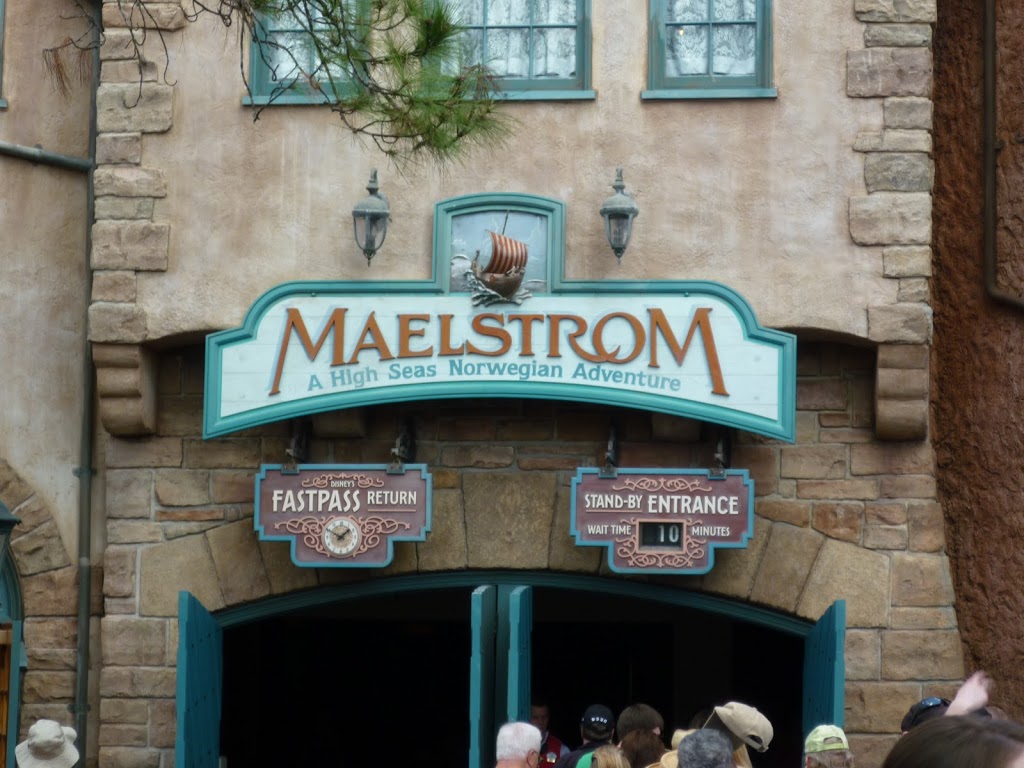
Ideas for novels can come from anywhere. The inspiration for my paranormal romance series arose from a ride at Disney World’s Epcot theme park (Epcot = Experimental Prototype City of Tomorrow). In World Showcase stands the Norway pavilion and a ride called Maelstrom, one of the best attractions in the theme park, in my opinion. You board a boat and enter a dark tunnel up a steep incline. At the top, staring down at you, is a glowing eye. The boat takes you into a misty forest where a troll pops up (or is it three trolls? I don’t remember). This evil character casts a magic spell on you to “Disappear…disappear.”
Suddenly, you are whisked backward through time (and literally backward as well). Then the  boat glides past a series of historical panoramas depicting Norse history. But then, uh oh, it appears as though your transport is about to plunge over the edge of a waterfall. Instead, after a slight turn, your boat does plunge downward but at a much less scary angle, landing with a splash amid oil rigs at sea. You’re back in the present and disembark at a seaside village.
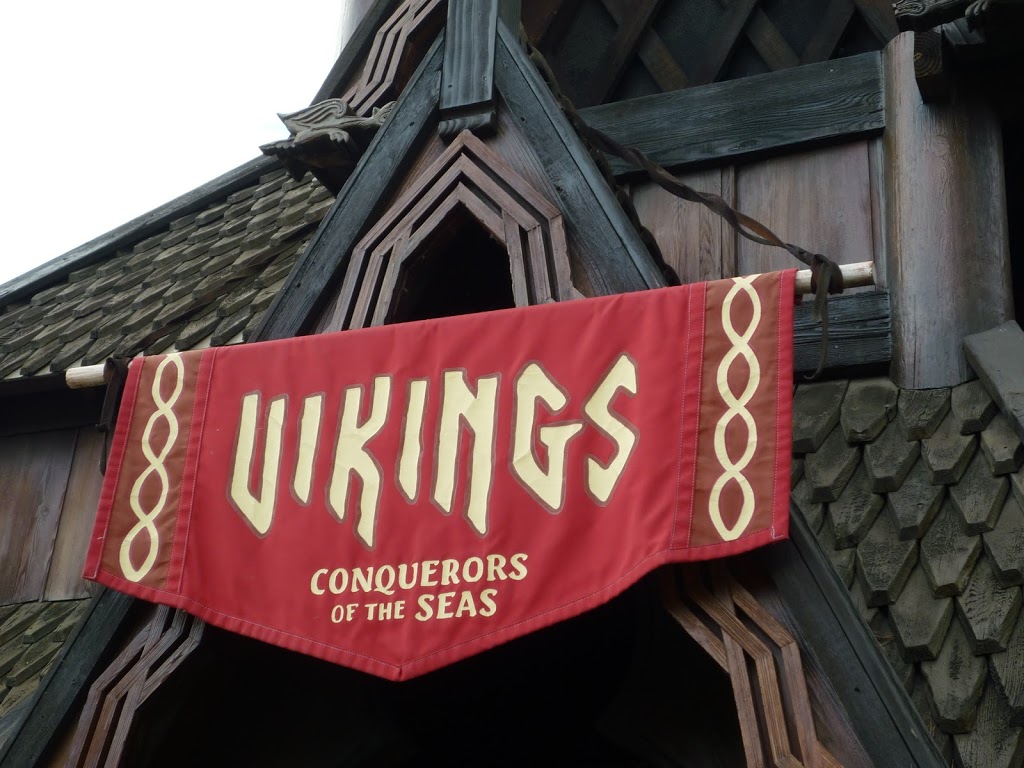
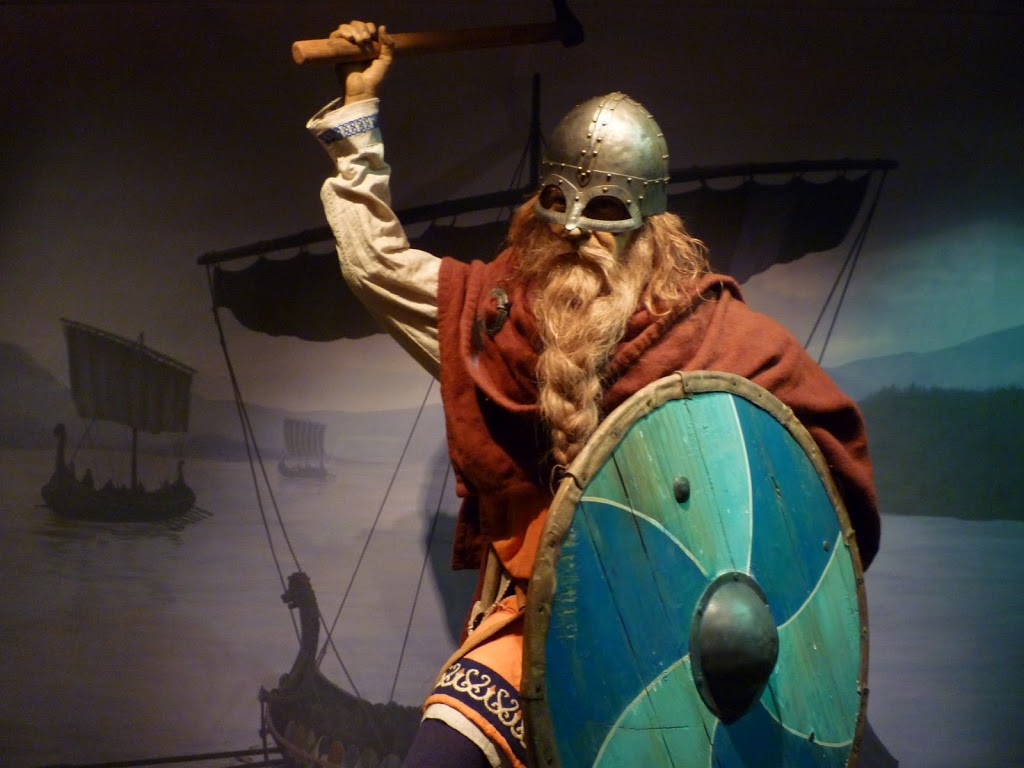
From here, guests are herded into a theater for a film about Norway. Here’s a tip: if you do not wish to linger, walk directly past the seats and out the door on the opposite side before the film starts. You’ll exit in the shops and can browse the expensive wool sweaters, fanciful troll dolls, books, and jewelry. The Norway pavilion also has a sit-down restaurant and a fast food café. A little known gem is a tiny museum with lifelike figures depicting ancient kings and warriors.
From this experience was born my fictional Drift Lords series with a band of warriors who come from outer space to save Earth from an invasion of Trolleks (my term for trolls), who arrived through a rift between dimensions (think Bermuda Triangle). They join forces with a group of Earth women whose special powers are just awakening. An ancient prophesy says history is repeating itself and Ragnarok, the destruction of the universe, approaches and only our heroes and heroines can prevent disaster.
My story is based on Norse mythology. I bought some books at the Norway pavilion on Vikings and Norse gods, studied up on the mythology, and watched some movies involving trolls. By now I’ve completed two books in this trilogy with one more to go. I put that aside to work on later because I’m working diligently to finish a mystery, first book in a new series, inspired by a reader at one of my book signings who said, why don’t you write a mystery about xxx−and so I did. Again, inspiration hit from an unexpected place.
Where do our ideas come from? They’re out there. We have only to latch onto them and turn them into our fictional worlds. And world building is a topic for another time.
So fellow writers, what inspired your current project?

FACEBOOK IS HERE TO STAY: A Great Medium For Free Exposure

By: Kathleen Pickering

I have seen three TV shows in the past week where characters mentioned Facebook. This fact cements in my mind that Facebook as a media tool is here to stay. So, my question is: Are you still not on Facebook?

If you’re like my mother, you are not, and never will be, on Facebook. (That’s a story for another time.) However, if you are a curious planet dweller with a story to tell, Facebook is a phenomenon not to be missed. It is the perfect tool for authors or artist of any sort. The ability to reach millions of people for free, and as personably as humanly possible on the Internet, creates an outrageous boon every author needs: Contacts! Lots of ‘em!

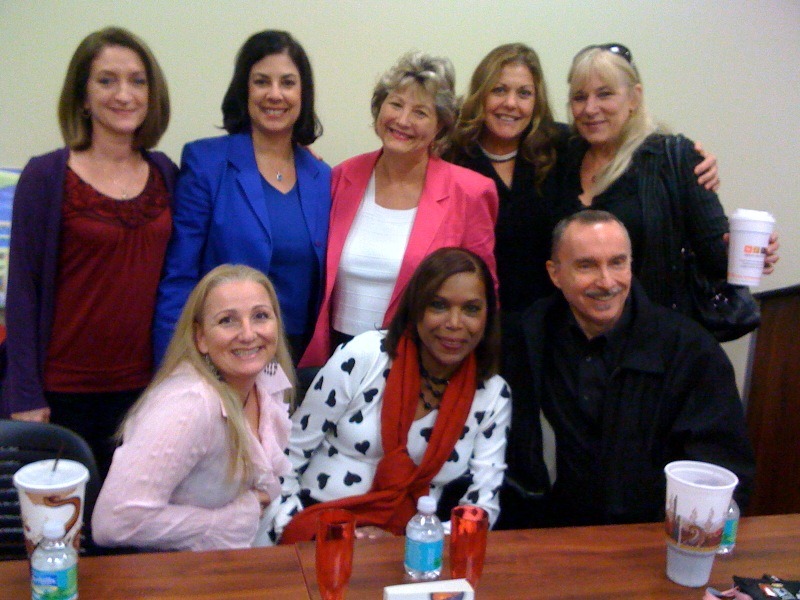
Writing Facebook BuddiesAuthor friends and fellow Facebook Buddies. Top L to R: Allison Chase, Nancy Cohen, Linda Conrad, Kathleen Pickering, Heather Graham. Bottom L to R: Traci Hall, Marcia King Gamble, Michael Meeske.

For those of us on Facebook, here are some quick tips I have learned to enhance your “Tribe” of friends:

For making friends:

When you offer and/or accept friend requests always add a note to the request, i.e., “Thank you for the friendship. Feel free to visit me at http://….” (or mention the topic that connects you as friends.)

Create Groups:

Build a tribe of your own with chat groups to discuss items relating to your business or areas of interests shared on Facebook. Go to your Message section and click on the “Groups” tab on the RH side. Then, click “Create Group” on the top. Send the group invitation to everyone on your Friends List. Be consistent with your Tribe with regular contact. Use your Group/ Tribe solely for relationship building and providing value to your group. Send them links to your blogs and videos. Note: Only promote business once per month, maximum. Your group is not for marketing; it is to establish you as an expert in your field.

Create Events:

When holding an on-line or on-site event and want to attract attendees, create this link. It is important that YOU be the Event Leader. It sets you apart as creative and reliable. Again, the Events link is found in the Message Section. Be sure to add an email contact for RSVP or inquiries. This is a great tool for building contact information. Tip: If you know how to build a Caputre Page for email captures, do not give the link to the event. Instead, set up a Capture Page for email captures to build your mailing list, then give the link to the event.

Tag Photos/Videos:

Take the time to “Tag” your friends in your uploaded photos/videos. This sends a direct link to their Facebook page as well as posts the photo/video on your profile page.

Create A Fan/Business Page:

Where your Facebook page is your social activity, your Fan Page is your business face. Both pages can be linked. (See Help Section under “Account”.)

Ideally, no more than 30 minutes per day should be all you need–either in the morning with your coffee or end of day before closing down business. If you cannot update daily, set a schedule that will work for you. They key: be consistent.

The more YOU reach out, the more you will attract visitors. Birthday announcements appear daily on Home page (right hand side). Send birthday greetings. (Stand apart from the crowd and use your computer’s camera to send a video and personalize your good wishes!) Respond with a quick reply to others’ posts, as well. You’ll enjoy the interaction as much as your friends.

Bottom Line: Facebook is your chance to shine and be recognized as unique among many by keeping a personal touch in the world of commerce. I have even gone so far as to place a Kathleen Pickering Welcome Video on my YouTube channel inviting folks to visit my Facebook page.

I invite you to visit me at http://www.facebook.com/kathleenpickering. Let’s be friends! If you know any Facebook tips, I’d love to hear them!

A Clean Desk Policy?

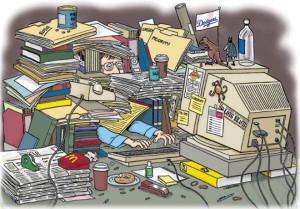
I seem doomed to have my writing environment in constant upheaval. Today we had workmen jackhammering up tile in the downstairs part of the house that got flooded and so I had no wifi, no room to get to my desk (because all the furniture is still stacked up in my study) and a whole lot of dust to clean up. Now, I am hardly the type to have a clean desk policy but this is getting ridiculous!

I remember the law firm I worked for in Melbourne many years ago tried to impose a strict clean desk policy. You were not supposed to have a scrap of work on your desk at the end of the day. Needless to say I failed miserably. I am a woman who works in ‘piles’ and if I don’t have these prominent situated around my office I can’t for the life of me remember what I am supposed to be doing. I was lucky that the partner who I worked for at the time, a very anally retentive lawyer with a spotless desk, took pity on me and let me continue in my dirty, piled up paper, working fashion. Apparently, he said, he couldn’t really fault me as I managed to work just as efficiently despite the mess. Although I would much rather work in a clean office environment, just as I think everyone else would too as it would allow us to get more work done. I might have to ask my manager if we can buy from Green Facilities or somewhere similar to ensure that our office remains as clean as possible.

I was pleased to read that this phenomenon is borne out in a book called The Perfect Mess by Dave Freedman and Eric Abrahamson which contends that those with cluttered, messy desks are often more efficient and creative than their neatnik brethren. Since my desk always looks like a disaster zone I think I am going to stick with the Freedman/Abrahamson interpretation…but nonetheless I have to wonder whether most writers are like me – or whether I am just deluding myself that disorder is merely a sign of a great author in the making.

As it is, I am always surrounded by piles of research and printed out copies of the latest manuscript. Currently I have marked up copies of part one of my young adult WIP, a pile of articles on Orphic mythology, notebooks with scrawls for two new projects I am contemplating, an atlas of WWI with post it notes spilling forth, files relating to my sons’ school stuff I need to attend to, and a messy pile of handwritten notes with a revised plot outline in progress.

So what about my fellow writers? Do you, like me, have a messy desk full of piles of paper or are you a neat freak with everything organized and de-cluttered for the sake of productivity and sanity? What do you think, is a messy desk a sign of creativity or just plain slovenliness?


– Posted using BlogPress from my iPad

Can Dark Shed Light?

I got my start in the Christian fiction market. It was a natural fit for me because I’ve always been interested in the great questions surrounding life, the universe, and everything––what theologian Paul Tillich called matters of “ultimate concern.” (And what Douglas Adams called 42).

Basically, how do we figure out this journey we’re all on?

In college I loved philosophy, though I didn’t major in it. I took a much more practical major, film. But all through college and after, I continued to read philosophy and theology. Love Plato. Love Pascal. Love the Stoics. I tried reading Kant but my head exploded. Aquinas was tough but fair. I’ve tangled with Nietzsche and the existentialists.  
The point is, I guess, that I just find compelling the threads of great thoughts as they wind down through the centuries.
Even now, with a general market publisher (Hachette) for my Try series, I find my characters involved in the big questions. Ty Buchanan is a lawyer whose fiancée is killed on page one of the first book, sending him reeling spiritually and every other way. He is befriended by an African American priest and a basketball playing nun who have one view of things. He hangs out at a coffee place run by Barton C. “Pick” McNitt, a former philosophy professor at Cal State who went insane, recovered, and now pushes caffeine and raises butterflies for funerals. He’s an atheist.
Buchanan finds himself bobbing and weaving between these characters even as he’s trying to find out the truth behind his fiancée’s death. 
And so it goes. The fiction I love best has characters going through inner as well as outer challenges, dealing with a dark world and trying to find their way around in it.
My recent release, Watch Your Back, has generated some responses from my established readers. One comment is that the tales seemed “dark” and unlike my previous work. This, I note, in spite of the fact that I do not use gratuitous elements in my fiction. I like to write in a style that would fit a 1940’s film noir (noir, of course, is French for dark).
So here’s why I chose the material I did for Watch Your Back: Dark tales can often be the most moral of all.
I believe in what John Gardner, the late novelist and writing teacher, said in an interview in Paris Review. Good art is about “creating, out of deep and honest concern, a vision of life that is worth pursuing.” He contrasted this with art that is just “staring, because it is fashionable, into the dark abyss.” And staying in the abyss. That doesn’t interest me.
As I look back at my work, the thread that seems to run through all of it is the pursuit of justice. Maybe that’s in part because of how I was raised, by an L.A. lawyer who fought for justice for the indigent as well as for paying clients.
Now, a dark story, in my view, ought to explore the consequences of human actions. Indeed, isn’t that what Greek tragedy was all about? By showing the audience the catastrophe of hubris, the theater was training citizens in virtue. There was a cosmic justice in the tragic fall.
Cut to: Stephen King. I would argue that King’s “dark” fiction is highly moral. Much of it shows, for example, what happens when one trucks with evil, even with good motives. Pet Sematary is perhaps the most lucid example of this. He has many others. I would call your attention especially to the fabulous mini-series he wrote, Storm of the Century. I won’t give away any spoilers, but you ought to watch it to see how this sort of thing is really done.
So, in my stories in this latest collection, you will find criminals, rip-off artists, adulterers and liars. But I believe you will also see I am not dwelling in the dark. When characters get it “wrong,” that’s another way of showing what’s right.
On the other hand, I’m not being didactic. I’m not a professor. I’m a writer whose first job is to keep you turning the pages. My favorite writers of all time do that for me, and then leave me thinking about the book when it’s over. I don’t know if you can ask much more of a fiction writer than that.

And that’s what I try to do in my fiction, including Watch Your Back.

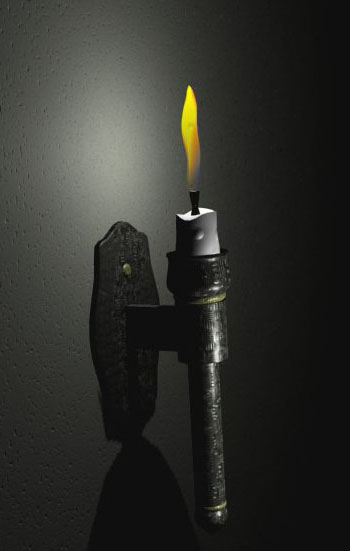
So who are some of the writers who have taken you through a dark story with a candle in their hands?

Crippolater, Alligator


John Ramsey Miller

In October while converting a porch into a room in my home, I touched my left thumb to a moving table saw blade. Don’t know how to describe the sensation except to say it was a sort of thrunk-thropping followed immediately by a realization that the anatomy of my left extremity would be forever altered to some degree. Then there was a serious infection and some necrosis of the tissue in the pad. To make a long story short, as I am typing with one finger on my right hand, I had surgery a few days ago to rebuild by flapping and grafting the disastered digit, and it’s in a huge bulbous cast so I am going to apologize for a very brief blog this week as typing is hard enough when you aren’t on painkillers. On March 3rd I’ll get to see if the surgery was successful, and hopefully I can get back to writing again. I really miss my time at the keyboard.

Has anything ever happened to interrupt your schedule for more than a few days?