
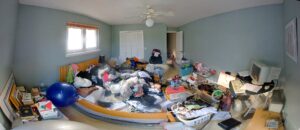
Photo credit: https://flickr.com/photos/46213661@N00/3623341152
by Debbie Burke
Recently I was talking offline with Justin, a regular TKZ reader. He’s currently editing his thriller novella and asked how to “declutter” it.
Great question!
Novella length is typically 20K-40K words. Jim Bell’s recent post on novellas explores the form in detail and offers excellent examples.
Compared to other genres like mystery, historical, speculative, romance, etc., thrillers are generally faster paced. There’s no room to wander through long descriptions, subplots that don’t relate to the main plot, or extended character backstories.
For a novella, there’s even less room.
Every story needs problems and goals. The hero must face a problem and solve it to achieve their goal.
Each scene presents a problem:
- A phone is lost..
- An identity is stolen.
- A friend goes missing.
The inciting incident is the only the first domino to fall in a succession of problems.
Each scene needs a goal:
- The hero must find their phone.
- They need to learn who stole their identity.
- They want to locate the missing friend.
But they can’t solve the immediate problem because a new obstacle appears.
- The lost phone contains all the hero’s contacts, delayed the ability to get help.
- A stolen identity leads to their bank account being drained and credit ruined.
- The missing friend disappeared on purpose because they committed a crime.
The hero must adjust their goal to overcome that roadblock instead.
Alternatively, they solve the immediate problem, but the solution leads to different problems.
- The hero finds their lost phone but it’s in the hands of a criminal who already used it to commit wire fraud.
- The hero protects their money by freezing bank accounts but learns the identity thief filed false tax returns and now the IRS is after the hero.
- The hero finds the missing friend but uncovers they’re involved in a sex trafficking operation.
Each scene causes the hero to make choices.
Subsequent scenes reveal additional problems and conflicts that force the hero to make increasingly difficult choices.
The conclusion of one scene should lead the reader into new problems, goals, and choices.
Scenes should be chain reactions.
Scenes need to be causally linked. If you find a scene that doesn’t connect to the past or foreshadow the future, it may not be necessary.
When reviewing a manuscript, ask yourself: Does this scene move the story forward?
If the answer is no, probably get rid of it.
Give the reader only as much information as they need to know to stay interested.
- Avoid tangents that aren’t relevant.
- Delete characters who don’t perform meaningful tasks.
- We authors are proud of our extensive research but in the novella (as well as longer forms), leave out 95+%. TMI (too much information) slows the story to a crawl.
- Use only specific details that add credibility, authenticity, and verisimilitude.
Readers want sufficient information to understand what’s going on but don’t want an entire graduate class about a subject.
Be clear but be careful not to spoil surprises.
Which details are absolutely necessary for clarity?
The reader should be able to determine:
- What is happening.
- Whom is it happening to.
- What the stakes are.
Be strategic about the details you cut. The reader should be intrigued but not confused.
Don’t answer all their questions immediately. Some mystery makes them turn the page.
But beware of withholding too much info because that’s not only confusing but also frustrating.
If you have trouble judging clarity because you’re too close to the story, ask your critique group or beta readers for help.
Edit ruthlessly.
Cut all unnecessary verbiage. With limited real estate, every single word must count.
Go through the story word by word. If a word or phrase isn’t needed, chop it. Here’s a post with a list of “junk” words.

The tighter the writing, the tighter the tension.
Readers never know what you deleted or left out. They’re only aware your clutter-free novella is a fast, compelling, enjoyable story.
~~~
TKZers: Are you concerned about being too wordy? How do you tighten your writing? Please share additional suggestions.
Every story has a natural length. Padding a novella to novel length will show; readers will get impatient. E.g., “The Goldfinch” was about 15 or 20% too long.
“Tightening” your writing is an art you’ll have to learn. Avoid phrases like, “He tried to,” or “She wanted to.” They should only be used if the attempt fails or is interrupted. Avoid “talking heads” scenes by not using locations where people sit down: restaurants, bars, and similar.
J, I share your opinion about The Goldfinch, a good 300 page novel stretched out to 800 pages.
Just read an excerpt about a character who thought about what they were going to do before they did it. Just do it already!
Given that growing up I read and enjoyed lengthier novels, I always expected I would have problems being too wordy but thus far haven’t had that issue. However, like anyone else, I do have to cut and slice as I learn to use those words to best effect. Like JGuenther said above–cutting things like ‘wanted to’ etc.
I don’t have the guts to try writing a thriller. I want to master the mystery first. LOL!
Brenda, I wrote a number of mysteries that didn’t work and were never were published. IMHO, mysteries are far more difficult to write than suspense/thriller where the villain is often known to the reader early on. Keeping the bad guy hidden is harder for me since it requires planting clues to play fair with the reader but not giving away the surprise.
Kudos to you for tackling a mystery.
Great advice for not only thrillers but all stories. When I first started writing, I had to cut 500 words from a short story. I learned how to make every word count in that exercise.
Pat, I used to enter short story contests with 100-word limits. They were a great exercise in choosing only necessary words. Surprising how many words are extraneous.
My first draft of my first novel was about 140K words. Published at closer to 80K. I love to ramble and have learned to be ruthless in my editing. Get the words first; don’t worry about word count. That’s for the editing pass(es). That being said, my novellas hit the upper limit of conventional word counts.
Current peeve: “started.” “His phone started to ring”. “His phone rang” does the job.
Terry, excellent point about “started to” or “began to”. Just do it.
I tend to write lean and have to go back to layer more muscle onto the skeleton. But whether the first draft is oo sparse or too wordy, you’re right that editing is the time to worry about what to cut and what’s missing. You don’t want to cut something that turns out later to be an important breadcrumb.
Great advice, Debbie. I start with the big picture—is the story focused? For a thriller, is it taut? I’m a put-inner rather than a take-outer when it comes to revision. However, while I add words, scenes etc, I also take unnecessary ones out. The word count still increases, but not by a huge amount because of the words being removed.
Dale, your terms “put-inner” and “take-outer” made me smile. I’ve had the same experience: what gets added mostly balances with what’s deleted.
Have a great day putting in and taking out!
Thanks for mentioning or coversations in this post. I was, in fact, editing two novellas and a short story for traditional publication as well as True crime book for an audio release. My novelettes/novellas.
A very early draft of one of these was also 200 pages. Culled from a short story I wrote when the late TKZ columnist Joe Hartlaub recommended I entered a contest. I combined it with it elements of novellas I drafted from Cerebral Palsy ordeals and my brother’s Autism. I also whittled it down, cutting scenes that didn’t fit and focused more on the main plot with a more lean result.
With these and other novellas, I removed characters and scenes that didn’t fit. I also moved around scenes and paragraphs to areas that did fit better. There was one novella, where a subplot clashed heavily with the main plot had a similar goal, so I removed it from that novella and built another around it.
Thanks for including me,
Justin
I meant to say at the end of the first paragraph that my novelettes/novellas are between 9,000 and 17,000 words.
Oops!
Justin
Justin, thanks for asking the question!
Recognizing when a subplot needs to be cut is a hard judgment call. Kudos to you for seeing the need. Double kudos for repurposing the subplot into its own story.
Great advice, Debbie.
When I first started to write seriously, I learned the phrase “Kill your darlin’s.” It’s so hard to delete that special chapter that has personal meaning to the author (and means nothing to the reader), but it has to be done.
So true, Kay. We get attached to our darlings and giving them up is heartbreaking.
Some writers take their cast-off darlings and repurpose them as short stories or essays to post on their websites, social media, or Substack. I plan to do that on Substack…when I get around to it.
I thought I was writing a novel, but after finishing the story I was stuck at about 20,000 words. To steal a cliché, I’m at a loss for words. As an engineer, I was raised on the “clear, complete, and concise” mantra, and making the transition to fiction, where entertainment matters as much as information, is difficult at best. I’m finishing up two non‑fiction books now and hope to return to my passion project soon. If I never develop the skills to reach full novel length, where do you find a potential home for novellas?