
“Without great solitude, no serious work is possible.” — Pablo Picasso
* * *
The psychologist Carl Jung first used the terms “introvert” and “extrovert” in the early 20th century to define personality types.
In general, introverts enjoy solitude but are uncomfortable in large social gatherings. They are self-aware and tend to be deep thinkers who like to have a few strong relationships rather than a lot of acquaintances.
Extroverts, on the other hand, prefer large groups and enjoy living in the spotlight. They are more outgoing and usually have a lot of friends.
In reality, being an introvert or extrovert isn’t an either/or definition. It’s more of a continuum, and we can imagine a line graph showing introvert at one end and extrovert at the other. The great majority of people probably fall somewhere in the middle area as ambiverts.

An article on WebMD notes some of the differences in brain function between introverts and extroverts:
Researchers have found that introverts have a higher blood flow to their frontal lobe than extroverts do. This part of the brain helps you remember things, solve problems, and plan ahead.
Introvert brains also react differently to dopamine than extrovert brains do. That’s a chemical that turns on the reward- and pleasure-seeking part of your brain. Introverts and extroverts have the same amount of the chemical, but extrovert brains get an excited buzz from their reward center. Introverts, on the other hand, tend to just feel run-down by it.
* * *
“The monotony and solitude of a quiet life stimulates the creative mind.” — Albert Einstein
* * *
In her book Quiet: The Power of Introverts in a World That Can’t Stop Talking, Susan Cain’s premise is that we live in a culture that rewards extroversion, but we need to take advantage of the significant gifts that introverts have to offer. Cain gives concrete evidence of the superpower of introverts:
“Some of our greatest ideas, art, and inventions—from the theory of evolution to van Gogh’s sunflowers to the personal computer—came from quiet and cerebral people who knew how to tune in to their inner worlds and the treasures to be found there.”
She then goes on to provide a very impressive list including Sir Isaac Newton, Albert Einstein, W.B Yeats, Frederic Chopin, Marcel Proust, George Orwell, Theodor Geisel (Dr. Seuss), Charles Schulz, Steven Spielberg, and J.K. Rowling.
* * *
“Writing is something you do alone. It’s a profession for introverts who want to tell you a story but don’t want to make eye contact while doing it.” — John Green
* * *
Many of the authors I know consider themselves to be introverts, and given the solitude and cerebral tendency of introverts, you’d expect most authors to be at the introvert end of the scale. You might be right. Here’s a list of a few:
- Emily Dickinson
- J.D. Salinger
- Harper Lee
- Edgar Allan Poe
- John Green
- Agatha Christie
- George R.R. Martin
- Charlotte Brontë
- C.S. Lewis
The introvertdear.com site even lists several reasons “Why Introverts Make the Best Writers”:
- Good writing is good thinking. And who thinks more than introverts?
- We’re comfortable with solitude (which is a necessity to write).
- We’re keen observers of people, places, and details, which makes our writing rich.
However, not all great authors are introverts. Consider these extroverts:
- Truman Capote
- Maya Angelou
- Malcolm Gladwell
- Nora Ephron
- Mark Twain
One famous writer who was thought to be a combination extrovert/introvert personality was Ernest Hemingway
* * *
Want to know where you fall on the introvert/extrovert scale? Take this quick 20-question quiz on Susan Cain’s website. Here’s where I ended up:

* * *
So TKZers: Do you think introverts have an advantage when it comes to writing? Where do you fall on the introvert/extrovert scale?
* * *
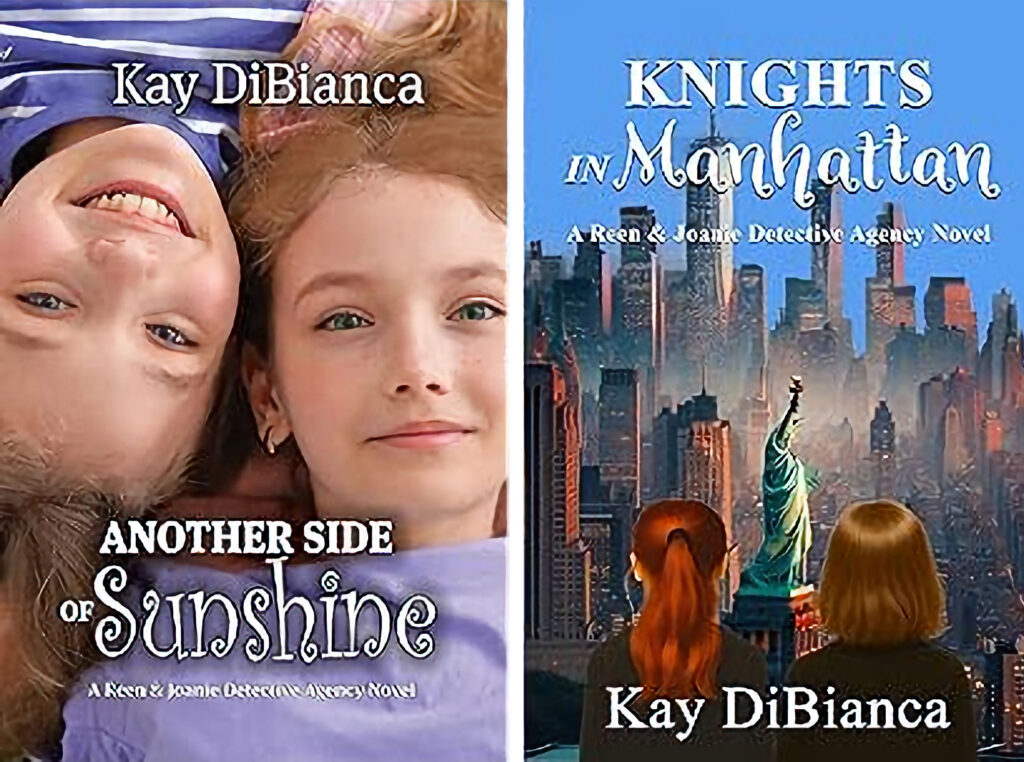
Extrovert Reen & her introvert cousin, Joanie, are the best kid detective team ever, solving problems and making the world a better place.
Click the image to go to the Amazon series page.
I was waaaay over on the introvert side with only 3 answers on the extrovert side. Hubby and I are extreme opposites, which makes for some interesting social situations!
I do think introverted writers have an advantage. We don’t get easily distracted by invitations to ‘get together.’ I am happy to say ‘No, I’m on a deadline,’ even if the deadline is self-imposed.
Good morning, Jane.
My husband is also more of a social person than I am. Like you say, it makes for some interesting situations!
Have a good week.
Mostly introvert – the quiz only gave me my score, which was obvious from my answers since I can count, but I’m heavy on the introvert side. Not a surprise.
Hi Terry.
I remember you’ve mentioned being an introvert before. I suspect our scores may change as we go through life.
Have a good week.
Kay,
Fascinating artcle about introverts. I’ve seen the surveys of writers over the years and understand most of us are introverts but you have put a different and morfe thorough spin on this area. Well-done.
Terry author of Book Proposals That $ell, 21 Secrets To Speed Your Success (Revised Edition) [Follow the Link for a FREE copy]
Good morning, Terry.
It’s nice to see you here on the Zone. What surprised me wasn’t that many writers are introverts, but that almost as many are extroverts. Where do they find the time to write? ⏰
Have a great week.
I’m your rare extroverted writer with a score of 4 true.
🙂 Deadlines help me to stay focused. Besides I’m really not alone when writing—I have all my characters to interact with.
Good morning, Pat!
I remember you mentioned in a previous post that you are an extrovert. I love your statement “I have all my characters to interact with.”😊
You’re the first to self-identify as extrovert. Let’s see how many more drop by.
I’m also an introvert who married an extrovert. Tim loves a party and is the life of the party. But he also appreciates a good silence and doesn’t mind if I say no to social situations. He has no problem going solo. We’ve made it work for 38 years. One of the reasons I married him is that he makes me laugh!
Hi Kelly!
I guess there really is something to that old saying that opposites attract. My husband also loves to make me laugh. Lots of dad jokes and puns have kept me smiling for over 50 years.
I scored heavy on the introvert side…15 true, 5 false. Not surprising to me. Some days, just the act of having to start the jeep before I go somewhere makes me feel stressed!
My husband and I are alike. Neither of us likes big crowds, lots of noise, or talking to more than 2 people at a time. Some days more than 1. 🙂 When we’re home, hours can go by before one of us speaks. (The dog talks more than we do…)
But it’s worked for over 38 years.
“Writing is something you do alone. It’s a profession for introverts who want to tell you a story but don’t want to make eye contact while doing it.” — John Green
Yup!
Have a great day!
Kay, thanks for the lists of introverted and extroverted writers. Really interesting about Hemingway.
I tend to be an introvert until I’m with a group of other writers. Then we’re like dogs at the dog park–you can’t shut us up.
After a conference, though, I’m drained and exhausted. Back to solitary.
Hey, there’s an idea for another list. Which authors wrote in prison, specifically during solitary confinement?
“Then we’re like dogs at the dog park–you can’t shut us up.”
👍👍👍
Interesting, Kay. Thanks for this.
My results surprised me, 11 introvert and 9 extrovert, so I guess solidly an ambivert. I would have categorized myself as an introvert, for sure. A boss who had all her employees hand-write a page about themselves and had them analyzed by a handwriting expert, told me he said he had never encountered anyone with a more balanced left brain/right brain. So, maybe this explains why I have trouble staying at my desk when something fun presents itself?