
Does it Really Matter?
Terry Odell
 Recently, I made some major changes to the wip. As in totally abandoning one thread of my female protagonist and replacing it with another. I’d written 14 chapters and was at the 13K word mark when I realized my heroine’s back story wasn’t working, and I was heading down a dark, winding road that didn’t seem to lead where I needed it to go. I knew the main conflict she was going to be dealing with, but the path we’d started on wasn’t getting there.
My keyboard has a delete key, and I know how to use it, but this wasn’t a matter of making some adjustments. This was ripping out huge chunks of chapters, and rewriting them.
My process here isn’t a “try to fix it” one. I open a new document and rewrite the offending chapters more of less from scratch. I have the original open on my second monitor, and if—and it’s a BIG IF—there is a paragraph or a section that works in both the old and new version, I’ll copy it, but this time, it was almost all new material.
I was happier with what was going on with my heroine. As for the hero, I wasn’t having any trouble with his story, but … where the two characters interacted didn’t work anymore. For most of his chapters, I could make modifications rather than start from scratch.
I’d been very proud of the fact that I’d kept up my chapter summaries on my spreadsheet. But now, other than the first 2 chapters, I had to start over. Doing summaries isn’t my favorite writing chore task, but I finally bit the bullet and worked on the requisite changes. Not as easy as I’d hoped, because as I redid the summaries, I discovered that time had ceased its unidirectional course. Results were happening before causes. Characters were reacting to, or talking about things that hadn’t happened yet.
More fixes.
And then, as I decided I should be noting whose POV each chapter was in (color coding cells comes in handy), I noticed that during the revision process, I’d ended up with two chapters in the same character’s POV. I used to have two POVs in a chapter, but with the trend to readers preferring shorter chapters, I’d switched to making each POV switch its own chapter.
Did it matter? Would readers get confused? Would they even notice? Note: I’m a stickler for establishing the POV character in the first paragraph—preferably in the first sentence—of each chapter, so I didn’t think reader confusion would be an issue. But I’m also anal when it comes to sticking to patterns, so I had to decide how to “fix” it, even if it wasn’t technically “broken.” Could I combine both those chapters into one? Maybe, but then it would be twice as long as all the rest, and anal me doesn’t like that, either.
Does chapter length matter? Back when I was a green newbie at the gig, I belonged to a RWA chapter, and the question of “How long should a chapter be?” came up. One answer was “as long as a cat’s tail,” which translated to “as long as it needs to be.” A recent read had chapters as short as a page and a half, to well over twenty pages. The book was published in 1994, so no telling whether an editor today would have “suggested” more uniform lengths, or would have gone with the “long as it needs to be” approach.
Could I tighten both chapters enough so the length wouldn’t be outside the “norm” for the book? A quick perusal of the text said “nope.” But a closer look gave me a semi-solution. I could reverse chapters 13 and 14, make some adjustments (that time thing again), and then I’d be ready to move into “new” territory.
Not saying it’s all smooth sailing from this point forward, but at least the first 15 chapters are working together. Except for those two characters who showed up. Who are they, and what are they doing here?
What about you, TKZers? Do you strive for something approaching uniformity in chapter structure, or don’t you care?
The floor is open.
TKZ:
Find me at Substack with Writings and Wanderings
Deadly Ambitions
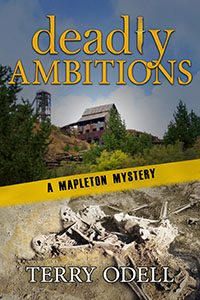 Peace in Mapleton doesn’t last. Police Chief Gordon Hepler is already juggling a bitter ex-mayoral candidate who refuses to accept election results and a new council member determined to cut police department’s funding.
Meanwhile, Angie’s long-delayed diner remodel uncovers an old journal, sparking her curiosity about the girl who wrote it. But as she digs for answers, is she uncovering more than she bargained for?
Now, Gordon must untangle political maneuvering, personal grudges, and hidden agendas before danger closes in on the people he loves most.
Deadly Ambitions delivers small-town intrigue, political tension, and page-turning suspense rooted in both history and today’s ambitions.
 Terry Odell is an award-winning author of Mystery and Romantic Suspense, although she prefers to think of them all as “Mysteries with Relationships.”
My pattern for pov is to have the pov character be the one most affected by the scene.
Mostly, there are alternations. Each scene has a short header – date/time/place/name IF any of these have changed.
In total, I want one main character to have the most scenes, a second one the next number of scenes, and the villain the fewest.
If you do RIGID alternation, you have to explain somehow why you’re not doing it this time (alternating chapters can end up being very different in length). But if I go with the flow, and the totals, it seems to work out for me.
There are no rules nor enforcers – not a soul has mentioned a word about my methods in that department, nor said they’ve had trouble understanding because of it. My guess, by using the most affected I also get the most conflict, that it helps keep readers interested.
I agree there are no rules. It’s an issue of my own making, and even though I’m sure readers don’t notice or care, it still interferes with the flow of my writing.
My chapters are as long — or short — as they need to be. I’ve had two-page chapters next to ten-page chapters. Rarely longer than that. I vary length to flow with the rhythm and pace of the story. If, for some reason, a chapter seems too long, I’ll cut the scene, begin a new chapter in the co-antihero’s POV, and finish the scene through his eyes.
Thanks, Sue. I need to get over my obsession with uniformity. It’s more of a problem in my romantic suspense novels, where there are two almost equal protagonists.
Interesting questions, Terry.
I don’t think uniformity matters as much in fiction as it does in nonfiction. For instance, a cookbook reader expects a consistent format: ingredient list, preparation steps, baking time, etc. A mystery reader generally doesn’t care as long as the story keeps moving forward in an interesting way.
My scenes generally run around 10-20 pages but occasionally a one or two page, punch-in-the-gut chapter occurs for a surprising or shocking discovery.
Momentum is most important to me.
Good point about momentum. I’ve found myself wanting to “fill” a chapter to make it fit the length of the others. But that generally gets fixed in edits.
I’m of the “a chapter needs to be as long as it needs to be” mind. I don’t write to page count, but word count. Since I write romantic suspense, my chapters are shorter than a strictly romantic one.
My chapters average 1500 words, but going into the 3rd act, they tend to get shorter. If the POV character is the villain, sometimes the chapter is only one page.
Thanks —
I look at word count as well as page count — dialogue heavy scenes have more white space, so more pages.
I think I’ve only written one book where I showed the villain’s POV.
I like the cat tail rule, Terry.
As a reader, I don’t care how long or short a chapter is as long as the flow is there.
As a writer, I don’t care either…but my editor has always cared. She’s not an autocrat about it, but rather a gentle hinter. 🙂
Have a great day!
Thanks, Deb. I’m thinking about readers who check to see how many more pages before a chapter ends, because “time for one more chapter before bed” is how a lot of people read. Thus, the trend to shorter chapters.
Yeah, guess I’ve done that, too…👍
As a reader, if I’m fully engaged in the story and flipping the pages, I probably am not even aware of chapter length. That’s the writer doing their job. If I do start thinking about chapter length, it probably means I’m getting bored and my mind is wandering.
When writing (based on a sample size of one) I have become a tail-of-the-cat kinda guy. When I first began, I prided myself on making the chapters about the same length. By some weird logic I can no longer explain, I thought I was giving the reader the best value. When I went back and read the chapters, I noticed that I had inserted a lot of filler to reach my ‘ideal’ chapter length. The kind of filler that makes the reader’s mind wander and start pondering things like chapter length. Every chapter has to have a purpose. Once I have achieved that purpose in an interesting way, I wrap it up and move to the next one. I appreciate it when authors I read do that.
Chuck
All good points. I need to get out of my head and just write the darn book.
That you care about these things speaks well of your professionalism. As a reader, give me a hero I can relate to, and I’ll read through some pretty clunky writing to follow them.
Thanks, Marshall.
Yes, for me it’s all about the characters, although there’s a limit to how much clunk I’ll tolerate.
Most of my chapters are between 1000 and 1500 words. Some go a little longer if needed. Sometimes I’ll go with a shorter chapter if I want to reveal a surprise to end the scene.
I’ve had quite a few readers express their appreciation for shorter chapters. They say they’re more likely to invest time in a book where they know the story will move along quickly.
Yes, I think readers–and maybe everyone these days–want things to be quick. I know I’m that when when it comes to anything video on my computer. Reels, podcasts, etc. The first thing I do is check how much time I’ll have to invest if I want to watch/listen.
Attention spans are getting shorter and shorter, it seems.