
by James Scott Bell
@jamesscottbell
 The other morning I was in my back yard with my laptop, ready to do some writing on my WIP. I was close to the end. I knew what the climax was going to be. I always know (or at least have a good idea about) my endings. This allows me to map out a “shadow story” that gives me all sorts of possibilities that are organically connected to the plot.
The ending is, of course, subject to change without notice. But usually when I’m 3/4 done, it’s pretty much set.
I was at that point. But I needed a few more scenes to get me to the climax. More of what I call “connective tissue,” meaning real scenes with conflict and suspense, not just “filler.”
So I sat sipping espresso, prompting my imagination with possibilities.
I use that word prompting on purpose. For I could have been prompting ChatGPT or Claude or Grok. I could have turned over this brainstorming completely over to the machine. Instead, I was prompting my own brain. I would set up a scene and watch it unfold. I’d tickling it a bit to get it to improvise, and when I thought, “That’s good!” I’d jot a one-line note about it. Then I did the same with another scene, and another.
And realized, after twenty minutes or so, how much fun I was having.
To play around in your imagination is one of the great pleasures of the writing life. Bradbury describes it this way:
“Let the world burn through you. Throw the prism light, white hot, on paper. Make your own individual spectroscopic reading. Then, you, a new Element, are discovered, charted, named!” – Ray Bradbury, Zen in the Art of Writing.
Now, I’m not going to make this another jeremiad about the deleterious effects of AI. I know many writers use it for various purposes, including as a virtual brainstorming “partner.”
I do issue a warning, however. The more imaginative play we hand over to the bot, the more our own capacity for same atrophies. This, in turn, affects all of our writing. It affects our voice, and our ability to produce delightful surprises in everything from dialogue to characterization to all the sinews of plot. And it’s just not as fun.
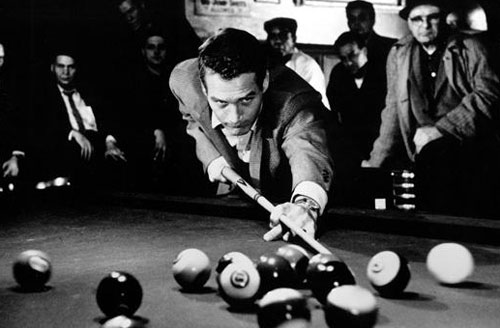
Paul Newman, The Hustler
Of course, all play and no work makes Jack a dull writer. Craft is work. But work is fun when you know what you’re doing and how to make good things happen on the page.
It’s like that speech in the great movie The Hustler, where Fast Eddie Felson (Paul Newman) asks his girl Sarah (Piper Laurie) if she thinks he’s a “loser” (like the character played by George C. Scott has called him). Then he explains the exultation he feels when he’s in the flow of a pool game. He tells her anything can be great, even bricklaying, “if a guy knows what he’s doing and why and if he can make it come off.”
“When I’m going, I mean when I’m really going, I feel like a jockey must feel. He’s sitting on his horse, he’s got all that speed and that power underneath him, he’s coming into the stretch, the pressure’s on him, and he knows. He just feels when to let it go and how much. ‘Cause he’s got everything working for him—timing, touch. It’s a great feeling, boy, it’s a really great feeling when you’re right and you know you’re right….You feel the roll of those balls and you don’t have to look, you just know. You make shots nobody’s ever made before. I can play the game the way nobody’s ever played it before.”
Sarah looks at him and says, “You’re not a loser Eddie, you’re a winner. Some men never get to feel that way about anything.”
I love this craft of ours. I love figuring out “when to let it go, and how much.” I love it when I pull something off, when I feel the flow of those words, and just know. I play my game the way I’ve never played it before.
I’m not about to trade that in.
How about you?
Spot on, Jim, and I’m not going to trade the God-given joy that comes from pure creativity. I’m linking your post to my evergreen page titled: Don’t Confuse AI with a Benign Tool. Thank you for your steady encouragement of writers and their craft!
Thanks, Grant.
Yes, creativity is about doing. There’s no fun in it for me if you’re not putting yourself through the challenges. Regardless of what genre you write, writers are secretly detectives — whether plotters or not, we’re solving the puzzles needed to bring our stories to life.
I’d say it works that way for visual art, too. One of my odd fascinations is the beauty of the moose. Such unique creatures. I could just create a computer generated image of a moose, but that wouldn’t be satisfying. Over time I want to learn to draw the moose bit by bit–learning how to use shading and other techniques to reflect details like how the individual hairs stand out on a wet moose standing in a stream under bright sunshine. There’s no satisfaction in letting a computer do that for me.
Writing can be frustrating at times, but nothing replaces the fun of the puzzle solving as you bring your story to life.
I’m a Bullwinkle fan myself. And what you say is right on. It’s the meeting of challenges that makes for the most satisfying feelings…and growth.
I’m a member of the Bullwinkle Fan Club & Statehood-for-Moosylvania Movement, and I have the papers to prove it!
For me, the writing is hardest when I know what’s supposed to happen. Then, it’s about finding the right words to get from A to B. It’s fun when I’m not sure where B is, and have to figure out what connects it to A. Writing words, discovering, often deleting words (which I’m sure plotters do with scenes), and then there’s the excitement when things start chugging along.
For me, knowing the shadow story is where the fun really begins.
Absolutely. Every writer brings a unique bundle of attitudes, memories, and skills to the challenge of crafting a story. When our talents and core beliefs mesh into the magic mix of a narrative we believe in and characters we identify with, we create something that pulls us along with it. Those moments when we’re telling the tale as skillfully and truthfully as we’re able, we can “play the game the way nobody’s ever played it before.” And there’s nothing quite like that feeling.
I like the way you put that, MC. Talent and core beliefs messing into magic.
Terry Brooks wrote a book on the craft called Sometimes the Magic Happens.
Amen, Jim! I refuse to subcontract out that feeling of my brain lighting up with creativity.
Subcontracting. Exactly. What’s the old saying? If you want something done right, do it yourself.
I don’t see ChatGPT and its brethren as a surrender of creativity, but rather as an augmenter of it. That’s what my post is all about this coming Wednesday.
Brother Jim, your post reminds me of one I wrote for TKZ on October 17, 2008–yes, that was *eighteen* years ago! I called it “Kindle Schmindle” and predicted the early demise of eBooks because well, they are not books. The International Tribunal of Soothsayers revoked my membership card for that one.
https://killzoneblog.com/2008/10/kindle-schmindle.html
Ha. An amusing blast from the past. However, I’m no Luddite. I’m not predicting the demise of AI nor the total avoidance of it. The only aspect I’m talking about here is when it becomes your first and immediate choice for the type of creative work I’ve described. It’s fast to be sure. That’s the lure of it. But it’s not as satisfying. And if we become too dependent on it, that’s not helping our own riding muscles.
Looking forward to further discussion on Wednesday. I promise not to ask Grok what it thinks of your post.
For me, writing a story is getting that movie playing in my head on paper, and that ain’t easy. I can brainstorm with other writers’ their stories, but I’ve never been able to brainstorm my story with someone–they can’t see that movie playing in my head. I’ve tried brainstorming with AI but it doesn’t work any better than with another writer–I’m the one who has to come up with the plot or the corner I’ve painted myself into. And like several have said, there’s no feeling like it when I do.
I know writers who love to brainstorm with other writers. At least they’re doing it face-to-face (or Zoom-to-Zoom). But, like you, I prefer letting my own head produce my movies.
I’m with you and Bradbury, Jim. Brainstorming is half the fun.
“Writers write,” as Billy Crystal and Danny DeVito’s characters in Thrown Mama From the Train said. We also think, and brainstorming is the creative fire version of thinking. It’s one of the times when the creative magic happens. Another is when we’re writing and then, wham!, an idea jumps in front of us.
Those moments when inspiration strikes after much skull sweat, or perhaps sidling up on little cat feet to lay the idea down in front of us while we’re writing in flow, are part of the process. I don’t want to outsource that to a machine and deprive myself of one of the joys of writing.
I’m here to open the toy chest of my imagination, and play, sharing the results with readers.
You’ve nailed it, Dale. Sometimes it’s “skull” sweat, other times “little cat feet.” Whatever it is, it’s a great feeling.
And the night was sultry…
I like the way Bradbury put it: “Let the world burn through you. Throw the prism light, white hot, on paper. Make your own individual spectroscopic reading.”
Every author is a prism that breaks apart simple facts into a complex array of words that only he/she can produce. The beauty of the spectrum has the power to touch hearts, and the warmth of the light may reflect back even on the writer.
Well said, Kay. Touching the hearts of readers is really the essence of what we do, and should be our primary goal. Too much bot makes the heart less hot.
Substituting the joy of writing and creating for easy AI is the saddest thing I’ve ever heard of for a natural writer. For everyone else, dreck will be dreck.
I like the term “in the zone” for those times when you are so deep in your story and the creative process that only story and words matter.
I’ve found several examples of the aspects of play, creation, and inspiration in writing. In the movie ROYAL WEDDING, Fred Astaire is waiting for his dance partner who hasn’t shown up. He starts with inspiration–replacing the dance partner with the coat rack, then he begins to play with and expand that inspiration through experimentation of what does and doesn’t work until he’s created a dance. Another example is one I’ve mentioned before. THE MAN WHO INVENTED CHRISTMAS about Charles Dickens’ life as he travels around London as he’s creating A CHRISTMAS CAROL. Bits and pieces come together as Scrooge and his journey to redemption is created.
Fred Astaire is a great analogy. Royal Wedding is also where he dances on the ceiling. Now that’s creativity.
Substituting the joy of writing and creating for easy AI is the saddest thing I’ve ever heard of for a natural writer.
Couldn’t agree more, Marilynn.
I’d never trade that feeling for anything. I love all parts of the writing process, even that dang 33% mark, where I stall till I clear my head and figure out which way I want to go.
While reading today’s post, I could feel your excitement, Jim. Congrats on completing another masterpiece!
Just about! Thanks, Sue.
I just don’t get why any writer would forfeit the feeling you speak of. I know several published writers who use AI constantly now. One of them has something like 10 different series going at once, so I guess they need it to buy cat food or whatever. I dunno…it is much different than James Patterson handing the reins to his stable of doo-bees? I don’t get it. I just don’t get it. What a joyless way to earn money.
I know, but most AI sloop descends pretty fast. Trying to make it up with volume is a slow, creative death.
Late to the party, once again. Speaking of being “in the Zone:”
❦ “Pele, perhaps the greatest soccer player ever, tells in his autobiography of a curious incident during a World Cup finals game with Sweden. He reported a peculiar calmness he’d never felt before, an exhilaration, a sense that he could not fail. He distinguished it from mere confidence, calling it more like absolute certainty of success.”―From “Why Alcoholics Relapse: The Guardienne Concept.”
❦ Writers can attain “the Zone,” too. In that state, the mind is not under the control of the frontal cortex. It’s been taken over by the brain’s emergency response network, “the Guardienne.” Creativity is a survival skill, so the Guardienne is the primary human creative engine. It is many times faster than the frontal cortex, Autonomous and semi-sentient, it also has no conscience, which is consistent with the very basis of Brainstorming: no criticism or evaluation of ideas allowed!
I loved Pele. When I played basketball, I remember a couple of nights where I felt like Pele did. It was magical. I truly made shots and passes I’d never made before. The the memories are vivid. When it happens when I’m writng, the time just goes away.
Those who’ve never experienced the Zone can’t know what it feels like, the amazing feeling of “I could do this a thousand times and never miss!” I’ve experienced it only once, but will never forget it.
This is what Copilot said when I asked for a comparison between human developmental editors and AI developmental editors:
A human developmental editor is a reader with expertise.
An AI developmental editor is a structural analyst with perfect recall.
Humans feel the story.
AI maps the story.
Put them together — or use AI as your first pass and a human as your final pass — and you get the best of both worlds.
For me, that makes AI just another tool in the kit — useful, fast, and sometimes clarifying, but not a replacement for human judgment. I’ve always defined common sense as the correct application of education to situation, and that applies here as well.
What you say is true. But I fear that younger writers will not do the hard work of learning not only what structure is, but WHY it works, which is really the whole point of knowing what to do with it.
This is, of course, an issue throughout all of education from now on.
I love getting unstuck with my own words and thoughts popping up to go on with the story when I’m ready. I would miss that. I do use assistant AI for marketing and such with AutoCrit but I prefer to handle the story on my own.