
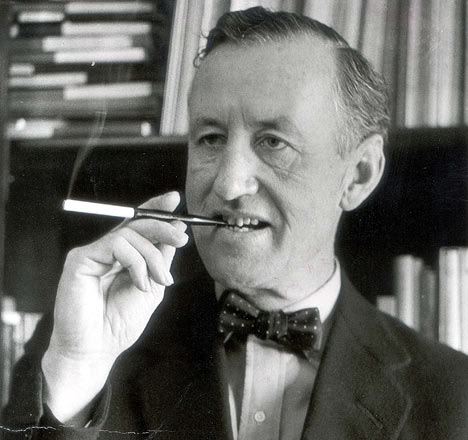
 Ian Fleming enjoyed a writer’s dream life. He owned an estate he called Goldeneye on the northern coastline of Jamaica, with a house on a cliff overlooking the ocean. It was here that he wrote all his James Bond novels. (Goldeneye was named for a secret operation Fleming planned for British Naval Intelligence during WWII.)
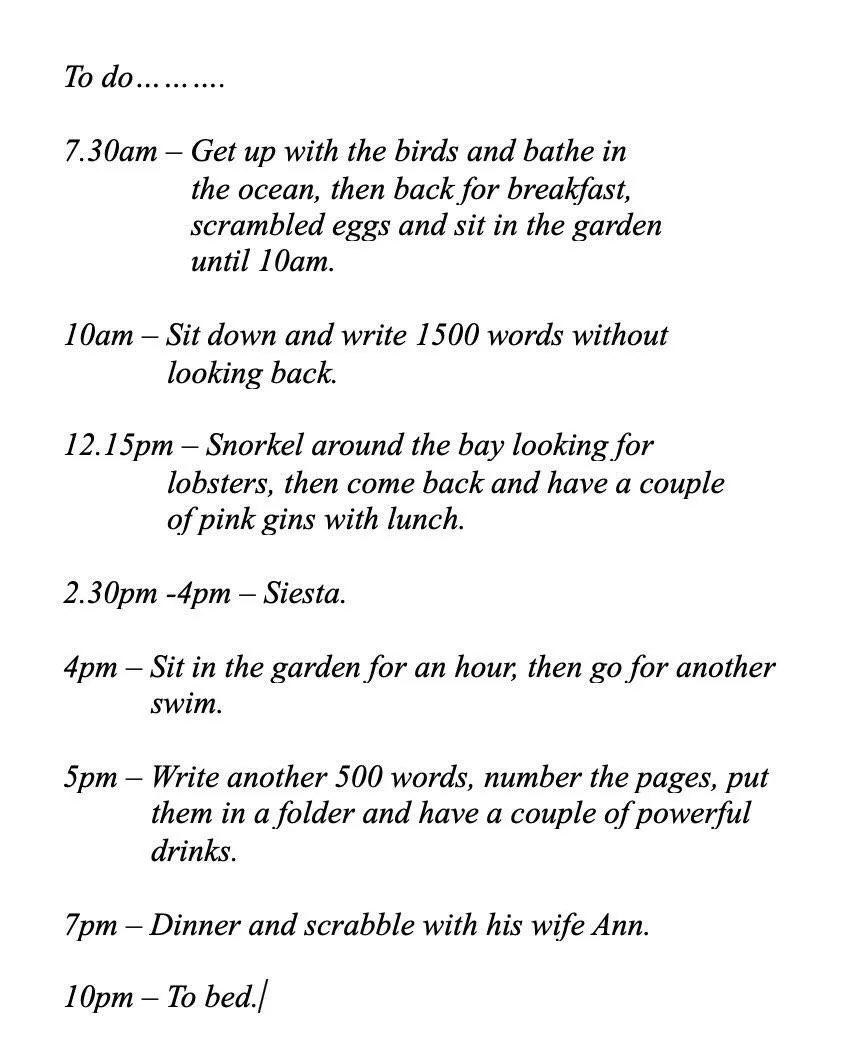
A meme recently circulated that describes his writing routine (click to enlarge):
More details can be found here.
This daily schedule of producing 2,000 words a day enabled Fleming to finish a first draft of his novels within approximately six weeks. After that, he would spend a week going through and correcting the errors as well as rewriting passages. Then the manuscript was sent off to his publisher.
Fleming said, “I find that unless I stick to a routine, if I just wait for genius to arrive from the skies, it just doesn’t arrive. I just get on with the work.”
Back in 1988, when I decided I had to follow my inner compulsion to write, and began devouring books and articles in Writer’s Digest, the first lesson I took to heart was to set myself a quota of words. Not time, because it is quite possible to sit in front of a computer for a couple of hours without getting many words done at all. I started aiming for 1,000 words a day. Later I modified that because, let’s face it, not all days are the same, and life has a way of intruding upon you, unbidden.
So I settled on 6,000 words a week, taking Sunday off to rest and recharge (essential, IMO). I kept track of my words on a spreadsheet (still do). That way, if I missed a day for some reason, I’d do a little more on the other days. If I got to the end of the week short of my goal, I forgot about it and started fresh the next week.
As I look back on the books I’ve managed to write, I can honestly say it was made possible only because of the quota system. Like Fleming, I couldn’t wait for “genius” or “the muse” to arrive. Indeed, I came up with ways to “goose the muse.”
My writing routine was not as time-clocky as Fleming’s, but has remained roughly the same.
I wake up early, while it’s still dark, and make the coffee. I spend an hour or so getting the motor running. I used to do that by reading a book or newspaper, but I regret to say the smartphone era has crowded in with emails and scrolling.
Anyway, I then get some writing done. If I can knock off 250 words (a Nifty 250) or even 350, it makes meeting my quota so much easier.
My wife awakens and we spend time together sipping brew, doing some devotional reading together, planning the day to come. The hours between 7 and 11 a.m. are my sweet spot. I write on my main WIP, first by doing a light edit on yesterday’s output, then charging ahead until I’ve hit my quota. If I’m going good, I keep on going. Or I do some development on other projects. I keep everything in Scrivener.
Around 11 I do some exercise and strength training (I need to up these) and have lunch. While I munch, I watch half an hour or so of an old movie (have you discovered Tubi yet?) and then take care of business matters.
I love to work in a power nap. When I had a law office I got real good at putting my feet up on my desk and nodding off for 20 minutes. The afternoon is open time for anything that needs to be taken care of, and is the best time for me to get some reading done. I have a big TBR pile, and usually am in one fiction and one nonfiction book, with several others in various stages of ingestion.
From 4–5 I might get some more words in.
From then on it’s wife time, meaning dinner, games, and watching a movie or show (we’re currently going through Person of Interest again). On occasion we’ll go out to dinner with friends, after I take out a home loan.
Then bed, and then the whole thing starts over again.
And that, for what it’s worth, is my writing routine. What’s yours?