
 Ian Fleming enjoyed a writer’s dream life. He owned an estate he called Goldeneye on the northern coastline of Jamaica, with a house on a cliff overlooking the ocean. It was here that he wrote all his James Bond novels. (Goldeneye was named for a secret operation Fleming planned for British Naval Intelligence during WWII.)
A meme recently circulated that describes his writing routine (click to enlarge):
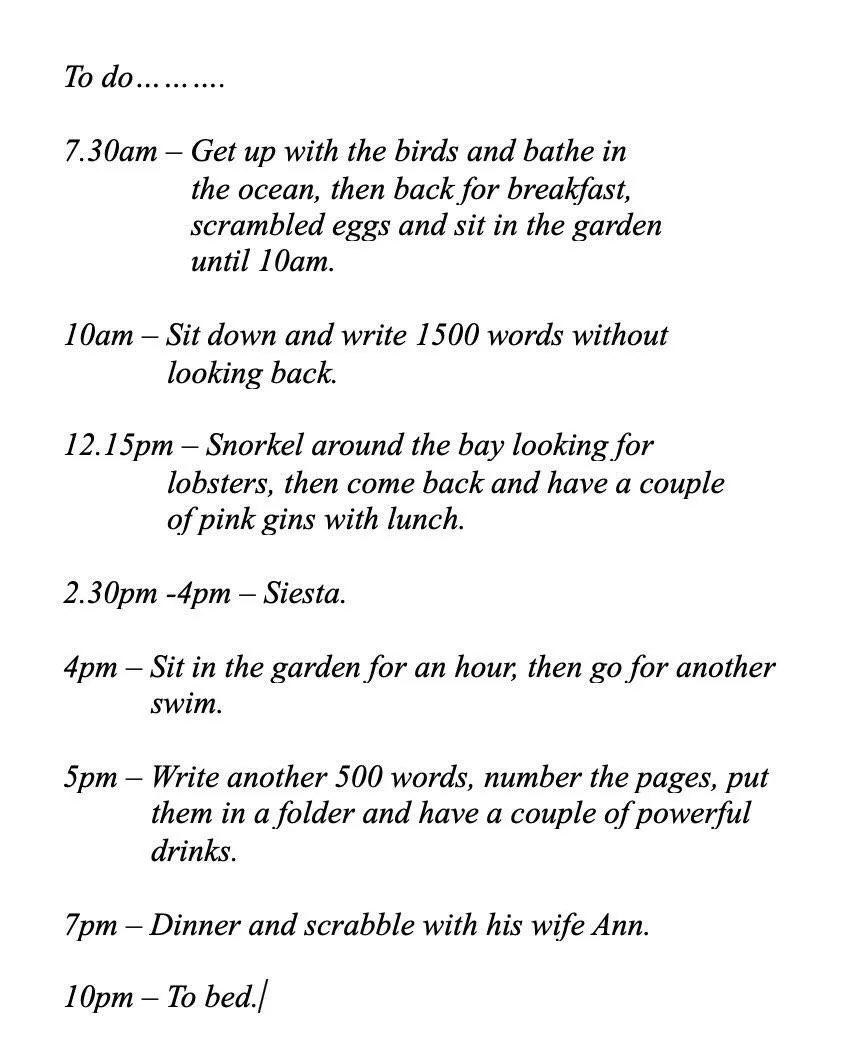
More details can be found here.
This daily schedule of producing 2,000 words a day enabled Fleming to finish a first draft of his novels within approximately six weeks. After that, he would spend a week going through and correcting the errors as well as rewriting passages. Then the manuscript was sent off to his publisher.
Fleming said, “I find that unless I stick to a routine, if I just wait for genius to arrive from the skies, it just doesn’t arrive. I just get on with the work.”
Back in 1988, when I decided I had to follow my inner compulsion to write, and began devouring books and articles in Writer’s Digest, the first lesson I took to heart was to set myself a quota of words. Not time, because it is quite possible to sit in front of a computer for a couple of hours without getting many words done at all. I started aiming for 1,000 words a day. Later I modified that because, let’s face it, not all days are the same, and life has a way of intruding upon you, unbidden.
So I settled on 6,000 words a week, taking Sunday off to rest and recharge (essential, IMO). I kept track of my words on a spreadsheet (still do). That way, if I missed a day for some reason, I’d do a little more on the other days. If I got to the end of the week short of my goal, I forgot about it and started fresh the next week.
As I look back on the books I’ve managed to write, I can honestly say it was made possible only because of the quota system. Like Fleming, I couldn’t wait for “genius” or “the muse” to arrive. Indeed, I came up with ways to “goose the muse.”
My writing routine was not as time-clocky as Fleming’s, but has remained roughly the same.
I wake up early, while it’s still dark, and make the coffee. I spend an hour or so getting the motor running. I used to do that by reading a book or newspaper, but I regret to say the smartphone era has crowded in with emails and scrolling.
Anyway, I then get some writing done. If I can knock off 250 words (a Nifty 250) or even 350, it makes meeting my quota so much easier.
My wife awakens and we spend time together sipping brew, doing some devotional reading together, planning the day to come. The hours between 7 and 11 a.m. are my sweet spot. I write on my main WIP, first by doing a light edit on yesterday’s output, then charging ahead until I’ve hit my quota. If I’m going good, I keep on going. Or I do some development on other projects. I keep everything in Scrivener.
Around 11 I do some exercise and strength training (I need to up these) and have lunch. While I munch, I watch half an hour or so of an old movie (have you discovered Tubi yet?) and then take care of business matters.
I love to work in a power nap. When I had a law office I got real good at putting my feet up on my desk and nodding off for 20 minutes. The afternoon is open time for anything that needs to be taken care of, and is the best time for me to get some reading done. I have a big TBR pile, and usually am in one fiction and one nonfiction book, with several others in various stages of ingestion.
From 4–5 I might get some more words in.
From then on it’s wife time, meaning dinner, games, and watching a movie or show (we’re currently going through Person of Interest again). On occasion we’ll go out to dinner with friends, after I take out a home loan.
Then bed, and then the whole thing starts over again.
And that, for what it’s worth, is my writing routine. What’s yours?
Since retiring and living in my motor home with a very talkative other half, I find if I can get up before him, I can easily meet my quota of 500 words. I set the bar low because it’s easy to blow past that daily goal and I feel really, realy good about myself.
The routine:
Coffee
Devotional time
Writing
Housework, cooking, baking, etc.
My afternoons are spent adding more words to the WIP or working on creating graphics for marketing or Sustack.
Some days I spend all afternoon writing.
I’m curious as to what others do and do they have a daily or weekly quota?
I’m trying to get used to a new schedule with mornings instead of afternoons as the household’s jobs have changed to mornings. I am trying to write by 7 and finish the day by 10 with various switch ups in assignments every half-hour to hour. I also scroll on my phone from when I get up at 5 and then for a shorter time after my power nap. The afternoon refresher gets me going. Although, I’m trying to do the same focus in the mornings now.
Dog in and out. First hour is getting the brain moving. Mini-Crossword, Connections & Strands. Compare results with daughter and crit partner. Check emails for anything important. Breakfast for dog and myself, usually around 7.
Read the printout of the chapter I marked up in bed last night, dealing with notes. Goal is 500 new words before lunch, 1000 by the end of the day.
Offer feedback to my crit buddies if they’ve sent chapters.
Deal with Substack, TKZ blog posts, any other “writing stuff” as needed.
Normal household things interspersed, also as needed.
If I finish a chapter, I print it to read in bed and make my notes.
Bottom line for writing a book: 1000 words/day is my goal, tracked on a spreadsheet.
It was much easier to stick to a schedule when I worked full time. Early morning, late at night, most of the day on Saturday. I finished first drafts in about three months. During one stretch when I was being paid not to work, I wrote a complete novel in ten days, writing all day while the house was empty of husband and children, except for Sunday. I could hardly wait for retirement, thinking I could do that again. Yeah, didn’t happen.
I have experimented and struggled to find a fitting schedule since then, and I can’t claim it’s perfect because almost anything will distract me, but this is what I’m currently doing.
Up early, devotions, get ready.
Write 1,000 words (7-11-ish)
I might eat a snack while writing, but DH knows to make his own breakfast.
Some weight lifting and band work while thinking (not a plotter).
After lunch, if nothing is going on, more writing. If the afternoon is busy with other things, I might write in the evening, but that’s mostly when I read.
I do have a spreadsheet for tracking word count, and manage 6-10,000 words per week.
Personally, the writing is the easiest part; I simply do not go back and edit, mostly because I edit as I go.
I write because my mind is full of stories. Maybe that’s enough.
My husband is nearing retirement and has more days off and home. It’s an adjustment but a wonderful one. Typical routine is breakfast and coffee in my study and read a devo. Then take care of emails. I’ve started putting “author newsletters to read” in a separate email folder to read later. Otherwise it’s rabbit trails for me. I haven’t set a specific quota.
Thanks so much for this encouragement!
Jen
When I’m firing on all cylinders my writing routine goes like this:
Every day I’m up between 5:30 and 6. After feeding and playing with the cats, I drink my first cup of black tea, while read some fiction (though, like you, the siren call of the internet can interfere with the fiction reading. I head into the writing office around 7 to have a first session. My wife and I take a morning walk a bit after 8AM and then we have breakfast.
On the weekend, after breakfast she’ll have a couple of hours of crafting time while I write, and then we’ll do yoga, have lunch, and then enjoy the rest of Saturday or Sunday together.
During the week, after breakfast, it’s chores, errands, the gym or yoga. After lunch, I’ll head into the writing office to write until 4:30 or so while she crafts.
I’m also working on reframing how I approach my daily writing practice. Rather than making it about “discipline”, which certainly has its uses, I’m focusing more on my devotion to it. We writers were given a gift, I want to honor mine by using it, rather than force marching myself to the keyboard.
Dale, great to look at writing as an honor rather than a forced merch!
Jim, we watched Person of Interest recently. The show ran from 2011 to 2016. Wow, all their predictions have come true.
Routine is up at 5-6 a.m., coffee, check email, read TKZ. Figure out what deadlines are pending and work on those. If I have an editing job, that’s #1 b/c those clients pay the bills. Otherwise, work on guest posts coming due, power points for writing classes I’m teaching, read/comment on critique group submissions, etc.
Midmorning exercise break, either zumba or a long walk (plotting time). Lunch then back to the computer. Working on my current novel is the reward for getting chores done.
House and garden work breaks. If I’m on a roll, I’ll write late in the night.
Often writing has to be done in short bursts between daily life obligations. Some weeks, I don’t get much writing done b/c of fires that need to be put out, appointments, etc, Other weeks are quieter with a few hours of uninterrupted writing time. Slow, steady, and consistent averages out over the long run.
I don’t have a word quota per se but I write every single day. The habit is so ingrained that if I don’t write for a day, it feels like something is missing.
My best writing time is also early in the day. I eat breakfast, read the newspaper on-line, zip through email (deleting most of it), do my devotional, and then start writing. I eat lunch at noon, take care of a few household chores, then back at the computer at 1 p.m. I spend 30 to 60 minutes doing social media. Then write some more. At 4:30 I do my seated aerobic exercises & stretches related to my mobility issues. I eat supper, clean up, do 30 minutes on the stationary bike, and then either read or watch “shows” with my husband. We’re also watching Person of Interest (my 2nd time, his first). I don’t have a quota for number of words. It varies a lot. I treat it like a 40-hour a week job as much as possible. With so many medical appointments I juggle from weekdays to weekends to get more writing time. I’ve never missed a deadline so I figure
My time isn’t my own these days, so I do what I can when I can. However, if I were looking for the perfect routine, I might go with Ian Fleming’s. Except I don’t have an ocean, so I’ll substitute the treadmill for swimming and email for snorkeling.
My writing sessions start with a quote from Matthew 7:7, “seek, and you will find” and then I proceed to seek out and find any excuse to avoid writing.
I start with a quote from Matthew 7:7, “seek and you will find,” and then proceed to seek, and always find, any excuse to avoid writing.
I do not recommend this method to any serious writers.
Like Jane, I have another half who wishes to have some conversation after he arises. Once he gets up, getting into the “groove” sometimes feels very difficult … but I do put pen to paper … or finger tips to the computer keyboard … and write.
my other says “Don’t talk to me before 8” so I use those first hours as “me” time.
I get up early while it’s still dark (best time to think), have tea, feed all my animals, inside and out, then have a second tea and breakfast. I hit the keyboard around 7:30 a.m.
This past week, I’d watched a memoir-turned-Netflix-series, and despised the protagonist. All she did was whine and made terrible decisions. The series aggravated me so much—many reviewers felt the same—I got all fired up about writing my own memoir (something I thought I would never do). The first day 4,000+ words just poured out of me. I couldn’t stop! And now, I’m consumed by it. So, my writing routine lately is full-throttle from early morning to about 3 p.m., when my motor runs out of gas.
Today, I finally was able to stop, work out my main and secondary themes, and outline the book. Pulling off a 30-year timeline without writing chronologically, which might bore readers, is a delicate balancing act that requires a detailed plan, but I’m excited for the challenge. The hardest part is figuring out what to leave in and what to skip.