Seeking The Zone

By John Ramsey Miller

I am a writer, but sometimes I fantasize about other occupations. This happens usually when I’m having a hard time with an idea for a book, or when I’m sure the books aren’t doing what the publisher or seller expected them to do. What else would I do? I’m a decent carpenter. I can paint a wall. I can run pipes and put in a bathroom from scratch. I can wire outlets. With a few hours of instruction I could probably do brain surgery. What I can’t be is a salesman. When I was in high school, I sold books to parents in rural West Virginia for their children. I’d be in people’s living rooms where the parents were worried about getting enough food for their kids to fill their stomachs and there I was trying to sell them books for kids to read while their bellies growled. I had learned to close wives before their husbands came home and freaked out that they’d given me the twenty-dollar deposit. It broke my heart and made me feel like I had the social conscience of Darth Vader. I decided it was a bad thing to take advantage of people with a prepared pitch cleverly designed so they couldn’t refuse without feeling like they were the worst parents since Ma Barker. I lasted two weeks.

I know I could probably make more money painting walls, and certainly if I performed a few brain surgeries if I could understand the instruction. But here’s the thing. The other day I wrote from eight AM until after five PM without taking more than 30 minutes away from the computer. I was outlining three chapters ahead as I wrote. It is days like that that keep me at this trade or craft or folly or whatever the hell it is. When I can walk into my book and feel the characters and the story I forget about the real world. It’s better than being on a vacation at the beach and it more than makes up for all those days when I can’t decide where I should go next or what I’ll do when I get there.

We authors talk a lot about being in the Zone, but getting there is illusive, and the bitch is that you can spend a day zooming and wake up the next day and fight to get back in again, and not be able to do it. It can’t be taught, it just happens. Or maybe all craftsmen can find that zone. Today I know I can’t get back into it because I have to go to the dentist, then meet a friend who’s coming by and I know it will be tomorrow before I can be alone to attempt to climb into the story again, find hopefully find the sweet spot and enter the Zone. We all know it’s better than any drug. How often are you writing and find yourself getting emotional, choking up, as the words hit the screen? How much higher than that can you get? What can be more rewarding? Okay, your wedding day, maybe watching a child come into the world, take their first steps, coming out of gibberish and calling you Daddy for the first time, or seeing your first book on a shelf in a store, or having a doctor tell you your spouse is cancer free is a better high. Yes, but short of that life-altering experience, …nothing.

So how often do you find yourself in the Zone? Can you make it happen by force of will, or does it just happen?

Mayhem, Murder Through Little Eyes and Big Ears

By John Ramsey Miller

I come from a town most people would describe as a slow, sleepy Mississippi Delta backwater. Cleveland, Mississippi is where I lived for six years, and I consider it my home town because those were my high-school years and I am connected to the people I knew there. Thomas Harris spent time living there as a young man, and has relatives there still. The town library was named for the Carpenter family whose members died from asphyxiation when their heating system malfunctioned and filled the house with smoke. The home had just been renovated and the windows painted shut. One of the bodies was found at a window and there were scratch marks …well I won’t delve into details. This week a friend of mine from high school wrote me a Facebook note that suggested that Harris modeled Hannibal Lechter on a man that was caught in our old town with a collection of human heads and human jerky in his pockets.

This took place in the late thirties and I’m sure Harris heard this story about the grave-robbing, head-collecting, human meat-eating Mr. Robinson. Mr. Robinson, an African/ American also murdered the entire Turner family, which incidentally happened to be Scot/Irish and cut an embryo from the murdered woman, whose body provided him with jerky. He was caught and admitted the killings, but said the heads he had accumulated were trophies from his grave robbing, not murders. Although it was reported in the media that he was shot while trying to escape, I believe the actual story is that he was de-celled and hanged while the town looked on, perhaps shot in the shoulder as he hung, and this was witnessed by an audience of angry, outraged individuals.

I suppose Thomas Harris may have given this murdering drifter a medical/ psychiatric degree, had him love fine things, and listen to opera while he drank rare wines and dined on the finer cuts of corpse meat. I don’t know Thomas personally, but it may have been Robinson and not Ed Gein he modeled Dr. Lechter’s cannibalism on. It was very likely Mr. Gein that inspired the body-skin wearing tailor, Jame “Buffalo Bill” Gumb, in Silence of the Lambs.

There were also three boys killed in nearby Rosedale, MS, whose killer and mutilator was never caught. That happened before I moved there, but was something parents had in the backs of their minds when we guys wanted to go camping. Even small towns have these stories of mayhem and murder, and retribution and justice dealt by private citizens outside courtrooms. When Mrs. Ringold killed her doctor husband with a shotgun one night after he’d beaten her, he was acquitted because the lawyer told the all male jury that it had been an accidental shooting. When the prosecutor brought up the fact that she had shot him more than once using a pump shotgun, Mrs. Ringold’s attorney (who later became Governor) argued that as a woman she was unfamiliar with the workings of shotguns and in her confusion and fright and horror she had reflexively pumped the shotgun three times, hitting him all three times. Released, she moved away, but a lot of people sympathized with her.

When I was very young we lived in the Methodist parsonage in Starkville, Mississippi and it was located across the street from a funeral home and the hospital was located within a hundred yards of us. The mortician had two sons I made friends with, and their father also had the town’s ambulance for emergencies. When he would take the ambulance out, he would either bring a corpse or two back to the funeral home or to the emergency room for repairs. We would wait for the siren, if there were survivors, we’d rush to the hospital’s loading dock to see what he had on a gurney, and if there was no siren, we’d be waiting at the funeral home for the delivery there. I can’t tell you how many maimed and dead people I saw, or how many times we laid ourselves in the grass outside the basement windows of the embalming theater and watch through the window, a young and impressionable audience, as Mr. Barry did his work. More than once I had known the corpses he worked on. I don’t know if he saw us, but if he did he never ran us off. He also had a notorious drinking problem, and lost his business when he was driving intoxicated and wrecked the ambulance depositing a battered casket and its corpse in the middle of the highway outside Jackson.

All of these stories and things I witnessed helped forge my imagination and introduced me to violence, death, justice, tragedy, and the heartbreak associated with them. I wouldn’t change a thing about my formative years, because it all contributed to bending me into the writer I am. I also learned about human nature and the complexities of the social structure and how good people can participate in bad things, and do surprising things for complex reasons. I grew up in the Civil Rights era, but that is a different blog for another time, although it is related when it comes to witnessing human complexities and contradictions.

We become who we are based on our experiences and we bring ourselves into everything we write, and how we see everything. I write about evil and the battle when good brings right to the table. In my stories good always wins over evil, not matter the odds. But life is not always so cut and dried, and evil often triumphs, and evil people often win the day in real life, if rarely in fiction. Our readers don’t want to see evil win, but to see good people facing seemingly insurmountable odds and both triumphant, whole, and happy at the end of their trial or quest. Our readers don’t need to know what the experiences were that made us become storytellers who seem to know violence and evil. They just want us to use our imaginations and experiences to make this battle between sides seem real, and to leave them feeling hopeful that they too can surmount the odds against them and prevail. As long as I can do so, I’ll do my best to accomplish that and leave the readers entertained, satisfied and hopeful.

Through The Fog

By John Ramsey Miller

“View From My Studio”

I am sitting in my writing studio, a converted feed shed I renovated, and I was looking out the double-pane window at my long driveway through a thick fog, and listening to one of my dogs on the porch chewing a ham bone and gentle rain pattering on the roof. As I peered down my driveway, I saw a deer silently move from the tree line and stand on the gravel. She turned her head as though she could see me and stayed frozen for a few minutes, and the dogs (I have three) never knew she was there. She decided (maybe she smelled the dogs) to stamp her front feet, which got my dogs’ attention and they began running toward her, blasting her with a cacophony of uttered threats and promises. As they approach the three ribbons of electric wire that encloses three acres, they stopped. I watched her reaction, which was to stand and stare at the approaching animals. Somehow she knew they would or could not cross the wire to make good on their threats, and I knew she somehow intuited this. But how? After a few minutes, she walked into the trees, and they lost interest and returned to the porch. I wonder how many times this has happened when I was not watching, and I thought about all the times my dogs seemed to be at the fence barking to beat the band, and I had no idea what they saw or heard that had them there. Now, after watching this, I will assume it is the same doe once again playing with the dogs for her own amusement. I know animals do things for their own amusement. My Australian Shepherd does not chase balls I throw for my Labradoodle to retrieve, but he will chase the Labradoodle down and hold him by the scruff of his neck, or by his tail, to keep him from getting to the thrown ball. This has to be because it amuses the shepherd, and because he knows that his holding action frustrates his playmate.

We writers are observers and we record our observations and add our own spins to what we see and hear. At the moment I am concocting a story of some length. My novel begins with a man and his dog on a boat. In this tale, my protagonist is propelled unwillingly and unknowingly into a conspiracy involving very powerful men and women. In the opening chapters he is visited by four men in search of something my protagonist has that they want and something they have come to retrieve. They also plan to kill him, a man they have never met and to their misfortune underestimate. In the first few scenes a secretary of state is assassinated, and the connection to that event and the man are as unknown to the reader, as to the man. The visitors shoot the dog, and my dilemma was whether or not to let the dog die trying to protect someone he cares about. I thought about this for weeks as I went about my daily routine, and I finally decided the dog’s instincts, loyalty, and nobility had to be rewarded, so I let him live. It wasn’t because some readers freak when we kill animals, but because I liked the creature I created based on my experiences with my own animals. Like the animal who is mismatched by professional gunmen, so too is my protagonist, who is an older man with no knowledge of, or use for high tech understanding. That old man is me to some extent, but he has neither phone (cell or land-line) much less a computer. Retired from the military, and estranged from his family due to his life choices, he spends his days fishing the lakes near Therio, Louisiana, and minding his own business, surrounded by neighbors who do not know him, but admire him for his qualities. He is the man I wish I could be, and I write him knowing that I fall miles short of him. But he is a man of integrity who is called on to face enemies he is inferior to (skill wise), but superior to morally speaking. He is a man with violence in his history, with right on his side, and who doesn’t have a chance as far as the reader knows. I’m having a blast writing him, and his enemies, who come to respect him even though they want nothing but to kill him and retrieve something he has been given. I think it’s the best story I’ve ever stumbled into, but others may disagree.

The creative process is so difficult on so many levels, but nothing is more rewarding when the process bears fruit, or more frustrating when it fails. Each time I sit down at this black box to start a new story I don’t have any idea whether or not I will be able do it all over again. So far I’ve been lucky, and hopefully the quest will only end when I am no longer able to sit here and think and dream. We talk about marketing, and building an audience, so we can be successful by the ways that are measurable, but what this is really about is the battle between us and filling the blank page.

One of these days I will write the doe I saw, and of her playing with the dogs, her sworn enemies. I will know when I need her and she will serve to make a point, and advance the story I’m wrestling with. I will continue to write characters with traits I wish I possessed and putting them through paces I can only imagine while I’m sitting at this laptop or gathering eggs or playing with my wonderful and complicated grandchildren. I hope someday those grandchildren will read my books and see something of the best of me in the pages they turn, and feel the awe and excitement I feel for my characters. To me, that hope is far more important than the checks that come in the mail, what my editor or publisher thinks, or just about anything else my overtaxed mind can imagine through the fog.


“My Writing Studio”

How Much Can You Put a Character Through?

neil-plakcyToday the Kill Zone blog welcomes our guest, award-winning author Neil Plakcy. Neil is the author of Mahu, just re-released in trade paperback by Alyson Books, and its two sequels, Mahu Surfer and Mahu Fire, which won the Hawaii Five-O award for best police procedural, and is a finalist for the Lambda award for best gay men’s mystery. His fourth book, Mahu Vice, comes out August 2009. Neil is the Vice President of the Mystery Writers of America, Florida chapter.

A few years ago, as he was getting his breakout novel Mystic River ready for publication, Dennis Lehane spoke at the Miami Book Fair. He’d just published the fifth Patrick and Angie book, Prayers for Rain, and he said that he’d put them through so much that they had just stopped talking to him. He thought he’d give them a break and write something else.

That idea really resonated with me, and I started to think about all the other fictional detectives, and their families and friends, who’d been put through the wringer a few times. In Les Standiford’s Deal series, Deal’s wife Janice leaves him after she’s been kidnapped, nearly drowned, and who knows what else.

The king of putting a character through hell, as far as I’m concerned, is John Morgan Wilson. Poor Benjamin Justice has lost his job and his reputation, been raped, infected with HIV, and had his eye put out. Just thinking of all that stuff makes me shiver. My hero, Honolulu homicide detective Kimo Kanapa’aka, is my alter ego, and I can’t imagine putting him through so much—it’d kill me, if it didn’t kill him!

Not to mention the complications you set for yourself, as a writer, when you make such a major change to a character. If you shoot your protagonist in book one, then the effects of that shooting are going to resonate for a while. Kill off a girlfriend or fiancée, as they used to do regularly in the James Bond movies, and your hero’s got to get a little shy of entering a new relationship. Zoe Sharp’s Second Shot begins with Charlie Fox getting shot—and the effects of that shooting resonate through not only that book, but Third Strike, the book that follows, as well.

mahu The same goes for the supporting players. Kimo’s best gal pal since high school, Terri, loses her husband in Mahu, the first book in my series. And then, in Mahu Surfer, the poor thing ends up in a firefight at her uncle’s house. In an early draft of the third book, Mahu Fire, I put her on the mountainside among the others Kimo needs to rescue.

Then I stepped back. How could I do that to her? And more important, would she ever talk to Kimo again after being traumatized in three books? I believe in recycling characters—but I knew that I couldn’t keep putting Terri in jeopardy, or she just wouldn’t remain a convincing character.

When I was in graduate school at FIU, our teachers, including Les Standiford and James W. Hall, reinforced to us that what happened in our books had to matter to our characters. It wasn’t enough for a detective to investigate a case; he had to have a personal stake. In Mahu, Kimo was fighting to restore his reputation at the Honolulu Police Department, and then in Mahu Surfer, he struggled to prove that he could be as good as any cop on the force, if given the chance. I added an extra bounce by bringing in an old nemesis and then putting his close friend at risk.

As I’ve written more books, it’s getting harder to find that personal connection for Kimo, without incurring what I think of as the Cabot Cove Syndrome. I used to wonder why anyone would associate with Jessica Fletcher, since her neighbors, friends and colleagues died so regularly. How much could Kimo’s friends and family take before they would get the hell away from him? And how to avoid the coincidence factor? Fortunately I write about an island, where there are lots of personal connections, where the cops either grew up with the crooks or are related to them, but it’s still important to maintain credibility.

In Mahu Fire, I brought back a sympathetic teenager from Mahu, who’d gone through some hard times, and made things even tougher for him. I teamed him up with a new character I hoped readers would care about. People care about kids, right? And then in Mahu Vice, which is coming out this August, I threw Kimo’s gay pal Gunter into danger, along with Kimo’s troublemaking brother-in-law.

But I try and remember, especially with these supporting characters, that they are civilians, not police officers, and then when they go through trauma, it’s going to take them a while to recover. Kimo’s a tougher guy; by the time we meet him in Mahu, he’s been a cop for nearly six years, three of those as a detective. He’s still got a soft heart, but his skin has been toughened by what he has seen and experienced on the street.

I’ve been shaking up his personal life, though, moving him in and out of romance, but to me that’s all part of his emotional growth and development. Getting dumped isn’t quite as life-threatening as getting shot at, but it’s still pretty painful.

For now, Kimo and his friends and family keep talking to me. Maybe some day, like Patrick Kenzie and Angie Gennaro did with Dennis Lehane, he’ll stop. But for now I’ll keep on throwing him curve balls and seeing how he, and his loved ones, react.

~~~~~~~~~~~~~~~~~~~~~~~~~~~~~

CALENDAR OF UPCOMING GUESTS

Mark your calendar for the following guest blogger at the Kill Zone:

Liz Jasper, March 29

Creating Characters that Jump Off the Page

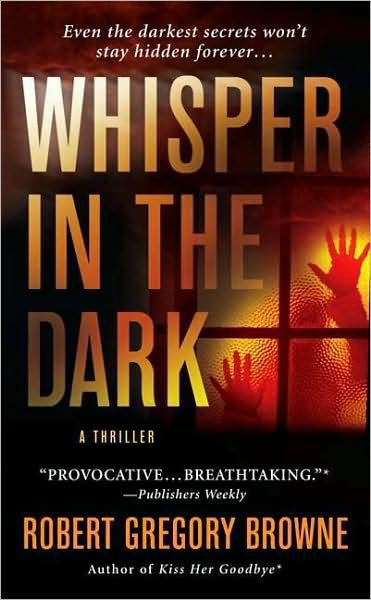
Rob-Toughguy Today our guest blogger is Robert Gregory Browne, whose latest work WHISPER IN THE DARK received a starred review from Publishers Weekly, and is currently available in stores everywhere…

Imagine, if you will, The Fugitive with Ace Ventura as the lead.

While much of the plot of this exciting movie could remain intact, the entire flavor of it would be radically different. Scenes would change, dialog would be altered… and, despite the plot similarities, chances are pretty good these two versions would wind up on completely different shelves in your local video store. Which isn’t all that surprising.

Because when we watch a movie or read a book it isn’t really plot that we invest ourselves in. It’s character. The characters set the tone, and our acceptance or rejection of those characters is essential to our acceptance or rejection of the story itself.

Great characters make us laugh and cry or even frustrate and infuriate us. Great characters make us squirm in suspense and excitement. Great characters take us on an emotional rollercoaster ride and are absolutely essential to our suspension of disbelief.

WELL, SURE, BUT…

Whenever I spout off about the all-important need for great characters, someone invariably disagrees. True writing success, they say, lies not only in great characters, but in your ability to come up with a great plot and structure, compelling dialogue and so forth.

And they aren’t wrong. In fact, I couldn’t agree more.

But the simple truth is this — and I’m not the first to say it: your characters define all those things. They are your story. Even if you succeed in giving us a wonderful plot and structure, you’ve got nothing unless your characters jump off the page. In writing fiction of any kind, characters are everything. Everything.

It is impossible to imagine Gone With the Wind without the feisty, self-centered yet courageous Scarlett O’Hara. Or Citizen Kane without the domineering presence of Charles Foster Kane.

But not only are these lead characters all-important, every character that surrounds them seems to be full-bodied and alive. The authors have somehow managed to pump life into every single character that occupies the page.

Now the question is this: how do you and I do the same thing?

CREATING COMPELLING CHARACTERS
WHISPERTruth is, I can’t tell you how to do this, but I can tell you how I do it — and I’m often complimented on my great characters. But my method, like any other method taught out there, is not surefire for everyone who tries it. In fact, many people will reject it out of hand as being far too simplistic. And they may be right. Yet it works for me. And, who knows, it might just work for you.

There are writing gurus who will tell you that the only way to create a great character is to sit down with a legal pad or a bunch of note cards or a character chart and start filling in the blanks.

How old is the character? What’s his occupation? What are his likes and dislikes? What school did he graduate from? Where’s his hometown? Who were his best friends in grammar school. What kind of parents does he have? Does he have any siblings? The list goes on and on and on.

All of these questions are designed to help you get under the skin of your character. To help you understand him or her to the fullest extent possible so that when you write your scenes, your character will be alive in your own mind. And if he’s alive in your own mind, then surely he’ll be alive in the minds of your audience.

Well, yes. Of course. But, I’m sorry, call me lazy, call me stupid — I just can’t bring myself to sit down long enough to answer all these questions.

Oh, I’ve tried. But halfway through I find myself wondering, what’s the point to all this? I may say my main character attended Dartmouth — but how exactly does that bit of information help me unless it’s directly related to the story at hand?

I have yet to figure it out. Instead, I approach the task in this way:

CHARACTERS ARE ATTITUDE

Let’s go back to Scarlett O’Hara for a moment. How did I describe her? Feisty, self-centered yet courageous? You could throw in flirtatious and childish as well. These are all attitudes that our audience can immediately latch onto and understand. We don’t need to know that she comes from a pampered Southern background and a rebellious Irish father to understand — and perhaps identify with — that attitude. Her attitude alone is enough to draw us in.

Why? Because attitude is action — the character in a state of being. Giving your character an attitude — preferably one that conflicts with the other characters in your story — is a great way to help you and your audience understand who that character is.

CHARACTERS ARE EMOTION

Adding emotion to your character can help your audience identify with him or her. Looking at Scarlett O’Hara again, when Gone With the Wind opens we see the flirtatious and selfish side of Scarlett’s personality. But as the opening scenes continue, we discover that despite all the attention she’s getting from the men in her world, she’s actually in love with another and has been rejected by him. Scarlett is wounded by that rejection yet hides the hurt from all but the object of her affection.

This is an emotion/reaction we can all identify with. If we haven’t experienced it ourselves, we have seen it in others we know and love. The emotion is what gives depth to… the attitude.

CHARACTERS MUST HAVE A GOAL

Every character must have a goal. Not just the main character. This is a given. Without a goal, your main character will wander aimlessly and your audience will disappear.

But every character that inhabits your story should have a goal. The character’s goal is often what defines both attitude and emotion.

Let’s take a relatively minor character for example. A grocery store clerk. The hero is buying a carton of milk. For a beat of conflict in an otherwise innocuous scene, we might give the grocery store clerk a goal: she wants to go home. She’s been on her feet all day long, the new shoes are killing her and all she wants to do is punch that time clock (and maybe anyone who gets in her way) and get the hell out of there.

This goal can help you define the character’s attitude. Is she weary? Is she grouchy? And how does this affect (read: conflict with) the hero?

Giving such a minor character a goal and an attitude/emotion may seem silly, but the result is a much richer story with much richer characters.

CHARACTER IS ACTION/DIALOGUE

Defining an attitude/emotion and a goal are all wonderful, helpful things. But none of them mean squat if we don’t see these things in action.

Sure, we can have Joe Blow say our hero is a selfish, manipulating bastard, but that means nothing unless we see this for ourselves. The way your character acts and speaks is what finally defines her/him.

When I describe Scarlett O’Hara as flirtatious and self-centered, these attributes are defined by what Scarlett says and does. She flirts with just about every man who enters her world, she manipulates them into paying attention to her despite the unhappiness this brings to the other women around her. By seeing her in action and hearing her words, we quickly understand the attitude and emotion she brings to the story.

The cliche, Show Don’t Tell, couldn’t be more true here. We must always show our characters acting and reacting — not simply talking about their motivations and desires.

ME + IMAGINATION

Defining a character’s goal/attitude/emotion/action are all wonderful things, but how exactly do we go about doing that without resorting to those cards and charts and character sketches the writing teachers tell us we so desperately need?

Again, this works for me. It may not work for you. And it’s deceptively simple:

Every character I write is me. From the hero and heroine down to that grocery store clerk, every single character I write is… me.

Yes, you say, but isn’t that a bit limiting? Doesn’t that make for a rather monotonous set of characters?

Maybe. But I have yet to hear any complaints. If my lead character is a divorced father of three who finds himself unwittingly involved in a conspiracy to overthrow the government, the first thing I ask myself when approaching a scene (even though I’m happily married and wouldn’t know a conspiracy if it jumped up and bit me) is this: how would I react in this situation.

Then I add the color (read: attitude/emotion). How would I react, if… I was a self-centered bastard… a no-nonsense cop… an officious political hack. And I apply this technique to every character I write.

In short, I’m like a method actor playing all of the parts. By using myself and a healthy dose of imagination, I can approach characterization from the inside out. And once I’m able to get into the skin of my characters, it’s much, much easier to create someone whom I, and hopefully the audience, can identify with.

FINALLY…

If you still feel like you have to drag out the cards and charts, then so be it. If knowing every single little detail about your character is important to you, then by all means write them all down, cover your entire wall with important tidbits of information. I would never belittle anyone for doing what feels right for them.

But while you’re at it, take into consideration the things I’ve talked about here. Remember attitude, emotion, goal and action.

Because these are the things that will make your characters leap off the page and propel your audience through the story. The key to success is to get your audience to say (and I’m cringing as I write this):

Frankly, my dear, I do give a damn.

Rob Gregory Browne was an award-winning screenwriter who rode the Hollywood roller coaster until severe motion sickness forced him to retire. He has now settled comfortably into his new life as a thriller writer, producing the books KISS HER GOODBYE, the just released WHISPER IN THE DARK — which received a starred review from Publishers Weekly — and the upcoming KILL HER AGAIN. Rob lives in California.

~~~~~~~~~~~~~~~~~~~~~~~~~~~~~

CALENDAR OF UPCOMING GUESTS

Mark your calendar for the following guest bloggers at the Kill Zone:

Neil Plakcy, March 22
Liz Jasper, March 29

Millionaire For a Night

John Ramsey Miller

Last weekend Susan and I went to Fairfax, VA to visit good friends. We went to a casino with John and Joy Gilstrap. We played blackjack. I drank Scotch. Starting with a check for $25,000.00, I found a table and the four of us began gambling. I soon bored with wagering $1,000.00 a hand because I was winning more than I was losing, so I quickly moved to bets of two and then three thousand a hand, but soon went to $5,000.00 a hand. Somehow I lost most of the money in thirty minutes.

When I was down to my last three thousand, I went to the roulette wheel and started betting color, even or odd and some other combinations––never numbers. After I’d picked up fifteen thousand dollars, I went back to blackjack, and before I stopped I was betting 75,000.00 a hand and doubling up. When I finally stopped and cashed in, I’d won one-point-four million dollars. I handed the winnings over to Joy Gilstrap. I mean she did stake me to the original $25,000.00 and we were her guests. And we all won, I just won more because I have a devil-may-care attitude about money, especially money in the form of chips, backed not by cash, or gold, but by thin air.

While the casino was a country club ballroom in Arlington and the casino dealers were novices. My dealer had clearly never dealt Blackjack before and barely had a grasp on the rules. In fact he’d never before played poker. Sometimes he paid off nineteen when he’d won with a twenty-one. He paid any twenty-one double. He paid ties. He couldn’t count. In fact any pit boss sober enough to be breathing would have hit him over the head with a bottle. So it was no surprise that I won, my wife won, and John and Joy won as well.

Sometimes the deck is stacked against you, and sometimes you just can’t lose. Winning… well, there’s no feeling its match.

I wish I could write like I played Blackjack last weekend, but even without the gaming, spending time with people you enjoy and care about is what life ought to boil down to. This weekend I’m off to the Mississippi Delta to a wedding. I sure hope it’s half as much fun as gambling with a rotten dealer and good company, but I doubt it will be.

If you Don’t Have Time For Your Fans, Do You Deserve Them?

By John Ramsey Miller

We need our fans and readers because they buy our books and not just because without their purchases we’d be negatively impacted financially. A lot of authors say they only owe their readers the best book they can write and nothing else. To a lot of authors, a book sale is merely an arm’s length business transaction. Other authors go out of their way to get close to their fans, surrounding themselves with their readers at every opportunity. I know some authors who see their fan clubs as being their immediate family. And some authors will go out of their way to avoid having their fans be able to get in touch with them.

I appreciate my readers and the fans of my books. Fans are readers who read every book I write. I’d love to have a few million fans who couldn’t live without my next book. The majority of the e-mails I get from readers say they enjoyed one of my books, or are asking when a new book is coming out. I can and do answer every e-mail I get. I guess a lot of authors are afraid they’ll get so many e-mails they can’t address them all without spending hours doing so, that they make themselves very difficult to get in touch with.

See, I think being reasonably accessible to readers and fans is good for one’s career. I don’t see my readers as nuisances, instead as individuals worthy of my attention.

Web sites are sales tools, and they should promote authors, but the best ones do more than that. I think a writer’s web site should have a way for readers to contact the author. Not having that feature seems arrogant to me. I think some authors see being hard to get in touch with creates a mystique, but I don’t think it does. I always smile at the way some authors listed in the “members registries” of professional organizations have their agents phone number as the way to contact them, which I think is a waste of an agent’s time. I guess if you are making your agent enough money they might be happy to become your answering service. My agent would not be at all amused.

Every very, very, busy author I know has a private e-mail address and a business e-mail address. I have four e-mail addresses. One I’ve had for fifteen years and is my “private” box. I have one connected to my web site, which goes directly into my private site. I have another one for my corporation, Burning Rabbit, LLC., and I have a G-mail one for getting into this blog site. I check e-mails when I’m at the computer. I give anybody reading this blog permission to drop me an e-mail any time they like. It may take time to respond, if I’m busy, but I will reply.

I have a busy life aside from writing, and a wonderful family and good friends, dogs and chickens all of which require time. But I want my readers to be able to at least send me messages, to ask me questions related to my books or about writing in general.

Although I might not “owe” a reader anything beyond my book, I think communicating with the people who invest time and money in my stories, and go to the trouble to write me a note is the least I can do. Just don’t come to my house without e-mailing ahead, or better yet, calling. I’m in the book.

The Rush to Self-Publish

By John Gilstrap
http://www.johngilstrap.com

I’m doing my part to rise to the challenge of 21st century book marketing by actively increasing my Internet footprint. I post on writers boards and try to be as cooperative and patient as I can be. People were helpful to me when I was first starting, so I think I need to invest in the Karmic balance.

A prevalent theme in these sites is an attempt to normalize and legitimize self-publishing, and I genuinely don’t get it. I don’t understand why people would pay the thousands of dollars necessary to make self-publishing happen. If the goal is to get one’s book into the hands of friends and family, a Kinko’s would serve as well as a self-publishing house. If the desired audience is bigger than that, the writer is hosed.

Selling a hundred copies to people who all know where you live is not really publishing, is it? Isn’t the point to sell not tens of copies, but tens of thousands of copies? It’s impossible to get that kind of distribution without a legitimate publisher.

Getting books on distant bookshelves requires infrastructure. Publishers establish a distribution network that involves wholesalers and transporters. After a few months, the books that don’t sell are returned to the publisher for a full refund. Authors are paid cash as an advance against royalties, and the money is theirs to keep even if the publisher fails to sell a single copy of the book. As compensation for that risk, the publisher keeps the lion’s share of the book’s cover price.

For self-published authors, none of that infrastructure is in place. Many bookstores refuse to stock self-published books because they cannot return unsold stock. If they do agree to stock a self-published book it’s probably because the visiting author is a good salesman. That’s all well and good, but who’s writing the next book (and probably working the day job) while the author is out there pounding the pavement?

I’m the first to admit that there’s a lot of crap out there from traditional publishers, but in every case, at least there’ve been some editorial hurdles. First, a literary agent blesses the book, and then it’s passed to an acquiring editor who then has to get approval from others before making an offer to buy the book. After that, there are several more editing passes before the book is finally printed and distributed.

Justly or not, it’s easy to see how self-published material is perceived by booksellers as being too undercooked for general consumption. I’m not saying they’re right necessarily, but the perception is understandable.

A popular hypothesis on the writers’ boards touts the notion that traditional publishers are resistant to new talent, and that writers have no choice but to publish on their own. It’s ridiculous. Publishers live off of new talent. They anxiously await the next great well-told story.

I think there’s undeniably a place for self-publishing. The history of a certain military unit, for example, or the story of how someone’s grandfather made his fortune against all odds are tales that will resonate with a certain definable group that is almost certainly large enough to recoup the author’s investment, but nowhere near large enough to attract the attention of a mainstream publisher. But it’s not a route to bestsellerdom.

What I worry about is my sense that too many people enter into those contracts with inflated expectations that are underwritten my greedy businessmen who know how to feed off the desires of frustrated artists. For the foreseeable future, the two publishing routes will never be seen as “equal,” anymore than a community theater production of a play will be considered the equivalent of Broadway.

Sweet Justice Is Coming

By Jordan Dane

The Kill Zone Blog welcomes Jordan Dane for today’s Sunday guest post.

dane-jordan1 Imagine the horror of going to your teenager’s bedroom one morning only to find her missing. Her bed hadn’t been slept in and her clothes are gone.

In 2000, that’s what one mother in Florida faced. Her only child had conspired against her and ran away. And worse, she later discovered that her daughter had left the country—without having a passport. From the moment I read this news story, I was hooked and had to know more about how such an atrocity could happen. The teen’s trail might have gone ice cold, but her mother pushed authorities in a direction.

She knew where to start looking.

Only six months earlier, the girl had received a computer for a gift—a thoughtful present from a mother who wanted the best for her child. But this gift soon brought a virtual menace into their home. A charming and anonymous stranger lured the 14-year old girl to Greece—a man she’d met in a teen chat room. We’ve all heard stories like this. But after researching the facts behind this case, I was amazed at the audacity of this Internet predator.

And I wanted to shed light on the shrewd tactics of online predators in my upcoming book—Evil Without A Face (Feb 2009, Avon, $7.99)—the first book in my Sweet Justice series.

evil-face The online predator not only manipulated the teenager in Florida, but he also convinced law-abiding adults to cooperate with his schemes. These people thought they were helping an abused kid, but they didn’t know the facts, check with her family or contact local law enforcement. This stranger duped an employee of the local phone company into arranging for a private cell phone to talk to the girl directly. His slick manipulation scored him a purchased airline ticket (without a direct connection to him) and a clandestine ride for the girl to the airport. But after he bribed a child pornographer to acquire an illegal passport for her to leave the United States, the girl was out of the country before her mother knew she was gone.

And the chase to save the girl was on—a mother’s worst fear.

Now I know what some of you are thinking. This happened in 2000, before the added airport security measures were implemented after 9/11 in 2001. The girl would never have been allowed on a plane without proper ID. But after contacting a source in the airline industry, I was shocked to learn how many children travel unaccompanied and without a valid ID on domestic flights these days. So this extraordinary Florida case became the framework for my novel, Evil Without A Face. And I chose to set part of the story in the unique venue of Alaska where I had lived for ten years.

My novels have the feel of being ripped from today’s headlines because real crime inspires me. Who says crime doesn’t pay? Violence is like the ripple effect on the surface of still water. The wake radiates out from the victim and touches many people. In my books, I give a voice to the many victims of crime.

In Evil Without A Face, an illusive web of imposters on the Internet lures a deluded teen from her Alaskan home and launches a chain reaction collision course with an unlikely tangle of heroes. A new kind of criminal organization becomes the faceless enemy behind an insidious global conspiracy. And the life of one young girl and countless others hang in the balance. This is the initial driver to my new series. With an international setting, these thrillers will focus on the lives and loves of three women—a bounty hunter operating outside the law, an ambitious vice cop, and a former international operative with a mysterious past. These women give Lady Justice a whole new reason to wear blinders.

And their brand of justice is anything but sweet.

After researching the case in Florida, I became more concerned for naïve kids socializing in cyberspace—young people like my nieces and nephews. Savvy online criminals lurk in anonymity and carry on without fear of repercussion. I’m an active member of MySpace and Facebook and know how they operate. But these social networks aren’t the problem—the criminals are. And as you’ve seen in the headlines and on TV, the online community has become a real hunting ground for predators.

Why not? It’s easy pickings.

For the most part, the Internet is an invaluable tool. And it breaks down the barriers between countries, allowing many of us to have international friends. But the anonymity of cyberspace attracts all sorts of users with criminal intent. Terrorists have found new high-tech ways to recruit online and they have duped some Internet users into funding their activities or have resorted to outright stealing through subterfuge. And since crimes that cross over jurisdictions and international borders are harder to prosecute, offenders often get away with their schemes. That’s why I wanted to write Evil Without A Face and dole out my brand justice. After all, who couldn’t use a liberal dose of ‘Sweet Justice’ when reality becomes stranger than fiction?

How has your use of the Internet changed over the years? Have you become more suspicious of certain behaviors from online strangers? And if you have children who use online resources, can you share some tips on how you keep them safer?

Avon/Harpercollins launched Jordan Dane’s debut suspense novels in a back to back publishing event in Spring 2008 after the 3-book series sold in auction. Ripped from the headlines, Jordan’s gritty plots weave a tapestry of vivid settings, intrigue, and dark humor. Publishers Weekly compared her intense pacing to Lisa Jackson, Lisa Gardner, and Tami Hoag—romantic suspense that “crosses over into plain thriller country”. Pursuing publication since 2003, this national best selling and critically acclaimed author received awards in 33 national writing competitions. And recently, her debut novel NO ONE HEARD HER SCREAM was named Publishers Weekly Best Book of 2008 and Romantic Times Magazine nominated NO ONE LIVES FOREVER as Best Intrigue Novel of 2008. Formerly an energy sales manager in the oil and gas industry, she now is following her passion to write full time. Jordan and her husband share their residence with two cats of highborn lineage and the sweet memory of an impossible to forget canine.

For more, visit www.jordandane.com.

Current Titles:

NO ONE HEARD HER SCREAM (Apr 08)

NO ONE LEFT TO TELL (May 08)

NO ONE LIVES FOREVER (Jun 08)

EVIL WITHOUT A FACE (Feb 09)

THE WRONG SIDE OF DEAD (Nov 09)

Awards/Recognitions:

· Publishers Weekly Best Book of 2008 – Mass Market (NO ONE HEARD HER SCREAM)

· Romantic Times Magazine Nominee Best Romantic Intrigue Novel of 2008 (NO ONE LIVES FOREVER)

_______________________

CALENDAR OF UPCOMING GUESTS

Mark your calendar for the following guest bloggers at the Kill Zone:

Michael Palmer, February 22
Mario Acevedo, March 1
Cara Black, March 8
Robert Gregory Browne, March 15
Neil Plakcy, March 22
Liz Jasper, March 29

Zippitydodah, I Got Squat.

John Ramsey Miller

This week, I got nothing. I thought about it yesterday while I was spreading four tons of number 57 grade blue stone with a shovel. I thought about it this morning while I was shoveling sawdust laced with chicken poop and composted leaves into my wife’s garden plot. I thought about it while I was throwing tennis balls for my dogs, and while I was on the phone with Robert Gregory Browne for twenty minutes. Yep, I’ve got zippidy-doo-da butkus.

A close friend of mine died this week and I started to do this blog about losing friends, but that could be a weekly column these days. All I’m hearing from my friends is “kerplunk.” She was such a treasure, but she wanted neither a funeral nor any gathering in her honor and not even an obituary. She donated her body to a medical school to make sure some good came from her passing, and she decided to do that when she was a young, beautiful woman. Her pottery studio was open the day after she died and it’s open today. I’m not going to write about her here, but I will think about her as long as I live. I may give my body to science as long as they don’t put me in that partially peeled, men-and-animals-traveling freak show. My son took my grand kids to see that and after walking in and turning around, he demanded his money back. My son is afraid of death, and those smiling, pulled-apart people about sent him to the hospital. Nothing bothers me about death except the actual dying part of it.

Life is about relationships and the lessons you learn. Writing is about ratting them out. I am writing a book where the protagonist is an old man, a Vietnam vet with a bunch of old friends who are also over the hill. It’s easy as hell to do the research because a lot of my friends are that age and we sit around a lot. In fact, I’m darned near that age myself. It’s fun writing this one because I’m using myself as a model a lot, and I can still scrap with the younger boys, yes, I can still boogie-woogie boy howdy. Well, I can remember well enough to write about it.

See I really did have nothing.

Maybe next week, I’ll sneak up on something. I bet everybody’s mad that I had Valentines Day and only mentioned it this once. I’ve been with my wife for 32 years, and I’m still in love with her. In fact I love her more than I did Valentines Day thirty-two years ago. That’s twice. I guess we grew and changed together.